How AI Technical Screening Actually Works
Learn how AI technical screening combines live voice interviews, adaptive probing, integrity checks, and evidence-linked hiring verdicts.
AI technical screening is a live, adaptive technical interview run by AI — not an async take-home — that answers one question before an engineering panel spends time: can this candidate reason at the level the role requires? At EasyInterview it is the round that follows an AI phone screen, so it runs on applicants who have already been filtered and ranked, not on the whole pile.
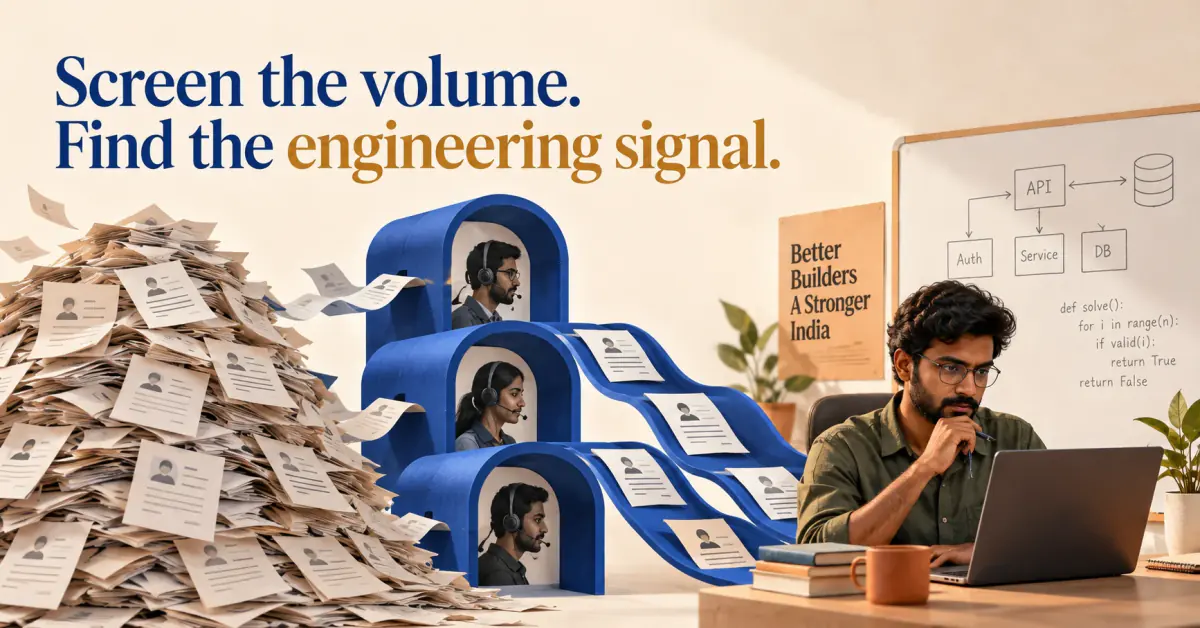
Today’s options for that round often fail. Teams either outsource a human screen for roughly $200–$450 or rely on remote assessments that tools such as Cluely and Interview Coder can quietly game. That is a fragile gate when a wrong engineering hire can become a six-figure mistake — the bad-hire calculator puts a number on it.
EasyInterview is an AI hiring pipeline for high-volume hiring. It circulates the job, screens every applicant against rules you write, phone-interviews the eligible ones in their own language, and ranks them. For engineering roles it adds a live technical round: a voice-based coding or system-design interview that adapts its follow-up questions, monitors integrity, and returns an evidence-scored verdict in minutes. The round is calibrated to the company’s own bar, so automation does not require the hiring team to accept an unexplained score.
The distinction is important. Speed alone does not repair technical screening. The screen must reveal how a candidate reached an answer, whether they can defend it, and exactly why they did or did not clear the bar.
Why the first technical screen stopped working
The technical screen has competing demands. It needs enough depth to protect the onsite panel, but assigning it to an experienced engineer consumes the senior time the screen is meant to save. Outsourcing moves the calendar burden elsewhere, but a human technical round still costs about $200–$450.
Take-homes and lightly supervised remote screens solve the scheduling problem, not the signal problem. A completed solution shows that somebody produced a good answer. It does not prove that the candidate can explain the reasoning, respond to a challenge, or work through an edge case without outside help. Assist tools make a polished submission even less conclusive.
Recruiter-run phone screens introduce a different weakness: inconsistency. When the depth of questioning changes with the interviewer, two candidates can face different bars. The hiring committee then has to compare notes and impressions rather than a common body of evidence. An AI phone screen fixes the consistency problem and the volume problem, but a phone call cannot watch a candidate write code or draw a design. That is the gap the live technical round fills.
For an engineering role at any level, the technical screen needs to test the same signals the later loop values: problem decomposition, correctness, and depth under pressure. It should push on trade-offs, complexity, and edge cases. And it should do that without placing every technical interview on an engineer’s calendar.
What AI technical screening means at EasyInterview
EasyInterview is a hiring pipeline, not an asynchronous question generator or an automated take-home. Every job runs through the same four stages. One branded apply link is circulated across LinkedIn, Naukri, Apna, Indeed, WhatsApp groups, QR posters, and your careers page, or you import a CSV of applicants you already have. Deterministic knockout rules you write, such as location, notice period, or salary band, sort the applicants; knockouts are shown politely to the candidate at submit, nobody is auto-rejected, and a human clicks every decline. An AI interviewer then phone-interviews every eligible applicant in the candidate’s own language, at a time they picked over WhatsApp. Every screened candidate ends up percentile-ranked within the job, with a score, a recording, a transcript, and a fit breakdown.
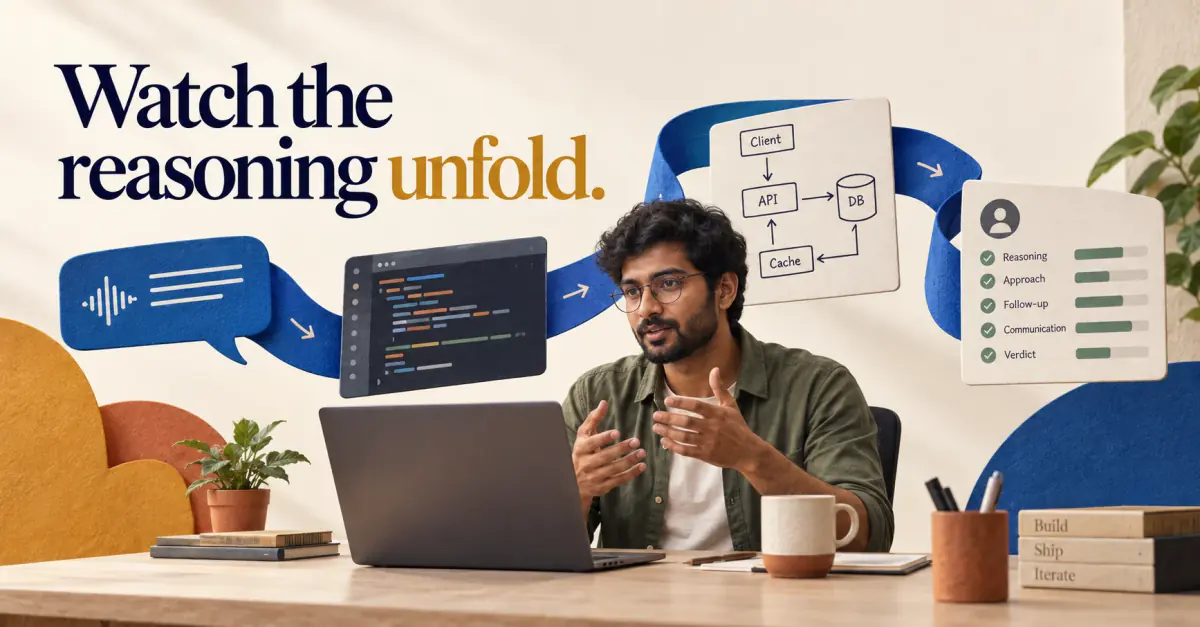
For engineering roles, the technical round is the extra stage that sits after the phone screen. It is a browser-native, 45–60 minute voice interview that a candidate takes on their own schedule. The candidate works in a live coding editor or a shared system-design whiteboard while reasoning aloud. The interviewer asks adaptive follow-ups and cross-questions the answer the way a staff engineer would.
That live interaction changes the unit of evidence. The system does not look only at the final code or architecture. It can ask why a choice was made, challenge a hand-waved assumption, and test whether the candidate understands the complexity or failure mode behind an answer.
The result is a structured technical round: one configured bar, one live interview, and one report that exposes the evidence behind its conclusion. Because the phone screen has already handled the volume, the technical round runs only on candidates who are worth an engineer’s attention.
The three steps from hiring bar to verdict
The workflow begins with the company’s standard rather than a generic passing score.
1. Configure the bar
The hiring team sets the role level, the rounds to run, and the rubric its interview loop uses. EasyInterview calibrates the interviewer to that bar.
This is what makes a score useful to a specific company. A hiring team needs to know whether a candidate clears its own bar for the role, whether that is a junior backend opening or a staff-level one, not whether the candidate performed well against an unrelated benchmark. Calibration ties the interview and its verdict to the signals the team has chosen to evaluate.
Teams can configure two technical round types:
-
Coding: The candidate works in a live editor and reasons aloud.
-
System design: The candidate works on a shared whiteboard while the interviewer probes the design in depth.
Adaptive follow-ups provide the depth within those formats. The interviewer can push on a trade-off, ask for the complexity behind a coding choice, explore an edge case, or keep questioning when an answer is not supported.
2. Send one single-use link
Candidates who clear the phone screen, or anyone the team invites directly, receive a single-use link. They open it in a browser and take the voice round when their schedule allows. There is no install and no scheduling exchange with an interviewer.
The experience retains the convenience teams want from asynchronous screening without turning the assessment itself into an asynchronous submission. During the 45–60 minute session, the candidate has to produce and explain the work live. The interviewer responds to that explanation in the moment.
This also removes interviewer time from the technical round. Engineers do not need to coordinate calendars, repeat the same opening screen, or write the first scorecard. They enter the process after the candidate has been assessed against the configured bar.
3. Get an evidence-scored verdict
Minutes after the interview, EasyInterview returns a hire/no-hire verdict. The report includes the confidence score, per-question deductions, full transcript, and recording.
The verdict is designed to be inspected. Every score links to the exact transcript quote behind it and the corresponding deduction. Reviewers can see where marks were lost and what the optimal answer was. Because the recording and transcript are chaptered by question, they can jump directly to the exchange that supports a score instead of replaying the entire interview.
The report exports as an ATS-ready scorecard that can be attached to the candidate. Direct integrations with Greenhouse, Lever, and Ashby are on the roadmap.
Why the live round is cheat-resistant by design
EasyInterview uses two complementary controls in the live technical round: live reasoning and an integrity monitor.
The live voice format makes a final answer insufficient on its own. Candidates must reason aloud, explain why an answer works, and defend it when the interviewer changes the angle of the question. A pasted or outsourced response cannot carry the round if the candidate cannot answer follow-ups about its trade-offs, complexity, or edge cases.
Adaptive probing matters because it tests depth rather than fluency. When an answer is vague, the interviewer can hold the line and ask for support. When a design choice looks plausible, it can explore a failure mode. When code is correct, it can still ask the candidate to justify the approach.
The integrity monitor adds a second layer. It flags copy-paste, lookup, and tool-assisted answer patterns. Those flags are not separated from the interview record: the hiring team also receives the recording and transcript behind the result.
The phone screen earlier in the pipeline applies a lighter version of the same idea. The AI probes vague answers with follow-ups until a real answer comes out, and it flags coached or scripted answers. But it is the live round, with a real editor and a shared whiteboard, that is designed to resist cheating.
In other words, cheat resistance does not depend on treating every candidate action as a black-box risk score. It comes from requiring defensible reasoning in a live conversation, detecting assist patterns, and preserving the evidence for review.
What the hiring committee can actually inspect
Most screening summaries compress an interview into a recommendation and a few notes. EasyInterview’s deliverable is meant to support the decision that follows the screen.
Each technical-round report contains:
-
A hire/no-hire verdict calibrated to the company’s bar.
-
A confidence score for the verdict.
-
Scores linked to exact transcript quotes.
-
Per-question deductions and the optimal answer.
-
A full recording and transcript, chaptered by question.
-
Flags for copy-paste, lookup, and tool-assisted answers.
-
An ATS-ready scorecard export.
The phone screen report that precedes it follows the same principle. Every score is pinned to a quoted moment in the call, the recording and transcript sit alongside the fit breakdown, and the candidate’s percentile rank within the job is shown next to the score.
That evidence gives a recruiter, engineering leader, or hiring committee a shared record. A reviewer can inspect the quote behind a deduction, compare it with the optimal answer, and replay the relevant chapter. The team does not have to infer why the system reached its conclusion.
The report therefore serves two needs at once: a fast decision at the top of the funnel and an audit trail for the people accountable for the hire.
The cost model: pay per round, not per seat
EasyInterview runs on a prepaid wallet shared by the team, with no seats and no subscriptions. Phone screens bill per connected minute with the scored report included, and calls under 30 seconds are free. Technical rounds are a flat price per round. The model ties spend to the screening a team actually runs instead of the number of people who need to review a result.
Both rates are published on the pricing page. For comparison, an outsourced human technical round costs roughly $200–$450. The verdict arrives in minutes, and the technical round uses zero engineer-hours. That changes the operating trade-off: teams can keep a technical gate before the panel without repeatedly assigning an engineer to run it, and they can phone-screen the whole applicant pile before that gate without a recruiter dialing each one. The cost-per-hire calculator shows what that difference does to a full funnel.
| Dimension | Take-home / remote screen | Human phone screen | Live AI technical screen |
|---|---|---|---|
| Cheat resistance | Low — gameable by assist tools | High | High — live voice + integrity monitor |
| Engineer-hours per screen | ~1 to review | ~1 to run | 0 to run |
| Cost per screen | Low, but low signal | $200–$450 | Flat published price per round |
| Turnaround | Days | Days to schedule | Minutes |
| Consistency across candidates | Varies by grader | Varies by interviewer | Same calibrated bar |
The human phone screen column is the recruiter- or engineer-run call. EasyInterview’s AI phone screen replaces that call earlier in the pipeline: it runs in parallel across the eligible applicants, in the candidate’s language, at a per-connected-minute rate, and every score is pinned to a quoted moment. It does not replace the live technical screen, because a phone call cannot watch a candidate write code or defend a design on a whiteboard.
The economic claim depends on the workflow, not just a lower per-round price. The candidate schedules the browser-based interview independently, the AI runs the live round, and the report arrives ready for review. Your engineers spend their interview time on candidates who have already cleared a phone screen and produced evidence against the team’s bar.
How the live-screen model compares with specific vendors
The trade-offs above look different against each category of first-round tooling. Now that EasyInterview covers circulation, knockout screening, and AI phone interviews as well as the technical round, several of these comparisons overlap more than they used to, and the articles below argue each one on the real remaining differences. We keep honest, regularly updated comparisons for each — and a side-by-side vendor comparison page:
- Assessment platforms: HackerRank alternatives, CodeSignal alternatives, and CoderPad alternatives
- Outsourced and conversational screens: Karat alternatives, Apriora (Alex) alternatives, HeyMilo alternatives, and Asendia alternatives
- Sourcing-side tools that hand the interview back to you: Prism alternatives and Standout alternatives
Everything above is about an engineering round, where the question is whether someone can write and defend code. If the roles you are filling are frontline ones hired in volume — telecalling, support, field sales, retail, delivery — the constraint is different and so is the tooling: the category is covered in automated phone screening, what that round should actually test is in the AI telephonic interview, and the pipeline around both is the bulk hiring process in India.
Frequently asked questions
Is this still an asynchronous assessment?
Only the scheduling is asynchronous. The candidate chooses when to start, but the assessment is a live voice interview. Coding happens in a live editor, system design happens on a shared whiteboard, and the interviewer probes answers during the session. The AI phone screen before it is live too: a real call, in the candidate’s language, at a time they picked on WhatsApp with a one-tap reschedule.
Is the score a black box?
No. Every score links to a transcript quote and a specific deduction. The report also shows the optimal answer, a confidence score, and the full chaptered recording and transcript. The phone screen report works the same way, with every score pinned to a quoted moment in the call.
How does EasyInterview apply our hiring standard?
The team configures the level, round types, and rubric before inviting candidates. EasyInterview calibrates the interviewer to that bar and uses the same evidence-backed structure for every candidate. For the phone screen, you also write the knockout rules yourself; every rule has an include-anyway override, and nobody is auto-rejected.
Is EasyInterview only for engineering roles?
No. The pipeline handles any role hired in volume: sales, support, field, ops, delivery, retail, and engineering. Circulation, knockout rules, the AI phone interview, and the ranked shortlist are the same for every role. The live coding and system-design round is the extra stage that engineering roles add after the phone screen.
Can we move the result into our ATS?
The report exports as an ATS-ready scorecard today. Greenhouse, Lever, and Ashby integrations are on the roadmap.
A better gate for the engineering panel
The technical screen should reduce uncertainty before expensive engineering time enters the process. That requires more than a correct submission or a fast automated grade. It requires live reasoning, consistent probing, integrity evidence, and a verdict the hiring team can audit.
EasyInterview brings those pieces into one round and sets that round inside a pipeline that has already circulated the job, screened every applicant against your rules, phone-interviewed the eligible ones in their language, and ranked them. The technical round is calibrated to the team’s bar, completed by the candidate on their own schedule, and returned with every quote and deduction behind the result.
EasyInterview is a newer product without a public customer roster or outcome benchmark yet, so the sensible next step is a low-commitment pilot on one role. Book a demo to see the pipeline and the technical round on your own candidates.
Rohit Pandit
Founder, EasyInterview · easyinterview.life
I build EasyInterview, an AI hiring pipeline for high-volume roles in India. These are field notes on screening at volume, hiring signal, and interview integrity, written from the work rather than from a keyword list.
Connect on LinkedIn