How to Hire 100 Staff in 7 Days: Festive Rush SOP
Hire 100 staff in 7 days in India: day-wise festive rush SOP with funnel targets, channels, screening throughput and joining buffers.
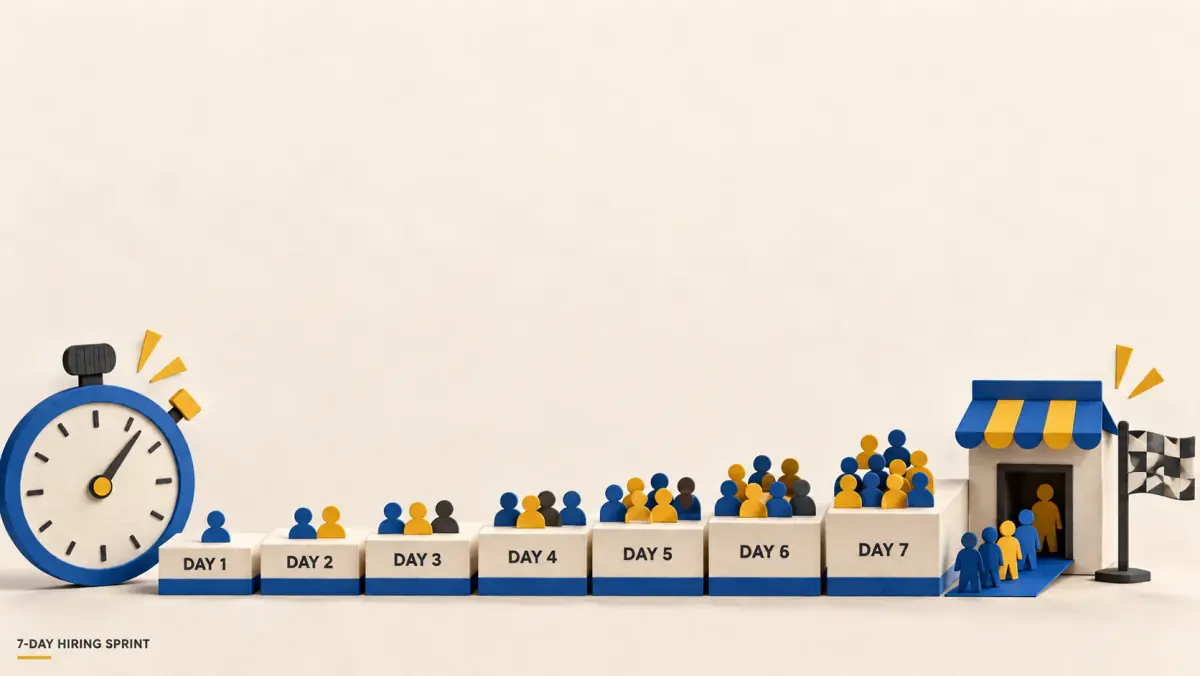
Hiring one hundred staff in seven days is not a hiring plan. It is an emergency procedure, and it should be read that way. The right way to staff a festive rush is the ninety-day countdown: forecast in August, build the pool in September, deploy trained people by mid-October. This SOP is for the team that missed that window, or had the target doubled last Monday, and now has one week to put one hundred productive people on the floor before the sale banners go up.
Two positioning notes so this does not get confused with its neighbours. The 48-hour telecaller plan covers a single voice role from req to offers in two days; this SOP covers multiple frontline roles from zero to one hundred joiners in seven, with channels, interview batches, offers, and buffers. The ninety-day festive checklist covers the full quarter; this is the speed-run you execute when that plan is unavailable. And one honest sentence about the promise: seven days gets you one hundred people ready for training or deployment on short-cycle frontline work. It does not compress notice periods, police verification tails, or skill training for technical roles. Anyone selling all three in a week is selling attrition.
Quick answer: work backwards from 100 joiners at your real offer-to-join rate to get the offers, interviews, screens, and applicants each day must produce; run three sourcing channels into one apply link; screen every eligible applicant by phone in parallel rather than in recruiter sequence; batch interviews daily with same-day offers; and over-offer against a written cap sized to your dropout rate. The plan fails at screening throughput and Day 8 attendance, so both get dedicated owners and daily numbers below.
Start with the arithmetic, not the job post
One hundred seats on Day 8 is the output. The inputs are five conversion rates you already own from your last drive: applicants passing knockouts, booked screens completing, completed screens earning interviews, interviews ending in offers, and accepted offers joining. Multiply them and you get applicants per seat. If you have no history, write down explicit guesses and label them guesses; the drive's second job is replacing them with measurements.
Here is the worked example this SOP runs on. All numbers are illustrative, not benchmarks; substitute yours before executing.
| Stage | Illustrative rate | Arithmetic for 100 seats | Needed |
|---|---|---|---|
| Joiners on Day 8 | given | 100 | |
| Offers extended | 60% of offers join | 100 ÷ 0.60 | 167 |
| Final interviews | 45% of interviews get offers | 167 ÷ 0.45 | 372 |
| Completed screens | 35% of screens earn interviews | 372 ÷ 0.35 | 1,063 |
| Screens booked | 75% of booked screens complete | 1,063 ÷ 0.75 | 1,418 |
| Applicants | 55% pass knockouts | 1,418 ÷ 0.55 | 2,579 |
Two thousand six hundred applicants in seven days is the headline. That is roughly 370 applicants a day, 200 screens booked a day, 150 screens completed a day, 53 interviews a day, and 24 offers a day. A three-recruiter team cannot call its way through that serially; the mass recruitment strategy makes the same point for larger drives, and the fix is identical: the screening stage must run in parallel, not in recruiter sequence. Everything below is designed around that constraint.
Illustrative arithmetic from the rates above, not a benchmark. Your daily targets come from your own conversion rates.
Day 0: the four hours before the clock starts
Day 0 is setup, and skipping it is how seven-day plans become ten-day plans. Four decisions, all in writing, before a single post goes live.
First, the knockout rules and the scoring rubric. Five or fewer hard filters: location or distance radius, minimum age, shift availability, salary band acceptance, and one role-critical item such as two-wheeler plus licence for riders. Write the interview rubric on one page with anchored scores, because fifty-three interviews a day with floating standards produces a shortlist nobody trusts.
Second, the channel plan: three channels, not eight. For festive frontline roles in India the highest-yield trio is usually a frontline job platform such as apna or WorkIndia, employee and ex-seasonal referrals with a stated referral payout, and walk-in plus QR-poster capture at the site or nearby hubs. One branded apply link serves all three so every applicant lands in one pile with one consent record. Budget splits opening at roughly half to the job platform, a third to referral payouts, and the remainder to on-ground capture; re-cut daily toward whichever channel produces completed screens, not raw applies.
| Channel | Job on this drive | Daily watch metric |
|---|---|---|
| Frontline job platform | Raw volume at speed | Applicants per day and cost per completed screen |
| Referrals and ex-seasonal rehires | Highest-intent candidates, fastest conversions | Acceptance and joining rate versus the blended average |
| Walk-in and QR-poster capture | Local top-up around the site, lowest intent risk | Show-up rate for scheduled screens |
The split matters less than the discipline: every channel feeds the same pile, every applicant faces the same knockouts, and spend follows completed screens rather than the loudest channel owner. A channel delivering four hundred applicants that never pick up the phone is not a sourcing channel; it is a vanity metric with a media bill.
Third, the over-offer cap and the overflow rule. At a 60 percent joining rate, 167 offers for 100 seats is the plan, but joining variance means some days overshoot. Write the cap, for example 175 offers, and the rule for overshoot: a dated waitlist with a second deployment date and a stated retention payout, not a rescinded offer. Rescinded offers in a local labour market are a next-season sourcing tax.
Fourth, roles and owners. Name the owner of sourcing volume, the owner of screening throughput, the owner of interview batches, and the owner of offer-to-joining follow-up. Four names on one page. Every daily review below asks each owner one question.
Days 1-2: flood the top and screen in parallel
Days 1 and 2 have a single objective: applicants in, screens out, with zero recruiter hours spent reading resumes. Posts go live on all three channels on the morning of Day 1 with pay, shift, location, and assignment length in the first three lines; seasonal candidates compare offers fast and the clearest post wins. Referral messages go to every ex-seasonal worker and every current employee in adjacent roles on the same morning, because rehires need almost no ramp-up and convert fastest.
Screening must clear roughly 300 completed screens across the two days. Serial calling cannot do this: at ten minutes a call, 300 screens are fifty recruiter-hours, which is the entire two days of a three-person team with nothing left for interviews. This is the parallel-screening requirement. Every eligible applicant gets a structured phone screen against the same rubric, running concurrently across the pool, with results ranked so recruiters spend their hours only on the shortlist. Whether that parallelism comes from an AI phone screen, a borrowed call team, or split shifts of your own staff, the arithmetic does not negotiate; pick the mechanism on Day 0 and measure completions per hour from the first evening.
End-of-Day-2 checkpoint: at least 700 applicants in the pile and 300 screens completed, with the interview shortlist for Day 3 already ranked. If applicants are short, move budget to the best-converting channel that night. If screens are short, the screening mechanism is the bottleneck and everything downstream slips a day; fix it before adding more applicants to the queue.
Days 3-5: interview batches and same-day offers
Days 3 through 5 run the same daily loop: batched interviews in the morning and early afternoon, decisions within hours, offers the same evening. Fifty-plus interviews a day means panels, not sequences: two or three interviewers running parallel fifteen-minute structured interviews against the one-page rubric, with a thirty-minute calibration huddle at the end of each day to hold the bar steady.
Three rules keep the loop tight. First, slots are offered in numbered batches with a one-tap confirm path, and reminders go the evening before; frontline no-show rates punish loose scheduling hardest at volume. Second, offers go the same day as the interview, every day, because candidates in a festive market hold multiple processes and the fastest credible offer wins disproportionately. Third, document collection starts at offer acceptance, not at joining: ID, address proof, bank details, and licence copies within 24 hours of acceptance, chased by the joining follow-up owner. Document-early is both an engagement signal and an early warning system; a candidate who goes dark on documents is telling you about Day 8.
End-of-Day-5 checkpoint: roughly 110 to 120 offers extended, which at the illustrative joining rate converts to the mid-sixties in confirmed joiners, with the remaining offers closing on Days 6 and 7. If interviews are converting below the assumed rate, the rubric or the sourcing mix is wrong; do not lower the bar to hit the offer count, because a warm body who quits in week one is negative headcount.
Days 6-7: close offers and protect Day 8
The last two days are about joining, not sourcing. Stop optimising the top of the funnel on the morning of Day 6 unless applicants are more than twenty percent short; every spare hour moves to offer follow-up. Each accepted candidate gets a joining confirmation with the reporting point, time, supervisor name, first-day pay cycle date, and one contact number. Run a joining-eve check on Day 7 evening: a short confirmation from every expected joiner, with transport and document queries resolved that night rather than discovered at the gate.
Buffer math decides Day 8. With 167 offers at a 60 percent joining rate, expected joining is 100 with meaningful variance either way. Hold a standby list of ten to fifteen offer-ready candidates from the Day 5 interviews who can be confirmed on the morning of Day 8 against actual turnout. Staff the first day for attendance chaining: buddy assignments, supervisor introductions in the first hour, and the first incentive milestone visible from day one, because first-week attrition in festive cohorts is an attendance problem before it is a performance problem.
End-of-Day-7 checkpoint: 160-plus offers extended, documents collected on at least 120, explicit Day-8 confirmations from at least 110. If confirmations lag, activate the standby list before the morning, not after the gate count disappoints.
What the market says about the 2026 rush
The context for this SOP is a festive season running hotter than last year. TeamLease's Festive Season Workforce Report 2026 expects temporary hiring across organised retail, e-commerce, quick commerce, logistics, FMCG, and consumer durables to grow 15 to 20 percent, with warehouse pickers, packers, dark-store personnel, retail associates, and store operations staff leading demand. Amazon India announced over 1.6 lakh seasonal opportunities across 400 cities, and Flipkart over 2.2 lakh seasonal roles with hundreds of festive-only delivery hubs. Quick-commerce festive hiring alone is expected to rise 35 to 40 percent year on year. Treat those numbers as your competition for the same candidates: wages, surge pay, and attendance incentives move daily in this market, so check your offer against the local going rate on Day 0 and again on Day 4 rather than assuming last month's band still clears.
Where EasyInterview fits (and where it does not)
EasyInterview is built for the Days 1-to-2 bottleneck this SOP is designed around: hearing every eligible applicant when the pile needs 150 completed screens a day. You circulate one branded apply link across the job platform, referral messages, and QR posters, or import a CSV of applicants you already have, with the apply form collecting consent and CSV imports recording existing consent in the same trail. Knockout rules you write sort the pile; nobody is auto-rejected, a human clicks every decline, and every rule carries an include-anyway override. Eligible applicants get an AI phone interview inside the workspace calling window in the applicant's selected language: English, Hindi, Bengali, Tamil, Telugu, Kannada, Malayalam, Marathi, Gujarati, Punjabi, or Odia. Each completed call returns a report linking every score to transcript evidence against role-specific rubrics, which are transcript-based screening judgments rather than certified fluency scores, so keep a fluent reviewer on voice-role calibration.
Three boundaries, stated plainly. First, EasyInterview sends no candidate messages: no WhatsApp, no SMS, no reminders from the product. All scheduling, reminders, and follow-ups in this SOP stay employer-run in your existing channels, and outcome emails to candidates are optional at handoff and require an email address on file. Second, it covers circulation, knockouts, and the phone screen; interview panels, offers, verification, and Day-8 operations stay yours. Third, it is a newer product with no public bulk-hiring case study yet, so the right evaluation is a pilot on one live req: run it alongside your current screen on Days 1 and 2, compare completions per hour and shortlist quality, and expand only if both beat the manual baseline.
Frequently asked questions
Is hiring 100 staff in 7 days realistic?
It is realistic for short-cycle frontline roles with clear knockouts, parallel screening, and daily offer batches, and unrealistic for roles needing notice-period compression, deep verification, or skill training. The binding constraints are screening throughput at roughly 150 completions a day and joining variance on Day 8. If either constraint cannot be staffed or buffered, extend the timeline or narrow the role mix rather than promising 100 and delivering 60.
How many applicants do we need for 100 joiners?
Divide 100 by each of your five conversion rates in sequence: joining, interview-to-offer, screen-to-interview, booking completion, and knockout pass. On the illustrative rates in this SOP that yields around 2,600 applicants; your number comes from your rates, and the first drive's job is to measure them. Recompute nightly from actuals and re-cut channel spend toward completed screens, not applies.
Should we lower the bar to hit the number?
No. A hire who quits or fails in week one costs more than an empty seat, because training, supervisor time, and re-hiring all repeat. Hold the rubric fixed through Day 5 and manage shortfalls with channel reallocation, referral payout bumps, and the standby list. If the interview conversion rate collapses, the sourcing mix is attracting the wrong profile; fix the post and the knockouts rather than the bar.
How do we handle over-joining if more than 100 show up?
Activate the written overflow rule from Day 0: a dated second deployment, usually the next weekly batch or a nearby site, with a stated retention payout for waiting candidates. Never rescind accepted offers at the gate; the local labour market remembers, and next season's sourcing gets harder and more expensive.
What is the single most common failure mode?
Serial screening. Teams post aggressively, collect two thousand applicants, and then call them one by one while candidates accept faster offers elsewhere. Parallel screening from Day 1, same-day offers from Day 3, and document-early follow-up are the three defences; miss the first and the other two cannot recover the week.
One hundred in seven days is won on Days 0 through 2 and collected on Days 6 and 7. Do the arithmetic, flood one pile, screen in parallel, batch decisions daily, and guard Day 8 like the deliverable it is. Book a demo to see parallel phone screening run on your own applicant pile.
Rohit Pandit
Founder, EasyInterview · easyinterview.life
I build EasyInterview, an AI hiring pipeline for high-volume roles in India. These are field notes on screening at volume, hiring signal, and interview integrity, written from the work rather than from a keyword list.
Connect on LinkedIn