CoderPad Alternatives: The Interviewer, Not Just the Pad
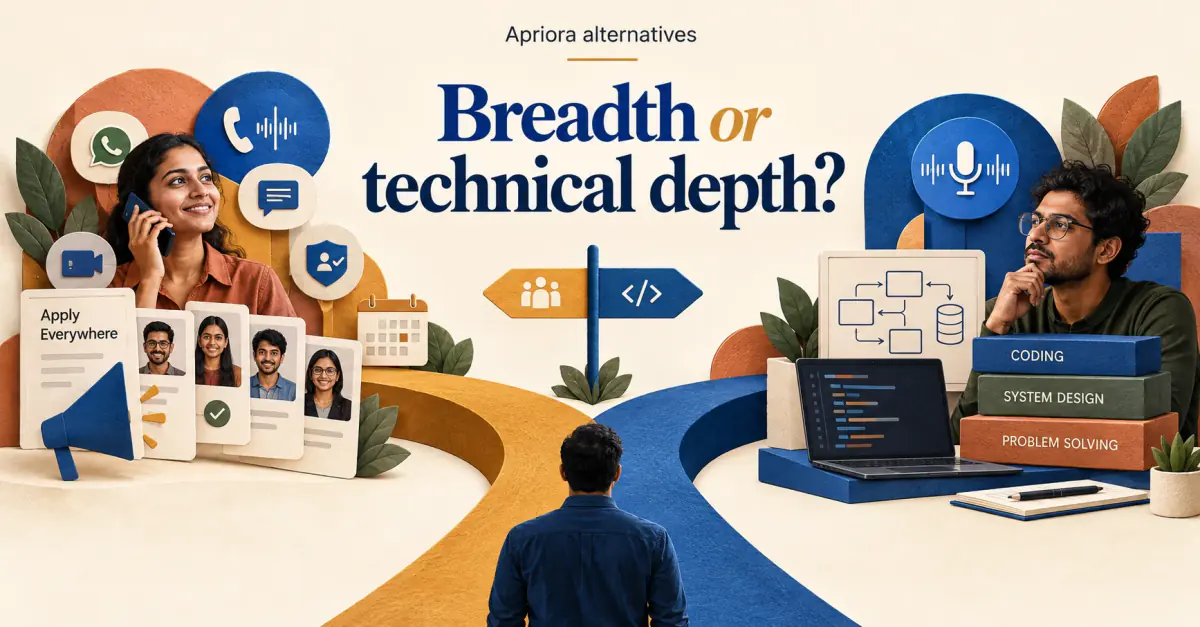
CoderPad alternatives compared: an AI-led first technical screen versus a live coding environment that still needs a human interviewer to run it.

If you are looking for a CoderPad alternative — or comparing EasyInterview vs CoderPad directly — first separate the interview room from the interviewer. CoderPad is a developer-friendly environment where a human interviewer and candidate can pair on code. EasyInterview is the interviewer inside an AI hiring pipeline for high-volume hiring: it circulates the job, phone-screens every applicant in their language, ranks them, then runs the first coding or system-design round itself for engineering roles, probes the candidate's reasoning, and returns a rubric-calibrated verdict. The products overlap around a live editor, but they remove different problems from the hiring process.
TL;DR
- Choose CoderPad when your engineers want to lead live pair-programming interviews in a real-IDE-style environment with broad language support, transparent pricing, and unlimited users.
- Choose EasyInterview when you want every applicant phone-screened and ranked before anyone codes, and the engineer hour removed from the technical round while preserving live questions, adaptive follow-ups, and an inspectable scorecard.
- CoderPad supplies the environment and session playback; the human interviewer still creates the signal and applies the bar. EasyInterview runs and scores the round against the employer's rubric.
- CoderPad is established and developer-loved. EasyInterview is newer, has no public outcome benchmark or public customer roster, and should earn trust through a one-role pilot.
How each one runs the first technical screen
CoderPad Interview is a live collaborative coding space. Its VS Code-like IDE supports broad language coverage, code playback, private interviewer notes, a question library, and a digital whiteboard. A human interviewer joins the candidate, chooses how to structure the session, asks follow-ups, and evaluates the work. CoderPad also offers Screen for asynchronous, multi-file take-home tasks.
That gives an engineer a familiar room for pairing, with keystroke-by-keystroke replay. Depending on the product, CoderPad lists support across 30-plus to 99-plus languages.
EasyInterview takes over the interviewer role, and it starts before the technical round. It circulates the job through one branded apply link, sorts applicants against knockout rules you write, and has an AI interviewer phone-screen every eligible applicant in their language, then ranks them within the job. Nobody is auto-rejected; a human clicks every decline.
For engineering roles, at any volume, the candidates you advance from that ranking take the live technical round. The candidate receives a single-use link and starts a 45–60 minute browser-native voice interview on their own schedule, with no install. Coding candidates work in a live editor. System-design candidates work on a shared whiteboard. The AI interviewer asks them to reason aloud and cross-questions trade-offs, complexity, and edge cases.
The hiring team configures the level, round, rubric, and bar. After the session, EasyInterview returns a hire or no-hire recommendation in minutes. Each score links to the candidate's transcript, the specific deduction, and the optimal answer. A chaptered recording and confidence score provide additional context.
CoderPad can be better for a final-round pairing session where human interaction is the point. EasyInterview targets the earlier stages, from the applicant pile through the first technical round, where teams want screening and live reasoning without a recruiter or engineer hour per candidate.
EasyInterview vs CoderPad at a glance
| Area | EasyInterview | CoderPad |
|---|---|---|
| What the product provides | The pipeline before the round (apply link, knockout rules, AI phone screens, ranking) plus the live AI interviewer, coding or whiteboard environment, scoring, and verdict | A live coding and whiteboard environment for a human-led interview |
| Human interviewer required | No | Yes for CoderPad Interview |
| Format and length | Browser-native voice coding or system design; 45–60 minutes | Human-led live pairing in a real-IDE-style pad; Screen is async |
| Speed to verdict | Evidence-scored verdict in minutes | Depends on the interviewer completing and applying the team's evaluation |
| Pricing | Prepaid team wallet, no seats; phone screens per connected minute, technical rounds flat per round | Free; Starter typically $120/month; Team typically $400/month |
| Hidden operating cost | No recruiter time to phone-screen and no engineer time to run the technical round | Engineer time to prepare, conduct, and score each live interview |
| Anti-cheat approach | Adaptive voice follow-ups plus paste, lookup, and tool-use flags | Human observation, paste and fast-completion notices, and session playback |
| Scoring and evidence | Rubric-calibrated verdict, transcript quotes, deductions, optimal answers, recording, and confidence | Notes and keystroke playback; scoring consistency depends on the human process |
| Best fit | Screening and ranking a whole applicant pool, then consistent technical rounds without interviewer scheduling | Human-led pair programming and later-stage collaborative interviews |
Cost and speed: the platform fee is not the interview cost
CoderPad's pricing is relatively transparent. At the time of writing, a Free plan is available. Starter is typically listed at $120 per month, or $80 per month billed annually for $960 per year, and includes five interviews per month. Team is typically $400 per month or $4,800 per year for 30 interviews per month. Custom and Enterprise plans are also available, and plans include unlimited users.
Those environment prices exclude the engineer who conducts and scores each live interview. That may be acceptable when interviewer time is part of the job; CoderPad gives both people a capable collaborative IDE.
EasyInterview charges for the screening itself, from a prepaid wallet shared by the team, with no seats and no subscriptions. Phone screens bill per connected minute with the scored report included, and calls under 30 seconds are free. Coding and system-design rounds are a flat price per round; current numbers are on the pricing page.
The larger difference is the engineer hour. EasyInterview runs the 45–60 minute technical round itself and returns scored evidence in minutes, and because it has already phone-screened the pool, that round runs only for candidates who ranked well. CoderPad reduces tooling friction but does not remove interviewer scheduling or variation in how people apply the rubric. The cost-per-hire calculator prices that engineer hour across a funnel.
A CoderPad room can start once both people are available. EasyInterview removes the shared calendar: the phone screen is scheduled over WhatsApp at a time the candidate picks, with one-tap reschedule, the technical round runs from a single-use link on their own schedule, and the verdict follows completion. If scheduling is your bottleneck, the time-to-hire calculator shows what those calendar gaps cost in days.
Cheat resistance in the AI era
CoderPad's best anti-cheat control is the human interviewer, who can watch code develop and probe a polished answer. Keystroke playback and notifications for large pastes or unusually fast completion add context.
At the time of writing, CoderPad does not directly detect outside AI tools such as ChatGPT, use webcam proctoring, or lock the browser. Public tests have shown translucent overlays triggered by operating-system hotkeys escaping its signals. Paste and speed notices are reactive clues.
CoderPad Screen can capture prompts when AI assistants use code context. That helps teams review permitted AI use, but the hiring team must still interpret the session.
EasyInterview makes adaptive questioning part of the product rather than depending on an individual engineer to do it. The candidate has to explain the approach aloud, defend trade-offs, respond to new edge cases, and sustain the reasoning as the interview changes direction. That makes a pasted or overlay-generated answer less valuable because it has to survive a live technical conversation.
An integrity monitor separately flags paste, lookup, and tool-assisted patterns. Teams can inspect the transcript quote, deduction, and recording before relying on the verdict. A sample scorecard shows the evidence returned.
Neither setup guarantees detection. CoderPad gives a human observation tools; the result depends on that person's questioning. EasyInterview applies adaptive probing and integrity monitoring consistently without a webcam.
Where CoderPad is the better choice
CoderPad is stronger when the team wants a human conversation. Final rounds often depend on how the candidate takes a hint, communicates while pairing, or works with a future teammate. A real-IDE-style room supports that interaction.
It also offers transparent platform pricing and unlimited users. A Free plan lowers trial cost, while broad language support, a question library, private notes, playback, and a whiteboard make it a mature tool for engineering-led interviews.
Choose CoderPad when your interviewers are available, interviewer judgment is intentional, and the goal is a collaborative session rather than removing operational work. It is also the clearer fit for later-stage pair programming. EasyInterview replaces the screening stages before that session, from the applicant pile through the first technical round. It is not a claim that human interaction has no place in the hiring loop. If what you actually want is a standardized async test rather than a room, see HackerRank alternatives and CodeSignal alternatives.
Where EasyInterview is the better alternative
EasyInterview fits teams whose bottleneck is not the quality of the pad but the size of the applicant pile and the availability and consistency of interviewers. It circulates the job from one apply link, phone-screens every eligible applicant in their language, ranks them, runs the technical round for the candidates you advance, and returns a verdict without scheduling a recruiter or an engineer. That lets the team reserve human pairing for candidates who have already defended their technical depth.
Scoring stays calibrated to the employer's rubric. Each score ties to a transcript quote, per-question deduction, and optimal answer, with a chaptered recording and confidence score for context.
That is a different deliverable from a coding-session replay. CoderPad preserves what happened so a person can assess it. EasyInterview assesses the round and makes the reasoning behind the recommendation available for review. The hiring team can inspect the important moments without replaying the entire interview.
EasyInterview exports an ATS-ready scorecard today. Named integrations with Greenhouse, Lever, and Ashby are on the roadmap and are not live. CoderPad's established position and workflow maturity may be preferable when the environment must fit an existing enterprise process immediately.
EasyInterview is newer and has no public customer roster or outcome benchmark. A team should start with a low-commitment pilot on one role, use the same rubric as its human panel, and compare the AI recommendation with interviewer judgment. Expansion should follow demonstrated alignment, not a marketing claim.
Frequently asked questions
Is EasyInterview a CoderPad alternative?
For everything up to and including the first technical screen, yes — EasyInterview phone-screens every applicant and runs the live technical interview without a human interviewer. CoderPad remains the better shared room when an engineer should pair, coach, or judge communication in person.
Does EasyInterview replace final-round pair programming?
No. It covers the stages before that: circulating the job, phone-screening and ranking applicants, and running the first technical round. Keep human pairing for later rounds where collaboration with a future teammate is the signal you care about.
Who scores the interview?
EasyInterview returns a calibrated, evidence-scored recommendation with transcript quotes, per-question deductions, and a chaptered recording. CoderPad preserves the session so a human interviewer can score it.
How do prices compare?
CoderPad offers transparent platform pricing with unlimited users on paid plans and a Free tier for trials. EasyInterview bills from a prepaid team wallet with no seats: phone screens per connected minute with the scored report included, and technical rounds at a flat price per completed round — see the pricing page. Compare recruiter and interviewer hours saved, not only license cost.
Does EasyInterview need a webcam for proctoring?
No. Integrity comes from live adaptive questioning plus paste, lookup, and tool-use flags. CoderPad relies on the human interviewer and any tools they choose to enable in the room.
The bottom line
CoderPad is a strong place for an engineer to conduct a live coding interview. EasyInterview screens the applicant pool by phone, then conducts the first technical interview itself, applies a calibrated bar, and returns an evidence-linked verdict without using that engineer hour. CoderPad is the better room for human pairing; EasyInterview is the better fit when the screening interviewer, from the phone screen through the first technical round, is the resource you need to replace.
The vendor comparison page puts the whole field side by side. If the interviewer is the constraint in your hiring process, Book a demo and evaluate one role first.
Rohit Pandit
Founder, EasyInterview · easyinterview.life
I build EasyInterview, an AI hiring pipeline for high-volume roles in India. These are field notes on screening at volume, hiring signal, and interview integrity, written from the work rather than from a keyword list.
Connect on LinkedIn