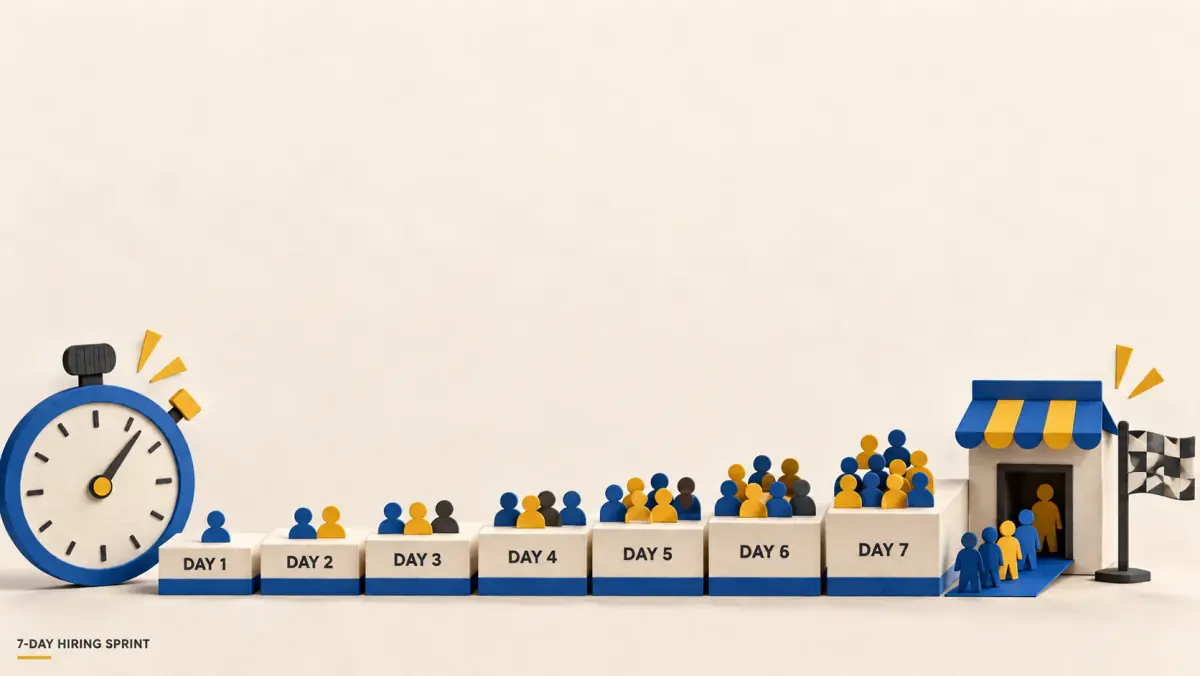
How to Reduce Interview No-Shows in Bulk Hiring
How to reduce interview no-shows in bulk hiring: a 7-step India playbook with WhatsApp cadence, vernacular screens and show-rate math.
It is 10:40 am. Your recruiter blocked the morning for ten phone screens for a telecaller floor in Pune. Four numbers ring out. Two candidates say "call later" and vanish. One did not know this was a voice-role interview in English. You complete three screens, and one of them joined a competitor yesterday. That is a normal Tuesday in Indian bulk hiring, not a bad one.
How to reduce interview no-shows in bulk hiring is therefore not a motivation question. It is a systems question: did the candidate pick a time they could keep, did the reminder reach them where they actually read, did they understand the role and the language of the screen, and did you screen them before a faster employer did. Teams that fix those four things see show-rates move. Teams that lecture candidates about professionalism do not.
Quick answer: cut the apply-to-screen gap to under 48 hours, let candidates self-pick slots including evenings, send three reminders on WhatsApp or SMS in the candidate's own language (confirm at booking, 24 hours before, 2 hours before) with a one-tap reschedule path, screen in the language the job is done in, and publish pay, shift, location and duration in the invite. Track show-rate by role, source and slot, and over-invite by the math, not by gut. Reminder cadences below are advice your team runs on its own channels; EasyInterview sends no candidate messages.
Why interview no-shows cluster in Indian bulk hiring
Every ranking guide for this keyword says the same five things: schedule fast, self-schedule, send reminders, go mobile-first, make rescheduling easy. They are right, and they are all written for the US frontline market over email and SMS. The Indian version of the problem has four extra layers they never mention, and those layers are where your no-shows actually come from.
Fountain's scheduling guide covers the five fixes well for the US market: faster scheduling, self-scheduling, automated reminders, mobile-first flows and AI voice first rounds, with the blunt line that no reminder optimisation compensates for a long scheduling lag (Fountain, "What Is Interview Scheduling," June 2026). Hirin's India staffing guide is the closest to our market: it puts the India numbers at 20-30% no-shows in peak BPO, IT and BFSI cycles on manual processes, and prescribes WhatsApp over email because open rates diverge so sharply (Hirin, "How to Reduce Interview No-Shows in High-Volume Staffing," 2026). SignalRoster's data-led guide adds the useful framing that attendance is a conversion problem where every extra click and unclear instruction lowers show-up (SignalRoster, May 2026). All three are worth reading. None of them covers what happens when the screen is in the wrong language, when the candidate holds three offers, or when the reminder itself needs consent to be legal.
That is the gap this playbook fills.
The multi-offer reality. A frontline candidate in Mumbai, Bengaluru or Noida is rarely in your pipeline alone. Apna, WorkIndia, foundit, Naukri and three WhatsApp job groups mean three to five live processes at once for telecallers, BPO voice, retail associates, delivery partners and field sales. Fountain's frontline research puts numbers on the impatience: 57% of frontline candidates name a slow hiring process as a top frustration and 52% name ghosting or lack of updates (2025 Fountain Frontline Report, cited June 2026). Hirin reports 42% of candidates abandon hiring processes when scheduling takes too long. In India the effect is sharper because the switching cost is near zero: the candidate who applied to you on Monday joined someone else on Wednesday, and your Friday slot was dead before you booked it. Speed is not politeness here. It is inventory control.
The language mismatch. Most bulk screens in India are still defaulted to English while the job is done in Hindi, Marathi, Tamil, Telugu, Kannada or Hinglish. The candidate who cannot do a confident English self-introduction does not call to say so; they simply do not pick up. Fountain's own buying checklist admits confirmations and reminders in a language the candidate barely reads get ignored (Fountain, June 2026), but no ranking guide builds the screen itself around vernacular. For voice roles this is the single biggest silent driver: you manufactured the no-show by choosing the wrong language, then recorded it as candidate behaviour.
The phone and shift reality. Your candidate shares a handset with family, works a current shift, commutes 60-90 minutes each way, and has patchy signal after 7 pm in a PG or chawl. A weekday 11 am slot chosen by a recruiter, an English-only email invite, and a "please join this Google Meet link" instruction is three small frictions that multiply. Frontline candidates apply between shifts from their phones; anything that needs a desktop, an app download, a login, or pinch-to-zoom loses them before the reminder even matters.
The trust deficit. Indian frontline candidates have been ghosted by employers too. AcEngage's 2026 India roundup notes 61% of job seekers report being ghosted after an interview, up 9 points from 2024, and 53% have been ghosted by an employer at some point (AcEngage, August 2026, citing Greenhouse). When your invite hides pay ("competitive salary"), hides shift ("flexible timings"), and hides duration ("a short discussion"), the candidate assumes the worst because experience taught them to. Vagueness reads as risk, and risk does not show up.
Measure your own no-show rate before you fix it: scheduled screens minus completed screens, divided by scheduled screens, split by role, source channel and time slot. Hirin's bands are a reasonable starting lens (under 5% excellent, 6-10% acceptable, 11-20% concerning, over 20% critical), but treat them as illustrative starting points, not benchmarks. Your apna evening slots and your Naukri morning slots are different funnels and should be managed as such.
The 7-step playbook to reduce interview no-shows
Each step below maps to one cause above. Do them in order; step 1 makes steps 2-7 cheaper, and skipping step 1 makes the rest performative.
1. Compress apply-to-screen to under 48 hours
Every day between application and first screen is drop-off risk. Hirin's India data and Fountain's frontline data agree on the mechanism even when the percentages differ: the competitor who screens tonight hires the candidate you scheduled for next week. For bulk roles, set the service-level rule that every applicant who clears knockouts gets a screen slot offered within 48 hours of applying, and the screen itself happens within 72 hours.
In practice this means knockouts on the form, not in chat. Location and door-to-door commute, shift yes-or-no, notice period and joining date, salary fixed-plus-variable band, and language the candidate can sell in: five facts collected once, applied identically to applicant 3 and applicant 300. A person clicks every decline, with an "include anyway" override for the candidate who is 15 km out but has done the exact job. That is the same knockout discipline the 48-hour telecaller hiring plan prescribes, and it is what lets you offer slots the same day instead of spending three days qualifying over chat.
If your pile is 800 applicants from two job groups and a Naukri export, do not serial-call them through one recruiter's phone. Parallelise the first screen so the queue clears in hours, not weeks. The screen is the bottleneck in the bulk hiring process generally; no-shows are what the bottleneck looks like from the candidate's side.
2. Let candidates self-pick slots, including evenings and Sundays
Recruiter-assigned weekday slots are the no-show machine. Candidate-picked slots convert because the candidate chose a time around their current shift, childcare and commute. Offer numbered choices (reply 1, 2 or 3) rather than open-ended "when are you free," and include at least one evening and one weekend block. Fountain's guide is explicit that opening evening and early-morning slots matters because that is when frontline candidates are free to commit, and Hirin's India guide reports mobile completion rates above 80% when candidates control timing.
Keep the choice load light: three concrete slots with day, date, time and language. "Tue 10 Sep, 11:00 am (Hindi, 15 min)" beats "sometime this week?" by a mile. When the candidate picks, confirm instantly on the same channel with the interviewer name or desk, the exact number that will call, duration, and language. A slot without those four details is a rumour, not a commitment.
Track which slots show best by role and city. In most Indian frontline funnels, 11 am-1 pm and 6 pm-8:30 pm outperform 3 pm-5 pm because candidates are between shifts, not inside them. Your data will differ; the point is to have the data.
3. Run a three-touch reminder cadence on the candidate's own channel, in their language
Email open rates in Indian frontline recruitment hover around 20-25% while WhatsApp open rates exceed 90% on vendor traffic (Hirin, 2026). Treat vendor numbers as directional, measure your own reply rates, but default to WhatsApp or SMS for reminders because that is where the candidate lives. One confirmation email at booking is not a reminder strategy.
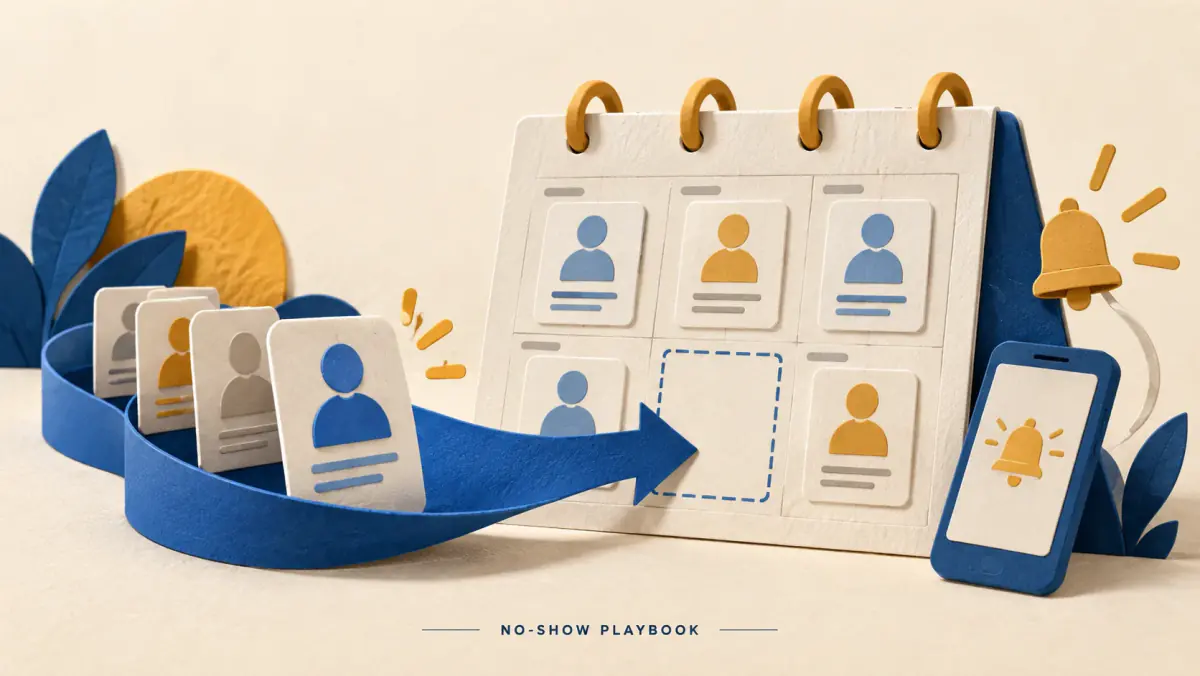
The cadence that works at volume is three touches, each carrying a one-tap reschedule path:
- At booking: role, company, job ID, date, time, duration, language, which number will call, and a STOP or opt-out line. Names the business in the first line so it cannot be mistaken for a scam.
- 24 hours before: date, time, number that will ring, what to have ready (notice period, expected salary, a quiet spot with signal), and a one-word reschedule path such as replying CHANGE.
- 2 hours before: short nudge with time, number, and the reschedule word again.
Send every message in the candidate's language, keeping numerals, dates and the STOP keyword in Latin script so they survive translation. The WhatsApp recruitment pipeline has copyable templates for each of these stages with the compliance notes (approved Meta template, named business, STOP honoured immediately). Important: these cadences are advice your team runs on its own WhatsApp Business Platform or SMS tool. EasyInterview sends no candidate messages today, so the reminder layer stays yours; the article's templates are written to be pasted into whatever tool you already use.
One warning from the field: do not send ten messages. Three to four across the window informs; ten chases. And never buy or scrape numbers from job groups. Each report lowers your number's quality rating, and a company number rate-limited in week two costs more than it saved.
4. Screen in the language the job is done in
If the floor sells in Hindi and de-escalates in Marathi, the screen should offer Hindi and Marathi, not English with an apology. The vernacular screen does two things at once: it removes the fear that keeps candidates from picking up, and it tests the actual skill (can this person sell, persuade, calm someone down) instead of a proxy skill (can they do a rehearsed English self-introduction).
Operationally this means asking language preference at apply, confirming it in the slot offer, and running the call in that language. For telecaller and BPO voice roles, split the assessment the way the telecaller plan does: which languages they can sell in versus which they can handle complaints in. Those are different bars and most forms collect neither. A candidate who picks Hindi at apply and gets an English screen at 11 am experiences that as a bait-and-switch, and no reminder cadence recovers it.
For written-reading or chat-writing tasks, keep a separate exercise. A spoken screen proves spoken skill; it does not prove the candidate can read an English ticket queue. Say which one you tested when you shortlist.
5. Make rescheduling easier than ghosting
SignalRoster's line is the right one: flexibility is a conversion tool, not a perk. A candidate whose shift changed, whose child fell sick, or whose commute bus broke down will ghost rather than call a recruiter to explain. Give them a 60-second exit that keeps them in the funnel: a digit reply, a fresh slot link, or a single CHANGE keyword that re-books without a phone call.
Route unconfirmed slots back into the pool after 24 hours. If the candidate did not confirm, the slot goes to the next applicant and the original candidate gets one re-offer, not five chases. Send one follow-up within 24 hours of a missed screen ("No problem, pick a new time: 1, 2, 3"), then mark unresponsive and move on. Pipeline cleanliness is part of show-rate: a queue full of dead slots teaches recruiters that scheduling is theatre.
For walk-in or panel stages, the same principle applies with location detail. "Come to our office" is not an instruction. Send exact address, landmark, floor, contact person and number, what to carry, and how long it takes. The walk-in interview alternative covers when a phone screen replaces the walk-in entirely, which for first rounds it usually should.
6. Publish pay, shift, location and duration in the invite
Post-offer ghosting gets the headlines, but pre-screen ghosting starts with the same surprise. When "competitive pay" turns out to be Rs 2,000 below expectation, when "flexible shift" means nights, when "10 minutes" means 45, the candidate does not negotiate. They vanish. Fountain's ghosting guide traces post-offer ghosting to pay, schedule or location details surfacing only at offer stage; the pre-screen version is identical, just earlier.
State in the slot offer itself: fixed plus variable pay range, shift days and hours including the late week, work location with commute hint, call duration and language, and what happens after the screen and by when. Candidates who decline on accurate information cost you one message. Candidates who ghost on vague information cost you a slot, a reminder sequence and a re-book.
This is also where joining propensity is won early. Ask two honest questions at apply or in the screen, not after offer: "How long is your door-to-door commute for this shift?" and "What would stop you joining if offered?" Distance and family sign-off predict joining far better than enthusiasm scores. Record the answers against the candidate so the offer-stage recruiter is not discovering them cold.
7. Over-invite by the math and fix the source, not just the slot
You will never reach zero no-shows, and you should not try. The goal is a pipeline that stays staffed despite them. That means two disciplines: arithmetic and source analytics.
The arithmetic is simple and illustrative, not a benchmark. Suppose you need 20 screens completed and your telecaller evening slots show at 65%. You must schedule about 31 screens (20 divided by 0.65). If morning slots show at 45%, you must schedule about 45. The teams that complain about no-shows are usually the ones that scheduled 20 for 20 and called the shortfall a surprise. Run your own show-rate by slot and role for two weeks, then set the over-invite factor per funnel. Revisit monthly; festive-season hiring and exam calendars move the numbers.
The analytics is where the compounding lives. Which roles run hot? Which sources (apna vs Naukri vs referral vs WhatsApp group) show best? Which recruiters' invites confirm fastest? Hirin's guide is right that pipeline analytics turns no-show reduction from gut feel into operations, and Fountain's checklist asks for no-show analytics broken out by location and channel for the same reason. Cut spend on the source that ghosts at 60% even if its cost-per-apply looks cheap; it is the most expensive source you have once recruiter hours are counted.
What one 1,000-applicant role actually costs in no-shows
Take an illustrative bulk funnel, not a customer benchmark. One role draws 1,000 applicants. About 400 clear knockouts and get screen slots. Your blended show-rate is 60%, so 240 screens complete and 160 slots go empty. Each empty slot still cost recruiter time: roughly 5 minutes to schedule and confirm, 3 minutes across reminders, and 10 minutes of blocked screen time or follow-up. Call it 18 minutes per no-show, all illustrative.
Illustrative arithmetic from the assumptions above, not a benchmark or customer data.
Forty-eight recruiter hours, more than a working week, spent on screens that never happened, before anyone assessed a candidate. Add the delay cost: each empty slot pushes the shortlist by a day or two while you re-book, and in a multi-offer market those days are when candidates sign elsewhere. That is why step 1 (speed) and step 7 (over-invite math) matter more than any single reminder tweak. The reminder industry sells step 3 as the whole answer; the calendar says otherwise.
| Cost element | Illustrative assumption | What it means |
|---|---|---|
| Schedule + confirm per slot | 5 min of recruiter time | 400 slots is 33 hours before reminders |
| Reminders across the window | 3 min per slot | Another 20 hours, mostly automatable by your team |
| Blocked screen time per no-show | 10 min | 160 no-shows is 27 hours of dead air |
| Time-to-shortlist delay | 1-2 days per re-book cycle | The window competitors hire inside |
Run your own numbers with your slot counts and show-rates. The point of the table is not the totals but the shape: scheduling and dead air dominate, reminders are the smallest bar. Fix the big bars first.
How EasyInterview fits, honestly
EasyInterview runs the first-round phone screen as a live AI call. It does not send WhatsApp or SMS reminders today, so the cadence in step 3 stays entirely on your channels. Use the WhatsApp recruitment templates on your own Business Platform number for confirmations and nudges, and use EasyInterview for the apply, screen and evidence side.
You circulate one apply link across apna, WorkIndia, Naukri, foundit, WhatsApp groups or a QR poster. The apply form records consent and runs your knockout rules (location, shift, notice period, salary band, language); a recruiter reviews every exclusion and can click "Include anyway" for the near-miss who deserves a screen. Applicants already sitting in a spreadsheet can enter through CSV import, which records existing consent rather than collecting it fresh and does not run the apply form's knockout checks. The Naukri applicant workflow covers that distinction, though the same CSV route works for any source.
The recruiter schedules eligible applicants with consent on file. Calls run inside the workspace's calling window, in the applicant's selected call language, across eleven: English, Hindi, Bengali, Tamil, Telugu, Kannada, Malayalam, Marathi, Gujarati, Punjabi and Odia. Set the allowed call languages per job and check the candidate's selection matches the skill you need to assess. For spoken-language tasks, pilot translated questions with a fluent reviewer before using results for decisions, as the multilingual screening guide sets out. Reading and writing need a separate exercise.
The call itself cross-questions instead of reading a script: it probes vague answers with follow-ups until specifics come out, and flags coached or scripted answers rather than scoring them as fluent. Reports link each scored answer to transcript evidence, with the full transcript and recording attached. These are transcript-evidence rubric scores, not a certified spoken-fluency assessment; a fluent reviewer should still listen to the recording for pace, tone and spoken quality. The hiring team reviews the evidence and decides whom to advance. Outcome emails are optional at handoff and need an email address.
The honest caveat: EasyInterview is a newer product with no public bulk-hiring case study yet. Evaluate it with a pilot on one live req alongside your existing screen, comparing the two shortlists and who is still there at 90 days. The sample report shows one recorded, scored call, and the comparison page sets it against form pre-screens and outsourced call centres.
Frequently asked questions
How many reminders should I send before a bulk-hiring interview?
Three touches is the working baseline: confirmation at booking, a reminder 24 hours before, and a nudge 2 hours before, each with a one-tap reschedule path. Fountain and Hirin both converge on confirmation plus 24-hour plus same-day timing, and SignalRoster's checklist uses the same shape. More than four messages starts to feel like chasing. The content matters more than the count: date, time, duration, language, which number will call, and what to have ready. Run these on your own WhatsApp or SMS tool; EasyInterview sends no candidate messages.
Why do candidates ghost even after confirming?
Confirmation is intent, not attendance. Shifts change, family needs intervene, a competitor offers faster, or the candidate never understood the shift or language and confirmed to avoid an awkward call. Treat confirmed no-shows as process signal: was the slot too far out, was pay or shift vague, was the screen in the wrong language, was there no easy reschedule? Segment by recruiter, role, source and slot for two weeks before changing anything globally.
Should I use email, SMS or WhatsApp for interview reminders?
Use WhatsApp or SMS as the default for Indian frontline roles and email only for detail or documentation. Hirin's India figures (roughly 20-25% email opens versus 90%+ WhatsApp opens on vendor traffic) are directional, not guarantees, but the behaviour is visible in every bulk funnel: candidates read the app they already open a hundred times a day. Whatever channel you pick, keep numbers, dates and opt-out keywords in plain numerals and Latin script, and honour STOP immediately across every recruiter and role.
What is a good interview no-show rate for bulk hiring?
There is no reliable published benchmark, only ranges tied to process quality. Practitioner reports for Indian BPO and staffing put manual-process funnels at 20-30% no-shows in peak cycles, with better-managed funnels materially lower. Rather than chasing a universal number, compare your own rate by role family, source channel, slot time and recruiter. If one site or source runs 20 points hotter than the rest, the issue is process or sourcing, not the labour market.
How do I handle a candidate who misses the screen?
Send one follow-up within 24 hours with fresh numbered slots and the reschedule keyword, then mark unresponsive if there is no reply and recycle the slot. Do not blacklist after one miss; shift workers miss for legitimate reasons and re-booked candidates show at solid rates when the friction is removed. Reserve blacklisting for repeated no-response across two re-offers, and keep the record (consent, chats, decline reason, who clicked it) in one system rather than on eleven phones.
Cutting no-shows is unglamorous work: faster slots, clearer invites, vernacular screens, reminders candidates actually read, and arithmetic instead of hope. Do those five and the funnel behaves.
Book a demo to see EasyInterview run a live, recorded phone screen in the candidate's language on one of your open bulk roles.
Rohit Pandit
Founder, EasyInterview · easyinterview.life
I build EasyInterview, an AI hiring pipeline for high-volume roles in India. These are field notes on screening at volume, hiring signal, and interview integrity, written from the work rather than from a keyword list.
Connect on LinkedIn