Apriora Alternatives: Technical Depth or Hiring Scale
Apriora (Alex) alternatives compared: both AI-interview every applicant at volume. Where EasyInterview's India-built phone screens and live coding round differ.
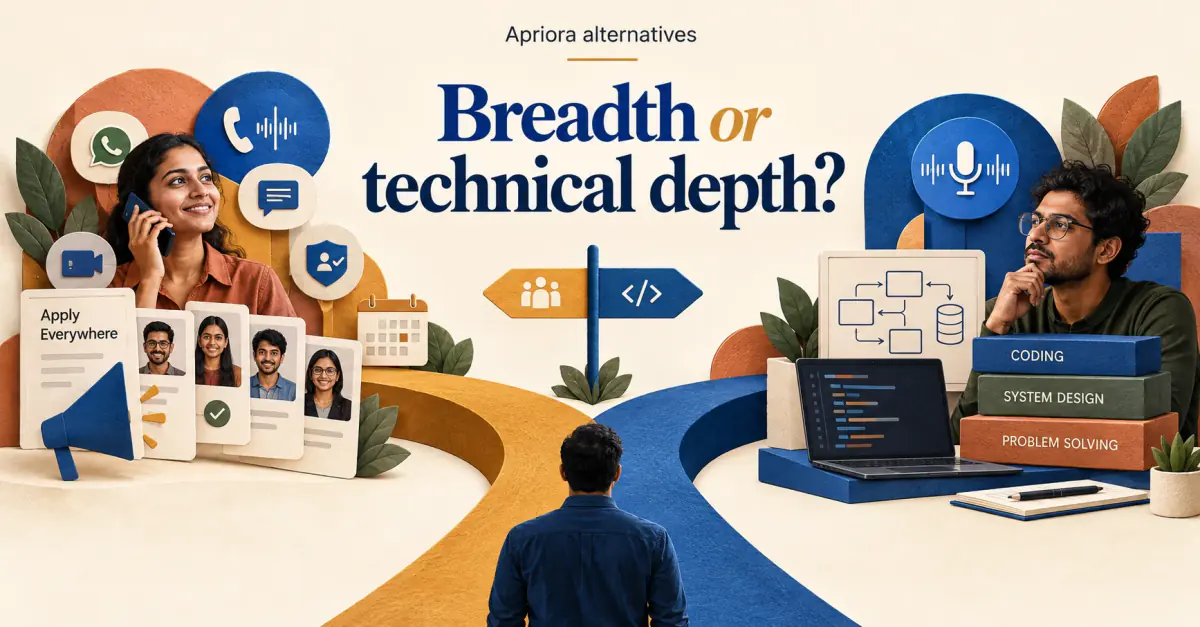
If you are looking for an Apriora alternative, EasyInterview is a direct one. Both circulate a job, AI-interview every applicant by voice, and rank the results, across any role hired in volume. The differences are where the engineering round happens, which languages the phone screen speaks, whether the price is published, and how much recruiting stack sits around the interview. For the wider shortlist an Indian team would consider in this category, see HireVue alternatives in India.
Apriora is an end-to-end AI recruiter: resume screening, a conversational first-round interview over phone, video, SMS, and WhatsApp, scheduling, identity checks, and ATS write-back across every role. EasyInterview is an AI hiring pipeline for high-volume hiring: one apply link circulated everywhere, rubric knockouts, an AI phone interview in the candidate's language, and a percentile-ranked shortlist with every score pinned to a quoted moment in the call. For engineering roles it adds a live coding and system-design round in a real editor and on a whiteboard, which Apriora's conversational technical screen does not have.
Note on the name: Apriora Inc. now does business as Alex, and
apriora.airedirects toalex.com. Many teams still search for "Apriora," so we use that name here; everything below applies to the product now marketed as Alex.
TL;DR
- Choose Apriora (Alex) when you want one vendor to own the whole recruiting operation across many countries and role families: resume screening, interviews over phone, video, SMS, and WhatsApp in 26 languages, scheduling, identity verification, talent rediscovery, and results pushed into your ATS through 33-plus integrations.
- Choose EasyInterview when you are hiring in volume in India and want every applicant phone-interviewed in Hindi, English, or one of nine other Indian languages, scheduled over WhatsApp, with a ranked shortlist where every score is pinned to a quoted moment in the call. For engineering roles it adds a live coding and system-design round in a real editor and on a whiteboard.
- Apriora runs "technical" and "coding" screens as a spoken conversation. It has no code editor, IDE, or whiteboard — candidates talk through code rather than write and run it.
- Apriora does not publish pricing; it is demo- and sales-led. EasyInterview publishes its rates: phone screens bill per connected minute with the scored report included, technical rounds are a flat price per round, and everything draws from one prepaid wallet with no seats. Details are on the pricing page.
How each one runs the first screen
Apriora is an agentic AI recruiter. Its AI agent conducts a live, natural voice or video interview, asks personalized follow-ups in real time, and can reach candidates over phone, video, SMS, and WhatsApp in 26 languages. Around that interview sits a full recruiting stack: resume screening, automatic scheduling (Coordinator), identity and fraud checks (Verify), talent rediscovery (Talent Match), and 33-plus one-click ATS integrations. The design goal is to interview every applicant the moment they apply and gate a single human round afterward — screening at volume without adding recruiter headcount.
EasyInterview runs the same top of funnel, built for high-volume hiring in India. You share one branded apply link on LinkedIn, Naukri, Apna, Indeed, WhatsApp groups, QR posters, or your careers page, or import a CSV of applicants you already have through the same consent flow. Phone numbers are OTP-verified at apply. Deterministic knockout rules you write (location, notice period, salary band) sort the pile. Knockouts are shown politely to the candidate at submit, nobody is auto-rejected, a human clicks every decline, and every rule has an "include anyway" override.
Then an AI interviewer phones every eligible applicant in the language they picked, at a time they chose over WhatsApp, with a one-tap reschedule. Calls run in parallel rather than queueing behind a recruiter's calendar. The interviewer probes vague answers with follow-ups until a real number or a real example comes out, scores every dimension with evidence pulled from the transcript, and flags coached or scripted answers. Every invite says the interviewer is an AI and that a person reads the transcript, and every message carries a STOP opt-out.
For engineering roles EasyInterview goes one step further than either phone screen. Candidates open a single-use link in the browser and spend 45 to 60 minutes in a live technical round: a coding session in a real editor or a system-design session on a shared whiteboard, reasoning aloud while the interviewer cross-questions trade-offs, complexity, and edge cases the way a staff engineer would. When they finish, the hiring team gets an evidence-scored report with per-question deductions, transcript quotes, and a recording chaptered by question.
The distinction is no longer scope. Both products interview every applicant across every kind of role. The distinction is where each one goes deep: Apriora into the recruiting operation around the interview, EasyInterview into the interview itself and into the Indian market it was built for.
EasyInterview vs Apriora at a glance
| Area | EasyInterview | Apriora (Alex) |
|---|---|---|
| What it is | AI hiring pipeline: circulate, screen, phone-interview, rank; live technical rounds for engineers | End-to-end AI recruiter (screen, interview, schedule) |
| Interview format | AI phone interview in the candidate's language, scheduled over WhatsApp; browser coding editor or system-design whiteboard for engineering roles, 45-60 min | Conversational voice/video screen; phone, video, SMS, WhatsApp |
| Coding environment | Live editor where candidates write and run code; shared whiteboard | Verbal only — no code editor, IDE, or whiteboard |
| Primary use case | High-volume hiring in India across sales, support, field, ops, delivery, retail, and engineering | High-volume hiring across many role types and countries |
| Scoring & evidence | Every score pinned to a quoted moment in the call; percentile rank within the job; per-question deductions, transcript quotes, chaptered recording on technical rounds | Rubric-based evaluation, interview summary, cheat flags |
| Anti-cheat | OTP-verified numbers; follow-ups that flag coached or scripted answers on phone screens; paste, lookup, and tool-use flags on technical rounds | Identity verification plus gen-AI, tab-switch, and copy-paste flags |
| Scheduling & ATS | WhatsApp scheduling with one-tap reschedule; branded apply link and CSV import; ATS-ready scorecard export; named integrations on roadmap | Built-in scheduling plus 33+ ATS integrations |
| Reach | 11 languages (Hindi, English, and 9 more Indian languages); phone and WhatsApp; browser for technical rounds | 26 languages; phone, SMS, WhatsApp, video |
| Pricing | Published: per connected minute with the scored report included for phone screens, flat per technical round; prepaid wallet, no seats | No public pricing; demo and sales-led |
Depth versus breadth: the real difference
Apriora markets "technical screens," "coding," and "system design" as interview types, but it conducts all of them as a spoken conversation. A candidate describes an approach out loud; they do not open an editor, write a function, run it against test cases, or diagram an architecture. Apriora's own interview channels are phone, video, SMS, and WhatsApp — none is a coding surface. That is a reasonable design for a generalist first-round screen, and it is exactly what a high-volume recruiter needs. It is not a substitute for watching an engineer build something.
EasyInterview's technical round is built around the surface Apriora omits. Coding candidates work in a live editor, write real code, and talk through it while the interviewer probes complexity and edge cases. System design candidates use a shared whiteboard and defend architectural decisions under adaptive follow-ups. The signal is not "can this person describe a hash map"; it is "watch how they actually structure, write, and revise a solution when questioned."
On the phone screen itself the two now overlap heavily, and the honest differences are smaller and more specific. EasyInterview's phone screens are built for India: 11 languages (Hindi, English, and nine more Indian languages), scheduling over WhatsApp where Indian candidates actually reply, and a consent flow that keeps a calling program on the right side of TRAI rules, with consent collected at apply, calls scheduled rather than cold, a STOP opt-out on every message, and CSV imports run through the same consent step. Every score in the report is pinned to a quoted moment in the call, so a reviewer can hear the evidence behind a 4 out of 5 rather than trust a summary.
Apriora's breadth runs the other way: 26 languages across many countries, video as well as voice, and modules for resume screening, identity verification, talent rediscovery, and ATS write-back that EasyInterview does not offer.
So the two do compete for the same requisition now. If you are screening a restaurant shift lead, a field sales executive, or a first-line support rep in India, both will phone-interview every applicant; the choice comes down to language coverage in the market you hire in, how much recruiting stack you want from one vendor, and whether you want to see the price before you talk to sales. If you are screening a backend or full-stack engineer, a verbal walk-through leaves the most important question, can they write correct and defensible code, untested. That is the gap EasyInterview's technical round closes and Apriora's conversational screen does not.
Cost and pricing
Apriora does not publish pricing. Its pricing page is a demo-booking form, and cost is quoted per engagement based on interview volume, role families, and which modules (verification, channels, integrations) you turn on. Some third-party aggregator sites list specific low monthly figures for Apriora; those numbers are not confirmed by Apriora's own site and should not be relied on. The practical takeaway is that Apriora is an enterprise, sales-led purchase — powerful for high-volume programs, but you will not know the number until you talk to sales.
EasyInterview publishes its prices. The team shares one prepaid wallet, with no seats and no subscription. Phone screens bill per connected minute with each scored report included, and a call that ends inside 30 seconds is free. Technical rounds are a flat price per round. Current rates are on the pricing page, and the cost-per-hire calculator shows what a per-screen unit cost means across a funnel of a thousand applicants.
The budget lines overlap more than they used to. Both cover the first round across every role. The difference is what sits around it. Apriora's quote covers an end-to-end recruiting automation platform, with verification, channels, and integrations priced in. EasyInterview's rates cover circulation, screening, the phone interview, the ranked shortlist, and the engineering round, and nothing you did not use. A team already running an ATS and a recruiting stack can add EasyInterview for one role without renegotiating anything, and a team without that stack should price Apriora's modules honestly against what it will actually turn on.
Cheat resistance in the AI era
Apriora takes integrity seriously for a volume screener. Its Verify module handles identity validation and fraud detection, and it flags suspected cheating using multi-modal signals — generative-AI usage, tab-switching, copy-paste, and background voices — with a per-session report. Apriora reports meaningful reductions in fraudulent applications from this layer. For a high-volume funnel where impersonation and application fraud are the main risks, that is a sensible control set.
EasyInterview runs two different controls at two stages. On the phone screen, the AI interviewer probes vague answers with follow-ups until a real number or a real example comes out, scores every dimension with evidence pulled from the transcript, and flags coached or scripted answers so rehearsed candidates do not sail through. Phone numbers are OTP-verified at apply, which removes the cheapest form of duplicate or fake application. On the technical round, the failure mode is different: a strong-sounding answer the candidate cannot actually produce or extend. The interview is live, conversational, and adaptive, so the candidate must write the code in the editor, defend complexity choices, handle edge cases, and modify the solution when the interviewer challenges a trade-off. An integrity monitor separately flags paste, lookup, and tool-assisted answers.
Neither approach is a substitute for a final panel or a real work sample. Apriora's control set is broader on identity and fraud across a large applicant pool, with a dedicated verification module that EasyInterview does not have; EasyInterview's OTP check confirms the phone number, not the person. EasyInterview's is tighter on the "looks right, cannot build it" problem in technical hiring, and on the coached phone answer that a script-following screener would accept.
Where Apriora is the better choice
Apriora is the stronger fit when you want one vendor to own the entire recruiting operation. If you hire across many functions and many countries, and need resume screening, identity verification, scheduling, talent rediscovery, and results written back into your ATS from one system, an end-to-end AI recruiter that speaks 26 languages across phone, SMS, WhatsApp, and video is exactly the right shape. Its 33-plus ATS integrations matter for a recruiting-operations team whose process lives in the ATS, and EasyInterview cannot match them yet: it exports an ATS-ready scorecard today, with named integrations on the roadmap.
Apriora is also well-funded and moving fast, a Y Combinator company that raised a $17M Series A in 2025, with a public customer roster that EasyInterview does not have. That matters if your procurement process needs references and a vendor investing heavily in the category. Choose Apriora when the problem is "we need the whole top of the funnel automated across every market we hire in, inside the ATS we already run."
Where EasyInterview is the better alternative to Apriora
EasyInterview is the better choice when the hiring is happening in India. The phone screen speaks Hindi, English, and nine more Indian languages, so a candidate in Indore or Coimbatore is judged on substance rather than English fluency. Scheduling happens over WhatsApp, with a one-tap reschedule, at a time the candidate picks. Consent is collected at apply, calls are scheduled rather than cold, and every message carries a STOP opt-out, which keeps a high-volume calling program on the right side of TRAI rules. And nobody is auto-rejected: knockouts are rules you wrote, a human clicks every decline, and every screened candidate gets an outcome message.
It is also the better choice when engineering roles are in the mix. A conversational screen, however fast and well-run, does not put a candidate in an editor. EasyInterview does: a live coding round, a system-design whiteboard, adaptive probing, and a decision-ready scorecard with per-question deductions, transcript quotes, and a recording chaptered by question, so an engineer can inspect the recommendation without replaying the whole session. Teams can see a sample scorecard to judge whether that evidence is detailed enough for their hiring committee.
The third reason is the report itself. Every phone-screen score is pinned to a quoted moment in the call, candidates are percentile-ranked within the job, and the reviewer plays the evidence rather than reading a summary before scheduling the next round in a click. Combined with published pay-per-screen pricing and a shared prepaid wallet, that makes a pilot cheap to run and easy to judge.
EasyInterview is a newer product without Apriora's breadth of channels, languages, and end-to-end recruiting modules, without ATS write-back, and without a public customer roster, case studies, or outcome benchmark. The sensible way to evaluate it is a low-commitment pilot on one role: write the knockouts and the rubric, run a defined set of applicants through the phone screen, and compare the ranked shortlist, and for engineering roles the coding and system-design evidence, against your panel's judgment before expanding.
Frequently asked questions
Is EasyInterview an Apriora alternative?
Yes. Both AI-interview every applicant by voice across any role hired in volume and rank the results. EasyInterview is built for India, with 11 languages, WhatsApp scheduling, and TRAI-compliant consent, and adds a live coding and system-design round for engineering roles. Apriora has broader channels, more languages, ATS write-back, and a public customer roster.
Does Apriora include a code editor?
No. Apriora's technical screen is conversational. EasyInterview puts engineering candidates in a live editor or on a shared whiteboard and scores what they build and defend.
How do integrity models differ?
Apriora emphasizes identity verification and multi-modal fraud signals across high volume. EasyInterview OTP-verifies phone numbers at apply, probes vague answers and flags coached or scripted ones on the phone screen, and adds paste, lookup, and tool-use flags on the live technical round.
How do prices compare?
Apriora is typically sales-led without public pricing. EasyInterview publishes its rates on its pricing page: phone screens per connected minute with the scored report included, technical rounds flat per round, all from a prepaid wallet with no seats. Compare total funnel cost, not only the interview line item.
Can we use Apriora and EasyInterview together?
Yes, though there is less reason to than before. Some teams run Apriora as the global recruiting layer and use EasyInterview for Indian hiring, where the language and WhatsApp coverage is deeper, or for engineering candidates who need a real editor and whiteboard before the panel.
The bottom line
Apriora (Alex) and EasyInterview now overlap on the job that used to separate them: both phone-interview every applicant across every kind of role and hand back a ranked, evidence-backed shortlist. Apriora is the broader recruiting platform, with resume screening, scheduling, verification, 26 languages, and ATS write-back behind a conversational screen, and a public customer roster to point to. EasyInterview is the deeper pipeline for high-volume hiring in India, with 11 languages, WhatsApp scheduling, TRAI-compliant consent, every score pinned to a quoted moment, published pay-per-screen pricing, and, for engineers, a live coding editor and system-design whiteboard that a conversation cannot replace.
If your bottleneck is a global recruiting operation that needs to live inside your ATS, Apriora is likely the better instrument — HeyMilo alternatives covers its closest conversational competitor, and Karat alternatives covers the human-delivered version of the outsourced screen. The vendor comparison page puts the whole field side by side. If your bottleneck is a thousand applicants in India and one phone, or knowing whether an engineer can actually build and defend a solution, book a demo and start with a pilot on one role.
Rohit Pandit
Founder, EasyInterview · easyinterview.life
I build EasyInterview, an AI hiring pipeline for high-volume roles in India. These are field notes on screening at volume, hiring signal, and interview integrity, written from the work rather than from a keyword list.
Connect on LinkedIn