AI Telephonic Interview: What the Round Tests and How to Run It
What a telephonic interview is, what the round should test, a 12-minute call structure with a scorecard, and what changes when an AI runs it at volume.
Search for the telephonic interview and every result is written for the person waiting for the call: ten common questions, sample answers, keep a glass of water nearby. Nothing is written for the person making the call, and less still for a team that has to make five hundred of them this week. This is that page: what a telephonic interview is, what the round is for, how to run it in twelve minutes so the two-hundredth candidate meets the same bar as the second, and what changes when an AI telephonic interview runs the round instead of a recruiter with a phone list.
What is a telephonic interview?
A telephonic interview is a short screening call held before a candidate is invited to a face-to-face, video or walk-in round. In Indian hiring it is the standard first filter for frontline and volume roles: telecalling, field sales, retail, delivery, support, nursing. In the US the same round is called a phone screen. "Telephonic round", "HR call" and "TI" all mean the same thing in Indian job posts and WhatsApp groups.
It usually runs ten to twenty minutes, is conducted by an HR recruiter, a hiring manager or a consultancy, and exists to answer one question: is this person worth the expensive round? The expensive round costs a manager's hour, a candidate's trip across the city, or a seat at a walk-in drive. The telephonic interview is cheap by design so that the expensive round is spent on the right people.
That is also where it goes wrong. Because it is cheap, it is under-designed: whoever is free calls whoever is at the top of the list, asks "tell me about yourself", and writes "good communication" in a spreadsheet. The round ends up filtering on who picked up that morning and who sounds confident in English, and neither of those is the job.
What the telephonic round is for, and what it cannot do
A telephonic round has four jobs. Verify the facts that decide whether a hire is possible at all. Probe the claims on the CV until they have units. Hear the candidate do a small piece of the work, in the language the work is done in. Tell them the hard parts of the job and listen to what comes back. Everything else belongs to the next round.
Just as important is knowing what a phone call cannot test, so you stop asking it to.
| The phone tests this well | The phone does not test this |
|---|---|
| Whether a customer could understand them, in the language of the job | Written English, typing or CV formatting, which should never filter an audible job |
| Whether the facts hold: commute at shift start, notice period, pay band, shift | Whether they will physically turn up, which the walk-in or the first day tests |
| Whether a claim survives two follow-ups on the same thread | Hands-on skill with a POS, a two-wheeler in traffic, a patient or a spreadsheet |
| Comprehension: can they summarise back what you just said | Appearance and grooming, and it should not |
| How they react when the job is described honestly | Who is on the line. A live voice answering unscripted follow-ups is a higher bar than a typed form, not identity verification |
Design the round around the left column. Push the right column to the round that can test it, and stop pretending an impression of "confidence" on a noisy line measures anything.
The twelve-minute telephonic interview, in order
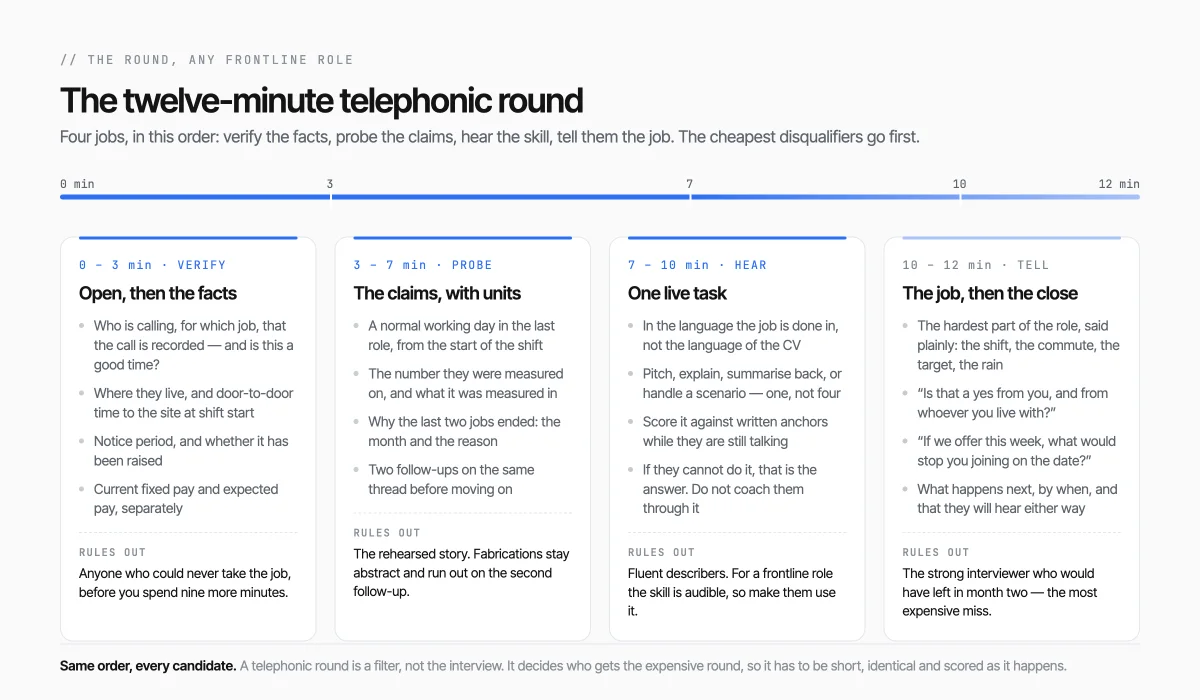
Twelve minutes is enough if the order is fixed. Disqualifiers are cheap to check and skills are expensive to assess, so the first three minutes go to the questions that end most calls.
Verify, minutes 0 to 3. Say who you are, which job, and that the call is recorded. Then the facts: door-to-door time to the site at shift start, not the city; notice period, and whether the employer has been told; current and expected pay as two numbers. If any of these ends the conversation, end it politely now.
Probe, minutes 3 to 7. Replace "tell me about yourself" with "walk me through a normal working day in your last job". Then the number they were measured on and its unit, and why the last two jobs ended, with a month and a reason each. Two follow-ups on the same thread before moving on: real experience gets more specific under follow-up, a rehearsed story gets more abstract and runs out on the second one.
Hear, minutes 7 to 10. One live task, in the language the job is done in. A sixty-second pitch for a telecaller, a complaint summarised back for support, a scenario for a nurse. Score it against written anchors while they are still talking. If they cannot do it, that is the result; do not coach them through it and score the coached version.
Tell, minutes 10 to 12. State the hardest part of the job plainly: the six-day week, the 2 pm to 11 pm rotation, the target, the monsoon on a two-wheeler. Ask whether that is a yes from them and from whoever they live with, and what could stop them joining on the date. Then say what happens next, by when, and that they will hear either way. A candid "I need to check at home" in minute eleven is a better signal than a fast yes.
The telephonic interview scorecard
The order gives you consistency within a call. The scorecard gives you consistency across five hundred calls and three interviewers. Fill it in while the call is happening, and write the evidence, not the adjective.
The Verify block is not scored: record the actual answers, commute in minutes, notice in days, pay in rupees, and mark each pass or fail against your rule. Score the rest of the call on five rows.
| Row | 1 | 3 | 5 |
|---|---|---|---|
| Clarity on the line | You are asking them to repeat themselves by the second minute | Understandable throughout, with effort on a noisy line | You could put them in front of a customer at the end of the call |
| Substance of the claims | Adjectives and percentages; no unit, no month, no base | Gives a number and a unit when asked | Volunteers number, unit, base and months missed; the story sharpens under follow-up |
| The live task | Cannot start without being fed lines | Gets through it, loses the thread once | Does it the way the job needs it done, in the job's language, unprompted |
| Response to the job as described | A fast yes with no questions, or a hedge on the shift or commute | Yes, with one honest reservation named | Asks a specific question about the hard part and answers for the household too |
| Consistency | The story changes between the CV, the opener and the follow-ups | Minor gaps, explained when asked | The same facts in the same order every time you approach them |
Under the rows, one line per score: the minute in the call and what was said. A score without a quoted moment is an impression, and impressions drift by candidate forty. Close with advance, hold or decline, and the date the outcome message will go out. Weight the response-to-the-job row up wherever early attrition is the real cost, which on most volume floors is everywhere.
Telephonic interview questions to ask, and what not to
The round is not a question bank, but ten questions do its work for almost any frontline role. Role-specific questions go in the Probe and Hear blocks, and the sibling banks for telecaller interview questions, sales executive interview questions, delivery partner interview questions, staff nurse interview questions and retail sales associate interview questions are built to slot in there with their own rubrics.
- "Is this a good time, and are you somewhere you can talk for twelve minutes?" A reschedule costs less than a wasted call.
- "Where do you live, and what time would you leave home to reach the site by shift start?" Door-to-door minutes, without hesitation. Vagueness here is the most reliable early sign of a joiner who does not join.
- "What is your notice period, and have you told your current employer you are looking?"
- "What is your current fixed salary, and what are you expecting, fixed and variable separately?"
- "Walk me through yesterday at work, from the start of the shift." A real sequence with times and places. Vagueness usually means a job they watched someone else do.
- "What number were you measured on, and what was it measured in?" The unit tells you what the last employer paid for, which is usually the behaviour you are about to hire.
- "Why did your last two jobs end? Give me the month and the reason for each." "Looking for growth" twice in eighteen months is a pattern.
- "Here is the hardest part of this job. Is that a yes from you, and from whoever you live with?"
- "If we make an offer this week, what could stop you joining on the date?" The honest answer here is the one that saves the offer.
- "What do you want to ask me?" A candidate who asks about the shift, the incentive or the team lead has been listening. One who asks nothing has already decided, one way or the other.
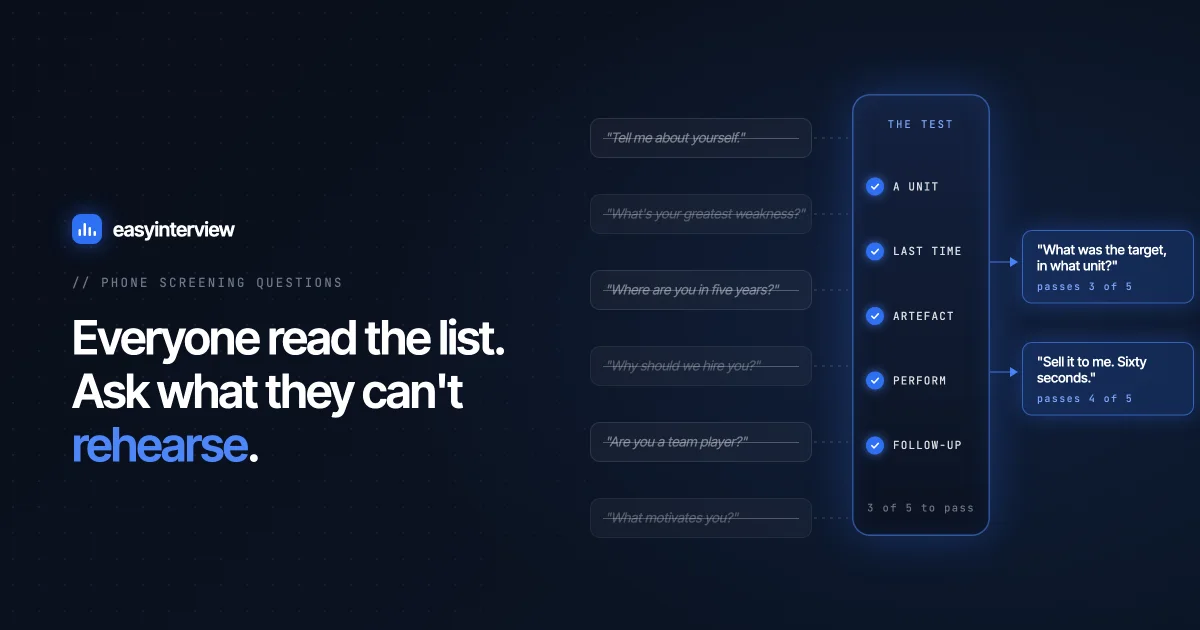
What not to ask: "tell me about yourself", "strengths and weaknesses", "where do you see yourself in five years". Every candidate-side guide has a model answer for each, and you will hear it read back to you. They cost minutes and measure preparation, not fit. The phone screening questions guide has a five-check test for telling a question that produces signal from one that produces a recital, and a rewrite for each of the usual offenders.
Adapting the round by role family
The four blocks do not change. What goes into Verify and Hear does.
The skill is the call itself, so the live task carries more weight here than in any other role family.
- Verify
- Shift rotation including the late week, commute at that shift's start, and the languages they can sell in versus de-escalate in.
- Hear
- A sixty-second pitch in the floor's language, then the same pitch in the second language.
- Weight up
- Clarity on the line and the live task. Skip anything about typing or CV quality; the job is audible.
Mobility decides whether the hire exists at all, so Verify runs longer here than anywhere else.
- Verify
- Own two-wheeler, valid licence, the area they can cover daily from home, and the ride time to the far end of the territory.
- Hear
- Pitch one product to a shop owner in the market's language, then handle one objection. For delivery, what they do when an address is wrong.
- Weight up
- Substance of the claims. A sales target without its unit and base is not a number.
Hours decide the early exits, so the round surfaces festival-season reality before the offer does.
- Verify
- Weekend and festival availability, the closing-shift commute, and standing hours.
- Hear
- Explain a product or menu item to a walk-in customer, then handle one who wants a refund you cannot give.
- Weight up
- Response to the job as described. Skip anything the floor manager will test in person on day one.
Nurses, technicians, pharmacists: confirm the credential exists and the judgment is real, then hand over to the specialist round.
- Verify
- Registration or licence number and its validity, night duty, and the notice period at the current employer.
- Hear
- One scenario with a wrong answer available: a patient refusing medication, a reading outside range. Score the reasoning, not the vocabulary.
- Weight up
- Consistency. A story that shifts between the CV and the follow-ups is a reference check waiting to fail.
What a recruiter-run telephonic round costs at volume
Say 500 applicants for 25 seats and a twelve-minute round each. The talking is only part of the cost. Every completed round also costs dial attempts that go unanswered, callbacks, and the notes that make the call worth having made.
Arithmetic from the assumptions stated above, not a benchmark or customer data. Dials and callbacks assume two extra attempts of about three minutes each per completed round; your connect rate will differ by role, city and time of day.
That is 175 recruiter-hours on the round itself, about 22 working days for one person, before the five hours of review or a single interview. Frontline candidates are usually in three processes at once, so a three-week round loses people to whoever called first. In practice nobody spends the 175 hours: the round is cut to a four-minute availability check, or the pile is cut on CVs before anyone is called, which is exactly the filter the phone was meant to replace.
The five hours at the bottom of the chart are the part that has to stay human. Everything above it scales with the pile. Run your own volumes in the time-to-hire calculator; it is the same step where the bulk hiring process breaks whatever the role.
What an AI telephonic interview changes
An AI telephonic interview is the same round, run by a voice agent instead of a recruiter. The candidate gets a call at a slot they chose, the agent asks the round's questions in the candidate's language and follows up on vague answers, and a recording, transcript and score land with a person who makes the decision. What changes is not the questions. It is who gets the round, when, in which language, and what survives the call.
| Recruiter making the calls | AI telephonic interview | |
|---|---|---|
| Who gets the round | The fraction the team has hours for, chosen by position on the list | Every applicant who clears the knockout rules |
| When | When the recruiter is free, which is usually when the candidate is at work | A slot the candidate picks, with a one-tap reschedule |
| Language | Whatever the recruiter speaks | The candidate's, from the languages the tool supports |
| The bar | Drifts with fatigue and differs by recruiter | The same questions and anchors for candidate 5 and candidate 500 |
| Follow-ups | Depend on attention in that minute | A vague answer is probed until a number comes out; scripted answers are flagged |
| What survives the call | Notes, if written | Recording, transcript, and every score pinned to a moment |
| Throughput | Serial, set by recruiter hours | Parallel, set by applicant volume |
| The human's job | Making the calls | Reading transcripts, deciding, and clicking every decline |
Two things do not change and should not. The AI does not reject anyone: it ranks, and a person decides, including on every knockout. And the candidate must be told. Say in the invite that the call is run by AI and recorded, collect consent at apply, and carry a STOP opt-out on every message, which is what TRAI's rules on commercial communication expect.
One more thing to design for. Much of what ranks for "AI telephonic interview" is candidate-side copilots that promise to whisper answers during a phone screen. A live round that follows up on the specific thing the candidate just said, and asks for the month, the unit and the base, is a much harder target than a typed form or a fixed script. It is still not proof of identity, and no phone round should claim to be.
How EasyInterview runs the telephonic round
EasyInterview runs the round for every eligible applicant. One branded apply link goes out to LinkedIn, Naukri, Indeed, apna, WhatsApp, foundit, Shine, a careers page or a QR poster, and a CSV of applicants you already hold enters the same pipeline. You write the knockout rules, which for a frontline role are the Verify block above: location, notice period, salary band, shift availability. Candidates see them politely at submit. Every decline is clicked by a human, every rule has an "include anyway" override, and every screened candidate gets an outcome message.
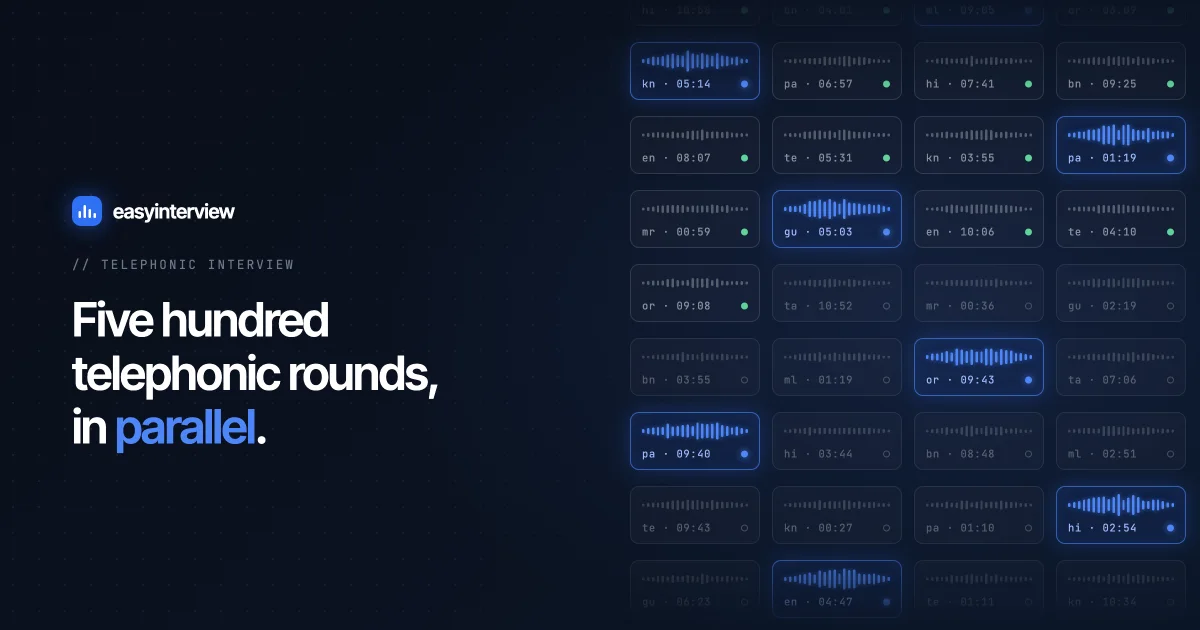
Everyone who clears them is invited to a live AI phone interview in their own language, across eleven: English, Hindi, Bengali, Tamil, Telugu, Kannada, Malayalam, Marathi, Gujarati, Punjabi and Odia. The AI is disclosed in every invite, the candidate picks a slot over WhatsApp with a one-tap reschedule, consent is collected at apply, and every message carries a STOP opt-out. Calls run in parallel, so throughput is set by applicant volume, not recruiter headcount.
The call does the Probe block the way this article describes it. It does not read a script; it follows up on a vague answer until the real number comes out, and it flags coached or scripted answers rather than scoring them as fluent. What comes back is a ranked shortlist scored on seven dimensions, Communication, Role knowledge, Experience fit, Problem solving, Availability, Integrity and Language fluency, with every rating pinned to the moment in the call that earned it, plus the recording, the transcript and a percentile rank. A person reads the transcript and makes the decision.
The honest caveat: EasyInterview is a newer product with no public bulk-hiring case study yet. Evaluate it the way you would any vendor claim, with a pilot on one live req, run alongside your existing telephonic round, comparing the two shortlists. The sample report shows what one scored call looks like, and the comparison page sets this against chat pre-screens and outsourced call centres.
Frequently asked questions
What is the difference between a telephonic interview and a phone screen?
Nothing but geography. "Telephonic interview" is the Indian English term and "phone screen" the American one, for the same short call before any in-person or video round.
How long should a telephonic interview be?
Ten to fifteen minutes for a first round, twelve if you use the structure above. That is enough to verify the facts, probe two or three claims with follow-ups, run one live task and describe the job honestly. Past twenty minutes you are running the interview, which is the round that should come after the shortlist.
Do candidates have to be told the telephonic interview is run by AI?
Tell them, whatever the legal minimum turns out to be where you operate. Put it in the invite, collect consent at apply, and give every message a way to opt out. A candidate who discovers mid-call that they were talking to software will tell everyone they know.
Should the telephonic round be in English or in the candidate's language?
In the language the job is done in, then check other languages separately if the role needs them. A Hindi-selling telecaller screened entirely in English is tested on a skill the job does not use while the one it does use goes unheard. At volume that systematically declines the people who would have performed best. If your interviewers cannot run the round in the market's language, that is the first thing to fix, with people or with software.
Can a telephonic round replace a walk-in drive?
It should come before one. A walk-in drive screens for who could travel that day, which tracks distance and shift rather than ability, and the panel's bar drifts by candidate forty. Run the telephonic round for everyone who applied, invite only the ranked top to the drive, and the drive's job becomes documents, identity and the offer, which is what it is good at.
Run the round for everyone who applied
The telephonic interview is the cheapest round you have and the one that decides where the expensive rounds go. Give it a fixed order, written anchors and a scorecard that records moments rather than adjectives, and run it for the whole pile instead of the fraction one recruiter can reach.
Book a demo to see EasyInterview take one req from an apply link to a ranked, evidence-scored shortlist, every telephonic round in the candidate's own language.
Rohit Pandit
Founder, EasyInterview · easyinterview.life
I build EasyInterview, an AI hiring pipeline for high-volume roles in India. These are field notes on screening at volume, hiring signal, and interview integrity, written from the work rather than from a keyword list.
Connect on LinkedIn