Automated Phone Screening: What It Is and How to Judge a Vendor
Automated phone screening explained for employers: what it replaces, when not to use it, and a 12-question vendor checklist on consent, languages and evidence.
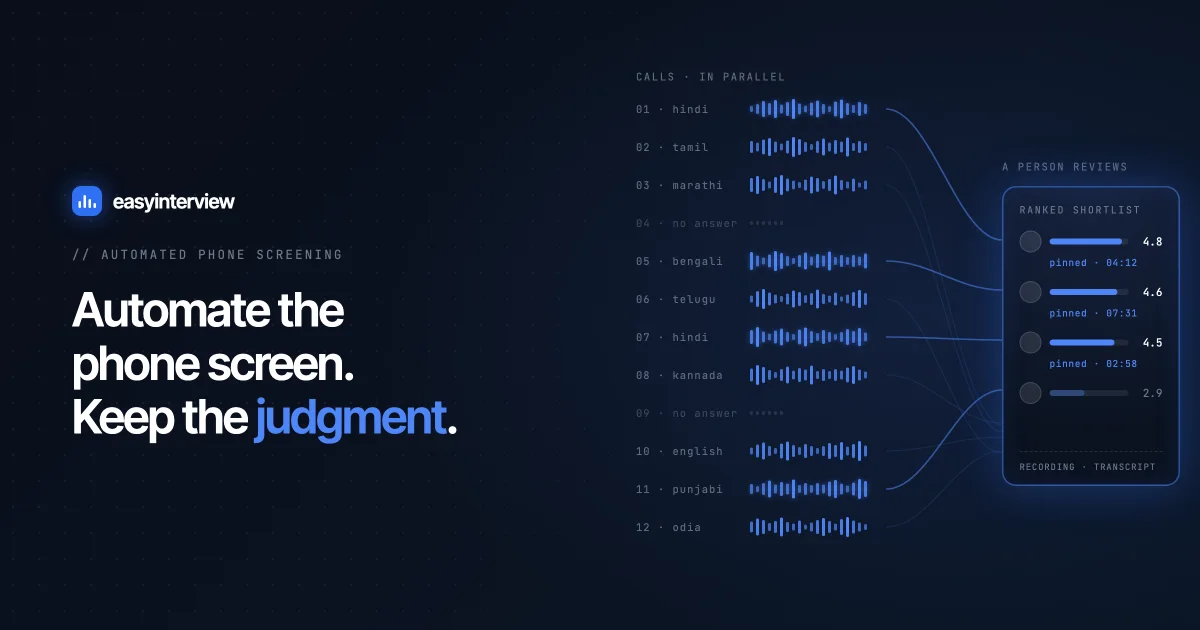
Automated phone screening is software that phones your applicants, runs the first-round screening conversation without a recruiter on the line, and hands back a scored, ranked list with the recording and transcript attached. Vendors sell the same category as AI phone screening, automated phone interviews or AI phone interviews. The label matters less than what is actually on the call.
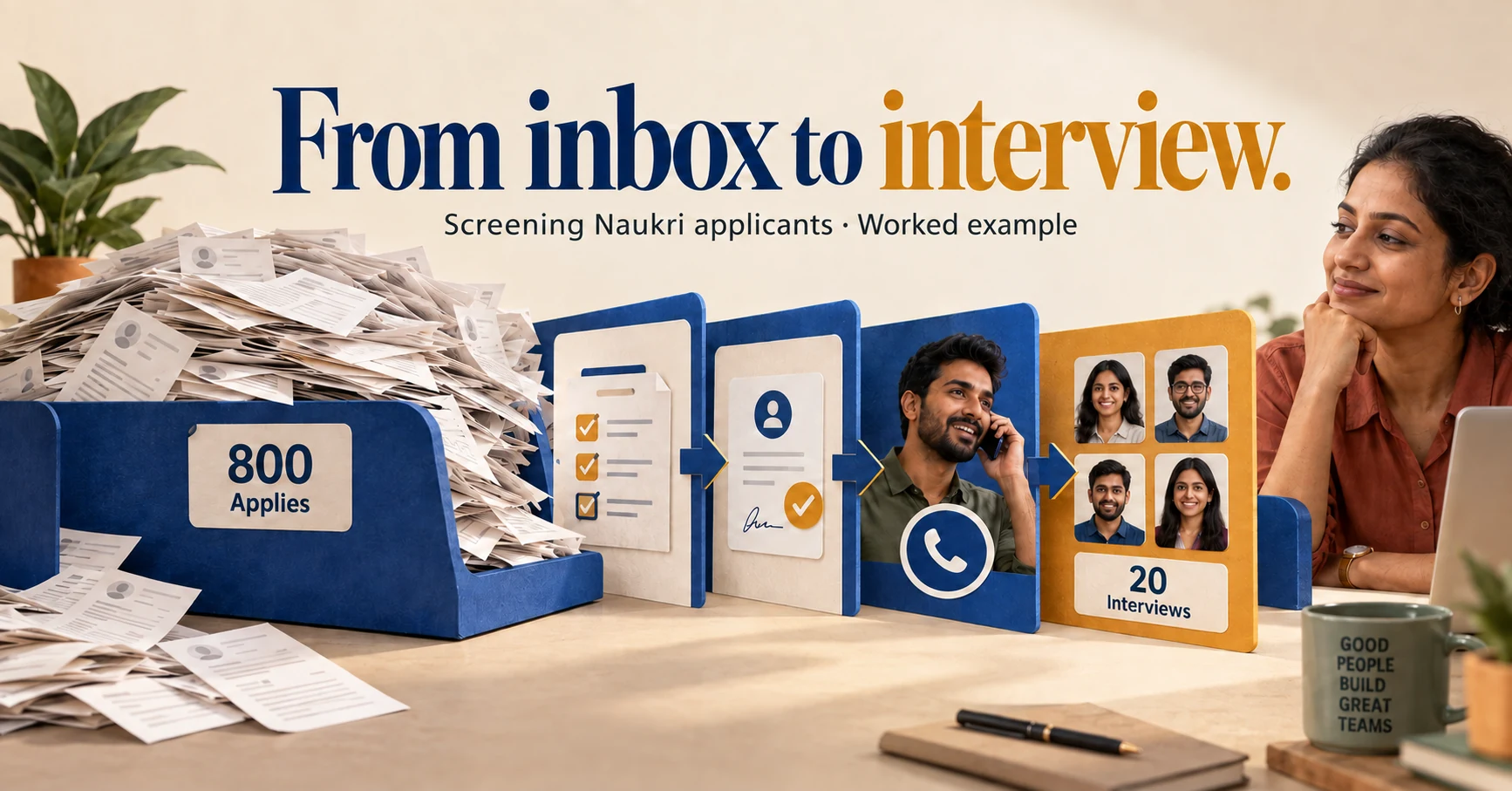
This guide is for the person buying one, not the person about to receive one: what the category does and does not replace, when the phone screen should stay human, and the twelve questions to put to any vendor before you sign. It sits in the one phase of the bulk hiring process that reliably breaks: the step between "we have 800 applications" and "we know who to call back".
What automated phone screening actually is
Strip the marketing and the mechanics are simple. A candidate applies. Hard knockouts you wrote in advance (location, notice period, salary band, shift) remove the people who could never take the job. Everyone left is invited to a call at a time they choose. The software runs the call, scores the answers against a rubric you agreed, and returns a ranked list with the audio and text of every conversation. A person reviews the top of the list and decides who gets a second round.
Two things in that description are yours, not the vendor's: the bar and the decision. The software supplies the hours. That division is the point of the category, and the first thing to test in a demo is whether the vendor respects it. The complication is that three quite different products are sold under the same name.
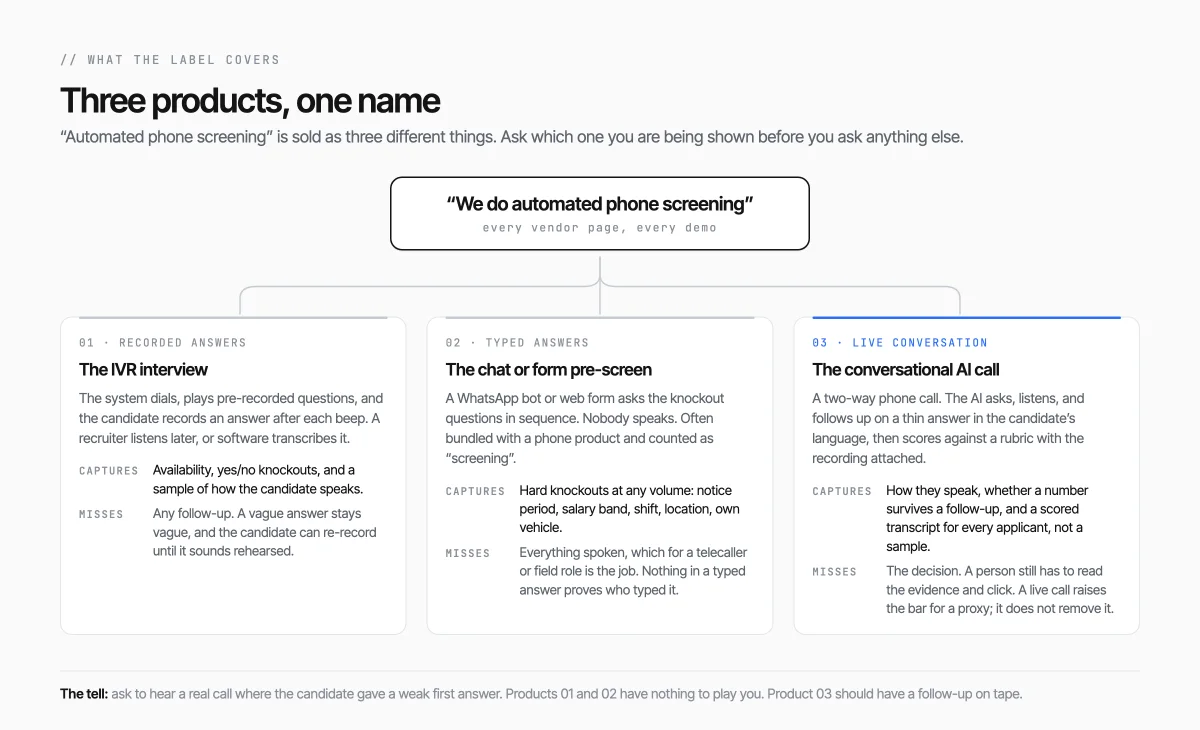
The IVR interview plays a recorded question and the candidate records an answer after the beep. It scales, but it cannot follow up, so a vague answer stays vague and a candidate can re-record until it sounds rehearsed. This is what "automated phone interview" meant for most of the last decade, and some pages ranking for the term still define it that way. The chat or form pre-screen, usually on WhatsApp, is excellent at hard knockouts and useless at anything the job consists of when the job is talking to people; nothing in a typed answer proves who typed it.
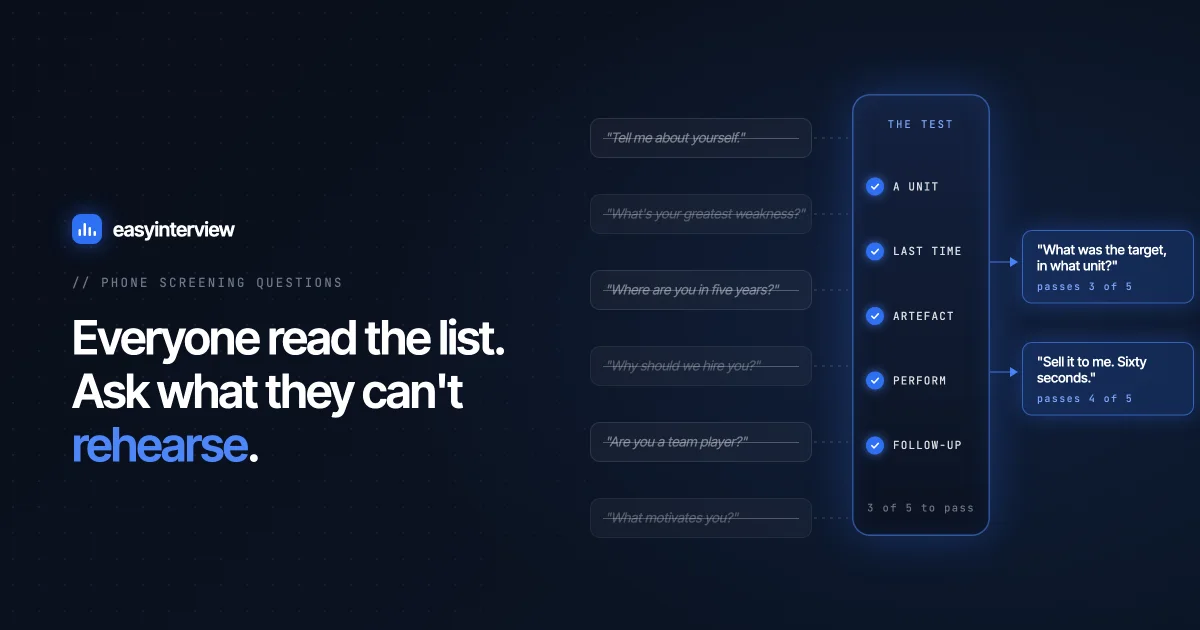
The live conversational AI call is two-way, in the candidate's language, with follow-ups when an answer is thin, scored against a rubric with the recording attached. It is the only one of the three that can stand in for a recruiter's first call, and the rest of this guide assumes it is what you are evaluating. If a vendor cannot say which of the three they are, ask to hear a follow-up on tape.
What it replaces, and what it does not
Be precise about the boundary, because the pitch will be vaguer than this and your team's fears will be larger.
| Automated phone screening replaces | It does not replace |
|---|---|
| Dialling, voicemail and phone-tag | Deciding what a pass looks like: the knockouts and the rubric |
| Asking the same eight questions 400 times | The decline decision on any individual candidate |
| Taking notes during the call and writing them up | The second-round interview, where you sell as much as assess |
| Scheduling back-and-forth | Document and reference checks |
| The first-pass ranking of a large pool | Edge cases: the strong candidate with a hedged answer on notice |
| Screening only the fraction a recruiter can reach | The offer conversation |
The right-hand column is not a list of limitations to apologise for. The tool makes every candidate meet the same bar; a person still decides where the bar sits and what to do with the people near it.
When not to automate the phone screen
Category pages rarely say this. Five situations where the honest advice is to keep the first call human.
Fewer than about fifty applicants a month for the role. A recruiter can call fifty people; the hours saved are small and setup eats most of them. The case gets strong at a few hundred applicants per req, which for a telecaller, field sales or delivery posting in a mid-size Indian city is a normal week.
The first call is really a sales call. For a scarce senior engineer, a specialist doctor or a plant head, the screen exists to convince the candidate, not to filter them. An AI screen tells that candidate exactly the wrong thing about how much you want them.
You cannot write down what a pass looks like. If the team has no knockouts and no rubric it agrees on, the tool will automate the ambiguity. Write the bar first, with the same discipline used to calibrate an interview rubric for an engineering loop: what does a 1, a 3 and a 5 actually sound like.
The gate is a document, not a conversation. A driving licence, a nursing registration, a Class 12 certificate: a call can ask, only a document check can verify. Put that gate before the call.
You do not have consent to call the list. A scraped or bought list does not become legal to dial because software is dialling it. Everyone in the pipeline should have applied to you or agreed to be contacted, and the vendor's consent step should show that.
If none of these apply, the question stops being whether to automate and becomes which vendor.
How to judge one: twelve questions to ask any vendor
This is the instrument. Take it into the demo, ask in order, write down the answers. The middle column is what a serious vendor says without being pushed. The right-hand column should end the meeting.
| # | Ask the vendor | A good answer sounds like | Walk away if |
|---|---|---|---|
| 1 | Where is consent collected before the first call, and how does a candidate stop the calls? | At apply, with the purpose stated, stored against the record. Every message carries a STOP. Uploaded lists go through the same step before anyone is dialled. | "We call whatever list you upload." |
| 2 | Does the candidate know it is an AI before the call? | Yes, in the invite, along with the fact that a person reads the transcript. | "Most of them can't tell." |
| 3 | Which languages does the call run in, and is the scoring done in that language? | A named list, and the candidate is judged on substance in the language they spoke. | "English and Hindi, the rest are coming," or a demo that only exists in English. |
| 4 | What happens when a candidate gives a vague answer? | It asks again, differently, until a specific comes out, and the transcript shows the follow-up. | "It moves to the next question." |
| 5 | Show me a low score and the moment in the call that produced it. What does my recruiter see? | A timestamp and a quote for every rating, plus the recording and full transcript, before anyone is advanced or dropped. | "The model weighs many factors," or a single overall number. |
| 6 | How does it treat a read-out or coached answer? | Flags it for a human to listen to, rather than rewarding fluency. | "Fluent answers score well." |
| 7 | Who declines a candidate, and what does a declined candidate receive? | A person clicks every decline, every rule has an override, and everyone screened gets an outcome message. | "Below the threshold is auto-rejected," or silence for the rejected. |
| 8 | How long are recordings and transcripts kept, where, and who can delete them? | A stated period, a deletion path on request, and a straight answer on where the data lives. | "Indefinitely," or nobody in the room knows. |
| 9 | What happens when 800 people apply on a Tuesday? | Calls run in parallel; the window is set by how many applied, not by seats or agents. | "They queue," or pricing per recruiter licence. |
| 10 | What do you do about someone else taking the call for the candidate? | An honest answer: a live call in real time raises the bar for substitution and does not guarantee against it. | "Our AI detects impersonation." |
| 11 | How does the shortlist reach my ATS or my sheet? | A clear line between what exports today and what is on the integration roadmap. | A named integration you cannot see working in the demo. |
| 12 | What am I paying for: seats, minutes or reports? | One sentence, and a way to pilot on a single role before any commitment. | An annual contract before a pilot. |
Question 5 matters most: a rating that cannot be traced to a moment in the call cannot be audited, and you cannot tell whether the model scores what you care about or how someone sounds. Question 7 decides whether your team stays accountable for its own funnel.
Questions 1, 2 and 8 have a legal floor under them in India. Commercial calls and messages fall under TRAI's Telecom Commercial Communications Customer Preference Regulations, 2018, which turn on consent and the recipient's ability to opt out, and which TRAI tightened again in a February 2025 amendment. Whether a scheduled screening call to someone who applied for your job counts as commercial communication is a question for your counsel, but the vendor should be able to show where consent is recorded and how STOP is honoured. The Digital Personal Data Protection Act, 2023 adds retention: personal data is meant to be erased once its purpose is served, and practitioners disagree on whether the Act's employment exemption stretches to applicants who were never hired. Assume it does not, and get a retention period and a deletion path in writing.
Run a pilot, not a demo
A demo shows you the vendor's best call. A pilot shows you your applicants' average one, and it is the only evaluation that answers the question you actually have: is this shortlist at least as good as the one your team builds by hand.
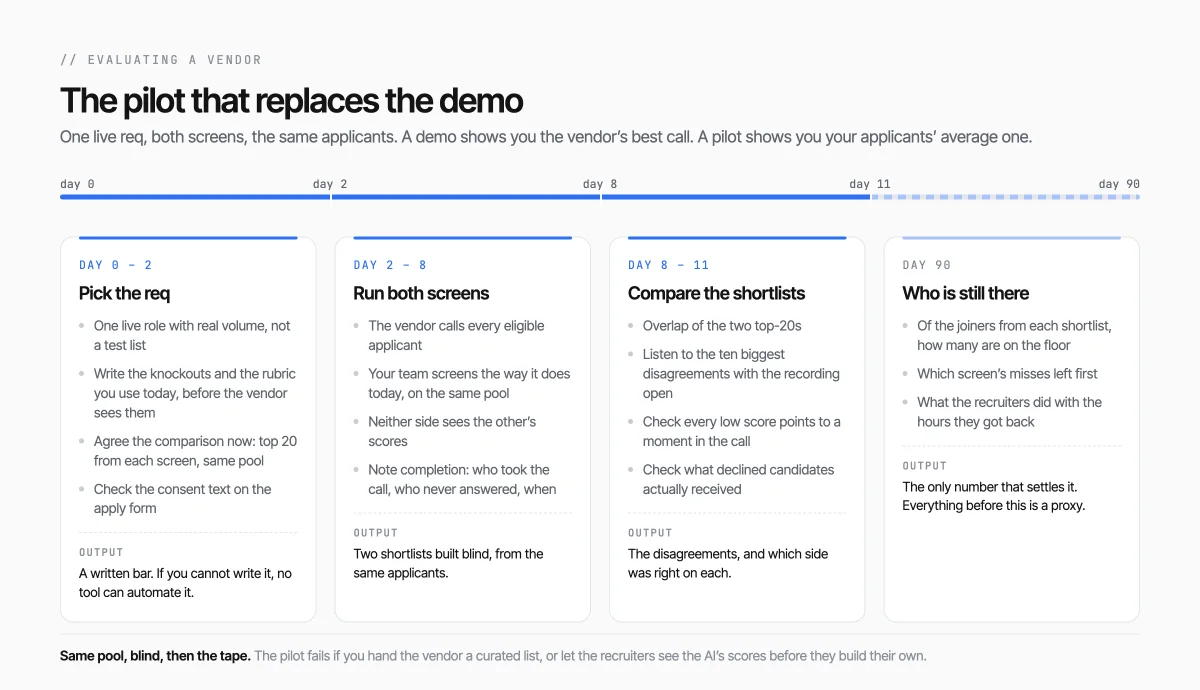
The design matters more than the duration. Use one live req with real volume, not a test list of twenty. Write the knockouts and the rubric before the vendor sees them. Run both screens on the same eligible pool and keep the scores apart until both shortlists exist. Then compare the two top-20s and spend an afternoon on the disagreements with the recordings open: the candidate the AI ranked fourth and your recruiter dropped, the one your recruiter loved and the AI scored 2.9. Each disagreement has a right answer once you listen, and the pattern of who was right is the pilot's result.
Record completion as you go: who answered, who never did, and when. Then wait. The number that settles it arrives at day 90: of the people each shortlist put on the floor, how many are still there.
What the hours are actually worth
The category exists because of arithmetic, so run it for your own req rather than trusting a vendor's multiplier. Take a posting that draws 1,000 applicants, of whom knockouts leave 400 to call. A proper first-pass call is around twelve minutes, but the conversation is only part of the labour: assume two dialling attempts of three minutes for every connected call, and five minutes of notes and handoff afterwards.
Arithmetic from the assumptions stated above, not a benchmark or customer data. The attempts-per-connection and note-taking figures are assumptions; substitute your own.
Around 150 recruiter-hours for one req, and nearly half of it is not the conversation. Dialling and note-taking disappear with any of the three products, however good the AI is; the conversation block only goes to a live screen that passes questions 4 and 5.
In practice nobody spends the 150 hours. The pile gets cut on resumes, or the calls shrink into two-minute availability checks, and the expensive round is spent on people who were never going to take the job. Put your own numbers into the cost-per-hire calculator. The same shape shows up in every volume role; the field sales question bank works through it for territory hiring, where the second round is a market visit and the screen exists to make sure the right twenty people get one.
How EasyInterview approaches automated phone screening
EasyInterview is a live conversational screen, the third product above, built India-first. Here is how it answers the twelve questions, including the one it answers less well.
One branded apply link goes out to LinkedIn, Naukri, Indeed, apna, WhatsApp, foundit, Shine, a careers page or a QR poster, and a CSV of applicants you already hold enters the same pipeline. Consent is collected when the candidate applies and every message carries a STOP opt-out (question 1). The AI is disclosed in every invite, and the candidate picks their own slot over WhatsApp with a one-tap reschedule (question 2).
Knockout rules are yours: location, notice period, salary band, shift availability, shown politely at submit. Every decline is clicked by a human, every rule has an "include anyway" override, and every screened candidate gets an outcome message (question 7).
The call runs in eleven languages, English, Hindi, Bengali, Tamil, Telugu, Kannada, Malayalam, Marathi, Gujarati, Punjabi and Odia, and candidates are judged on substance rather than English. It cross-questions: a vague answer gets follow-ups until the real number comes out, and coached or scripted answers are flagged rather than scored as fluent. Calls run in parallel, so the window is set by applicant volume, not recruiter headcount (questions 3, 4, 6 and 9).
What comes back is a ranked shortlist scored on seven dimensions, Communication, Role knowledge, Experience fit, Problem solving, Availability, Integrity and Language fluency, with every rating pinned to a moment in the call, plus the recording, the transcript and a percentile rank. A person reads the transcript. The sample report shows one scored call end to end, the fastest way to check question 5 yourself.
On question 10, the honest answer is the one in the table: a live call in real time is a higher bar for a proxy than a form, and not a guarantee. On question 11, the scorecard exports today; named ATS integrations are roadmap, not shipped. Pricing is a prepaid wallet billed per connected minute with the scored report included, with no seats or subscriptions; current rates are on the pricing page, and the pricing buyer guide works the cost-per-screened math across the four models this category sells under.
The caveat that belongs in any vendor section: this is a newer product without a public bulk-hiring case study yet. Evaluate it the way the pilot section describes, on one live req alongside your existing screen, comparing the two shortlists and then who is still there at ninety days. The comparison page sets out how it differs from a chat pre-screen, an IVR interview and an outsourced call centre.
Frequently asked questions
What is an automated phone screening?
From the employer's side, a first-round screening call run by software rather than a recruiter: the system phones each eligible applicant, asks the screening questions, scores the answers against a rubric and returns a ranked list with the recording and transcript. The employer still writes the knockouts and the rubric and still makes the decline decisions. The term covers three products, from recorded-answer IVR to live conversational AI, so ask which one you are being shown.
Is an AI phone interview the same thing as automated phone screening?
Mostly. "AI phone interview" and "AI phone screening" usually mean the live conversational version, where the AI asks follow-ups in real time. "Automated phone interview" is older and often still means a recorded-answer IVR. The useful distinction is whether the call can follow up on a weak answer, and whether every score is traceable to a moment in the recording. In India the same round is usually called a telephonic interview, and what that round should test — regardless of who or what makes the call — is covered in the AI telephonic interview guide.
Is automated phone screening legal in India?
Calling and messaging sit under TRAI's TCCCPR 2018 framework, built on consent and an opt-out, and candidate data sits under the Digital Personal Data Protection Act, 2023. A pipeline where candidates apply to you, consent to be contacted, receive a disclosed and scheduled call, and can send STOP at any time is designed around those rules. Confirm the specifics with your counsel.
Does the AI reject candidates?
It should not, and you should not buy one that does. Knockouts are rules you wrote, shown at submit; the call produces a ranked, evidence-backed list; a person clicks every decline. Auto-rejection below a score threshold is the fastest way to lose good candidates you never heard.
Keep the bar, buy the hours
Automated phone screening is worth buying when it lets every eligible applicant meet the same bar, in their own language, while your team keeps the judgment about where that bar sits and who clears it. The twelve questions tell you within an hour whether a vendor understands that division. The pilot tells you within two weeks whether the product does.
Book a demo to put the twelve questions to EasyInterview, and to run the pilot on one live req.
Rohit Pandit
Founder, EasyInterview · easyinterview.life
I build EasyInterview, an AI hiring pipeline for high-volume roles in India. These are field notes on screening at volume, hiring signal, and interview integrity, written from the work rather than from a keyword list.
Connect on LinkedIn