Proxy Interview Calls: How to Detect and Stop Them Fairly
Proxy interview calls, explained for employers: the five varieties, the signals you can hear, what each one innocently means, and a staged verification plan.
A proxy interview call is a screening or interview call where the person you are assessing is not the person doing the answering: a stand-in takes the whole call, or the real candidate speaks while someone, or something, off-screen supplies the words. Every article about proxy interview calls lists the red flags. Almost none of them mentions that a nervous candidate on a 4G phone in a shared PG room produces most of the same flags, and that is the version of this problem that actually costs Indian employers money: not the proxy who gets through, but the honest applicant declined on a hunch.
Proxy interview meaning: five varieties, not one
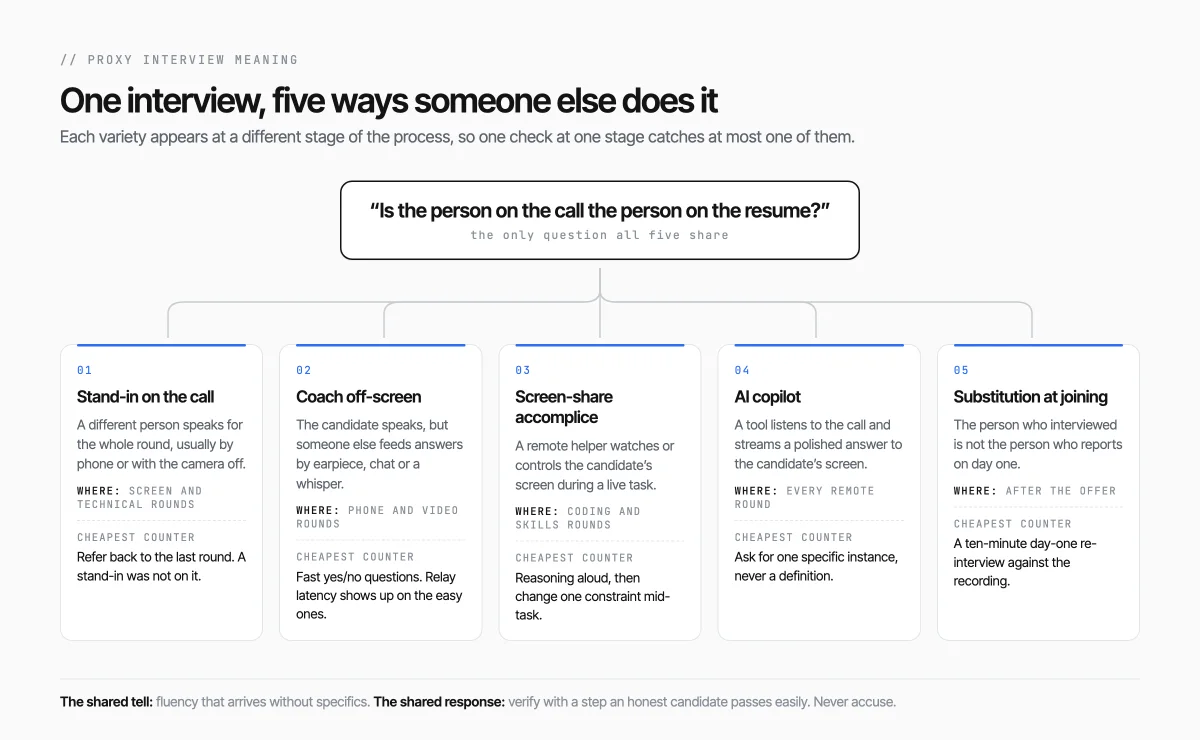
In Indian hiring, "proxy" means someone else doing the interview. It has nothing to do with the network proxies a Skype or Teams client connects through, which is why a search for the term returns VPN tutorials next to fraud warnings. It covers five arrangements: a stand-in who takes the whole call; a coach feeding answers off-screen by earpiece, chat or whisper; a helper watching or controlling a shared screen during a live task; an AI copilot that transcribes the call and streams a fluent answer to the candidate's screen; and full substitution at joining, where the person who reports on day one is not the person who interviewed. They fail at different stages, so one check at one stage catches at most one of them.
The mix depends on the role. In IT services, the stand-in and the screen-share helper are the paid-service cases: an "interview support" business clears the round for a fee and sometimes keeps doing the job after joining. In BPO, telecalling and field sales, the proxy is usually a cousin, a friend or a placement agent with better English than the applicant, and the motive is language rather than skill.
Why proxy interview calls are growing
Remote and telephonic rounds. A proxy has to disappear before onboarding, and that used to be a real constraint: the person who cleared the walk-in was the person in front of you. A phone or video round removes it.
An open market. At the time of writing, a vendor in Ahmedabad openly lists "IT interview proxy services" on IndiaMART at ₹5,000 an hour, rising to ₹18,000 by profile, and "job support" offers on Telegram and LinkedIn mean exactly what they say. When a service has a rate card, it has customers.
Interview copilots. The newest variety needs no accomplice: tools that listen to a call and stream a polished answer to the candidate's screen are advertised on the same results page as the jobs. The candidate speaks in their own voice; the words are not theirs.
How common is it? Most "X% of candidates are fake" figures come from vendors selling proctoring. The one independent number worth citing is a Gartner survey of about 3,000 job candidates in 2025, in which 6% admitted to interview fraud, defined as posing as someone else or having someone pose as them (HR Dive, August 2025). There is no good public number for India. The cost that matters is the bad hire, and for a frontline role you can put a number on that before deciding how much verification is worth.
How to detect proxy candidates on a call: the signals table
Everything below can be done by a human interviewer with no software, on a phone call, in the language the job requires. The middle column is the one competitor guides leave out, and it is what stops you declining good people.
| What you observed | Innocent explanation | What to do next |
|---|---|---|
| A steady pause before every answer, including trivially easy ones | Network lag; translating from their mother tongue; nerves | Three fast yes/no questions. Relay latency survives easy questions; lag and nerves affect everything equally or fade. |
| Fluent but generically structured answers: definitions, textbook order, no first person | A prep course; a fresher who memorised; over-preparation | Ask for one instance: "The last time you did this, what went wrong?" Coaching and copilots stall on the specific. |
| Fluent on concepts, blank on their own resume: dates, team size, manager's name | An old project; an NDA; a career gap; a CV written by a consultancy | Ask them to reproduce one claim in a different form: in sequence, or explained to a layperson. Verify the resume at offer, not on the call. |
| Keyboard clicks after each question; a second voice; whispering; muting before answering | A shared PG or family room; a call-centre background; a cheap headset; a child | "No problem, let's continue with the mic open." Note it. Do not accuse. |
| Eyes tracking left to right while answering; lips out of sync on video | Reading their own notes, which is legitimate; low-bandwidth desync | Ask them to close other windows, or move to phone-only for three minutes. Same question, continued. |
| Reluctance to switch to Hindi or the local language, or to leave the expected script | Nervous in a second language; their comfortable language is not one you offered | Offer the switch as a kindness. Honest candidates relax. A stand-in hired for their English will not take it. |
| Voice or manner does not match the previous round | A different device; a cold; a different room; a different interviewer on your side last time | Refer back: "Last time you mentioned…". A stand-in was not on the last round. |
| Name, phone, email and LinkedIn photo do not map to one person | Common names; a family phone; a shared email; an old photo | Verify against ID at offer. It is not a call-stage question. |
The rule that goes with the table: one signal is noise. Two independent signals from different rows earn a verification step, never a rejection. Only a failed verification is a conclusion.
How to stop proxy interviews: countermeasures ranked by friction
Cheapest for you and least intrusive for honest candidates first. Notice how far down the expensive tools sit.
| Countermeasure | Your cost / their friction | Catches | Misses |
|---|---|---|---|
| 1. Ask plainly at the start: "Are you alone? Using any tool? This call is recorded." | None / none | Nothing alone; an honest deterrent that makes later action defensible | Anyone willing to lie |
| 2. Follow every claim two levels down | None / none; it is a better interview | Coaching and copilots, through latency and generic structure | A stand-in who did the work themselves |
| 3. Live tasks over recall: role-play the sale, walk through the ticket, reason aloud | Low / low | Copilots; screen-share helpers, once reasoning aloud is required | A stand-in who has the skill |
| 4. Continuity between rounds: same interviewer or shared notes, so round two refers to round one | Low / none | Stand-ins swapped between rounds | A stand-in used consistently |
| 5. Change the medium mid-process: phone to video, video to phone for three minutes, a short video moment before offer | Low / medium unannounced, low if disclosed in the invite | Screen-share accomplices, copilots, off-screen coaches | A stand-in who is also the joiner |
| 6. ID check at offer, face on ID against the video from round two | Medium / medium, and expected here | Identity substitution before payroll | Coaching, irrelevant by then |
| 7. Day-one re-interview: ten minutes with someone who heard the rounds, two questions from the recording | Low / low; they have joined | Substitution at joining | Nothing that matters after this point |
| 8. Proctoring and monitoring software | High / high; false positives on eye movement, second screens, bandwidth | Copilots on the monitored screen | A phone in the lap; a second device; and it penalises honest candidates in bad conditions |
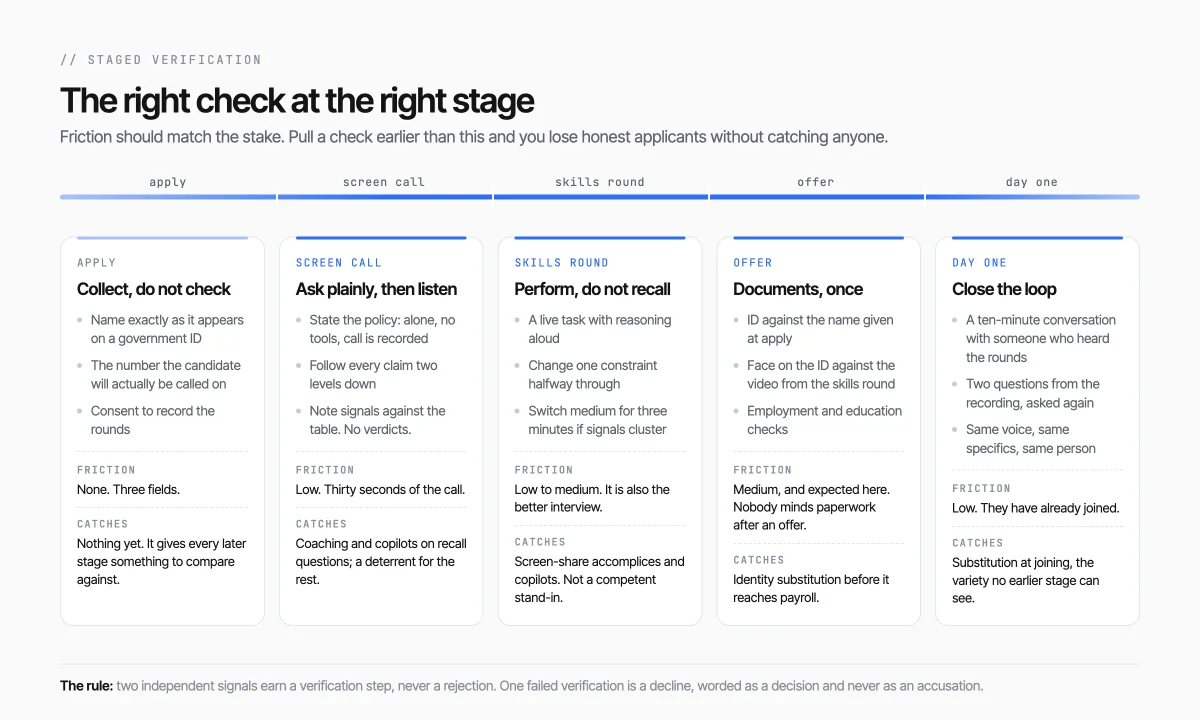
The order is the instrument. Rows 1 to 4 cost nothing and improve the interview regardless, so they belong in every call. Rows 5 to 7 are proportionate because they land where the stake justifies the friction. Row 8 is what most vendors sell, and it should be the last thing you buy, not the first. Above all, do not pull the ID check forward to the application form: it costs you honest applicants and catches nobody, because the proxy is not at the application stage.
Suspicion is not evidence: the fairness rules
This section matters more than the detection section, because this is where the money is actually lost.
A false accusation is expensive. You lose a candidate who was probably good: the signals that trigger suspicion cluster among people who are nervous, remote or working in their second language, which describes your best frontline applicants rather than your worst. They tell people, on AmbitionBox and in the WhatsApp groups your next applicants sit in. A written accusation of fraud you cannot prove is a defamation risk.
Connectivity and nervousness look exactly like guilt. Latency, muting, looking away from the camera, a long pause before a simple answer: every one is on the proxy checklist, and every one is what a 22-year-old on a shared hostel connection does in their first phone interview.
Accented or non-native English is not evidence. A Tamil speaker pausing in English is translating, not waiting for a relay. If you run the screen only in English for a job done in Hindi or Kannada, you are manufacturing the very signal you then treat as suspicious, and doing it disproportionately to the candidates the role most needs. Interview in the language the job is done in, and offer the switch.
Preparation and difference are not evidence either. A fresher who practised sounds scripted because they are, by themselves; a second-level follow-up settles it in one question. Processing time, eye contact, a flat affect, a stammer: none of these belong near a fraud judgment.
So, the rule for when you suspect and are not certain:
- Never say the word. Not "proxy", not "someone helping you", not on the call and not in writing.
- Add a step, not a verdict. A second call from a different interviewer, a three-minute video moment, an in-person round: something an honest candidate passes without noticing.
- Two people before a decline on identity grounds. One interviewer's hunch is not a decision.
- Record the reason as "could not verify", never as "fraud". The first is true. The second you cannot prove.
- The outcome message states the decision, not the suspicion. "We are not moving forward" is a complete sentence.
Proxy interviews at volume: what changes in bulk hiring
Everything above assumes an interviewer with attention to spare. In bulk hiring for BPO, telecalling, delivery or field sales, that is the first thing to go, and it is a specific failure of the bulk hiring process: screening gets less attention per candidate exactly when substitution gets easier. The proxy here is a relative, not a service: a brother with better English, or a placement agent who clears the call for three candidates in an afternoon. The substitution happens at the screen and surfaces later, as a puzzlingly high rejection rate at the face-to-face round or as first-month attrition.
The fix is mostly the language of the screen. If the job is done in Hindi and the screen is in English, you created the proxy market yourself. Screen in the language the job is done in, record the call so day one has something to compare against, and make the day-one re-interview a standard ten minutes for everyone rather than an accusation for some. None of it costs more per candidate at volume, and it slots into a telecaller rubric you already run.
How EasyInterview fits, and where it does not
EasyInterview runs the first-round phone screen as a live AI call, which changes the proxy problem in specific and limited ways.
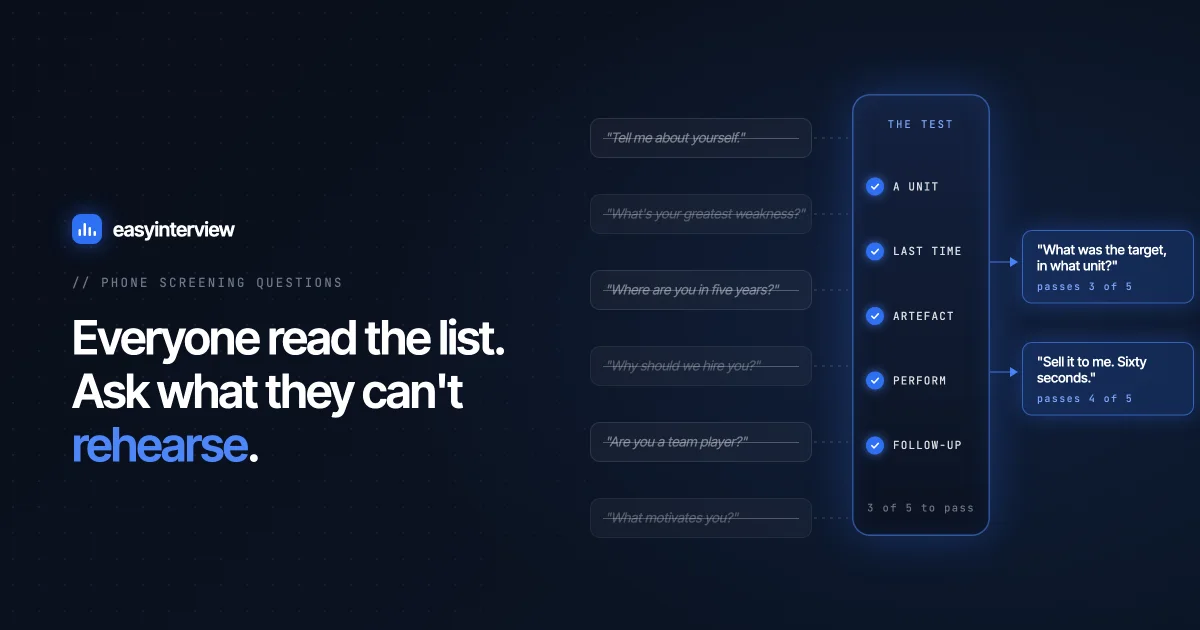
A live call is a higher bar than a form. Nothing about a typed answer on a pre-screen form proves who typed it. A live phone conversation, where the questions are not known in advance and each follow-up depends on the previous answer, is a meaningfully harder thing to hand to someone else or route through a copilot. It is not a guarantee: a competent stand-in who takes the call themselves can pass a live AI phone screen, the same way they can pass a human one. EasyInterview does not reliably detect impersonation, and neither does anything else on a phone line.
The call runs in the candidate's language, across eleven: English, Hindi, Bengali, Tamil, Telugu, Kannada, Malayalam, Marathi, Gujarati, Punjabi and Odia. For BPO and field roles this removes the main motive for a proxy, which is English. The call cross-questions rather than reading a script: it probes vague answers with follow-ups until the specific comes out, and flags coached or scripted answers rather than scoring them as fluent. That is countermeasure two applied to every candidate: a coaching and copilot countermeasure, not an identity check.
Every call produces a recording, a transcript and a score on seven dimensions (Communication, Role knowledge, Experience fit, Problem solving, Availability, Integrity and Language fluency), each rating pinned to the moment in the call that earned it. For this article the recording matters more than the score: it is what your day-one re-interview compares against. Integrity here is a judgment about the consistency of what the candidate said, not a claim about who was speaking.
A person stays in the loop. Every invite discloses that the interviewer is an AI and that a person reads the transcript; every decline is clicked by a human, every knockout rule has an "include anyway" override, and every screened candidate receives an outcome message. Consent is collected at apply and every message carries a STOP opt-out.
The caveat: EasyInterview is a newer product with no public bulk-hiring case study yet. Evaluate it with a pilot on one live req run alongside your existing screen, comparing the two shortlists and then who is still there at ninety days. The sample report shows one recorded, scored call, and the comparison page sets it against form pre-screens and outsourced call centres.
Frequently asked questions
How do I manage a Skype or video interview if I suspect a proxy?
Do not confront. Ask three quick yes/no questions to test for relay latency, ask for one specific instance instead of a definition, offer a switch to the candidate's comfortable language, and move to phone-only for a few minutes if audio and video are out of sync. If two independent signals remain, add a verification step rather than a decision.
Is a proxy interview illegal in India?
Pretending to be another person to obtain something is cheating by personation under Section 319 of the Bharatiya Nyaya Sanhita, 2023, punishable by up to five years, a fine, or both. Whether a specific arrangement meets that bar depends on the facts, and employers rarely pursue it. Your practical risk runs the other way: a defamation claim if you accuse someone in writing without proof.
Can AI detect proxy interviews?
Not reliably, and be wary of anyone who says otherwise. AI can run a live, cross-questioning call for every candidate instead of a form, flag coached or scripted answers, and leave a recording that a person compares against whoever turns up on day one. A competent stand-in who takes the call themselves can still pass. Identity is confirmed by documents and by people, at offer and joining.
How do I stop proxy interviews in bulk hiring?
Screen in the language the job is done in, which removes the main motive. Make the screen a live conversation with two-level follow-ups rather than a form, and record it. Check ID once, at offer. Then run a standard ten-minute day-one re-interview for every joiner against the recording. None of these costs more per candidate at 1,000 applicants than at 10.
Verify like a professional, not a detective
The proxy problem is real, it is growing, and it is far more expensive to over-react to than to under-react to. Learn the signals; learn the innocent explanations next to them better. Put the checks where the stakes are, and let a failed verification, never a hunch, be the thing that ends a candidacy.
Book a demo to see EasyInterview run a live, recorded, cross-questioning phone screen on one of your open roles, in the language the job is actually done in.
Rohit Pandit
Founder, EasyInterview · easyinterview.life
I build EasyInterview, an AI hiring pipeline for high-volume roles in India. These are field notes on screening at volume, hiring signal, and interview integrity, written from the work rather than from a keyword list.
Connect on LinkedIn