Karat Alternatives: AI vs Human-Run Technical Screens
Karat alternatives compared: how a live AI technical screen stacks up against Karat's human Interview Engineers on cost, speed, cheat-resistance, and evidence.
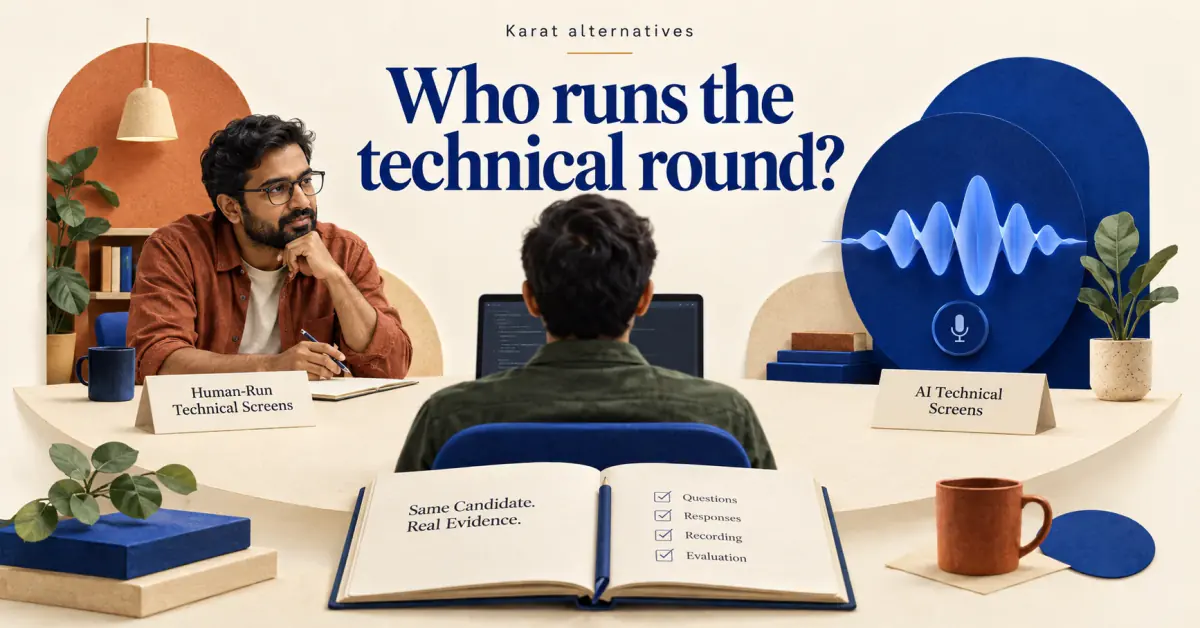
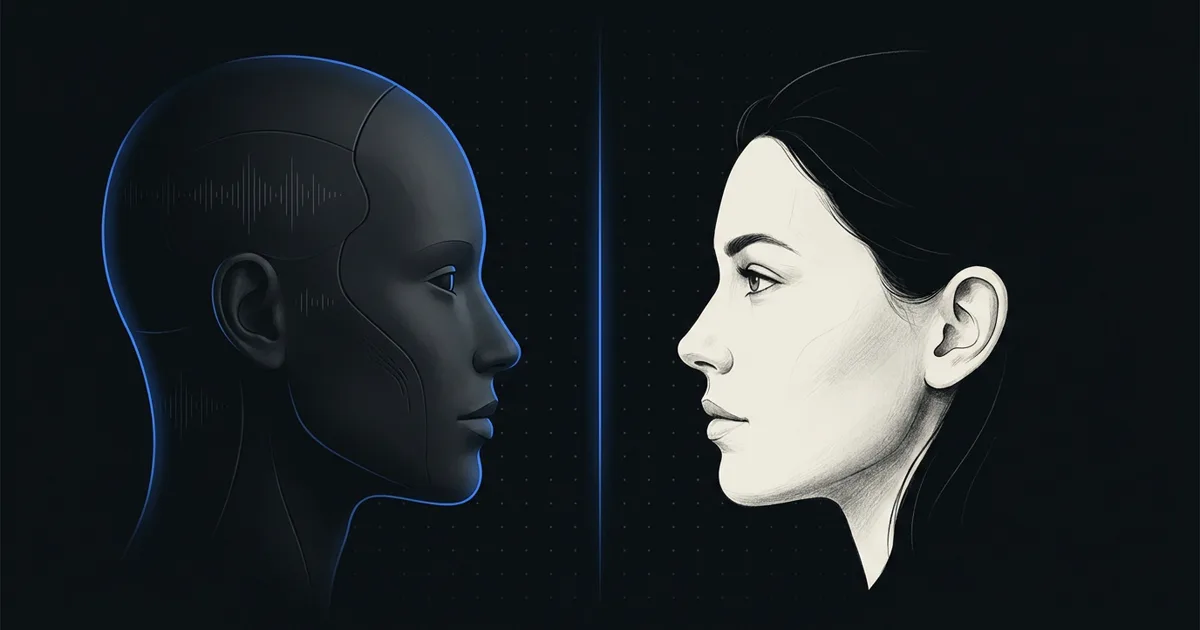
If you are looking for a Karat alternative — or comparing EasyInterview vs Karat directly — both products replace a weak first technical screen with a rigorous, calibrated, recorded round. The decisive difference is who conducts it: Karat sends a human Interview Engineer, while EasyInterview uses a live AI voice interviewer. EasyInterview brings the cost down to a flat per-round price, a fraction of a human-delivered screen, and returns a verdict in minutes instead of leaving the hiring team to review playback, often a day later.
TL;DR
- Choose Karat when you want a proven, human-run interview service, broad programming-language coverage, strong candidate support, and a benchmark built from more than 600,000 interviews.
- Choose EasyInterview when you want live, adaptive technical screening for engineering roles at any volume without paying a human interviewer for every session, with an AI phone screen in front of it that reaches every applicant in their language.
- Karat typically costs $200-450 per interview. EasyInterview charges a flat published price per round — a fraction of that; see the pricing page.
- Both approaches resist cheating through live follow-ups. Karat relies on a trained human; EasyInterview combines adaptive voice questioning with an integrity monitor and evidence-linked scoring.
How each one runs the first technical screen
Karat is a technical-interview-as-a-service provider. A trained human Interview Engineer, or IVE, runs a live session in Karat's recorded video and coding environment. The roughly 60-minute interview combines an introduction, discussion questions, and programming in a fully tooled IDE. Karat supports more than 100 languages and frameworks, and the IVE applies a standardized rubric calibrated with the hiring company.
That human layer is the center of the Karat model. The interviewer can clarify instructions, observe how the candidate writes code, probe an answer, and support a candidate who gets stuck or nervous. Every session is recorded. The hiring team's engineers typically review the playback asynchronously, commonly the next day, before making a decision.
EasyInterview moves that same live-interview principle into a browser-native AI voice session. The candidate opens a single-use link on their own schedule, with no install and no interviewer coordination. Over 45-60 minutes, they complete a coding round in a live editor or a system design round on a shared whiteboard. They reason aloud while the interviewer cross-questions trade-offs, complexity, and edge cases.
The technical round is also the deeper stage of a wider pipeline. Before a candidate reaches it, EasyInterview circulates the job through one branded apply link, sorts applicants with the knockout rules the team writes, and AI phone-interviews every eligible applicant in their language, then ranks them on evidence-scored fit. Teams can send the technical round on its own or reserve it for candidates who cleared the phone screen. Karat starts at the technical interview and does not offer that earlier stage.
Both products calibrate to the employer's bar. Karat standardizes delivery through trained IVEs and its interview library. EasyInterview calibrates the scoring to the hiring team's rubric, then returns a hire or no-hire recommendation with the evidence behind it. The goal is not to guarantee that every candidate who passes will clear the final panel. It is to make the first-screen bar reflect the panel's expectations closely enough to spend engineer time on better-qualified candidates.
EasyInterview vs Karat at a glance
| Area | EasyInterview | Karat |
|---|---|---|
| Interviewer | Live AI voice interviewer | Trained human Interview Engineer |
| Format & length | Browser-native coding or system design; 45-60 minutes | Recorded video, discussion, and programming; about 60 minutes |
| Before the technical round | Apply link, knockout rules, and an AI phone interview of every eligible applicant in 11 languages | Not offered; the engagement starts at the technical interview |
| Speed to verdict | Evidence-scored verdict in minutes | Team typically reviews playback asynchronously, often a day later |
| Price per screen | Flat published price per round | Typically $200-450 on a custom quote |
| Anti-cheat approach | Adaptive follow-ups plus paste, lookup, and tool-use flags | Live human observation, follow-ups, and session-behavior analysis |
| Scoring & evidence | Per-question deductions, transcript quotes, optimal answers, recording, confidence score | Standardized rubric, recording, and human scoring |
| Customization to your stack | Calibrated to your rubric and bar | Calibrated rubric; questions come from Karat's library |
| Track record / benchmark | Newer product; no public outcome benchmark yet | 600,000+ historical interviews; 98.8% recommendation consistency |
| ATS handoff | ATS-ready scorecard export today; named integrations on roadmap | Results delivered to your hiring team; ATS specifics not public |
Cost and speed: where the gap is widest
Karat's pricing reflects a real person delivering each interview. It has no public price list, but typical custom pricing runs from $200 to $450 per interview depending on volume, contract term, and tier. A mid-size company conducting 500-1,000 interviews a year commonly spends $150,000-$350,000 all-in.
EasyInterview prices each technical round flat, paid from a prepaid wallet the whole team shares, with no seats, no subscriptions, and no custom quote. The phone screen in front of it bills per connected minute with the scored report included, and calls under 30 seconds are free. Current prices are on the pricing page.
At 500 screens a year, Karat's per-screen range works out to about $100,000-$225,000, while the same volume at EasyInterview's flat per-round prices comes to a small fraction of that — the cost-per-hire calculator lets you run the exact numbers for your round mix. The budget difference is large enough to change where a team can use a live screen. Karat may be reserved for selected roles; EasyInterview can sit earlier in the funnel without turning every additional candidate into a large variable cost, and the phone screen ahead of it can reach the whole applicant pile rather than a hand-picked slice.
The speed difference matters beyond recruiter convenience. Karat offers 24/7 scheduling, which is flexible for candidates, but a live human still has to join. The hiring team then commonly reviews the recording asynchronously. EasyInterview lets the candidate use a self-serve link on their own schedule and produces an evidence-scored verdict minutes after completion. Recruiters can move a strong candidate forward while the process is still active rather than waiting for the next playback-review window.
Fast does not have to mean opaque. EasyInterview attaches every score to a transcript quote, a specific deduction, and the expected answer. The report also includes a question-chaptered recording and a confidence score. Teams can see a sample scorecard before deciding whether that evidence is detailed enough for their hiring committee. This traceability can also support NYC Local Law 144 or EU AI Act-style audit work, though it should not be treated as a promise of legal compliance.
Cheat resistance in the AI era
Karat's live human interviewer is a strong integrity control. An experienced IVE can watch code develop, ask why a candidate chose an approach, and change the follow-up when an answer feels memorized or externally supplied. Karat also uses session-behavior analysis. For hiring teams that trust human observation most, this is a sound reason to accept the higher cost.
Karat has also adapted its philosophy to AI-assisted engineering. Its NextGen format, launched in December 2025, lets candidates work with an AI assistant and evaluates whether they can direct it, inspect its output, and explain the result under pressure. That is a thoughtful test of AI-native engineering rather than a test of recall alone.
EasyInterview automates the probing layer instead of removing it. The interview is live, conversational, and adaptive. Candidates must reason aloud, defend complexity choices, handle edge cases, and respond when the interviewer challenges a trade-off. That makes a hidden-answer tool much less useful: producing a plausible answer is not enough when the candidate must explain and extend it in real time. An integrity monitor separately flags paste, lookup, and tool-assisted answers.
The distinction is philosophical as much as technical. Karat puts a trained person in the loop and can test productive AI use through NextGen. EasyInterview uses consistent adaptive questioning and observable session signals to make the same kind of defense-of-reasoning available at screening-scale economics. Neither is a substitute for a real work sample or final panel, but both are materially stronger than an unattended quiz.
Where Karat is the better choice
Karat fits large enterprises that want a mature human-run service. Its customer list includes Mastercard, Duolingo, Electronic Arts, Citizens Bank, Compass, Deliveroo, and Flatiron Health. Its 600,000-plus historical interview benchmark gives buyers external proof that a newer product cannot match.
The human model also provides maximum candidate hand-holding. Candidates get a professional interviewer, 24/7 scheduling, and the option to request a redo within 24 hours when the first attempt did not represent them. Karat is also known for candidate empathy and its Brilliant Black Minds program.
Choose Karat if broad stack coverage is essential, a trained human must be present, or an established benchmark and enterprise references outweigh unit economics. It is also the clearer choice when the NextGen human-led, AI-integrated format matches what your engineers now do. The tradeoff is that you are paying for human delivery and accepting a slower review loop and more limited freedom to tailor questions beyond Karat's library.
Where EasyInterview is the better alternative to Karat
EasyInterview is an AI hiring pipeline for high-volume hiring, and for engineering roles it adds a live technical round as the deeper stage. That round keeps the depth of a senior-level interview whatever the volume, and it is not a quiz optimized for trivia. Coding candidates work in a live editor and explain their reasoning; system design candidates use a shared whiteboard and defend architectural decisions under adaptive follow-ups.
Recruiters can send one link without finding an interviewer or coordinating a calendar. Every candidate gets the same calibrated process, and the hiring team receives a decision-ready scorecard in minutes. Per-question deductions, transcript evidence, optimal-answer context, and the recording let an engineer inspect the recommendation without replaying the full session. When the round runs after the phone screen, candidates arrive already interviewed in their language and percentile-ranked within the job, so engineers review the top of the ranking rather than the whole pile.
That makes EasyInterview a practical option when the team wants to preserve live rigor but cannot justify $200-450 for every first screen. It also fits teams that want their own rubric and bar to drive the result. The scorecard exports as an ATS-ready file today, with named ATS integrations on the roadmap; Greenhouse, Lever, or Ashby should not be assumed to be live integrations yet.
EasyInterview does not have Karat's public customer roster, historical benchmark, or years of human-delivered interviews. The sensible buying motion is therefore a low-commitment pilot on one role. Calibrate the rubric, run a defined set of candidates, compare the evidence with your panel's judgment, and decide whether the signal is strong enough before expanding.
Frequently asked questions
Is EasyInterview a Karat alternative?
Yes for teams that want a live technical screen without paying a human interviewer for every candidate, at any hiring volume. EasyInterview also covers the stage before it, circulating the job and AI phone-interviewing every eligible applicant in their language, which Karat does not offer. Karat remains stronger when enterprise references, human-delivered interviews, and a large historical benchmark are the buying criteria.
Is the interviewer a human or AI?
Karat uses trained human interviewers. EasyInterview uses a live AI interviewer that probes coding or system design in a browser-native session and returns an evidence-linked scorecard. Every invite discloses that the interviewer is an AI and that a person reads the transcript.
How do costs compare?
Human technical screens often land around $200–$450 per round. EasyInterview charges a flat published price per round — a fraction of that; see the pricing page. Karat is a premium managed service; expect enterprise-style pricing rather than public per-screen prices.
Can EasyInterview match Karat's language or stack breadth?
Not on programming stacks. Karat's human interviewer network covers more than 100 languages and frameworks, while EasyInterview's technical round covers coding and system design calibrated to your rubric, for engineering roles at any volume. On spoken language the picture flips: EasyInterview's AI phone screen interviews applicants in 11 languages, Hindi, English, and nine more Indian languages, and Karat has no equivalent stage.
How should we evaluate EasyInterview vs Karat?
Run a one-role pilot. Use the same rubric as your panel, compare recommendations and evidence with interviewer judgment, and expand only after alignment — not after a single marketing demo.
The bottom line
Karat and EasyInterview both treat the first technical screen as a live evaluation of reasoning, not a quiz. Karat is the premium human service with enterprise proof, wide programming-language coverage, and high-touch candidate care. EasyInterview is the lower-cost, faster option for teams that want adaptive probing, explainable evidence, and calibration to their own engineering bar, with a phone screen in front of the technical round that reaches every applicant in their language. If you are surveying the wider AI-interviewer field, Apriora alternatives and HeyMilo alternatives cover the conversational screeners, and the vendor comparison page puts everything side by side.
If that tradeoff matches your hiring process, Book a demo and start with a pilot on one role.
Rohit Pandit
Founder, EasyInterview · easyinterview.life
I build EasyInterview, an AI hiring pipeline for high-volume roles in India. These are field notes on screening at volume, hiring signal, and interview integrity, written from the work rather than from a keyword list.
Connect on LinkedIn