Asendia Alternatives: Coding Screen or Voice Screen
Asendia AI alternatives compared: employer-run AI hiring pipeline with phone screens and live coding rounds versus Asendia's agency-focused AI voice recruiter.
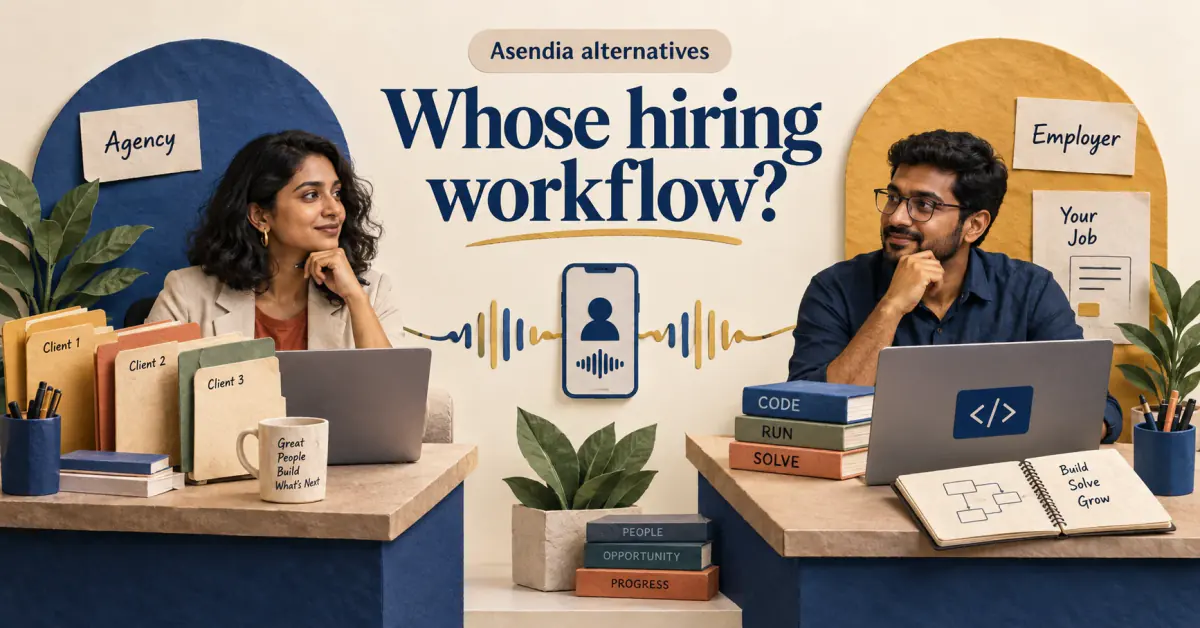
If you are looking for an Asendia alternative, or comparing EasyInterview vs Asendia, the short verdict is this: both screen candidates by AI voice call at volume. Asendia is built for staffing agencies, with sourcing, outreach, and ATS write-back. EasyInterview is an employer-run pipeline that circulates your own job, screens whoever applies, and adds a live technical round for engineers. What that voice round should test, whoever runs it, is set out in the AI telephonic interview guide.
The old way to tell them apart was what the candidate does: talks in an Asendia screen, builds in an EasyInterview screen. That is no longer the whole picture. In an EasyInterview phone screen the candidate also talks, to an AI interviewer in Hindi, English, or nine other Indian languages. The engineering round, where the candidate writes and runs code in a real editor or diagrams a system on a whiteboard, sits on top of that pipeline rather than being the whole product.
A disambiguation up front: this is about Asendia AI, the YC-backed AI recruiting startup at asendia.ai — not Asendia the international mail and parcel logistics company at asendia.com, which is unrelated.
TL;DR
- Asendia AI clones a staffing agency's best recruiters into AI agents. Its AI, "Sarah," places automated voice phone screens and follows up across SMS, WhatsApp, and email, then writes structured notes back to the ATS.
- Asendia is built for staffing agencies in high-turnover verticals such as healthcare, IT staffing, and light industrial. Its buyer is the agency recruiter, and its modules (a candidate database, outbound outreach, ATS sync) are shaped around the agency motion.
- EasyInterview is the AI hiring pipeline for high-volume hiring, run by the employer: one branded apply link circulated everywhere, deterministic knockout rules, an AI phone interview in the candidate's language, and a percentile-ranked shortlist with every score pinned to a quoted moment in the call.
- For engineering roles, EasyInterview adds what a voice screen cannot: a live coding round in a real editor, a system design whiteboard, integrity flags, and evidence-linked scoring. Asendia has no code editor, IDE, whiteboard, or run-code capability, and no stated anti-cheat.
- Asendia does not publish pricing. EasyInterview does.
What each product actually is
Asendia AI is a recruiting-automation platform aimed at staffing agencies. Its pitch is "don't replace your recruiters, clone your best ones": it turns an agency's top recruiters into AI agents that source from a large candidate database, reach out across voice, SMS, WhatsApp, and email, run multilingual conversational screens by phone, score candidates for compatibility, and sync notes into 50-plus ATS systems. The flagship is the AI voice agent that calls candidates and conducts a preliminary screen the way a human recruiter would — qualifying for interest, experience, and availability — and then hands a ready-to-hire shortlist to the agency. It is an end-to-end automation of the agency screening motion, and it is genuinely broad within that motion.
EasyInterview is a hiring pipeline that an employer runs on its own job. You publish once and share one branded apply link on LinkedIn, Naukri, Apna, Indeed, WhatsApp groups, a QR poster, or your careers page, or import a CSV of applicants you already have. Applicants verify their phone number by OTP. Knockout rules you write, such as location, notice period, or salary band, sort the pile; knockouts are shown politely at submit, and nobody is auto-rejected, because a human clicks every decline. An AI interviewer then phone-interviews every eligible applicant in the candidate's language, scheduled over WhatsApp at a time they pick, with calls running in parallel. It probes vague answers with follow-ups, scores each dimension with evidence pulled from the transcript, and flags coached or scripted answers. You get every candidate percentile-ranked within the job, with a recording, a transcript, and a fit breakdown, and everyone screened gets an outcome message.
For engineering roles, the pipeline adds a live technical interview: 45 to 60 minutes in the browser, in a real code editor or on a shared system design whiteboard, with adaptive cross-questioning the way a staff engineer would run it, an integrity monitor, and an evidence-scored report. That round is a product line inside the pipeline, not the identity.
So the distinction is no longer depth versus breadth. Both products screen candidates by voice at volume, in many languages. The difference is who runs the motion and on whose candidates. Asendia sells an agency the ability to source, reach out to, and screen a database of candidates for its clients. EasyInterview sells an employer the ability to circulate its own job and screen whoever applies. EasyInterview does not source or headhunt candidates who did not apply, and it does not write back to an ATS yet.
EasyInterview vs Asendia at a glance
| Area | EasyInterview | Asendia (Asendia AI) |
|---|---|---|
| What it is | AI hiring pipeline for high-volume hiring, run by the employer | AI recruiter that automates agency screening |
| What the candidate does | Applies on a branded page and takes an AI phone interview in their language; engineers also write code or diagram a system | Talks through a voice phone screen |
| Coding environment | Live editor plus system design whiteboard for engineering roles | None — no code editor, IDE, or whiteboard |
| Primary buyer | Employers hiring in volume: sales, support, field, ops, delivery, retail, engineering | Staffing agencies and high-volume recruiters |
| Typical roles | Any role hired in volume; engineering roles get a deeper technical round | Healthcare, IT staffing, light industrial |
| Sourcing and outreach | None; circulates your own job via one apply link or CSV import and screens only people who applied | Candidate database, outbound sourcing, multichannel outreach |
| Anti-cheat | Phone screen flags coached or scripted answers; technical round flags paste, lookup, and tool use | None stated |
| Scoring & evidence | Percentile rank within the job, every score pinned to a quoted moment in the call, recording and transcript; technical rounds add per-question deductions | Compatibility scoring, assessment reports, recordings |
| Channels | Apply link on any job board or WhatsApp group; WhatsApp scheduling; voice calls in 11 languages; browser for technical rounds | Voice, SMS, WhatsApp, email; multilingual |
| ATS | Reports export as an ATS-ready scorecard; named integrations on the roadmap | Writes notes back to 50-plus ATS systems |
| Pricing | Published: phone screens per connected minute with the scored report included, technical rounds flat per round, prepaid wallet, no seats | Not published; demo and sales-led |
Where the difference matters
The load-bearing difference used to be what the screen verifies. It still matters, but the line has moved. Both products run a spoken screen at volume, and a spoken screen is good at what conversations reveal: interest, availability, experience, communication, and role fit. Asendia does it for an agency's database across many client requisitions. EasyInterview does it for an employer's own applicants, in Hindi, English, or nine other Indian languages, scheduled over WhatsApp at a time the candidate picks, with a one-tap reschedule.
Three differences remain, and they decide which product fits. The first is whose candidates are being screened. Asendia's motion starts before the application: it sources from a candidate database and reaches out across voice, SMS, WhatsApp, and email. EasyInterview's motion starts at the application: it circulates your job, screens everyone who applies against your knockout rules, and does not go looking for people who did not.
The second is what happens after the voice screen for an engineering role. A conversation, however well run, does not put a candidate in front of a compiler. EasyInterview adds the live technical round: coding candidates write real code and talk through it while the interviewer probes edge cases and complexity; system design candidates defend decisions on a whiteboard under adaptive follow-ups; and because AI-assisted cheating is a live risk in any remote screen, an integrity monitor flags paste, lookup, and tool-assisted answers. Asendia does not advertise anything comparable.
The third is how the score is evidenced. Every EasyInterview score is pinned to a quoted moment in the call, so a reviewer can jump to the timestamp, hear the answer, and agree or disagree with the AI. Asendia produces compatibility scores and reports; how far each score is tied back to a specific quote is something to check in a demo.
That is why the two compete for some requisitions now and not for others. An agency screening a database for many clients is Asendia's shape. An employer with a job post and a pile of applicants, in India, in the candidate's language, is EasyInterview's.
Pricing
Asendia does not publish pricing. Its site routes to a "talk to founders" demo, and cost is quoted for the engagement rather than listed in tiers. Some third-party aggregator sites show specific per-interview or per-minute figures, but those are not confirmed by Asendia's own site and should not be relied on. The practical takeaway is that Asendia is a sales-led purchase sized to an agency's screening volume — powerful for high-volume programs, but you will not know the number until you talk to sales.
EasyInterview publishes its prices. The model is a prepaid wallet shared by the team, with no seats and no subscriptions. Phone screens bill per connected minute with the scored report included, and calls under 30 seconds are free, so a no-show or a wrong number costs nothing. Technical rounds are a flat price per round. Current numbers are on the pricing page, and no custom quote is required to begin. Because Asendia prices an end-to-end agency platform sized to an engagement and EasyInterview prices each screen and each round, the budget conversations differ: with EasyInterview you can work out the cost of screening a known number of applicants before you start. The cost-per-hire calculator shows what a known per-screen and per-round unit cost does across a funnel.
Where Asendia is the better choice
Asendia is the stronger fit when you are a staffing agency, or run a recruiting function that behaves like one. If your job is to fill client requisitions from a candidate database, reach out to people who have not applied, and hand a shortlist to someone else's hiring manager, then sourcing, multichannel outreach, and ATS write-back are the core of the work, and Asendia has all three. EasyInterview has none of them: it screens people who applied to your job, and its reports export as a scorecard rather than syncing into your ATS.
Asendia is also designed to augment recruiters rather than replace them, which fits agencies that want to increase each recruiter's throughput without adding headcount. Its stated verticals, healthcare, IT staffing, and light industrial, match that agency motion, and if you already work across many ATS systems in a multi-client environment, its write-back is a practical advantage over a scorecard export. If your bottleneck is "we need to find and screen more candidates for more clients", Asendia addresses that directly.
Where EasyInterview is the better alternative to Asendia
EasyInterview is the better choice when you are the employer and the candidates are already coming to you. You have a job, you want it on LinkedIn, Naukri, Apna, Indeed, and WhatsApp with one link, and you want every applicant screened against your rubric, phone-interviewed in their language, and ranked, without your team dialling anyone. That is the whole product, and it works for sales, support, field, ops, delivery, retail, and engineering roles alike.
It is a stronger fit for hiring in India specifically. Calls run in Hindi, English, and nine other Indian languages, so candidates are judged on substance rather than English. Scheduling happens over WhatsApp, with a one-tap reschedule. Consent is collected at apply, every invite discloses that the interviewer is an AI and that a person reads the transcript, and every message carries a STOP opt-out, which keeps the process TRAI-compliant.
For engineering roles it goes further than any voice screen can. After the phone interview, candidates who clear the bar take a live coding round in a real editor or a system design round on a shared whiteboard, with adaptive probing, integrity flags, and a decision-ready scorecard with per-question deductions, transcript quotes, and a recording chaptered by question. You can see a sample scorecard to judge whether that evidence meets your committee's standard.
EasyInterview is a newer product with no public customer roster, case studies, or outcome benchmark, so the sensible way to evaluate it is a low-commitment pilot on one role: set up the apply link and knockouts, let the AI phone-interview a defined batch, and compare the ranked shortlist and the quoted evidence against your own judgment before expanding. For an engineering role, add the technical round to the same pilot.
Frequently asked questions
Is Asendia an alternative to EasyInterview?
Yes, with a real overlap now. Both run AI voice screens at volume in many languages. Asendia is built for staffing agencies and bundles sourcing, outbound outreach, and ATS write-back. EasyInterview is run by the employer on its own job: circulate one apply link, screen everyone who applies, phone-interview them, and rank them, with a live coding round for engineers. Pick by who runs the motion and whose candidates are being screened.
Does Asendia have a coding test or code editor?
No. Asendia's screening is a voice conversation. It has no code editor, IDE, whiteboard, or run-code capability, so it does not test whether an engineer can actually write code. EasyInterview's phone screen is also a voice call, but for engineering roles it adds a live coding and system design round in the browser.
Does Asendia have anti-cheat or proctoring?
Asendia does not advertise anti-cheat or proctoring features. EasyInterview's phone screen flags coached or scripted answers, and its live technical round runs an integrity monitor that flags paste, lookup, and tool-assisted answers.
How much does each cost?
Asendia does not publish pricing; it is demo- and sales-led. EasyInterview publishes its model on its pricing page: a prepaid wallet with no seats, phone screens billed per connected minute with the report included, and technical rounds flat per round. Ignore third-party aggregator pricing for Asendia — it is not confirmed by the company.
What is the best Asendia alternative for technical hiring?
If the roles are engineering roles, EasyInterview covers both halves: the AI phone screen that qualifies the pile and the live coding and system design round that a voice screen cannot run. It suits engineering hiring at any volume, from a handful of openings to a campus batch, and the technical round keeps the depth of a strong senior interviewer, with evidence-linked scoring you can audit.
The bottom line
Asendia and EasyInterview now overlap on the voice screen and differ on everything around it. Asendia is an AI voice recruiter built for staffing agencies, with sourcing, multichannel outreach, and ATS write-back around a conversational phone screen. EasyInterview is an employer-run hiring pipeline: it circulates your job, screens every applicant against your rules, phone-interviews them in their language, ranks them with every score pinned to a quoted moment, and, for engineers, puts them in a real coding editor and on a system design whiteboard.
If you are an agency filling client requisitions from a database, a voice recruiter like Asendia is likely the better instrument. HeyMilo alternatives and Apriora alternatives cover the other conversational screeners, and the vendor comparison page puts the field side by side. If you are the employer with a job post and a pile of applicants, and especially if some of those roles are engineering roles, book a demo and start with a pilot on one role.
Rohit Pandit
Founder, EasyInterview · easyinterview.life
I build EasyInterview, an AI hiring pipeline for high-volume roles in India. These are field notes on screening at volume, hiring signal, and interview integrity, written from the work rather than from a keyword list.
Connect on LinkedIn