AI Technical Screening for Hiring Teams in India
AI technical screening in India: why first rounds break at high applicant volume, what engineer-led screens really cost in INR, and how to pick a vendor.
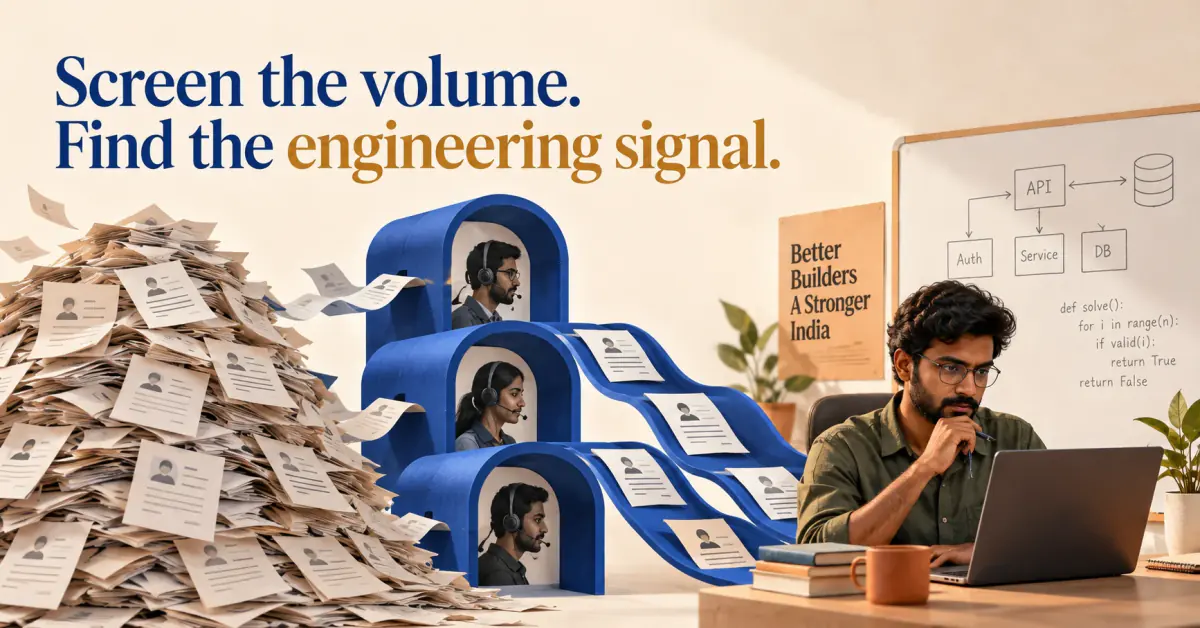
AI technical screening in India means handing the first pass of an engineering req to an AI pipeline: one apply link, knockout rules you write, a phone interview in the candidate's own language, a ranked shortlist, and a live coding round only for the engineers worth an hour. (How AI technical screening works covers the mechanics end to end.)
It exists because Indian applicant volume breaks the human first round long before the panel does. A single backend req posted by an Indian startup, GCC, or IT services firm routinely draws several hundred applicants — sometimes an order of magnitude more than an equivalent posting in a smaller market. Resume filters cut that down. They do not tell you who can actually write and defend code.
Why the first screen breaks at Indian applicant volumes
Every screening process has a throughput ceiling set by whoever runs the first conversation. Do the arithmetic on a normal req.
Say 400 applicants clear the job board and 60 survive a resume filter. At one hour per phone screen plus scheduling overhead and written notes, that is roughly 75 engineer-hours for one open role — you can run your own numbers in the cost-per-hire calculator. Run five reqs at once and you have consumed most of a senior engineer's quarter on conversations that mostly end in a no.
Notice what happened before the arithmetic started: 340 people were cut on a resume, and nobody heard any of them speak. That failure is not specific to engineering hiring — it is the defining bottleneck of the bulk hiring process in India, and it gets worse the further from a keyword-friendly resume the role sits.
Teams respond in three predictable ways, and all three lose signal:
- Screen fewer people. The filter tightens, so the shortlist gets narrower and more resume-driven. Strong non-traditional candidates — service-company engineers moving to product, tier-3 college graduates, self-taught developers — get cut before anyone hears them reason.
- Push the screen down. A junior engineer or a non-technical recruiter runs it. The bar drops and gets inconsistent, and the panel starts absorbing candidates who should not have reached it.
- Replace it with a test. An auto-graded assessment scales fine and answers the wrong question. It tells you a correct solution was submitted, not who produced it or whether the candidate understands it.
There is a fourth failure that shows up specifically at scale: the screen becomes a scheduling problem. Coordinating a live round between a candidate who is employed full-time and an engineer who is shipping means the calendar, not the pipeline, sets your time-to-hire — the time-to-hire calculator shows how quickly those gaps compound. When a strong candidate is in three processes at once, a five-day scheduling gap is a lost candidate.
What an engineer-led phone screen actually costs in India
The usual argument for engineer-led screening in India is that engineering time is cheaper here than in the US, so the screen is cheap too. Run the numbers on your own team before accepting that.
Take a senior engineer's fully loaded cost — salary, employer contributions, equity, and the overhead your finance team already applies. Divide by working hours in a year. Then multiply by the real time a screen consumes: the interview itself, plus scheduling, plus prep, plus writing the scorecard. That is rarely under 1.25 hours per candidate.
The absolute number is smaller than the equivalent in San Francisco. The ratio is not. A senior engineer in Bengaluru or Hyderabad is still one of the most expensive hours your organisation buys, and most of those hours end in a rejection. Worse, the cost is opportunity cost: it comes out of shipping, not out of a recruiting budget line, so nobody sees it.
| Approach | Engineer time per screen | Cost per screen | Turnaround | Consistency |
|---|---|---|---|---|
| Engineer-led phone screen | ~1.25 hours | 1.25 × your loaded hourly engineer cost | Days to schedule | Varies by interviewer |
| Auto-graded test or take-home | ~0.5 hour to review | Low, but weak signal | Days | Same test, gameable |
| Outsourced human screen | 0 | Priced in USD, typically $200–$450 | Days | Vendor's bar, not yours |
| AI phone screen, every eligible applicant | 0 | Per connected minute with the scored report included | Hours; calls run in parallel | Same rubric on every call |
| Live AI technical round, the ranked few | 0 for the round itself | A flat, published price per round | Minutes after the round | Same calibrated bar |
We compared the auto-graded route in HackerRank alternatives and the outsourced human screen in Karat alternatives. The point of the table is the shape, not the vendor. When the first conversation costs minutes of call time and zero engineer-hours, you stop screening 15 candidates and start screening all 60, or all 400. The engineer's hour then goes to the shortlist the phone round produced, not to finding it. Current rates for both stages are on the pricing page.
AI-assisted cheating is just as present in Indian pipelines
Any screening change has to survive the integrity problem, and Indian pipelines are not an exception to it. Tools like Cluely and Interview Coder are free or cheap, work in any browser, and are widely known among candidates. Assume a meaningful share of your remote first-round candidates have access to real-time answer assistance, because they do.
This is why take-homes and lightly proctored online tests have degraded fastest. They evaluate an artifact, and an artifact can be produced by a model in seconds. No amount of tab-switch detection changes that a correct submission is now weak evidence.
The durable defence is not surveillance. It is making the final answer insufficient on its own. In a live voice round the candidate has to explain why an approach works, state the complexity, handle a challenge to an assumption, and respond when the interviewer changes the angle. A pasted solution collapses under two adaptive follow-ups because the candidate cannot reconstruct the reasoning that produced it.
EasyInterview's live technical round adds a second layer on top of that: an integrity monitor flags paste, lookup, and tool-assisted answer patterns, and those flags arrive alongside the recording and transcript rather than as a standalone risk score. You can go read the exchange and judge it yourself. The phone screen has a softer version of the same idea. The AI interviewer flags coached or scripted answers, and every score is pinned to a quoted moment in the call, so a rehearsed answer is visible rather than hidden behind a number. That matters more in a high-volume pipeline, where a false positive on an honest candidate is not a rounding error — it is a person you wrongly rejected.
AI technical screening in India: what to look for in a vendor
Most AI interview vendors are built for a US buyer and sold into India unchanged — the vendor comparison page lays the field out side by side. Five things separate a product that works here from one that merely ships here.
Billing in INR, not a converted dollar price. A USD-denominated tool means your per-screen cost moves with the exchange rate, your finance team eats FX and card fees, and procurement gets a foreign-vendor approval cycle. Native rupee pricing on the invoice is the difference between a purchase order and a quarter-long argument. Ask whether the price is set in INR or simply displayed in INR.
A screen in the candidate's language, with consent handled. Plenty of strong engineers from service companies and tier-3 colleges reason better in Hindi, Tamil, or Telugu than in interview English, and an English-only screen measures accent before it measures ability. Ask which languages the interviewer actually speaks, whether the candidate picks the slot, and how consent works. In India, a scheduled call the candidate agreed to at apply, with a STOP opt-out on every message, is the difference between a screen and a TRAI complaint.
Voice infrastructure in region. A live AI interview is a real-time voice conversation, whether it runs over a phone line or in the browser, and voice is unforgiving about latency. If the audio pipeline round-trips to a US or EU region, every turn picks up delay: the interviewer talks over the candidate, pauses read as hesitation, and a nervous person gets penalised by geography. Ask where the real-time media and agent infrastructure run. For candidates in India, that answer should be an Indian region.
Timezone-independent scheduling. Indian pipelines usually span at least IST plus a US or European hiring manager, and most candidates are employed and can only interview at night or on a weekend. A product that still requires a synchronous calendar match has not solved the bottleneck. Let the candidate pick a slot over WhatsApp for the phone round, send a single-use link for the technical round, and read the reports the next morning.
Evidence, not a score. A number between one and ten is not reviewable and will not survive a debrief. You need the score tied to the exact transcript quote, the per-question deduction, the optimal answer, and a recording chaptered by question so a reviewer can jump straight to the exchange in dispute. That applies to the phone screen as much as the technical round: a ranking you cannot open and check is a resume filter with extra steps.
That last one is what separates real technical interview as a service in India from a resume-parsing chatbot with a voice. The vendor is not just saving you an hour; it is producing the artifact your hiring committee argues over.
Where EasyInterview fits
EasyInterview is an AI hiring pipeline for high-volume hiring, and it runs the whole first pass, not only the technical round. You share one branded apply link on LinkedIn, Naukri, Apna, Indeed, WhatsApp groups, a QR poster, or your careers page, or import a CSV of applicants you already have, and every applicant's phone number is OTP-verified. Knockout rules you write, such as location, notice period, or salary band, sort the pile. Nobody is auto-rejected: a human clicks every decline, and every rule has an "include anyway" override.
An AI interviewer then phones every eligible applicant in the candidate's language, Hindi, English, or one of nine more Indian languages, at a time the candidate picked over WhatsApp, with one-tap reschedule. Calls run in parallel, the interviewer probes vague answers with follow-ups, and every dimension is scored with evidence quoted from the transcript. Every invite says the interviewer is an AI and that a person reads the transcript, every message carries a STOP opt-out, and consent is collected at apply, which keeps an Indian pipeline inside TRAI rules.
The output of that stage is a shortlist ranked by percentile within the job, with a recording, a transcript, and a fit breakdown for every candidate screened. For engineering roles you send the top of the ranking into the live technical round: a browser-native, 45 to 60 minute voice interview with a real coding editor or a shared system design whiteboard, no install, taken on the candidate's own schedule via a single-use link. It cross-questions the way a staff engineer would, and the team configures the level, round types, and rubric first, so the verdict is calibrated to your bar rather than a generic benchmark.
Pricing is a prepaid wallet shared by the team, with no seats and no subscriptions. Teams in India see and pay a rupee price list, not a dollar figure converted at checkout. Phone screens bill per connected minute with the scored report included, calls under 30 seconds are free, and each live technical round is a flat price. Current numbers are on the pricing page.
The infrastructure that runs the voice interviews is deployed in the Asia-Pacific south region, so candidates interviewing from Indian cities are not paying a latency tax to reach a US datacentre mid-sentence.
The technical round's output is a hire/no-hire verdict with a confidence score, scores linked to transcript quotes, per-question deductions with the optimal answer, a chaptered recording, and integrity flags. It exports as an ATS-ready scorecard today; named Greenhouse, Lever, and Ashby integrations are on the roadmap. You can read an actual sample report before you decide whether the evidence is good enough for your debriefs.
One honest caveat. EasyInterview is a newer product with no public customer roster or outcome benchmark yet, so run it as a low-commitment pilot on one live req and compare the shortlist it produces with the one your team would have built by hand.
Frequently asked questions
Is the interview live or asynchronous?
Both stages are live conversations; only the scheduling is asynchronous. The phone screen happens at a slot the candidate picked over WhatsApp, and the technical round starts whenever the candidate opens the single-use link. In each case the AI interviewer asks adaptive follow-ups in real time, and the technical round adds coding in a live editor or design on a shared whiteboard. That is what makes it hard to game.
Are we billed in rupees?
Yes. Teams in India are billed from a rupee price list, not a converted dollar figure, out of a prepaid wallet the whole team shares. Phone screens bill per connected minute with the scored report included, and technical rounds are a flat price per round. The current numbers are on the pricing page.
Does it work for high-volume IT services and GCC hiring?
That is the case it is built for. The phone screen calls every eligible applicant in parallel, in their language, so throughput is set by how many people apply rather than by interviewer availability, and the cost model is per call and per round rather than per seat. The live technical round then goes only to the engineers the ranking puts at the top. The same pipeline runs for the support, sales, and operations roles a services firm hires alongside its engineers.
Which languages does the phone screen run in?
Hindi, English, and nine more Indian languages: Bengali, Tamil, Telugu, Kannada, Malayalam, Marathi, Gujarati, Punjabi, and Odia. The interviewer scores the substance of the answers rather than the candidate's English.
Can we keep our own hiring bar?
Yes. You write the knockout rules and the phone rubric, and for the technical round you set the role level and the rounds to run, all before inviting anyone. The interviewer is calibrated to that standard for every candidate, and nothing is auto-rejected against it: a person clicks every decline.
Screen more people without spending more engineering hours
The Indian hiring problem is not a shortage of applicants. It is that the one step capable of separating them — a real conversation — is the step you cannot afford to run on everyone. Running that conversation as an AI phone screen with every eligible applicant, and a live, adaptive, evidence-producing technical round with the ranked few, changes which candidates get heard at all, and it does that for minutes of call time instead of a senior engineer's afternoon.
Book a demo to see EasyInterview take one Indian engineering req from apply link to ranked shortlist to a first technical round against your bar, priced in INR.
Rohit Pandit
Founder, EasyInterview · easyinterview.life
I build EasyInterview, an AI hiring pipeline for high-volume roles in India. These are field notes on screening at volume, hiring signal, and interview integrity, written from the work rather than from a keyword list.
Connect on LinkedIn