HeyMilo Alternatives: Hands-On Coding or Voice Screen
HeyMilo alternatives compared: EasyInterview's AI hiring pipeline, phone screens in 11 languages and live coding rounds, versus HeyMilo's AI voice recruiter.

If you are looking for a HeyMilo alternative, or comparing EasyInterview vs HeyMilo directly, both now run conversational AI phone screens at volume. The real differences are elsewhere: EasyInterview adds a hands-on coding and system-design round for engineering roles, is built India-first, and publishes its pricing. HeyMilo has deeper ATS write-back and a longer customer track record. If you are shortlisting in this category generally rather than comparing these two, the twelve questions to put to any vendor are in how to judge automated phone screening.
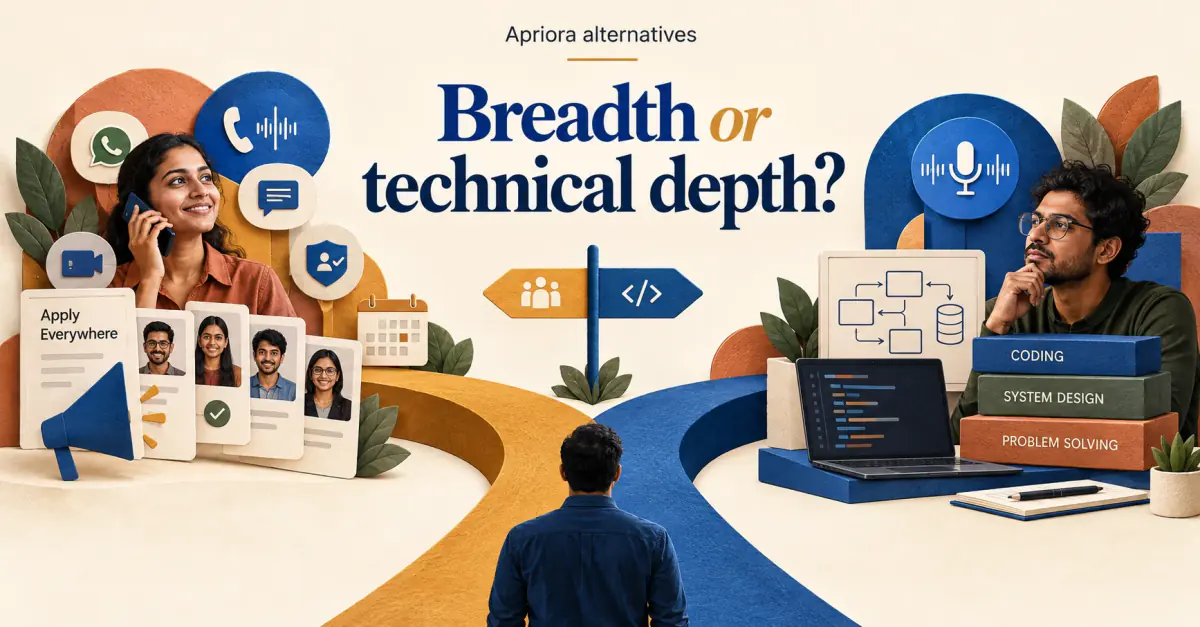
HeyMilo runs a conversational voice or video interview and scores what a candidate says about their skills; its own materials describe its technical capability as a "voice-based technical assessment." EasyInterview circulates the job from one apply link, sorts applicants with your knockout rules, AI phone-interviews every eligible applicant in their language, and ranks them. For engineering roles it then runs a live round where the candidate writes and runs code in a real editor or designs a system on a whiteboard.
TL;DR
- HeyMilo is a strong conversational AI recruiter for high-volume hiring: natural adaptive voice and video interviews, multilingual, 24/7 completion, deep ATS write-back, and an integrity layer with a trust score. It is genuinely good at screening at scale.
- HeyMilo's "technical" interview is a spoken conversation. It has no code editor, IDE, whiteboard, or run-code surface, and its own comparison pages concede coding assessments to other tools.
- EasyInterview is an AI hiring pipeline for high-volume hiring: one apply link, rubric knockouts, AI phone interviews in 11 languages scheduled over WhatsApp, and a percentile-ranked shortlist with evidence. For engineering roles it adds a live coding and system-design round with integrity flags and evidence-linked scoring.
- Choose HeyMilo if you need results written back into a staffing ATS today, hire in languages outside EasyInterview's eleven, or want a vendor with a public customer roster. Choose EasyInterview for India-first volume hiring in Indian languages, published pricing, and roles where the candidate must actually write and defend code.
How each one runs the screen
HeyMilo is an agentic AI recruiter positioned for high-volume hiring teams — "the AI Recruiter for High-Volume Hiring," in its own words. You point it at a job description, it generates an interview, and candidates talk to a conversational AI over phone, browser audio, or video whenever they like. The AI listens, asks adaptive follow-ups rather than reading a fixed script, scores each answer against a rubric with written reasoning, records the session, and writes results back to the ATS. Around that sit multi-channel follow-up to lift completion, resume screening and ranking, talent rediscovery, white-labeled interview screens, multilingual support, and an integrity layer. It is a polished, end-to-end conversational screen designed to process a lot of candidates quickly.
EasyInterview runs the whole first round as a pipeline. You share one branded apply link on LinkedIn, Naukri, Apna, Indeed, WhatsApp groups, a QR poster, or your careers page, or import a CSV of applicants you already have. Applicants verify their phone number by OTP and answer your knockout questions, such as location, notice period, or salary band. Knockouts are deterministic rules you wrote, shown politely to the candidate at submit; nobody is auto-rejected, a human clicks every decline, and every rule has an "include anyway" override. An AI interviewer then calls every eligible applicant in the candidate's language, at a time the candidate picked over WhatsApp with a one-tap reschedule. It probes vague answers with follow-ups and scores every dimension with evidence pulled from the transcript. Every screened candidate lands in a percentile-ranked shortlist with a score, a recording, a transcript, and a fit breakdown, and every one of them gets an outcome message.
For engineering roles the pipeline adds a second surface: the live technical round. The candidate opens a link in the browser and, over 45 to 60 minutes, completes a coding round in a real editor or a system design round on a shared whiteboard. They reason aloud while the AI interviewer cross-questions complexity, trade-offs, and edge cases the way a staff engineer would, and the hiring team receives an evidence-scored report calibrated to its rubric, with the recording chaptered by question.
Both run live, adaptive AI conversations at volume. The differences are the technical surface, the India-first candidate flow, the ATS story, and the pricing model.
EasyInterview vs HeyMilo at a glance
| Area | EasyInterview | HeyMilo |
|---|---|---|
| What it is | AI hiring pipeline: one apply link, rubric knockouts, AI phone interviews, ranked shortlist; live technical rounds for engineering roles | Conversational AI recruiter for high-volume hiring |
| Technical round | After the phone screen, candidate writes and runs code or diagrams a system live | Voice-based technical assessment — candidate talks through skills |
| Coding environment | Live editor plus system design whiteboard | None — no code editor, IDE, or whiteboard |
| Primary buyer | Recruiters and hiring teams hiring in volume, India-first; engineering teams for the technical round | Recruiters, TA, and staffing / high-volume teams |
| Typical roles | Sales, support, field, ops, delivery, retail, and engineering | Frontline, support, sales, healthcare, staffing; screening for technical roles by conversation |
| Anti-cheat | Phone screen flags coached or scripted answers; technical round adds paste, lookup, and tool-use flags | Active proctoring plus a trust score (speaker and AI-content checks) |
| Scoring & evidence | Every score pinned to a quoted moment; percentile rank within the job; recording, transcript, fit breakdown; per-question deductions on technical rounds; ATS-ready scorecard export | Per-question scores with reasoning, transcript, recording, client-ready reports, native ATS write-back |
| Channels & languages | Voice phone screens in Hindi, English, and nine more Indian languages, scheduled over WhatsApp; browser-based technical rounds | Phone, browser audio, video, SMS; multilingual |
| Pricing | Published model: prepaid team wallet, per connected minute for phone screens, flat per technical round, no seats | Not published; demo and sales-led |
Where the difference matters
The first load-bearing difference is what the technical score is based on. HeyMilo's technical rating comes from a conversation: how well a candidate describes their experience, reasons out loud, and answers follow-ups. That is a legitimate and useful signal, and HeyMilo's adaptive questioning makes it better than a one-way recorded quiz. But it is a score of what someone says about coding, not of code they wrote. HeyMilo is candid about this: its own comparison pages label its capability "voice-based technical assessment" and point engineering-heavy teams that want integrated coding evaluation toward other tools.
EasyInterview's phone screen produces the same kind of conversational signal, and for a sales, support, or field role that is the right signal. For an engineering role it does not stop there. Coding candidates write real code and run it while the interviewer probes edge cases and complexity; system design candidates defend architectural decisions on a whiteboard under adaptive follow-ups. Each score is pinned to a quoted moment and a specific deduction, so an engineer can see not just that a candidate rated well but why. That is the difference between "interviews well about systems" and "can actually build one."
The second difference is where the candidate flow was built. EasyInterview's phone screens are voice calls in Hindi, English, or nine other Indian languages, scheduled over WhatsApp at a time the candidate picks, with a one-tap reschedule. Consent is collected at apply, so the flow stays inside TRAI rules in India. Every invite discloses that the interviewer is an AI and that a person reads the transcript, every message carries a STOP opt-out, and every screened candidate gets an outcome message. HeyMilo is multilingual and multi-channel too, with phone, browser audio, video, and SMS. The difference is that EasyInterview's defaults were designed around Indian applicant volume and Indian consent rules rather than adapted to them.
The third difference runs the other way. HeyMilo writes results back into the ATS, and its integration list is deep on staffing systems. EasyInterview exports reports as an ATS-ready scorecard today; named Greenhouse, Lever, and Ashby integrations are on the roadmap, not live. If native write-back into Bullhorn or JobDiva is a hard requirement, that decides it for HeyMilo.
Pricing
HeyMilo does not publish pricing. Its pricing page redirects to a demo booking, and cost is quoted for the engagement rather than listed in tiers. Some third-party sites circulate per-interview figures for HeyMilo, but those are not confirmed on HeyMilo's own site and should not be relied on. In practice HeyMilo is a sales-led, volume-oriented purchase, and reviewers describe it as enterprise-tilted rather than aimed at low-volume buyers.
EasyInterview publishes its pricing model. The team shares one prepaid wallet with no seats and no subscriptions. Phone screens bill per connected minute with the scored report included, and calls under 30 seconds are free, so a no-show or a wrong number costs nothing. Technical rounds are a flat price per round. Current numbers are on the pricing page, and no quote is required to start. Because HeyMilo prices an end-to-end platform for the engagement and EasyInterview prices per screen and per round, the honest comparison is at your funnel's actual shape: how many applicants clear your knockouts, how long a screen runs, and how many engineering candidates need a technical round. The cost-per-hire calculator shows what a known per-screen unit cost does to the funnel.
Cheat resistance in the AI era
HeyMilo takes integrity seriously and has a real story here: an active proctoring layer and an AI-classifier that produces a trust score, using single-speaker verification, AI-generated-content detection, and voice analysis, plus a monthly third-party bias audit. For a high-volume conversational screen, that is a thoughtful control set aimed at impersonation and AI-assisted answers.
EasyInterview's phone screen works the conversational problem from the questioning side: the AI probes vague answers with follow-ups until the real number comes out, and flags coached or scripted answers so rehearsed candidates do not slip through. The live technical round then attacks a failure mode a voice screen cannot reach: a strong-sounding answer the candidate cannot actually produce or extend. Because the candidate is writing and running code live and then explaining and modifying it under questioning, a hidden-answer tool helps far less; producing plausible text is not enough when you have to make the code work and defend it in real time. An integrity monitor separately flags paste, lookup, and tool-assisted answers. Both approaches are meaningfully stronger than an unattended quiz. HeyMilo's is tuned to conversational integrity at volume, with speaker verification and a trust score; EasyInterview's technical round is designed around the "looks right, cannot build it" problem.
Where HeyMilo is the better choice
HeyMilo is the stronger fit when your hiring runs through a staffing system and the ATS is the system of record. Its integration list leans heavily on Bullhorn, Avionté, and JobDiva, results write back natively, and a staffing agency, RPO, or BPO screening large applicant pools gets the whole loop inside the tools it already runs. Its customer stories, screening thousands of applicants in days and tripling qualified submissions, are about exactly that scale, and EasyInterview cannot answer them with a public roster of its own yet.
HeyMilo is also a polished, well-funded product with a natural, human-like conversational experience that reviewers praise over robotic one-way tools, video as well as voice, and fast setup. Its multilingual support is not scoped to one market, so if your applicant pool speaks languages outside the 11 that EasyInterview's phone screens cover (Hindi, English, and nine more Indian languages), check HeyMilo's language list against yours. If you want video interviews rather than phone calls, or your procurement team needs a vendor with a track record before it will approve a pilot, HeyMilo addresses that directly.
Where EasyInterview is the better alternative to HeyMilo
EasyInterview is the better choice when the pile is Indian and the roles are hired in volume: sales, support, field, ops, delivery, retail, or engineering. One apply link circulates the job everywhere your applicants already are, the knockouts sort the pile against your rubric with a human on every decline, and the AI phone screen runs in the candidate's own language with WhatsApp scheduling and a consent flow built for TRAI. Every candidate gets an outcome, and you review a percentile-ranked shortlist rather than a stack of recordings.
It is also the better choice when the roles you care about are engineering roles and the question is whether someone can actually write and defend code. A conversational screen, however adaptive and well-run, does not put a candidate in an editor. EasyInterview does, after the phone screen: a live coding round, a system design whiteboard, adaptive probing, integrity flags, and a decision-ready scorecard with per-question deductions, transcript evidence, and a recording chaptered by question, so an engineer can inspect the recommendation without replaying the whole session. You can see a sample scorecard to judge whether that evidence meets your committee's standard.
Published pricing matters here too. A team can start with a wallet top-up on one role without a sales cycle, and the per-minute model means the bill tracks screens that actually connected, not seats or a contract term.
EasyInterview is a newer product with no public customer roster, case studies, or outcome benchmark, so the sensible way to evaluate it is a low-commitment pilot on one role: run one job through the pipeline, compare the ranked shortlist against your recruiters' own calls, and for an engineering role compare the coding and system design evidence against your panel's judgment before expanding.
Frequently asked questions
Is HeyMilo a good EasyInterview alternative?
Yes, and the overlap is real: both run conversational AI phone screens for high-volume hiring. HeyMilo has deeper ATS write-back, video as well as voice, and a public customer roster. EasyInterview is India-first, with phone screens in 11 languages, WhatsApp scheduling, published pricing, and a hands-on coding and system-design round for engineering roles.
Does HeyMilo have a coding test or code editor?
No. HeyMilo's technical round is a voice-based conversation; it has no code editor, IDE, whiteboard, or run-code surface, and its own comparison pages direct teams that want integrated coding assessments elsewhere. EasyInterview adds a live coding and system-design round for engineering roles after the phone screen.
Does HeyMilo have anti-cheat?
Yes, an active proctoring layer and a trust score using speaker verification and AI-content detection. EasyInterview's phone screen flags coached or scripted answers, and its live technical round flags paste, lookup, and tool-assisted answers while the hands-on format makes hidden-answer tools far less useful.
How do the prices compare?
HeyMilo is demo- and sales-led with no public tiers. EasyInterview publishes its model on its pricing page: a prepaid team wallet, phone screens billed per connected minute with the report included, technical rounds at a flat price per round, no seats. Ignore third-party aggregator pricing for HeyMilo; it is not confirmed by the company.
What is the best HeyMilo alternative for technical hiring?
If you need to evaluate engineering ability, meaning hands-on coding, system design, and evidence-linked scoring, EasyInterview is built for that. It runs the volume phone screen first and the live technical round on the candidates who clear it, so you do not need a separate screener in front of it.
The bottom line
HeyMilo and EasyInterview both run adaptive AI phone screens at volume, so the choice is no longer voice screen versus coding test. HeyMilo is a polished conversational recruiter with multilingual support, strong ATS write-back, video, and a customer track record; its technical round scores what a candidate says. EasyInterview is an AI hiring pipeline built for Indian applicant volume, from one apply link to a ranked shortlist, with phone screens in 11 languages, published pricing, and, for engineering roles, a live round that scores what candidates build.
If ATS write-back into a staffing system or a proven roster is the deciding factor, HeyMilo is likely the better instrument — Apriora alternatives covers its closest end-to-end competitor, and Asendia alternatives the staffing-agency variant; the vendor comparison page puts the whole field side by side. If your pile is Indian, your budget wants a published price, or you need to know whether an engineer can actually write and defend a solution, book a demo and start with a pilot on one role.
Rohit Pandit
Founder, EasyInterview · easyinterview.life
I build EasyInterview, an AI hiring pipeline for high-volume roles in India. These are field notes on screening at volume, hiring signal, and interview integrity, written from the work rather than from a keyword list.
Connect on LinkedIn