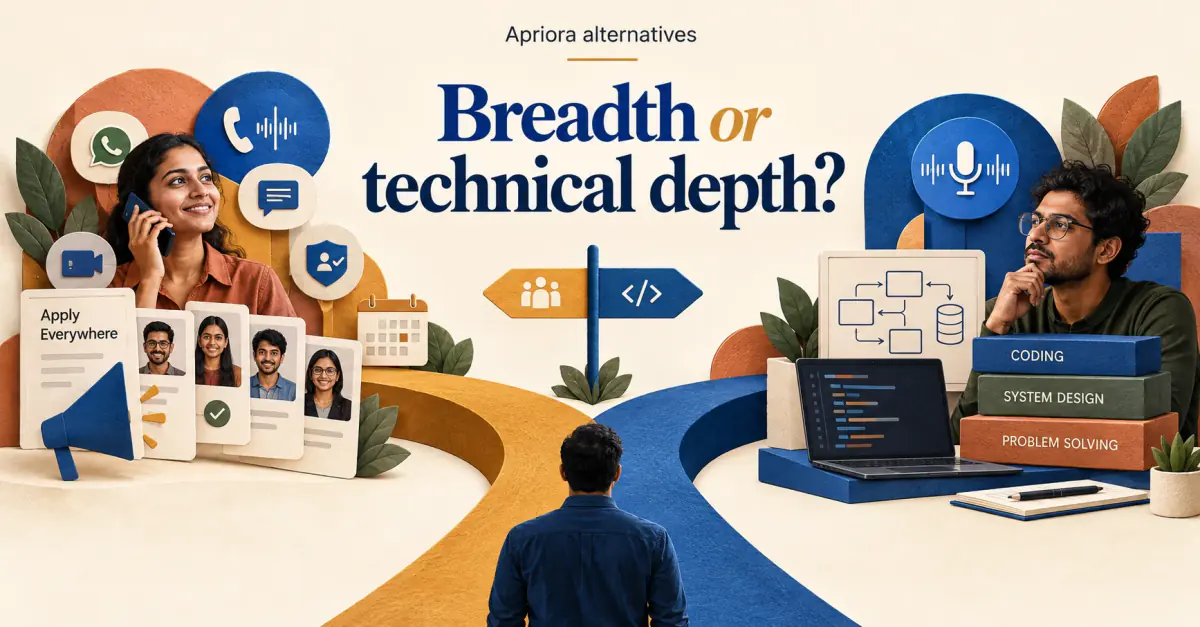
Prism Alternatives: The Screen After the Shortlist
Prism (tryprism.com) alternatives compared: an AI hiring pipeline that screens, phone-interviews, and ranks your applicants vs Prism's AI recruiting agency.

If you are looking for a Prism alternative, or comparing EasyInterview vs Prism directly, the short answer is this: Prism finds candidates who did not apply to you. EasyInterview takes the people who did apply and turns them into a ranked, interviewed shortlist. They overlap at the shortlist, and differ on where the candidates come from.
Prism (at tryprism.com) is an AI-native recruiting agency: it sources candidates, runs outreach, screens for fit, and delivers a ranked shortlist. Then, by its own description, it hands the interview back to you. EasyInterview is an AI hiring pipeline for high-volume hiring. It circulates your job, screens every applicant against your rubric, phone-interviews them in their language, and ranks them. For engineering roles it adds a live coding and system design round. So the shortlist Prism hands you is something EasyInterview also builds, from your own applicants, and then interviews.
A quick disambiguation: this is about Prism at tryprism.com, the YC recruiting agency — not SelectPrism / Prismforce (selectprism.ai), an unrelated hiring platform that does include an interviewer module. If you meant that product, this comparison is not about it.
TL;DR
- Prism is a done-for-you recruiting agency powered by AI. You brief it, and it sources, engages candidates across LinkedIn, email, and WhatsApp, and returns a ranked shortlist with a transparent breakdown of where each candidate meets the bar.
- Prism explicitly does not run the interview. In its own words, "you step in to interview and make the offer." It has no code editor, IDE, whiteboard, or technical assessment.
- EasyInterview runs the whole funnel for the people who apply to you: one apply link circulated to job boards and WhatsApp, knockout rules you write, an AI phone interview in the candidate's language, and a percentile-ranked shortlist where every score is pinned to a quoted moment in the call. Engineering roles add a live coding or system design round.
- EasyInterview does not headhunt. It has no talent pool, no outbound sourcing, and no recruiters on staff. If nobody applies, it has nobody to screen.
- They overlap at the shortlist and differ on where candidates come from. If your bottleneck is that not enough of the right people apply, Prism helps. If your bottleneck is that too many people apply and nobody has time to screen and interview them, EasyInterview does.
What each product actually is
Prism markets itself as an AI-native recruiting agency, not software you operate. You brief it, often over a shared Slack channel, and its AI agents source candidates from a curated pool, your network, your ATS, and the open web, including LinkedIn and GitHub. It runs multi-channel outreach, manages replies, and screens for the hidden criteria buried in your job description and past hires, then delivers a ranked shortlist where each candidate comes with a transparent breakdown of where they meet the bar and where they do not. Prism's own framing is explicit about the handoff: it does the sourcing and qualification, and "you handle the parts a founder should, which in our view are the interviews and the offer."
EasyInterview is software your team runs, and it starts one step earlier than most screening tools. You publish one branded apply link and share it on LinkedIn, Naukri, Apna, Indeed, WhatsApp groups, a QR poster, or your careers page, or you import a CSV of applicants you already have. Every applicant's phone number is OTP-verified, and consent to be contacted is collected at apply. Deterministic knockout rules you write, such as location, notice period, or salary band, sort the pile, and the result is shown politely to the candidate at submit. Nobody is auto-rejected: a human clicks every decline, and every rule has an "include anyway" override.
Then an AI interviewer phones every eligible applicant, in their language (Hindi, English, and nine other Indian languages), at a time the candidate picked over WhatsApp, with a one-tap reschedule. Every invite says the interviewer is an AI and that a person reads the transcript, and every message carries a STOP opt-out. Calls run in parallel, so the size of the pile stops mattering. The AI probes vague answers with follow-ups, scores every dimension with evidence from the transcript, and flags coached or scripted answers. Every screened candidate gets a score, a recording, a transcript, a fit breakdown, and an outcome message, and is percentile-ranked within the job. For engineering roles, the candidates you shortlist can go straight into a live AI technical interview: 45 to 60 minutes in a real code editor or on a shared system design whiteboard, with adaptive cross-questioning and an evidence-scored report.
Put plainly: Prism finds people who did not apply. EasyInterview takes the people who did apply, screens and interviews them, and hands you a ranked shortlist with the evidence attached.
EasyInterview vs Prism at a glance
| Area | EasyInterview | Prism |
|---|---|---|
| Category | AI hiring pipeline for high-volume hiring, with live technical rounds for engineering roles | AI-native recruiting agency (done-for-you sourcing) |
| Stage of funnel | Apply link, knockout screen, AI phone interview, ranked shortlist, technical round | Sourcing, outreach, and shortlisting |
| Runs the interview? | Yes: an AI phone interview for every eligible applicant, plus a live coding or system design round for engineering roles | No — hands the interview back to you |
| Technical assessment | Live coding editor plus system design whiteboard, with an integrity monitor | None; no code editor, IDE, or whiteboard |
| Output | Percentile-ranked shortlist; per candidate a score, recording, transcript, and fit breakdown, each score pinned to a quoted moment | A ranked shortlist with a meets-the-bar / doesn't breakdown |
| How candidates are engaged | Your own applicants: one apply link shared on job boards, WhatsApp, QR posters, and your careers page, or a CSV import; calls scheduled over WhatsApp in 11 languages | Prism sources and reaches out across LinkedIn, email, WhatsApp |
| Pricing model | Prepaid team wallet, no seats or subscriptions; phone screens per connected minute with the report included, technical rounds a flat price per round | $500 retainer plus 15% of first-year salary on a hire, at the time of writing |
| Best for | Teams with more applicants than they can screen, for any role hired in volume | Teams whose bottleneck is finding candidates who have not applied |
Where the difference matters
The decisive question is where your candidates come from. Prism is built for the case where the right people are not applying: passive engineers on LinkedIn or GitHub who need to be found, contacted, and persuaded to talk. That is genuinely valuable when inbound is thin, and it is a job EasyInterview does not do. EasyInterview has no talent pool and no outbound motion. It works only on people who applied to you, or whom you imported and who consented to be contacted.
EasyInterview is built for the opposite case, which is the common one for roles hired in volume: too many people apply and nobody has time to screen them properly. A field sales opening, a support desk, a delivery fleet, or a junior engineering intake can draw hundreds of applicants in days. A recruiter can hand-dial a few dozen of them a day. EasyInterview circulates the job, sorts the pile with your knockout rules, phone-interviews every eligible applicant in parallel, and ranks them, so your team looks only at the top of the list.
The second difference is what "screened" means. Prism's shortlist tells you where each candidate meets the bar on fit and interest, based on its outreach and qualification. EasyInterview's shortlist is built from a structured interview: every score is pinned to a quoted moment in the call, the AI has probed vague answers until a real number came out, and coached or scripted answers are flagged. For engineering roles, the technical round goes further than any outreach conversation can. A strong resume and a good conversation do not tell you whether someone can structure a solution, reason about complexity, or defend a design under questioning. EasyInterview puts the candidate in a real editor and on a whiteboard and finds out, then ties every deduction to a transcript quote so an engineer can trust the verdict.
The third difference is the operating model. Prism is a service: you brief it, and its people and AI agents do the work. EasyInterview is software: you write the rubric and the rules, the AI runs the calls and the rounds, and a person on your team reads the reports and clicks every decision.
They can still be complementary, and the pairing makes most sense for hard-to-fill roles. If Prism surfaces a dozen senior engineers who were not looking, you can import that list, run them through the same phone interview and technical round as your inbound applicants, and compare everyone on one ranking. For a volume role with plenty of inbound, a placement fee per hire rarely makes sense, and EasyInterview on its own covers the funnel.
Pricing
Prism uses a recruiting-agency model, not a software subscription. At the time of writing, its published pricing is a $500 retainer to kick off a search plus 15% of the candidate's first-year salary when a Prism-sourced hire signs, with the retainer sometimes waived via launch promotions. That undercuts the typical 20-25% agency contingency fee, but it is still an outcome-based placement fee tied to a specific hire, and it applies only to candidates Prism sources.
EasyInterview is usage-priced from a prepaid wallet shared by the whole team, with no seats and no subscriptions. Phone screens bill per connected minute with each scored report included, and calls that last under 30 seconds are free. Technical rounds are a flat price per round. Current rates are on the pricing page. You pay a known unit cost per candidate screened, from any source, whether or not they are hired. Because one is a placement fee and the other is a per-screen cost, they are not substitutes on a spreadsheet; the cost-per-hire calculator helps you model both on the same sheet.
Where Prism is the better choice
Prism is the better fit when the right people are not applying. If you are an early-stage startup where the founder is doing the recruiting, the role is senior or specialised, and you would rather receive a vetted, ranked shortlist than build an outbound sourcing motion, Prism is built for exactly that. Its people-search engine and multi-channel outreach are aimed at surfacing passive, high-fit candidates beyond active job seekers, and its agency model means you pay mainly when it delivers a hire. EasyInterview does not make that offer. It will circulate your job widely, but it cannot find, contact, or persuade someone who never applied.
Prism also removes the operational overhead entirely: there is no software to learn, no rubric to write, and the transparent candidate breakdowns speed up calibration. If your constraint is "we can't find enough qualified engineers to talk to," Prism addresses that directly.
Where EasyInterview is the better alternative to Prism
EasyInterview is the better choice when your problem is the pile, not the pipeline. If a job post draws more applicants than your team can call, EasyInterview does the whole first pass: it circulates the job, sorts applicants with your knockout rules, phone-interviews every eligible one in their language, and ranks them with evidence. That covers roles where a per-hire placement fee rarely makes sense, such as sales, support, field, ops, delivery, and retail, and it covers engineering intakes at any volume.
It is also the better choice when the interview itself is the bottleneck. Once you have a shortlist, from EasyInterview's own ranking, from Prism, or from referrals, someone still has to determine whether each engineer can build and defend a solution. Doing that with live human interviews is exactly the founder-hour drain Prism assumes you will absorb. EasyInterview runs the technical round without lowering the bar: a live coding round in a real editor or a system design round on a shared whiteboard, adaptive cross-questioning the way a staff engineer would, an integrity monitor that flags paste, lookup, and tool-assisted answers, and a report with per-question deductions, transcript quotes, and a recording chaptered by question. Reports export as an ATS-ready scorecard. You can see a sample scorecard to judge whether that evidence meets your committee's standard.
EasyInterview is a newer product with no public customer roster, case studies, or outcome benchmark yet, so a low-commitment pilot on one role is the sensible way to evaluate it: write the rubric and knockout rules, run a defined set of applicants through the phone screen and, for engineering, the technical round, and compare the ranking against your panel's judgment.
Frequently asked questions
Is Prism an alternative to EasyInterview?
Partly. Both deliver a ranked shortlist, but from different candidates. Prism sources people who did not apply to you and hands the interview back. EasyInterview takes the people who did apply, screens and phone-interviews them, ranks them, and runs the technical round for engineering roles. If your problem is not enough applicants, Prism is the alternative; if it is too many, EasyInterview is.
Does Prism run technical interviews or coding tests?
No. Prism explicitly hands the interview back to the client and has no code editor, IDE, whiteboard, or technical assessment. Its job ends at delivering a ranked, screened shortlist. EasyInterview runs both the AI phone interview and, for engineering roles, a live coding or system design round.
Does EasyInterview source candidates like Prism?
No. EasyInterview is not an agency and does not headhunt. It circulates your job, one apply link shared on job boards, WhatsApp groups, QR posters, and your careers page, so more of the right people apply, and it can import a CSV of applicants you already have. But it has no talent pool and does not reach out to people who never applied. That is Prism's job.
How do the prices compare?
At the time of writing, Prism charges a $500 retainer plus 15% of first-year salary on a hire it sources. EasyInterview bills usage from a prepaid team wallet: phone screens per connected minute with the scored report included, technical rounds at a flat price per round, no seats or subscriptions. See the pricing page for current rates.
Can I use Prism and EasyInterview together?
Yes, and for hard-to-fill roles it is a sensible pairing. Prism finds the candidates who were not looking; you import that shortlist into EasyInterview, they go through the same consent flow, the same phone interview, and the same technical round as your inbound applicants, and everyone lands on one ranking before your final panel.
The bottom line
Prism and EasyInterview both end at a ranked shortlist, but they start from different people. Prism is an AI recruiting agency that finds, engages, and shortlists candidates who did not apply, then hands the interview to you. EasyInterview is an AI hiring pipeline for the people who did apply: it circulates the job, screens every applicant against your rubric, phone-interviews them in their language, ranks them with evidence, and for engineering roles runs the live coding and system design round.
If your bottleneck is finding people, a sourcing partner like Prism helps; Standout alternatives covers the marketplace variant of the same sourcing-side model, and Karat alternatives the fully outsourced interview; the vendor comparison page puts the field side by side. If your bottleneck is screening and interviewing the people who already applied, book a demo and start with a pilot on one role.
Rohit Pandit
Founder, EasyInterview · easyinterview.life
I build EasyInterview, an AI hiring pipeline for high-volume roles in India. These are field notes on screening at volume, hiring signal, and interview integrity, written from the work rather than from a keyword list.
Connect on LinkedIn