The Bulk Hiring Process in India: Where It Actually Breaks
The bulk hiring process, step by step, and the one phase every guide glosses over: screening at applicant volume. What breaks, what it costs, and how to fix it.
Bulk hiring is filling many openings for the same or similar roles inside a short window — a BPO ramping 500 telecalling seats, a retailer staffing for festival season, a field-sales team opening 40 territories at once. The process runs through six phases: workforce planning, sourcing, screening, interviews, offers, and onboarding. Almost every guide to bulk hiring stops there, as if the six phases were equally hard. They are not. One phase is where a bulk hiring pipeline actually fails, and it is rarely the one teams plan for.
That phase is screening. Sourcing at volume is a solved problem — job boards, referral drives, and a single apply link will get you the applicants. What breaks is the step between "we have 1,000 applications" and "we know who to call back," because that step has always required a person to look at each one, and a person can only look at so many.
If that pile is already in Naukri's response inbox, the Naukri applicant-screening workflow covers the export or apply-link handoff, eligibility checks and structured calls that turn it into a shortlist.
The bulk hiring process, phase by phase
Here is the standard framework, the one every recruiter has seen in some form. Use it as a checklist. The interesting part is the third column.
| Phase | What it involves | Where it actually breaks |
|---|---|---|
| Workforce planning | Forecast headcount, map roles, set the hiring timeline | Rarely — this is a planning exercise, not a bottleneck |
| Sourcing | Post to job boards, run referral and campus drives, take walk-ins | Rarely, unless the role itself is hard to source for |
| Screening | Filter applicants against role requirements before anyone talks to them | Almost always — see below |
| Interviews | Confirm fit and calibrate the shortlist with a human conversation | Only if screening upstream didn't narrow the pool enough |
| Offers | Extend and negotiate offers to the selected candidates | Sometimes, on offer-to-joining drop-off |
| Onboarding | Batch-process paperwork, compliance checks, and orientation | Sometimes, on logistics at very large cohorts |
Notice what screening is actually being asked to do: take a pool that sourcing correctly made large, and turn it into a pool small enough for a human to interview. Every other phase in the table can be solved with more people, more budget, or more time. Screening is a judgment problem, and judgment does not parallelize by adding headcount — it parallelizes by adding structure.
Where the process actually breaks, and why
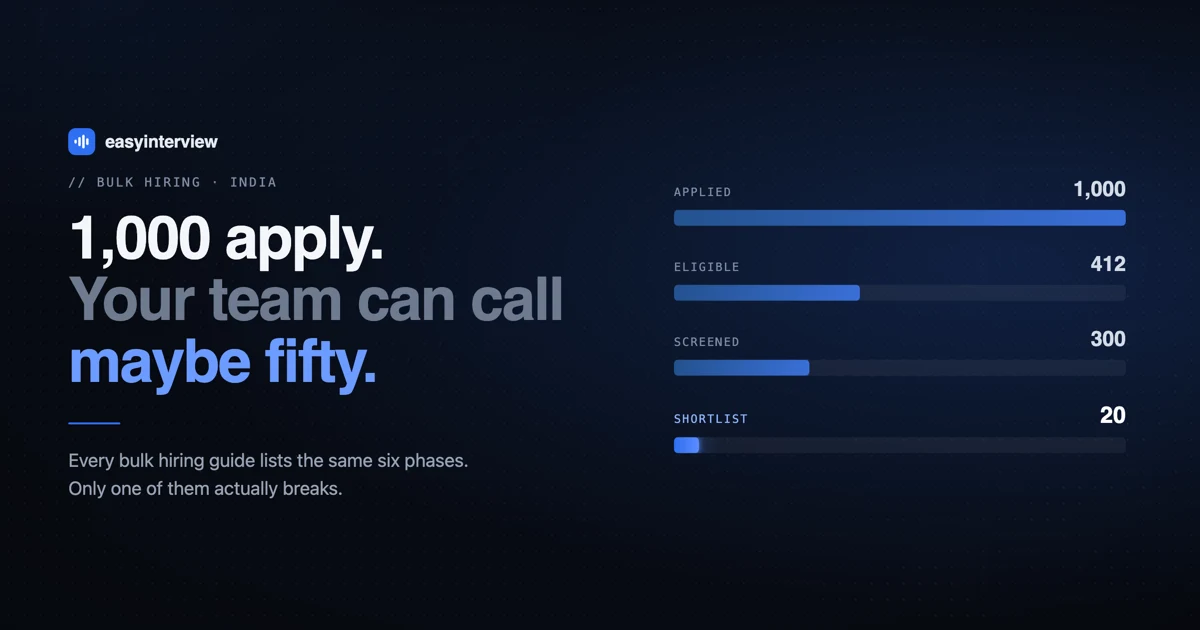
Picture a field-sales role that draws 1,000 applications in a week — a realistic number for a well-circulated posting in a mid-size Indian city. Somebody has to get from 1,000 to a shortlist a sales manager can actually interview.
An example job, not customer data — the same illustrative funnel EasyInterview uses on its homepage. Your ratios will differ by role, city and channel; the shape rarely does.
The gap between the first bar and the last one is the whole problem. Sourcing filled the top. Something has to do the narrowing, and each option teams reach for trades away something different.
Fast, cheap, and blind to the thing you are actually hiring for.
- Catches
- Hard mismatches on paper: wrong city, missing licence, no relevant experience.
- Misses
- Whether the person can hold a sales conversation, handle a rejection, or serve the notice period you need. A resume optimises for keywords, not for the job.
- Cost
- Minutes per applicant of recruiter attention, and a large number of good people cut without anyone hearing them speak.
The default at volume in India, and the hardest one to keep consistent.
- Catches
- Presence, punctuality, basic communication — and it closes fast, because offers can be made in the room.
- Misses
- Everyone who could not travel on the date. Attendance runs well below the invite count, and it skews by distance and shift, not by ability.
- Cost
- A full day from several recruiters, plus bar drift: the panel is sharp at candidate 10 and coasting by candidate 100.
The right conversation, rationed by however many hours the team has.
- Catches
- Real signal. A live conversation is still the best predictor of whether someone can do a frontline role.
- Misses
- Most of the pile. At volume the team calls a fraction of applicants, and the fraction is chosen by whoever is at the top of the list that morning.
- Cost
- The bar becomes whatever each recruiter's judgment is that day. Two candidates giving the same answer get different outcomes depending on who picked up.
Scales perfectly, and answers a narrower question than teams think it does.
- Catches
- Hard knockouts at any volume: notice period, salary expectation, shift availability, own vehicle.
- Misses
- Everything conversational. A form has no back-and-forth, so it cannot probe a vague answer or hear how someone handles being pushed.
- Cost
- Low in money, high in false confidence — and nothing in a typed answer proves who typed it.
None of these four is wrong, exactly. They're what's available when the only tool for screening at scale is more people or a static form. The actual bottleneck is that a real conversation — the thing that tells you whether someone can do the job — has always required a human on the other end of it, and a human only has so many hours.
The problem almost nobody's bulk hiring guide mentions: who's actually on the call
There's a second failure mode that's specific to bulk hiring and rarely gets a section of its own: impersonation. When hundreds of people are moving through a pipeline fast, with less individual attention per candidate than a normal hiring process gets, it becomes easier for someone other than the applicant to sit an assessment, take a screening call, or even show up to an in-person round on the applicant's behalf. Employment-fraud data collected by background-verification vendors in India puts fabricated credentials and impersonation at a meaningful share of flagged cases in high-volume sectors like BFSI and BPO — the exact figure varies by report and by year, but the pattern is well known to anyone who has run bulk hiring at scale: volume and light-touch screening make substitution easier, not harder.
A chat-based or form-based pre-screen doesn't catch this, because there's nothing about typed answers that proves who typed them. A live phone conversation is a meaningfully higher bar for substitution — the person has to speak in real time, respond to a question they haven't seen in advance, and sound like themselves doing it. It is not a perfect defense; a determined and well-coached impersonator can still get through a phone screen, the same way one can get through a human-run one. But it closes the gap that a static form leaves wide open, and it is a real, underdiscussed reason to prefer a live conversation over a submitted form as the first real filter in a bulk hiring pipeline.
How EasyInterview runs bulk hiring screening
EasyInterview is built around the phase that actually breaks. The rest of the pipeline — planning, offers, onboarding — is yours to run as you already do; the product circulates one branded apply link to LinkedIn, Naukri, Indeed, apna, WhatsApp, and your careers page (or takes a CSV import if you already have a list), then handles what happens between "applied" and "shortlisted":
- Knockout rules you write, not a black box. You set the hard filters — location, notice period, salary band, shift availability — and every applicant sees the reason politely at submit. Every decline is still clicked by a human; nothing is auto-rejected against your rules.
- One rubric, applied the same way on every call. The scoring bar is the one you set up front, not the one a tired panel drifts toward by candidate 100 — the same discipline covered in how to calibrate an interview rubric, applied to a frontline role.
- A live AI phone interview for every eligible applicant, in one of 11 Indian languages, run in parallel so throughput is set by how many people apply, not by how many recruiters you have. The candidate picks their own slot over WhatsApp.
- A ranked shortlist with evidence, not a raw score: a recording, a transcript, and every rating pinned to the moment in the call that earned it, so a coached or scripted answer is visible instead of hidden behind a number.
That last part is the honest caveat: EasyInterview is a newer product without a public bulk-hiring case study yet, so the right way to evaluate it is a pilot on one live req, comparing the shortlist it produces against the one your team would have built by hand. You can see the shape of the output before you commit to that — the sample report shows a real evidence-scored call, and the vendor comparison page lays out how this differs from a chat-based pre-screen or an outsourced human call center.
What screening at scale actually costs, one way or another
Whatever you use to screen 1,000 applicants down to a shortlist, someone pays for the hours. If a recruiter spends even 15 minutes per applicant on a first-pass call — screening, notes, and the handoff to the hiring manager — 1,000 applicants is 250 recruiter-hours before anyone extends an offer.
Arithmetic from the assumptions stated above, not a benchmark. It counts recruiter time only: an AI phone screen moves the cost onto billed call minutes instead of salaried hours, which is a line item rather than a calendar constraint. Rates are on the pricing page.
Run three roles like that at once and manual screening alone consumes more than a month of a recruiting team's time, for a process that mostly ends in "not a fit." You can run your own numbers, role by role, in the cost-per-hire calculator — it's the same funnel-cost arithmetic that makes the AI-technical-screening case for engineering hiring in India, applied to a sales or support req instead of an engineering one.
An AI phone screen changes where that cost sits. The calls happen in parallel instead of one at a time, so a 1,000-applicant pool doesn't take longer to screen than a 100-applicant one — it takes more concurrent minutes, which is a cost line, not a calendar problem. Your recruiters' hours move from making first-pass calls to reviewing a ranked shortlist and running the interviews that matter.
Frequently asked questions
What's the difference between bulk hiring and mass hiring?
In practice, recruiters use the terms interchangeably in India. Where a distinction gets drawn, "bulk hiring" usually means filling many openings for similar roles on a defined timeline — a BPO's 500 telecalling seats — while "mass hiring" leans toward very large, often one-time hiring events, like a new factory's entire opening headcount. The screening problem is the same either way: too many applicants for one-by-one human review to keep up with.
Does automated screening mean candidates get auto-rejected without a human involved?
Not in EasyInterview's model. You write the knockout rules — location, notice period, salary, shift — and the applicant sees the reason politely at submit, but a person clicks every decline. The AI phone interview doesn't reject anyone either; it produces a ranked, evidence-backed shortlist, and your team makes the call on where the line sits.
How do you stop someone else from taking the call for the candidate?
A live phone conversation, in the moment, is a meaningfully harder thing to fake than a submitted form — the person has to respond to questions they haven't seen in advance, in real time. It is not a guarantee against a well-prepared impersonator, and no screening method is. It is one honest layer of defense that a static pre-screen form doesn't have at all.
Which languages does the phone interview run in?
Eleven: English, Hindi, Bengali, Tamil, Telugu, Kannada, Malayalam, Marathi, Gujarati, Punjabi, and Odia. Candidates are judged on the substance of their answers, not on how they sound in English.
What does this cost per candidate?
EasyInterview bills from a prepaid wallet the whole team shares — phone screens per connected minute with the scored report included, no seats or subscriptions. Current rates are on the pricing page.
Screen the pile you actually have, not the one you can afford to call
Bulk hiring doesn't fail because teams can't source enough applicants. It fails because the one step that separates them — a real conversation — has always been rationed by however many hours a human team has. Running that conversation as a live AI phone screen, for every eligible applicant instead of the fraction you can afford to call by hand, is what changes the shape of the funnel.
Book a demo to see EasyInterview take one bulk-hiring req from an apply link to a ranked, evidence-scored shortlist.
Rohit Pandit
Founder, EasyInterview · easyinterview.life
I build EasyInterview, an AI hiring pipeline for high-volume roles in India. These are field notes on screening at volume, hiring signal, and interview integrity, written from the work rather than from a keyword list.
Connect on LinkedIn