Retail Sales Associate Interview Questions to Ask, With a Rubric
40 retail sales associate interview questions to ask store staff, with a 1-5 rubric, a shrinkage block, phone-screen live tasks and a store-opening calendar.
Every retail sales associate interview question list online is written for the candidate, and the candidates have read them. Ask "how would you handle an angry customer" and you get the paragraph from the top result. This is a bank of 40 questions written for the person hiring store staff, with an anchored rubric, a knockout block and live tasks that work over a phone — built for store hiring in India, where a chain announces a launch date and then has weeks, not months, to put a trained team on the floor.
What a retail sales associate interview is actually testing
Retail selling is not field sales with a roof. The customer comes to you, the interaction lasts minutes rather than months, and the job is as much standing, stocking and billing as it is persuading. A bank built for a beat, like the sales executive interview questions, asks about territory and denominators. A store bank asks about the till and the Sunday shift.
Eight things. Four are about the floor: customer approach, reading a browser from a buyer and opening without hovering; product and category learning speed, because a new associate has a wall of two hundred lines to learn in a fortnight; billing, POS and cash-drawer accuracy; and upselling and attachment without pushiness.
Four decide whether the hire survives and whether the store does: shrinkage and integrity, the defining exposure of the role; standing hours and festival-season availability, because retail's peak is exactly when everyone else has holidays; grooming and store-standards discipline; and the language of the catchment, which for a store is narrower than for a city.
Published lists cover the first four and skip the second four almost entirely. The second four are where the money goes.
The knockout block: settle these before the interview starts
Knockouts are not interview questions. They are yes-or-no facts that make the rest of the call pointless if the answer is wrong, which is the phone screening guide's rule for what belongs on the apply form, so ask them at apply or in the first two minutes, in this order.
| Knockout | Why it knocks out | Ask it as |
|---|---|---|
| Commute to this store | Stores open before the buses fill; a ninety-minute commute is a month-three exit | "How will you reach this store, not the mall, by 9:30 on a Sunday?" |
| Weekday off | The weekend is the week's business | "Your off is a weekday, never Saturday or Sunday. Is that a yes from you, and from home?" |
| Festival weeks | Diwali, Christmas and the end-of-season sale are all-hands | "Which of those three can you not work? Tell me now." |
| Standing shift | Nine to ten hours on the feet with two breaks | "Have you worked a ten-hour standing shift before?" |
| Notice against launch | A thirty-day notice against a five-week launch means joining after opening | "What is your notice, and have you told your current store?" |
| Salary band | Fixed and incentive, separately | "What is your current fixed, and what are you expecting?" |
| Payroll documents | Aadhaar, PAN and a bank account in their own name | "Do you have all three, with the same name on each?" |
A candidate who fails the first two has told you everything, and you have spent ninety seconds.
The scoring rubric: what a 1, a 3 and a 5 sound like
Score each competency out of 5 while the call is happening. Written anchors are what let one interviewer at candidate 3 and another at candidate 300 give the same answer the same number — the same discipline as calibrating an interview rubric, pointed at a store floor.
| Competency | Weight | 1 | 3 | 5 |
|---|---|---|---|---|
| Customer approach | 15 | "Can I help you" in the first five seconds, or never approaches. | Approaches on a signal, but cannot say what the signal was. | Names the signals that separate a browser from a buyer, and opens differently for each. |
| Product learning speed | 10 | Cannot sell back a product described forty-five seconds earlier. | Two of three points, out of order. | Three points, as benefits, in order, after asking what the customer wants. |
| Billing, POS and cash | 15 | Cannot describe the billing screen; change arithmetic wrong. | Names the system and payment modes; arithmetic right after a pause. | Describes the screen step by step, gets offer arithmetic right while talking, knows the order of things when the drawer is short. |
| Shrinkage and integrity | 20 | Hedges on the staff-discount question, or cannot say "staff" when asked why stores lose stock. | Says no, without reasoning; has never seen a stock-take variance. | Says no with a reason that keeps the friend, names staff as a cause unprompted, describes what they did the time it happened. |
| Hours and festival availability | 15 | Vague on the commute, hedges on the weekend off, has not thought about Diwali week. | Clear on two of the three. | Exact route and time to this store, an unqualified yes on the weekday off, names the one festival they need before you ask. |
| Grooming and standards | 5 | Cannot describe a grooming standard. | Names the standard; hedges on the manager question. | Names the standard, admits a correction, says the store looks the same without the manager. |
| Upsell and attachment | 10 | Pushes twice after a no, or never attaches. | Attaches something generic; takes the no. | One item that fits the purchase, one sentence, a clean stop, and can say when upselling is wrong. |
| Catchment language | 10 | Functional in one language only. | Sells in the catchment language; the refusal collapses into English. | Sells and refuses a refund in the catchment language; switches register for an angry customer. |
Re-weight before you use it; the tabs further down give numbers for three formats. These weights are a starting point for a general store staff seat, not a law.
40 retail sales associate interview questions to ask, by competency
These are written to be asked, not answered. A dozen are live tasks, and every one works over a phone, because the phone screen is where a store's applicant volume actually is.
There are no model answers here, deliberately. Publish sample answers for a role where every candidate reads the same four articles and you will hear your own article read back to you within a month. The italic notes are for the interviewer.
Customer approach: reading a browser from a buyer
-
"A customer walks in, looks at the wall of shirts and does not look at you. What do you do in the first thirty seconds?"
Strong answer: a greeting with no question attached, space, then an approach on a signal — they pick something up, they check a size. "Can I help you" in the first five seconds is someone trained to hover, and hovering is why customers leave.
-
"How do you tell someone browsing from someone who has come to buy today?"
Strong answer: observable things — walking to a section instead of drifting, checking sizes and prices, carrying a competitor's bag. "Body language" on its own is not an answer.
-
Live task: "I am the customer. I have just said 'just looking, thanks.' Open with me anyway, without annoying me."
-
"A customer asks for a size you do not have on the floor. Walk me through the next two minutes."
-
"Two customers need you at once: one is ready to bill and one has a question. What do you do?"
-
"Tell me about a customer who left without buying that you think you could have converted."
Product and category learning speed
-
Live task: "I will describe a product for forty-five seconds. Then sell it back to me in three points." (Pick something from your catalogue the candidate has never sold.)
Strong answer: three points, as customer benefits, in order, without notes. This is the fastest test there is of how quickly they will learn a two-hundred-line wall.
-
"In your last store, how many lines did you have to know, and how long before you were confident on the floor?"
-
"What did you do when a customer knew more about the product than you did?"
-
"How did you find out a new line had arrived or a price had changed?"
Strong answer: a mechanism — the morning briefing, the store WhatsApp group, the shelf-edge label. "I noticed" is a store where the associate learns from the customer.
-
"Name the three fastest-moving items in your last store and why they moved."
Billing, POS and cash-drawer accuracy
-
"Which billing system did you use? Describe the screen after you scan the last item."
Strong answer: names the software and the steps — discount line, payment mode, mobile-number capture, print. Very hard to fake; "we had a computer" is not an answer.
-
Live task: "The bill is ₹1,847. The customer hands you ₹2,050. What change do you give, and in what notes?"
₹203. A pause is fine; ₹153 is not. You are checking whether they can do it while talking to someone.
-
Live task: "The offer is buy two, get the cheapest free. The customer has items at ₹599, ₹499 and ₹399. What is the bill?"
₹1,098. The ones who say ₹1,497 did not read the offer rule, and will not read yours.
-
"Your drawer is ₹300 short at closing. What do you do, in order?"
Strong answer: recount, check voids and the last few bills, tell the store manager the same evening. Quietly topping it up from their own pocket sounds honest and is the wrong answer: it hides the pattern.
-
"Which payment modes did you handle, and which one caused the most trouble at the counter?"
-
"How many bills did you ring on a weekday, and on a Saturday?"
Shrinkage and integrity
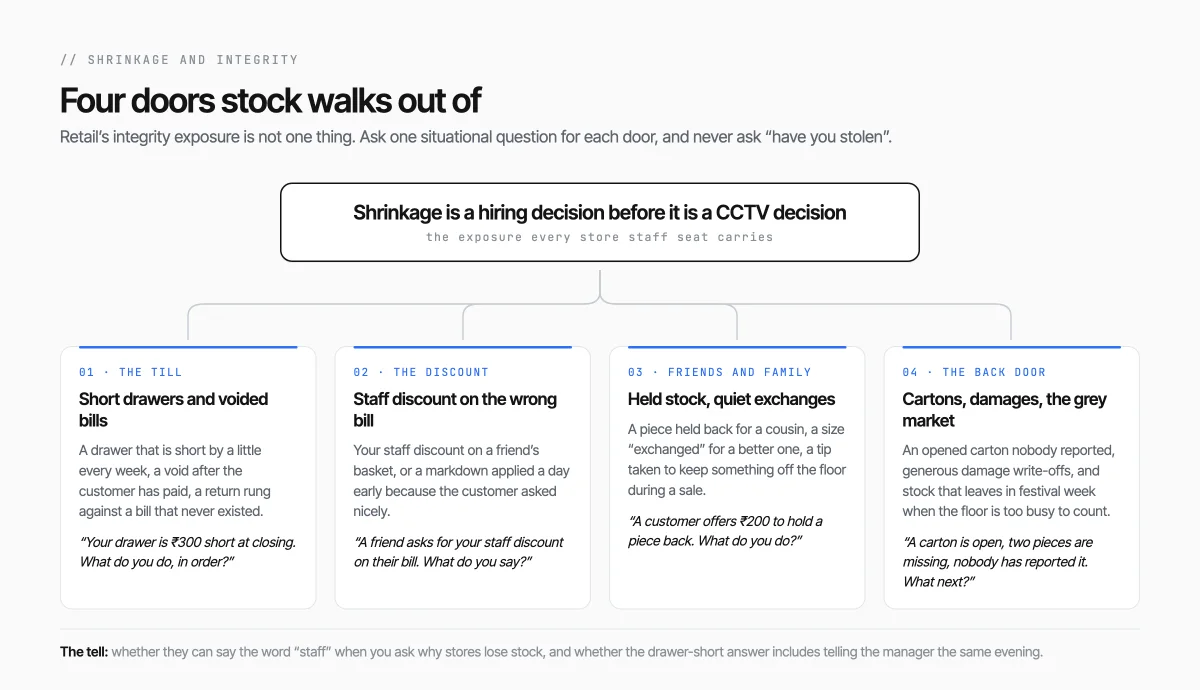
This is the block to weight. Shrinkage is a line in a retailer's accounts, not a hypothetical: Motilal Oswal's June 2024 reading of Trent's FY24 annual report put shrinkage at about 0.41% of sales, up 20 basis points in a year — small as a percentage, large in rupees at the scale of a national chain. Stock leaves a store through its own staff by four doors, and a question for each is worth more than any reference check.
-
"A friend comes in and asks you to put your staff discount on their bill. What do you say to them?"
Strong answer: a flat no, phrased to keep the friend, ideally with a remark that this is the most common way associates lose jobs. A hedge is the answer.
-
"A colleague is billing a customer at a markdown that has not started yet. What do you do that day?"
-
"You find a stockroom carton opened with two pieces missing and nobody has reported it. What next?"
-
"Have you been asked to process a return on something you suspected was worn? What did you do?"
Strong answer: the policy check — tags, receipt, condition — then a polite refusal and an escalation. Someone who accepts "everyone does it" will accept it at your counter.
-
"Tell me about a stock-take that found a variance in your section. What was the number, and what happened?"
Strong answer: a number, a cause and a change. Every store has variances; a candidate who has never seen one has never been in a count.
-
"During the festival rush a customer offers you ₹200 to hold a piece back. What do you do?"
-
"Why do stores lose stock? Give me the three reasons you have actually seen."
Strong answer: customer theft, billing errors, and staff — the third said without being led. A candidate who cannot say "staff" out loud is not the one you want closing the till alone at 9 pm.
Standing hours, weekends and festival-season availability
The block every published list skips, and the one that decides whether your hire is still there for the end-of-season sale. The peak everybody hires for at once is also the week your associates want off: Adecco India's festive-season outlook, as reported by People Matters in August 2026, expected 2.5 to 2.7 lakh temporary and gig roles this season and said around 80% of employers were short of frontline staff.
-
"Where do you live, and how will you reach this store by 9:30 on a Sunday, when there are fewer buses?"
Strong answer: an exact route and time. Retail's joiner drop-off starts here.
-
"Your weekly off will be a weekday, never a Saturday or Sunday. Is that a yes from you, and from your family?"
-
"Diwali week, Christmas week and the end-of-season sale are all-hands. Which of those can you not work? Tell me now."
Strong answer: a straight answer, including a candid "I go home for Pongal every year," which you can roster around. A fast yes that becomes a leave request in October cannot be.
-
"This job is nine to ten hours on your feet with two breaks. Have you done that, and what was the hardest part?"
-
"What is your notice period, and have you told your current store yet?"
-
"How many jobs in the last two years, and why did each one end?"
Grooming and store-standards discipline
-
"Describe the grooming standard at your last store, and what you were pulled up on."
Strong answer: names the standard — uniform, hair, nails, badge — and admits one correction. Never pulled up on anything means a store without standards, or a candidate not telling you.
-
"It is 10 am, the store has just opened, and the closing shift left your section a mess. What do you do first?"
-
"What does a store look like when the manager is not there?"
Strong answer: the same. Any hedge tells you what your store looks like on the manager's weekly off.
Upselling and attachment without pushiness
-
Live task: "I have just bought a pair of formal trousers. Attach one item. If I say no, stop."
Strong answer: one item that fits the purchase — a belt, a shirt, the second pair on offer — in one sentence, and a clean stop at the no. Watch for the second attempt; that is the associate customers avoid.
-
"What was your average bill value or units per bill, and what did you do to move it?"
Strong answer: a number and a lever. "I always suggested add-ons" without a number is a poster in the back office.
-
"When is it wrong to upsell?"
-
Live task: "I am the customer. 'This exact shirt is ₹300 cheaper online.' Sell it to me anyway."
Strong answer: does not match the price and does not argue about the app. Asks one question, then names what the store gives that a parcel cannot — try it now, exchange across the counter, take it home today. Discounting on the spot is a decline for the till, not just the sale.
The language of the catchment
-
"Which languages can you sell in, and which can you handle an angry customer in?"
Strong answer: two different lists. The second is the one that matters at the returns counter on a Sunday.
-
Live task: "Greet me and ask what I am looking for — in the language most of our customers speak, then in English." (Pick the language of this store's catchment, not the city's. A store in Whitefield and a store in Malleshwaram need different answers.)
-
Live task: "I am the customer. I want a refund on a kurta I have worn once. You cannot give it. Tell me — in the customer's language."
Strong answer: the no is in the first sentence, the reason is plain, what they can do — exchange, alteration, credit if policy allows — follows, and it holds when pushed. Refusing politely in a second language is a different skill from refusing in your own, which is why you score it in the catchment's.
If the screen is live, there is a fair 41st, asked plainly at the start: "Is anyone with you right now?" It is not a lie detector. It is an honest deterrent, and the cheapest of the countermeasures against a proxy on the line.
The ten-minute phone screen for store staff
Forty questions is a bank, not a call. A first round is ten minutes, the telephonic round's four blocks compressed, and the order is the instrument: cheapest disqualifiers first, then the two things a store cannot train, then the thing that decides whether they last.
- Minutes 0–2: the knockout block. Commute to this store, weekday off, festival weeks, notice.
- Minutes 2–5: two live tasks. The sell-back (7) and the online-price objection (37), or the refund refusal (40) in the catchment language.
- Minutes 5–8: integrity. The staff-discount question (18) and the three-reasons question (24), scored hard.
- Minutes 8–10: staying power. Standing hours (28) and the last two years (30).
Everything else belongs to the floor trial, which is the expensive round. The screen exists to make sure the people who get a trial are the right people.
Hiring against a store-opening date
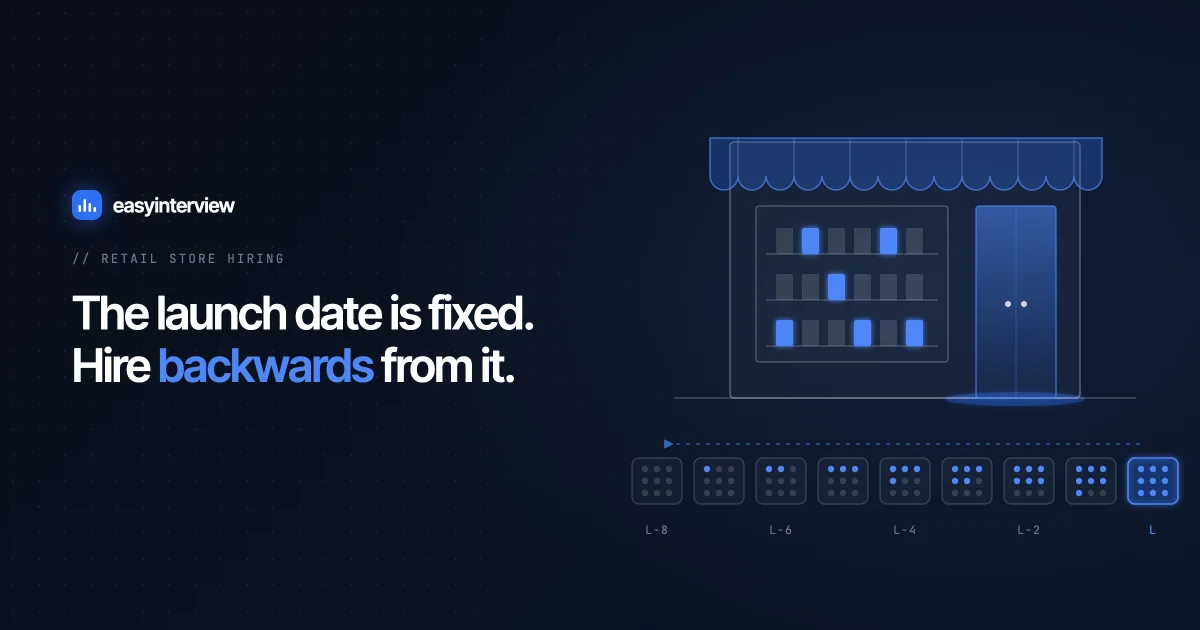
Most volume hiring has a soft deadline. Store hiring has a hard one, printed on a hoarding: the launch date is announced to the landlord, the mall, the press and the catchment, and it does not move because screening ran late. Every day the pipeline slips past it is a day of a fitted-out store with an empty floor — or, more commonly, a store opened with staff borrowed from three sister stores that are now short.
The scale is real. Trent's results release for the year to March 2025 (Trent, April 2025) reports 244 Zudio and 40 Westside stores opened in one financial year, more than five a week, each needing a trained team on day one. Smaller chains open fewer stores and face the same clock.
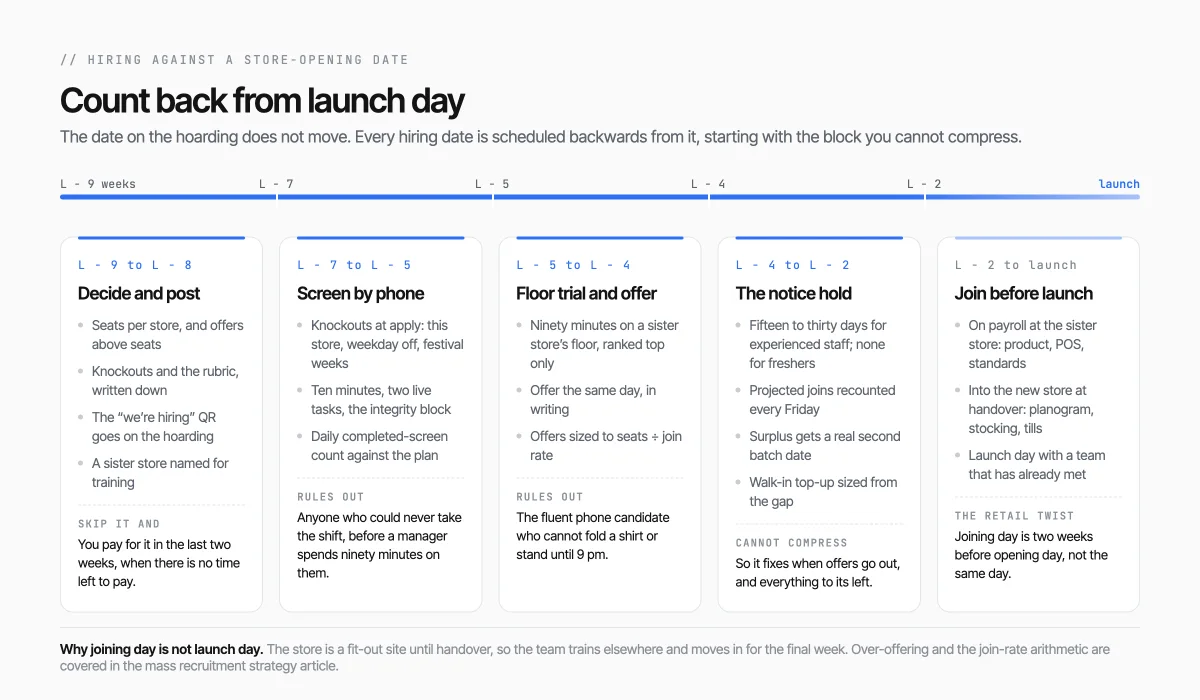
Two things about this calendar are specific to retail. Joining day is not launch day. The new store is a construction site until handover, which often lands only a week or two before opening, so associates go on payroll before that — learning product, POS and standards at a sister store — and move into their own store for planogram, stocking and till setup in the final days. The joining date sits a couple of weeks before the launch date, and everything else counts back from there.
The notice hold sets the start. Experienced associates carry fifteen-to-thirty-day notices; freshers carry none but hold several offers at once. The hold is the block you cannot compress, so it fixes when offers must be out, which fixes when trials must run, which fixes when the phone screen must start. Nine weeks before launch is a working figure for a chain hiring mostly experienced staff; a fresher-heavy plan can start later, with a join rate it knows least.
The rest is not specific to retail and is covered elsewhere on the blog. Chains routinely offer well above the seat count, because joiner drop-off for store staff is high and late: the offer that looked accepted evaporates when a nearer mall opens. The arithmetic for sizing the over-offer — seats divided by join rate, a real second batch date for any surplus, projected joins recounted every Friday — is in the mass recruitment strategy for India, and the phase-by-phase process behind it is in the bulk hiring process. Use those rather than a rule of thumb; the join rate that matters is yours.
One sourcing note. The best channel for a new store is the hoarding outside it: a "we're hiring" QR code on the construction fascia reaches exactly the people who live in the catchment and pass it twice a day, which is the commute knockout solved at source. apna and WorkIndia fill the rest; foundit and Shine are for the store manager.
Adapting the bank: fashion, grocery, electronics
"Store staff" covers at least three jobs. Re-weight before you use it.
The default weighting above, with the floor and the fitting room doing most of the work.
- Weight up
- Customer approach to 20, Upsell and attachment to 15. Take it out of Billing and Product learning.
- Add
- "A customer in the fitting room asks if it suits them, and it does not. What do you say?"
- Also add
- "What does the floor look like at 7 pm on the first Saturday of the end-of-season sale, and what is your job in it?"
- Watch for
- Stock answers that stop at the shelf. Fashion shrinkage is fitting-room shrinkage; ask how they counted pieces in and out.
Billing volume, early shifts and perishables. The counter matters more than the pitch.
- Weight up
- Billing and POS to 20, Shrinkage to 25, Hours to 20. Upsell drops to 5.
- Add
- "An item scans higher than the shelf label, with a queue behind the customer. What do you do?"
- Also add
- "How did you handle near-expiry stock in your section?"
- Watch for
- A candidate who has never done a rotation. First-in-first-out is the whole job in dairy and bakery.
A catalogue that changes monthly, a customer who has read the reviews, and finance schemes at the counter.
- Weight up
- Product learning to 20, Catchment language to 15. Shrinkage stays at 20: the boxes are small and the tickets are large.
- Add
- "A customer wants 'a good camera' and has ₹20,000. Ask me two questions, then recommend."
- Also add
- "A customer wants to buy on EMI. What do you check before you promise a monthly figure?"
- Watch for
- Spec-reciting without a question first, and any looseness about what a finance scheme costs the customer. In this format, mis-selling is the integrity failure.
Screening at volume: where the hours go
Take a chain opening thirty stores on one date, eight associates each: 240 seats. Say ten applicants a seat, a ten-minute first-round call, and a floor trial for two shortlisted candidates per seat at ninety minutes of a sister-store manager's time each.
Arithmetic from the assumptions stated above, not a benchmark or customer data. Trial hours are spread across thirty sister-store managers; the call hours land on one central team.
The trial hours look larger, but they are spread across thirty store managers, about a day each. The 400 call hours land on one central recruiting team inside a two-week screening window: three recruiters doing nothing else, assuming every call connects first time. Nobody spends it. The calls shrink into availability checks, or the pile gets cut on resumes, which for a job whose skills are audible and physical is close to cutting at random. Either way the trial slots go to the wrong people, and the stores open with the sister stores' staff.
That is why the screen has to be sharp rather than long, and run in parallel rather than in a queue. Run your own numbers in the cost-per-hire calculator; the bottleneck sits in the same place whether the role is store staff, telecallers or field sales.
How EasyInterview runs a store staff screen
EasyInterview is built for that 400-hour block.
One branded apply link goes out to LinkedIn, Naukri, Indeed, apna, WhatsApp, foundit, Shine, a careers page or a QR poster at the store — for a new store, on the hoarding — and a CSV of applicants you already have enters the same pipeline. You write the knockout rules, which for a store are location against this store, shift and weekend availability, notice period and salary band, and they are shown politely to the candidate at submit. Every decline is clicked by a human, every rule has an "include anyway" override, and every screened candidate gets an outcome message.
Everyone who clears them gets a live AI phone interview in their own language, across eleven: English, Hindi, Bengali, Tamil, Telugu, Kannada, Malayalam, Marathi, Gujarati, Punjabi and Odia. For a chain that means screening the Malleshwaram catchment in Kannada and the Whitefield one in Hindi or English from the same pipeline. The AI is disclosed in every invite, candidates pick their own slot over WhatsApp with a one-tap reschedule, and a person reads the transcript.
The call does not read a script. It probes a vague answer with follow-ups — the drawer-short answer that stops at "recount", the "I always upsell" with no number behind it — and flags coached or scripted answers rather than scoring them as fluent. Calls run in parallel, so a thirty-store opening does not take longer to screen than a one-store opening; the window is set by applicant volume, not recruiter headcount.
What comes back is a ranked shortlist scored on seven dimensions — Communication, Role knowledge, Experience fit, Problem solving, Availability, Integrity and Language fluency — with every rating pinned to the moment in the call that earned it, plus the recording, the transcript and a percentile rank. Integrity and Availability are scored dimensions rather than notes in a margin, which is the point for a store. Consent is collected at apply, and every message carries a STOP opt-out.
The honest caveat: this is a newer product without a public bulk-hiring case study yet. Evaluate it with a pilot on one live store, run alongside your existing screen, and compare the two shortlists — then compare who was still on the floor at ninety days. The comparison page covers how this differs from a chat pre-screen or an outsourced call centre.
Frequently asked questions
What should I ask a fresher with no retail experience?
Drop the questions that need history — 8, 11, 12, 17, 22, 30, 31 and 35 — and lean on the live tasks, which a fresher can do as well as anyone: the sell-back (7), the change and offer arithmetic (13, 14), the "just looking" opener (3), the online-price objection (37) and the refund refusal (40). Spend the saved minutes on hours. A fresher's risk is not skill; it is finding out in the second week what ten hours standing on a Sunday means.
Should I interview store staff in English or the local language?
In the language of the store's catchment, then check English separately if the format needs it. A store's language is narrower than a city's: one store's catchment can be Tamil-first and another's in the same city Hindi-first, and screening both in English tests a skill neither needs. Questions 38 to 40 exist for this. Score the refusal, not just the greeting.
How do I assess shrinkage risk without accusing the candidate?
Never ask whether they have stolen; ask what they did the time it happened around them. The staff-discount friend, the early markdown, the open carton, the worn return and the three-reasons question are all situational, and a candidate with a real store behind them has an answer for each. The tell is not a confession. It is whether they can say "staff" when you ask why stores lose stock, and whether the drawer-short answer includes telling the manager.
How many people should I hire for a store opening?
More than the seats, by a number rather than a feeling. Divide the seats by the share of accepted offers that actually joined at your last opening, issue that many offers, and give the surplus a real second batch date; the worked arithmetic is in the mass recruitment strategy article linked above. If you have no last opening, write down a guess and label it one. The first opening's job is to replace it.
What is the difference between a sales associate, a cashier and a CSA?
In Indian chains the titles blur. "Customer service associate" or "store staff" usually means a combined floor-and-billing role; large formats split the till into a cashier seat and keep associates on the floor. The bank covers both. Re-weight Billing up and Upsell down for a cashier, the reverse for a pure floor seat, and decide which you are hiring before you post, because the knockouts and the trial differ.
Are walk-in drives still the best way to hire store staff?
They are the fastest way to fill the seats nearest the venue, which is not the same thing. A walk-in screens for who could travel that day, so it staffs the store by the venue first and the one across the city last, and the panel's bar drifts by candidate 60. Use a phone screen to rank, a floor trial to confirm, and keep the walk-in as a sized top-up in the last week; what replaces the walk-in drive covers the trade-offs.
Score the till, not the smile
A retail question bank on its own is half an instrument. The other half is the anchored scale that holds the bar in one place across 2,400 calls and thirty stores, plus the discipline of weighting the four things published lists skip: the drawer, the Sunday shift, the standards and the catchment's language. Copy the rubric into a sheet, re-weight it for the format you are actually opening, and run it on the next call.
Book a demo to see EasyInterview take one store opening from a QR code on the hoarding to a ranked, evidence-scored shortlist.
Rohit Pandit
Founder, EasyInterview · easyinterview.life
I build EasyInterview, an AI hiring pipeline for high-volume roles in India. These are field notes on screening at volume, hiring signal, and interview integrity, written from the work rather than from a keyword list.
Connect on LinkedIn