Sales Executive Interview Questions to Ask in Field Sales
38 sales executive interview questions to ask, with a 1-5 rubric for field sales hiring in India: territory, real numbers, a live task and attrition risk.

Every sales executive interview question list online is written for the candidate, and every candidate has read them. That is why you hear the same three sentences all day: I'm target-driven, I build relationships, and I did 110% of my number. This is a set of 38 questions written for the person on the other side of the table, grouped by competency, with a rubric — and built for field sales in India, where the job is a beat, a two-wheeler and a bag, not a CRM dashboard.
What a field sales interview is actually testing
Seven things. "Tell me about yourself" tests none of them.
Four are about the work: territory and beat discipline (can they plan and hold a route), the numbers (do they know their own, with units), selling and objection handling (what happens after the retailer says no), and language and rapport (can they open a conversation in the language the market actually speaks).
Three decide whether the hire survives: communication and reporting (does the DSR get filled, does the ASM find out about a problem before it becomes one), availability and mobility (bike, licence, commute, notice — the reasons a joiner does not join), and integrity (cash, stock, schemes, and what gets said to a retailer to close a month).
The last three are exactly what published lists skip. They are also where the money goes — not on a candidate who interviewed badly, but on one who interviewed well and left in month three, taking a territory's relationships with them.
The number every candidate gives you
Before the questions, the habit that makes them work.
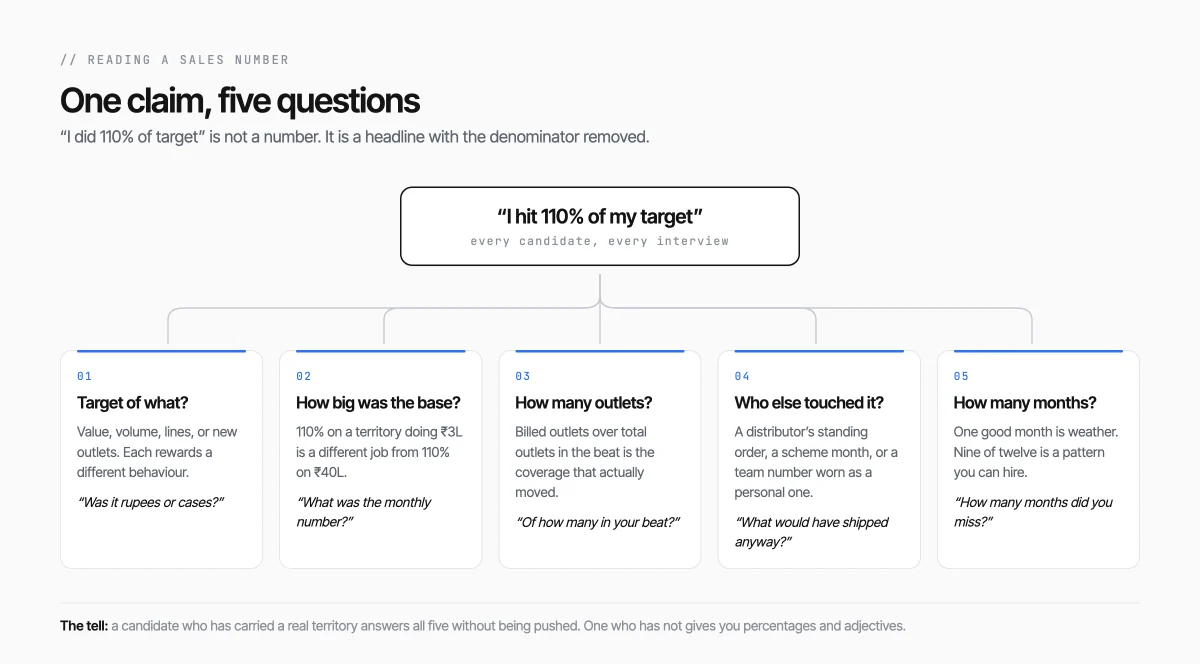
A percentage with no denominator is not a number, and it is the single most common thing a sales candidate says. The fix is not a cleverer question — it is refusing to accept the headline and asking the five underneath it. A candidate who has carried a real territory answers all five without being pushed, usually with a rueful comment about the months they missed. One who has not will keep giving you percentages and adjectives, and will keep doing it for as long as you let them.
The scoring rubric: what a 1, a 3 and a 5 sound like
Score each competency out of 5 while the call is happening, not afterwards from memory. Written anchors are what make two interviewers give the same answer the same number — the same discipline as calibrating an interview rubric for a technical loop, pointed at a frontline role.
| Competency | Weight | 1 | 3 | 5 |
|---|---|---|---|---|
| Territory and beat discipline | 15 | Cannot describe a normal working day or how the route was decided. | Names the beat and roughly how often each outlet was visited. | Describes the beat plan, the coverage they inherited, and what they changed about it. |
| The numbers | 20 | Percentages only. No unit, no base, no misses. | Gives a target and a unit when asked. | Volunteers target, unit, base, outlets billed and the months missed, unprompted. |
| Selling and objection handling | 20 | Repeats the pitch after a no, only louder. | Handles one objection, then folds or discounts. | Qualifies first, handles two objections, closes for a specific next action. |
| Language and rapport | 15 | Only functional in one language; struggles to open with a stranger. | Comfortable selling in the market's language. | Sells and de-escalates in the market's language, and switches register for a shop owner versus a distributor. |
| Communication and reporting | 10 | Vague about what was reported, to whom, how often. | Names the app or format and the daily rhythm. | Describes what they escalate early, and gives an example of raising bad news before it grew. |
| Availability and mobility | 15 | Hedges on bike, licence, commute or notice. | Clear on two of the four. | Own bike and valid licence, exact travel time, unqualified yes on the territory, notice already raised. |
| Integrity | 5 | Hedges on the fake-scheme or short-cash question. | Says no, without reasoning. | Says no, and describes what they did the time it actually happened. |
Re-weight before you use it. A distributor-led FMCG beat should push Territory and Integrity up; a B2B field role should push Selling and Communication up and Territory down. The weights above are a starting point for a general outbound field sales seat, not a law.
38 sales executive interview questions to ask, by competency
These are written to be asked, not answered. Several are live tasks, which is the point — selling is performed, not described.
There are no model answers here, deliberately. Publish sample answers for a role where every candidate reads the same four articles and you will hear your own article read back to you within a month. The italic notes are for the interviewer.
Territory and beat discipline
-
"Describe yesterday. What time did you leave home, where did you go first, and how did you decide the order?"
Strong answer: a real sequence with times and place names. Vagueness here almost always means the beat plan was somebody else's and they followed it without thinking about it.
-
"How many outlets were in your beat, and how many did you actually bill in a month?"
-
"How often did each outlet see you — weekly, fortnightly, monthly? Who decided that?"
-
"Which outlet in your territory was hardest to convert, and what finally worked?"
Strong answer: names a specific shop and a specific lever — credit terms, a scheme, a display, persistence over months. A generic "I built the relationship" is a candidate describing a job they watched someone else do.
-
"You have a new territory and no history. What do you do in week one?"
Strong answer: map and count the outlets before selling anything. A candidate who starts pitching on day one has never inherited a territory.
-
"How did you handle an outlet that ordered from you and the competitor equally?"
The numbers, with denominators
-
"What was your monthly target, and what was it measured in — value, volume, lines, or new outlets?"
Strong answer: gives the unit without being asked. The unit tells you what behaviour their last employer actually paid for, which is usually the behaviour you are about to hire.
-
"What was the territory doing in rupees per month when you took it, and when you left?"
-
"How many calls a day, and how many of those were productive?"
Strong answer: knows both numbers and that they are different. Anyone who has worked a beat knows their strike rate; anyone who has not quotes one number and stops.
-
"Of the last twelve months, how many did you miss? Which ones, and why?"
Strong answer: volunteers the misses with reasons — a scheme that ended, a distributor who went out of stock, monsoon. A candidate who claims twelve of twelve is either exceptional or rounding, and one more question will tell you which.
-
"What part of that number would have shipped without you?"
Strong answer: engages honestly with standing orders and distributor push. This question is uncomfortable on purpose; the candidates who answer it well are the ones who understand their own contribution.
-
"What was your incentive structure, and when did you last earn the full amount?"
-
"How much of your business came from your top three outlets?"
-
"Show me on your phone — what does your DSR or sales app look like at the end of a day?"
Strong answer: opens it. This is the single hardest question in the bank to fake, and it is entirely fair to ask.
Selling and objection handling
-
Role-play: "I run a kirana. 'Your rate is higher than the distributor down the road.' Go."
Strong answer: does not immediately offer a discount. Asks what rate they are comparing, then trades on margin, replacement, credit or delivery frequency.
-
Role-play: "'I already stock your competitor and it moves fine.' Go."
-
"Sell me one product from your last company in sixty seconds. Now sell it to a shop owner instead of to me."
Strong answer: the second version is visibly different — shorter, about margin and rotation, not features.
-
"A retailer asks for 30 days credit. You can give 15. What do you say?"
Strong answer: holds the line and trades something non-monetary. A candidate who invents terms in an interview will invent them in the market.
-
"What is the most common reason a shop says no to you, and what did you change about your opening because of it?"
-
"Tell me about an order you lost after the retailer had already agreed."
-
"How do you get a new SKU onto a shelf that has no space?"
Language and rapport
-
"Pitch that same product to me in the language you'd use in the market. Now in English."
Strong answer: the same three points survive both. Weak candidates lose the structure in their second language and start listing features in whatever order they remember.
-
"Which language would you be comfortable selling in, and which could you handle an angry shop owner in?"
Strong answer: treats these as different bars. De-escalating in a language you only sell in is where field relationships break.
-
"Your territory has outlets where the owner speaks only Marathi and you don't. What do you do?"
-
"How do you open with a shop owner who has never seen you before and is mid-sale with a customer?"
Strong answer: waits, and knows that waiting is the answer. Candidates who interrupt describe a job they have not done.
Communication and reporting
-
"Who did you report to, how often, and in what format?"
-
"Tell me about a problem in your territory that your manager found out about late. What happened?"
Strong answer: owns one. Everybody has one. A candidate with no example is managing your impression rather than answering.
-
"What did you do when a distributor was out of stock on your best-selling line?"
-
"How did you keep track of outlets that promised to order next week?"
Strong answer: it was written down somewhere specific. "I remembered" is a territory that leaks.
-
"What would your last ASM say you were worst at?"
Availability, mobility and attrition risk
The section every published list skips, and the one that decides whether your hire is still there in month three.
-
"Do you own a two-wheeler, and is your licence current?"
-
"Which areas can you cover daily from where you live, and how long is the ride to the far end?"
Strong answer: an exact travel time, given without hesitation, because they have already worked it out. Vagueness here is the most reliable early signal of a joiner who does not join.
-
"This role is six days, out of the house by 9, back after 7, and it rains for three months. Is that a yes from you and from whoever you live with?"
Strong answer: answers both halves. A candid "I need to check" is a better sign than a fast yes.
-
"What is your notice period, and have you told your current employer yet?"
-
"What are you expecting — fixed and variable separately? And what is your current fixed?"
-
"How many jobs in the last eighteen months, and why did each one end?"
Strong answer: dates and concrete reasons — territory reassigned, distributor closed, family move — rather than "looking for growth".
Integrity: cash, stock and schemes
-
"You are short on the month by one order and a retailer offers to take stock he'll return next month. What do you do?"
Strong answer: a flat no, and ideally names it as the thing that wrecks next month too. This is not a trick question, and a hedge tells you what happens on the 30th.
-
"Have you handled cash collection? What did you do the day the amount didn't tally?"
Strong answer: escalated the same day, to a person, with the number. Anyone who says it never happened has either not collected cash or is not telling you.
If your panel runs the screen live, there is a fair 39th: "Is anyone else with you right now?", asked plainly at the start. It is not a lie detector. It is an honest deterrent.
The twelve-minute screen: what to ask when
Thirty-eight questions is a bank, not a call. A first round is twelve minutes, and the order is the instrument.
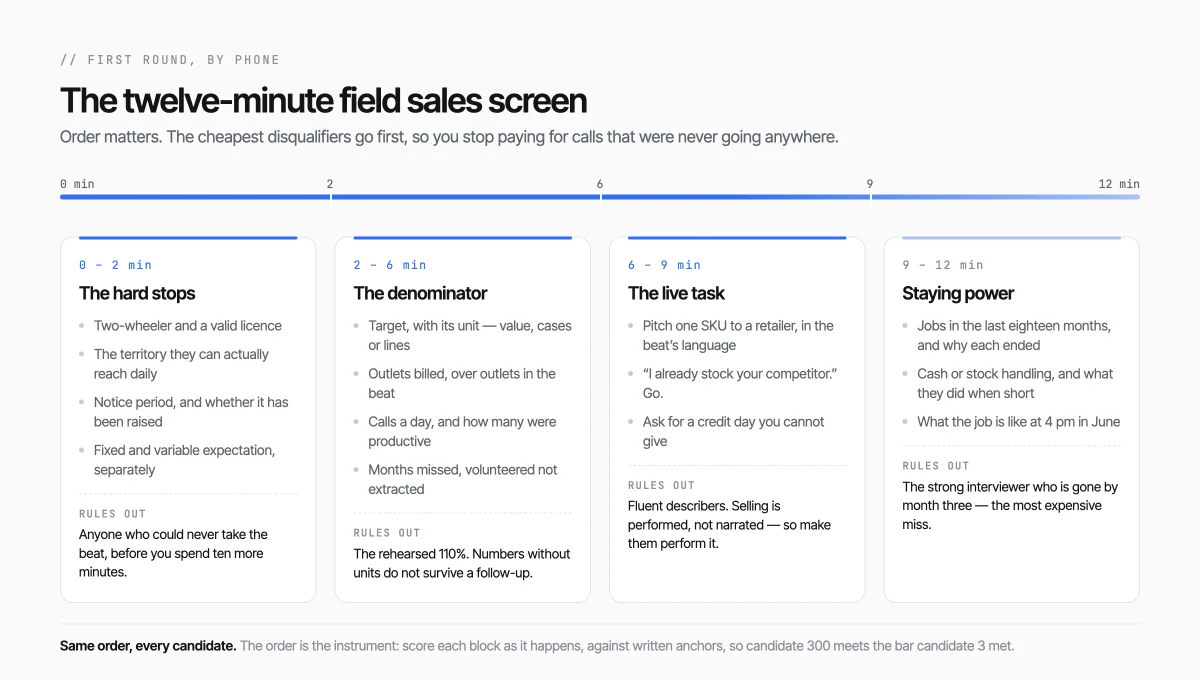
The logic is that disqualifiers are cheap and skills are expensive to assess, so you spend interviewer minutes in that order. There is no sense running a polished role-play with a candidate who does not own a bike and cannot reach the beat — and that is the most common way a screening hour gets wasted.
Adapting the bank: FMCG, B2B field, and BFSI
"Field sales" covers three different jobs. The same questions weighted the same way will hand you the wrong person for two of them.
A beat of kiranas and a distributor in between you and the money — the closest fit to the default weighting.
- Weight up
- Territory and beat discipline to 25, Integrity to 15. Take it out of Communication and Selling.
- Add
- "What was your ECO or productive-call number, and how was it counted?"
- Also add
- "Describe your relationship with the distributor's salesman. Who actually placed the order?"
- Watch for
- A candidate whose numbers were really the distributor's standing orders. Question 11 is the one that surfaces it.
Longer cycles, fewer accounts, a buyer who wants a quotation and three follow-ups.
- Weight up
- Selling to 25, Communication and reporting to 20. Territory drops to 5 — there is no beat.
- Add
- "Walk me through your longest deal, from first meeting to payment. How many touches?"
- Also add
- "Who signs, who blocks, and who did you have to convince who was not in the room?"
- Watch for
- Pipeline described in activity rather than outcomes. Ask what actually closed, and when the money came in.
Regulated selling to individuals, where mis-selling is the expensive failure, not a missed month.
- Weight up
- Integrity to 20, Language and rapport to 20. Selling drops to 15.
- Add
- "What must a customer understand before they sign, even if explaining it loses the sale?"
- Also add
- "Tell me about a customer you talked out of a product."
- Watch for
- Any hint that the lapse or surrender rate on their book was somebody else's problem.
Screening at volume: where the hours actually go
A good question bank assumes an interviewer with attention left. At field sales volume, that is the first thing to go.
Say fifteen territory seats, around 250 applicants, a twelve-minute first-round call each, and a second round that is a real market visit — ninety minutes of joint field work with an ASM, because you cannot assess a field seller in a meeting room.
Arithmetic from the assumptions stated above, not a benchmark or customer data. Your numbers will differ by role, city and channel.
Fifty hours before anybody has ridden anywhere. In practice nobody spends it — the calls get shortened until they are availability checks, or the pile gets cut on resumes, which for a job whose skill is audible and physical is close to cutting at random. Both roads end at the same place: a market visit spent on someone who was never going to take the beat.
That is why the phone screen has to be sharp rather than long. The market visit is the expensive round; the screen exists to make sure the twenty people who get one are the right twenty. Run your own version of this in the cost-per-hire calculator, and the same bottleneck shows up in every volume role — it is the phase where the bulk hiring process breaks, whether you are hiring field sales, telecallers, or support.
How EasyInterview runs a field sales screen
EasyInterview is built for that fifty-hour block.
One branded apply link goes out to LinkedIn, Naukri, Indeed, apna, WhatsApp, foundit, Shine, a careers page, or a QR poster at the distributor point — and a CSV of applicants you already have enters the same pipeline. You write the knockout rules, which for a field role are the ones that matter most: territory, two-wheeler, notice period, salary band, shift. They are shown politely to the candidate at submit. Every decline is clicked by a human, every rule has an "include anyway" override, and every screened candidate gets an outcome message.
Everyone who clears them gets a live AI phone interview in their own language, across eleven — English, Hindi, Bengali, Tamil, Telugu, Kannada, Malayalam, Marathi, Gujarati, Punjabi and Odia. For field sales that is not a nicety: you are hiring someone to sell to a shop owner in Marathi, and the default screen evaluates them in English. The AI is disclosed in every invite, candidates pick their own slot over WhatsApp with a one-tap reschedule, and a person reads the transcript.
The part that matters for this article is the cross-questioning. The call does not read a script — it probes a vague answer with follow-ups until the real number comes out, which is exactly the denominator problem above, and it flags coached or scripted answers rather than scoring them as fluent. Calls run in parallel, so the window is set by applicant volume rather than by how many recruiters you have.
What comes back is a ranked shortlist scoring seven dimensions — Communication, Role knowledge, Experience fit, Problem solving, Availability, Integrity and Language fluency — with every rating pinned to the moment in the call that earned it, plus the recording, the transcript and a percentile rank. Those seven are the same seven competencies in the rubric above, under slightly different names; the instrument in this article and the report the product produces are deliberately the same shape. Consent is collected when the candidate applies, and every message carries a STOP opt-out.
The honest caveat: this is a newer product without a public bulk-hiring case study yet, so evaluate it the way you would evaluate any vendor claim — a pilot on one live req, run alongside your own screen, comparing the two shortlists and then comparing who was still there at ninety days. The sample report shows what one scored call looks like, the comparison page covers how this differs from a chat pre-screen or an outsourced call centre, and how to hire telecallers fast walks the same pipeline end to end on a different role.
Frequently asked questions
What should I ask a fresher with no field sales experience?
Drop everything that needs history — 2, 8, 9, 10, 11, 12, 13, 14, 26, 36 — and lean on the live tasks, which a fresher can do as well as anyone. The sixty-second pitch in two languages, the kirana rate objection, the credit-terms question and the "shop owner is mid-sale" opener all work with zero experience. Spend the time you save on mobility and role realism: a fresher's risk is not skill, it is discovering in week two what six days on a bike in June actually means.
How do I verify a sales candidate's numbers?
You mostly cannot, and chasing verification is the wrong instinct. What you can do is make the claim expensive to fake: ask for the unit, the base, the outlet count and the missed months, then follow up twice on the same thread. Fabrications stay abstract and run out on the second follow-up, while real territories produce specifics without effort. Asking to see the sales app on their phone (question 14) is fair, quick, and harder to fake than any reference check.
Should I interview field sales candidates in English or the local language?
In the language they will sell in, then check the others separately. Screening a Marathi-market candidate entirely in English tests a skill the job does not need and hides the one it does — and in a volume funnel it systematically declines the people who would have performed best in the territory. Questions 22 and 23 exist for exactly this.
What is the difference between a sales executive and a field sales executive?
In Indian job postings the titles overlap heavily, which is why this bank covers both. "Sales executive" is often used for an inside or showroom role where the customer comes to you; "field sales executive" means a beat, a bike and daily travel. Before you interview anyone, decide which one you are hiring, because the weighting changes a lot: territory discipline and mobility barely matter for a counter role and are decisive for a beat.
How do I screen 250 field sales applicants without a month of calls?
Split the job into three steps rather than one. Hard knockouts first — territory, two-wheeler, notice, band — to remove people who could never take the role. Then a short structured screen against written anchors for everyone left, run in parallel rather than in a queue, because a serial queue through one recruiter is the actual bottleneck. Then spend the expensive round, the market visit, only on the ranked top. The failure to avoid is cutting the pile on resumes, since a CV mostly tells you who had help writing a CV.
How do I reduce early attrition in field sales hires?
Ask the availability block properly and believe the answers. Most early exits are not performance failures; they are people who were never going to sustain the commute, the six-day week or the variable-heavy pay, and who said something hedged in the interview that nobody scored. Give that block real weight in the rubric, state the hard parts of the job plainly during the screen, and treat a candid "let me check with my family" as a good signal rather than a weak one.
Score the territory, not the resume
A question bank on its own is half an instrument. The other half is the anchored scale that keeps the bar in one place across 250 calls and three interviewers, plus the discipline of never accepting a percentage without its denominator. Copy the rubric into a sheet, re-weight it for the beat you are actually hiring, and use it on your next call.
Book a demo to see EasyInterview take one field sales req from an apply link to a ranked, evidence-scored shortlist.
Rohit Pandit
Founder, EasyInterview · easyinterview.life
I build EasyInterview, an AI hiring pipeline for high-volume roles in India. These are field notes on screening at volume, hiring signal, and interview integrity, written from the work rather than from a keyword list.
Connect on LinkedIn