How to Calibrate a Technical Interview Rubric
Calibrate a technical interview rubric with behavioral anchors, a repeatable calibration protocol, drift detection, and scores linked to real evidence.
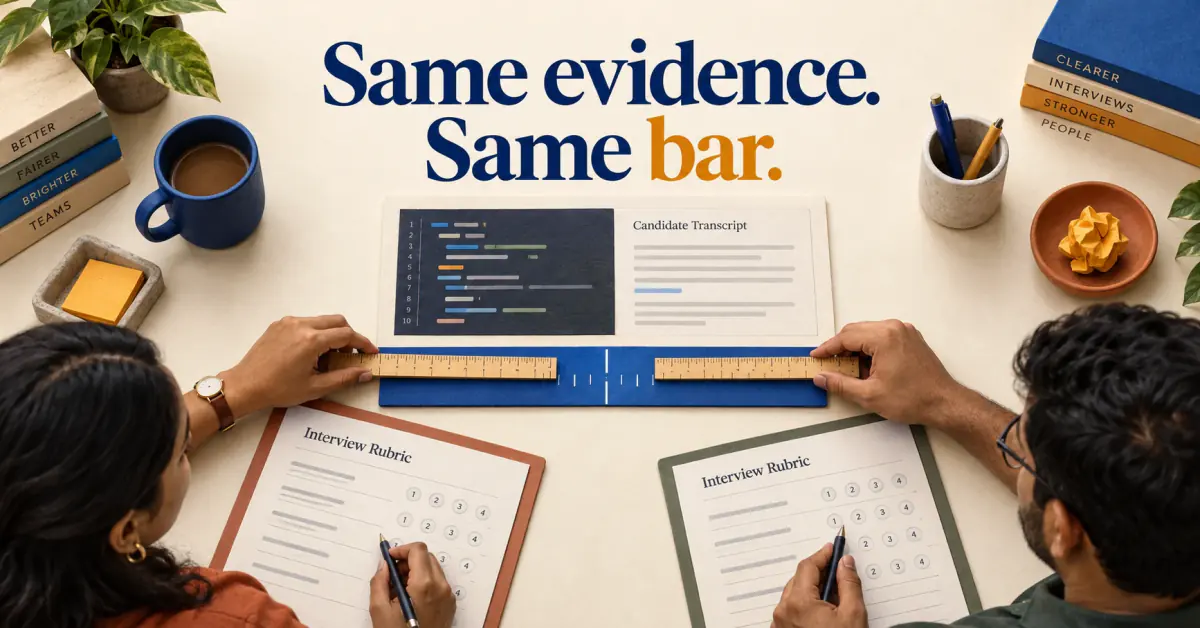
A technical interview rubric is calibrated when two interviewers, watching the same candidate, land on the same score for the same reason. Calibration is not a document exercise. It is the ongoing work of writing behavioral anchors, scoring shared evidence together, and checking for drift once real interviews start.
Most rubrics fail on the second half. The team writes dimensions and a 1–4 scale, circulates it, and never scores anything together. Six months later the rubric is still in the wiki and the hiring decisions still come down to who ran the screen.
This is the process for fixing that: what to put in the rubric, how to anchor it, how to run the calibration meeting, and how to detect drift before it costs you a hire.
Why uncalibrated rubrics still produce inconsistent decisions
An uncalibrated rubric moves the disagreement rather than resolving it. Instead of arguing about whether a candidate was strong, interviewers argue about whether "solid problem decomposition" means a 3 or a 4. The scale looks objective and the variance stays exactly where it was.
Three failure patterns cause most of it.
Adjective anchors. A rubric that defines 3 as "good" and 4 as "excellent" has defined nothing. Every interviewer imports their own reference class, usually the last strong engineer they worked with.
Unweighted dimensions. If communication and correctness both carry equal weight in a senior backend screen, a fluent candidate who ships subtly wrong code can outscore a quiet one who does not.
No shared evidence. Interviewers calibrate against their memory of past candidates. Memory is not a shared artifact, so two people can be internally consistent and still disagree with each other permanently.
Fixing these takes one working session and a recurring check, not a rewrite every quarter.
Choose four to six dimensions and weight them
Start by naming what the role actually needs, then cut the list until each dimension could plausibly change a hire decision on its own. Four to six is the usable range. Beyond that, interviewers stop scoring dimensions independently and start distributing a general impression across the form.
For a senior backend screen, a defensible set looks like this.
| Dimension | Weight | What it tests | Fails the bar when |
|---|---|---|---|
| Problem decomposition | 25% | Breaking an ambiguous problem into solvable parts before coding | The candidate starts writing before the shape of the problem is clear |
| Correctness under constraints | 25% | Working code that handles the stated edge cases | The solution works only on the happy path |
| Trade-off reasoning | 20% | Naming and defending the cost of a chosen approach | Choices are stated but never justified |
| Depth under follow-up | 20% | Holding up when the interviewer challenges an answer | The answer changes shape whenever it is questioned |
| Communication | 10% | Reasoning aloud so a reviewer can follow the path | Work is correct but unexplained |
Weights are a leadership decision, not a committee vote. They encode what the team is willing to trade. If you cannot explain why decomposition outweighs communication for this role, the weighting is arbitrary and interviewers will quietly ignore it.
Write behavioral anchors that describe evidence, not quality
An anchor is a sentence an interviewer can match against something the candidate actually did or said. The test: could a reviewer read the anchor and the transcript, and independently pick the same score? Nothing about that test is specific to engineering: the same method produces the anchored scales in the telecaller and field sales question banks, where the dimensions differ but the discipline does not.
Here is one dimension anchored on a 1–4 scale.
| Score | Problem decomposition — what it sounds like | Evidence to capture |
|---|---|---|
| 1 | Starts coding immediately. When asked what the input looks like, restates the prompt rather than answering. No sub-problems named. | Timestamp of first line of code versus first clarifying question |
| 2 | Names one or two obvious sub-problems ("parse the input, then sort") after prompting. Misses the constraint that drives the design, such as the data arriving unsorted or unbounded. | The prompt that produced the decomposition; the constraint left unaddressed |
| 3 | Unprompted, states the sub-problems and the boundary between them. Identifies the constraint that matters and says how it shapes the approach. Order of attack is deliberate. | Quote naming the driving constraint before coding started |
| 4 | Everything in a 3, plus explicitly rejects an alternative decomposition and says why. Flags which part is most likely to be wrong and plans to verify it. | Quote of the rejected alternative and the stated reason |
Notice what separates a 2 from a 3. It is not effort or polish. It is whether the decomposition arrived unprompted and whether the candidate found the constraint that actually drives the design. That is a factual question about the recording, which is exactly what makes it calibratable.
Two rules keep anchors honest. Use an even-numbered scale so there is no comfortable middle, and describe the 4 as a real behavior rather than an aspiration. If nobody on the current team would score a 4, the anchor is written wrong.
Run the calibration meeting as a scored exercise
The meeting is where the rubric becomes shared. Ninety minutes, everyone who runs screens, three past interviews you already have recordings for. Pick one clear pass, one clear fail, and one that split the team.
-
Score alone first, 20 minutes. Everyone watches or reads the same interview and scores every dimension privately. No discussion. Silent scoring is what surfaces real disagreement; anything else converges on whoever speaks first.
-
Reveal the spread, 5 minutes. Post the scores per dimension. Ignore averages and look only at range. A dimension where scores span 1 to 4 is a broken anchor, not a difficult candidate.
-
Argue from evidence, 30 minutes. Take the widest-spread dimension first. Every participant has to cite the specific moment behind their score. "It felt shallow" is out of bounds. "At 14 minutes they said the index would fix it and could not say what the index would be on" is in.
-
Edit the anchor on the spot, 20 minutes. When the disagreement is real, the anchor is ambiguous. Rewrite it in the room using the language people just used to defend their scores. This is where most of the meeting's value is created.
-
Re-score the split interview, 15 minutes. Apply the edited anchors to the candidate who divided the team. If the spread narrows, the edit worked. If it does not, the dimension is probably measuring two things and needs to be split.
Run this before a hiring push, when a new interviewer joins the loop, and whenever the bar for a level changes. Once a quarter is a reasonable floor for a team hiring continuously.
Detect drift before it costs you a hire
Rubrics decay quietly. Interviewers get more generous under pipeline pressure, stricter after a bad hire, and both effects show up as a moving bar rather than an argument. Watch four signals.
Score distribution by interviewer. Compare each interviewer's median score per dimension against the group. A persistent one-point gap is calibration, not candidate luck.
Pass rate over time. A pass rate that climbs during a hiring crunch and drops after a rough onboarding is tracking your mood, not the talent pool.
Dimension correlation. If every dimension for a candidate scores the same, interviewers are assigning one overall impression and back-filling the form. Independent dimensions should disagree sometimes.
Screen-to-onsite agreement. Track how often a screen pass clears the onsite. Falling agreement means the screen has drifted away from the bar the panel is applying.
None of these need a data team. A spreadsheet of scores per interviewer per dimension will surface all four, provided every score is recorded at the dimension level rather than as a single verdict.
Link every score to the evidence behind it
A rubric is only as calibratable as the evidence attached to it. If a scorecard says "3 — decomposition" with no quote, the next reviewer cannot check the judgment, and your calibration meeting has nothing to score against.
Require three things on every screen: the dimension score, the specific moment that produced it, and what a higher score would have required. That last item is the one teams skip, and it is what turns a rejection into something you can defend and a rubric into something you can improve.
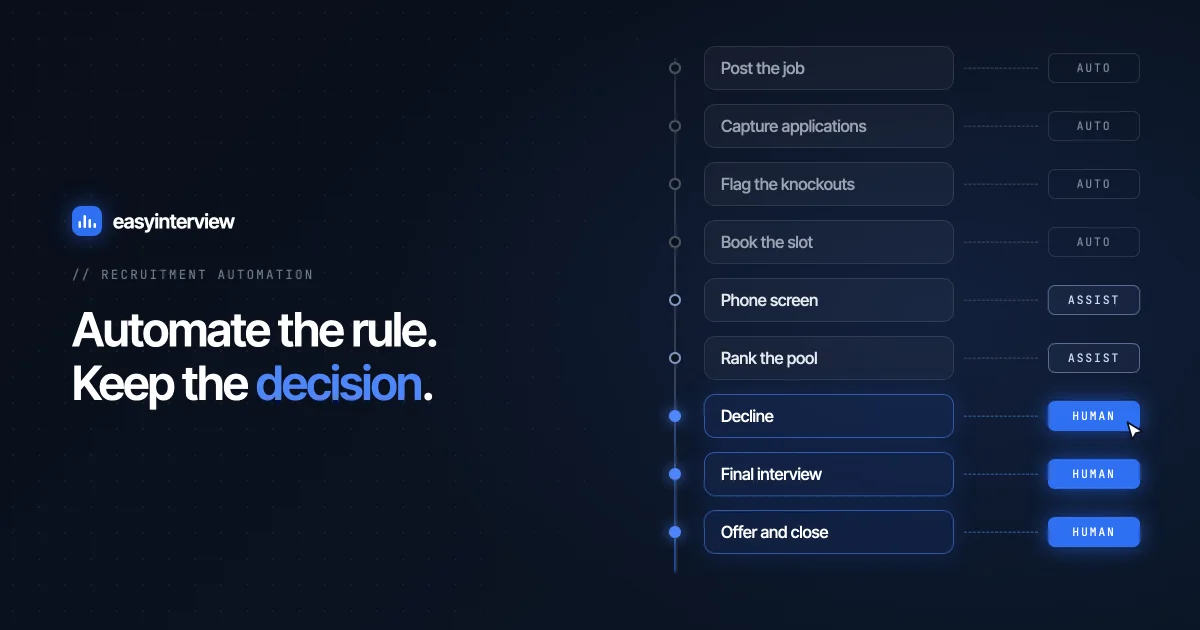
This is also where automated screening earns its place. EasyInterview is an AI hiring pipeline for high-volume hiring: it circulates the job, screens every applicant against the knockout rules you set, phone-interviews the eligible ones in their own language, and ranks them with every score pinned to a quoted moment in the call. For engineering roles it adds a live technical round that runs the rubric your team configures, in a real code editor or on a shared system-design whiteboard, and returns a report with per-question deductions, the transcript quote behind each score, a confidence score, and a recording chaptered by question. Because the same calibrated bar runs for every candidate, interviewer variance is removed from that round entirely, and the report gives your calibration meeting a stack of comparable, evidence-linked interviews to score. You can inspect a sample scorecard to see the evidence shape, and how AI technical screening works covers the round itself in more detail.
Frequently asked questions
How many dimensions should a technical interview rubric have?
Four to six. Fewer, and you cannot distinguish a candidate who is strong in one area from one who is strong in another. More, and interviewers stop scoring dimensions independently and spread a single overall impression across the form.
Should we use a 1–4 or 1–5 scale?
Use an even-numbered scale. A midpoint gives interviewers a place to park uncertainty, which produces scorecards that look complete and carry no signal. Forcing a choice between the lower and upper half surfaces genuine disagreement.
How often should we recalibrate?
Before a hiring push, whenever an interviewer joins the loop, and at least quarterly if you hire continuously. Recalibrate immediately if screen-to-onsite agreement drops or one interviewer's median diverges from the group.
What if two interviewers still disagree after calibration?
Persistent disagreement on one dimension usually means the dimension measures two things at once. Split it, anchor both halves separately, and re-score the interview that caused the disagreement.
Calibrate once, then keep it honest
A technical interview rubric earns its keep when it makes decisions reproducible: the same evidence yields the same score whoever is in the room. That takes anchors written from behavior, a calibration meeting scored against real interviews, drift checks on real data, and every score tied to a quotable moment.
The alternative is a well-formatted document that records the interviewer's opinion in four decimal places.
Book a demo to see how EasyInterview's technical round runs your rubric for engineering roles at any volume and returns the evidence behind every score.
Rohit Pandit
Founder, EasyInterview · easyinterview.life
I build EasyInterview, an AI hiring pipeline for high-volume roles in India. These are field notes on screening at volume, hiring signal, and interview integrity, written from the work rather than from a keyword list.
Connect on LinkedIn