BPO Interview Questions and Answers: What a Strong Answer Sounds Like
36 BPO interview questions to ask, a 1-5 rubric with BPO anchors, a live phone task, and how international voice, domestic voice and chat support differ.
Search "BPO interview questions and answers" and you get the answer key: fifty-five model answers on one page, thirty-three on another, both updated this year. Your candidates have read them, which is why everyone in the queue opens with the same paragraph about how the BPO industry helps businesses reduce costs. This page is the other side of the table: the questions to ask for a voice or chat process, what a strong answer sounds like to the interviewer, and a rubric to score it, written for hiring in India, where the job is a script tree, a client SLA and a cab at 3 am.
Decide the process before you open the bank
"BPO" covers two jobs that share a floor and not much else. Decide which one you are hiring for first, because the bar moves on almost every axis.
| International voice | Domestic voice | |
|---|---|---|
| Customer | US, UK or Australian, on a compressed VoIP line, using idiom nobody learned in school | Indian, mixing Hindi or a regional language into English mid-sentence |
| Shift | Night or graveyard, fixed to the client's hours | Day and evening rotations; 24x7 on some telecom and e-commerce processes |
| Metric that bites | AHT and the client's QA audit score | Repeat-call rate and CSAT; regulator complaints on BFSI processes |
| Data rules | PCI DSS on payment calls, the client's PII policy | KYC and account data; India's DPDP Act is the reference point |
| Language bar | Understanding a native speaker at pace, and being understood first time | Switching languages and registers without losing the thread |
| What ends the tenure | The night shift, the commute, and the family | Pay against expectation, and abusive callers on collections |
Chat and email support is a third job again, where typing, written tone and three conversations at once replace the accent question; the tabs further down re-weight the bank for each. If the seat is outbound, working a list and a dialler, that is a telecaller, and it has its own question bank.
The answer-key problem, and the swap that fixes it
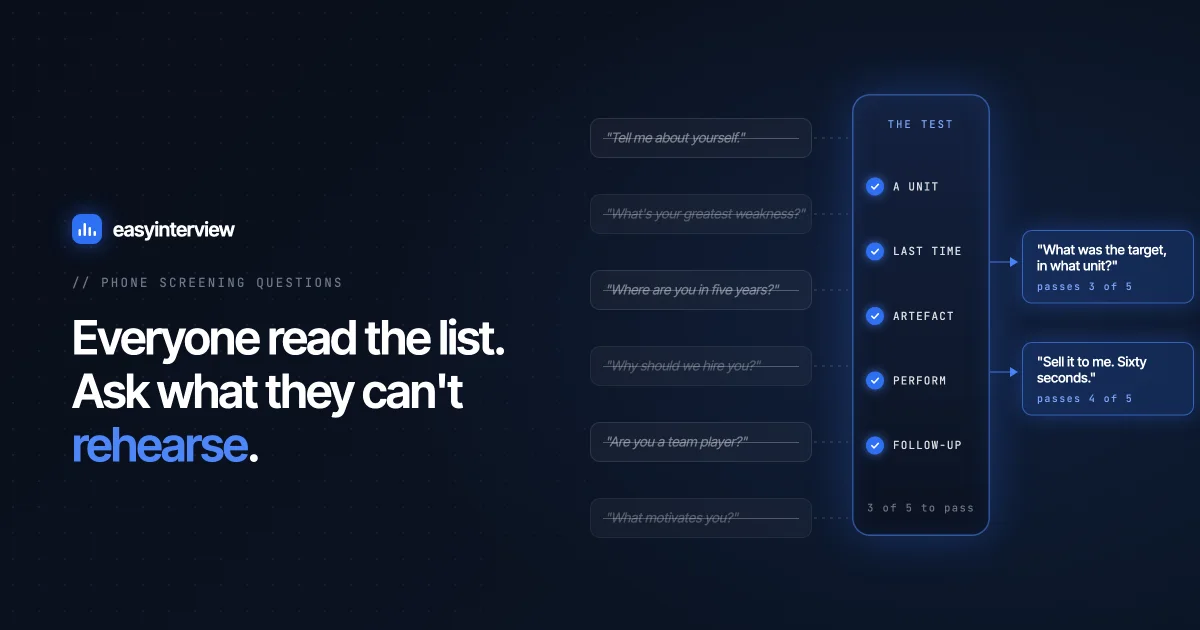
Every prep page answers the same questions, so the interviewer's first job is to stop asking them.
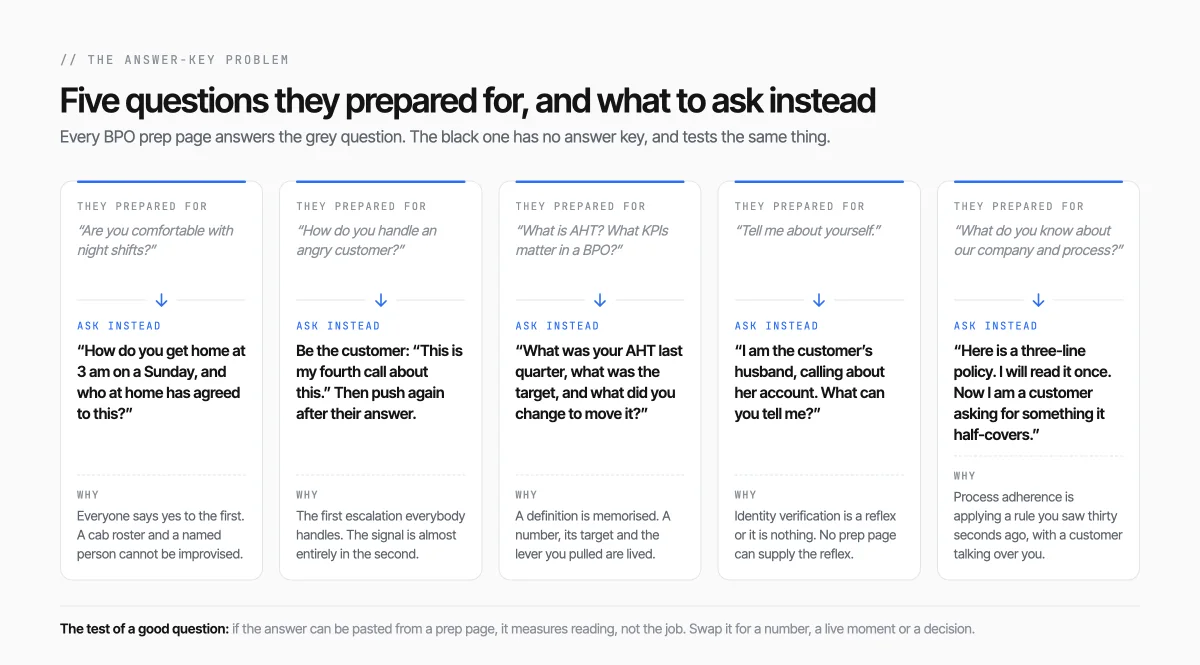
The test for every question below is the one in that footer, and the five-check test is its general form: if the answer can be pasted, the question measures homework, not the job. Numbers with targets, live tasks and decisions under a push cannot be pasted, and they are the whole bank.
The scoring rubric: what a 1, a 3 and a 5 sound like
Six competencies, and fluency is not one of them. Score each out of 5 as the call happens, against written anchors, so two interviewers hearing the same answer land on the same number. The weights are for an international voice seat; the tabs further down move them for domestic voice and chat.
| Competency | Weight | 1 | 3 | 5 |
|---|---|---|---|---|
| Comprehension under accent | 20 | Loses the ask when pace or accent changes; answers the question they expected to hear. | Gets the ask after one repeat, but their own pace never adapts to the listener. | Gets the ask and the detail first time or after one precise clarifying question; changes pace for the listener without losing the structure. |
| Metric literacy | 15 | Can define AHT and CSAT; has no numbers of their own. | Gives their own AHT and the target; cannot say what moved it. | Gives AHT, CSAT or QA with targets, names the trade-off between them, and the specific thing they changed. |
| Process adherence and KB | 15 | Cannot describe a call flow; "I would manage" when the answer is not in the KB. | Names the flow and the mandatory lines; treats the KB as optional under pressure. | Names the flow and why each mandatory line exists; holds with permission, searches, never invents, and raises KB conflicts to get them fixed. |
| Escalation judgment | 15 | Escalates everything or nothing; transfers on the first "get me your supervisor". | Knows the policy list; cannot explain the why. | Explains escalation by consequence, not capability; owns the call once before transferring; contacts the customer before a promised deadline lapses. |
| Data security discipline | 15 | Would help the husband; would write down the card number "to be quick". | Knows the rules when asked; hesitates under a friendly push. | Refuses as a reflex, offers the compliant path, and would report a colleague. |
| Night shift and commute reality | 20 | "Comfortable with any shift"; no plan for 3 am; nobody at home consulted. | Has done nights before; commute plan vague; family "will be fine". | Names the roster, the route, the daytime sleeping arrangement and a household yes that was actually asked for, and knows the take-home number they need. |
36 BPO interview questions to ask, by competency
Written to be asked, not answered. There are no model answers on purpose: publish them for a role where every candidate reads the same four pages and you will hear your own article recited back within a month. The italic notes are for the interviewer.
Comprehension under a customer's accent
-
Live: "I'll describe a problem the way a customer in Glasgow would, at their pace. Then tell me what they want." Read thirty seconds at natural speed with real idiom: "My broadband's been on the blink since Tuesday, I've been on hold for ages, and I'm not being funny but if it's not sorted by Friday I'm off."
Strong answer: the fault, the timeline and the threat, in their own words, after at most one repeat. Score comprehension, never accent.
-
"Say 'the refund will reflect in five to seven working days' the way you'd say it to a seventy-year-old on a bad line. Now to someone in a hurry."
Strong answer: the pace changes and the sentence does not. A candidate who cannot slow down without falling apart is AHT on every call.
-
"A customer uses a word you don't know. What do you say?"
Strong answer: a plain clarifying question, not a bluff. Bluffing at the customer is the most expensive habit on a floor.
-
"Which is harder for you to follow, an American or a British customer? Why?"
-
"The customer is speaking English but every third word is Tamil. Do you switch, stay, or mix?"
Strong answer: on a domestic process, mirrors the customer; on an international one, stays in the client's language and checks comprehension more often.
-
"Explain to me, as a customer, why my bill is higher this month, when you don't yet know the reason."
Strong answer: does not invent one. Names the usual causes as possibilities, then asks the question that would settle it.
Metric literacy: AHT, CSAT, FCR and the QA score
-
"What was your AHT last month, what was the target, and what did you change to move it?"
Strong answer: three numbers and a lever. A percentage with no target is the BPO version of "I hit 110%".
-
"Your AHT came in under target and your CSAT dropped the same month. What happened?"
Strong answer: sees the trade-off at once: rushing, cutting the recap, transferring instead of owning.
-
"What is the difference between first-call resolution and a closed ticket?"
-
"Name one QA parameter you were marked down on, and what the auditor said."
Strong answer: a specific parameter and what changed. "I always scored well" is a candidate who never read the audit.
-
"What was your schedule adherence target, and did you hit it?"
-
"Which of your metrics did you think was unfair, and why?"
Strong answer: a real critique, usually that AHT penalises doing the right thing. "All the metrics were fair" is impression management.
Process adherence and the knowledge base
-
"Walk me through your last process's call flow, greeting to closing. Which lines were mandatory, and why?"
Strong answer: opening, verification, issue capture, hold, resolution, recap, closing, and the compliance or QA reason behind each mandatory line.
-
"A customer asks something that is not in your knowledge base. What are the next thirty seconds?"
Strong answer: hold with permission and a time, search, ask an SME, or offer a transparent callback. Never invent. This question predicts client escalations.
-
"The KB article says one thing and your team lead told you the opposite last week. Which do you follow?"
Strong answer: raises the conflict, follows the documented version unless told otherwise in writing, and gets the KB fixed.
-
"How do you put a customer on hold?"
Strong answer: asks permission, gives a time, comes back before it expires. Tiny question, enormous predictive value, and QA marks it on every call.
-
"Tell me about a time you went off script, and why."
Strong answer: a considered deviation with a reason and an outcome. "Never" is either scripted or not telling you.
-
After the live task: "Give me the case notes for the call we just did, the way you'd type them."
Strong answer: issue, action taken, next step, commitment time, usable by the next agent. Notes are where first-call resolution is won or lost.
Escalation judgment
-
"Give me an example of something you should escalate even though you could fix it yourself."
Strong answer: a fraud indicator, a legal threat, anything touching regulated data. The reasoning is consequence, not capability.
-
"And something you should handle even though the customer is demanding a supervisor."
-
"A customer says they'll post this on social media, or write to the regulator. What changes?"
Strong answer: the tone does not change, the logging does. Watch for the candidate who would bend a rule to avoid a bad review.
-
"You promised a callback within 48 hours. At hour 40 the back office hasn't resolved it. What do you do?"
Strong answer: contacts the customer before the deadline. Silence until hour 49 turns a resolved case into a second complaint.
-
"Tell me about a time you escalated and were wrong to."
Strong answer: has one, and can say where the line was. Nobody who has taken calls for six months has never over-escalated.
-
"The customer has a fair point and the policy still says no. Say the no to me now, then tell me what you'd write in the notes."
Strong answer: a clear no with the reason and an alternative, and notes that feed the case back to whoever owns the policy.
Data security and PII discipline
-
"I'm the customer's husband, calling about her account. What can you tell me?"
Strong answer: nothing until the account holder is verified or has authorised him, said kindly, with a path forward. The best data question in the bank, because the pressure to help is real.
-
"What can you confirm to a verified customer, and what must you never read out even to them?"
-
"Your phone is on your desk and a customer reads out a policy number. Why does that matter?"
Strong answer: a personal device next to PII is the risk. Clean desk, phone in the locker. Anyone from a compliant floor answers instantly.
-
"A friend asks you to check whether someone they know is a customer. What do you say?"
-
"In one sentence, what does PCI DSS mean for you on a call?" (Payment processes.)
Strong answer: do not hear, write or store card data beyond what the process needs, and know the pause-and-resume or secure-capture step. The PCI Security Standards Council's information supplement on telephone-based payment card data (v3.0, 2018) is where those norms are written down; the candidate needs the reflex, not the document.
-
"You notice a colleague photographing their screen. What do you do?"
Strong answer: reports it, per policy. "Mind my own business" is a decline on any process handling client data.
Night shift, commute and staying power
The block every prep page coaches with one sentence, "I am comfortable with rotational shifts", and the block that decides whether the seat is still filled at day 90. Ask about the shift and the arrangement, never about who is at home; the phone screening questions guide draws that line statute by statute.
-
"This process runs [tell them the real shift band]. How do you get home at 3 am, and how do you get in?"
Strong answer: knows about cab rosters and pickup windows, or has a real alternative. Interviewer's note: several states' Shops and Establishments rules require written consent and employer-provided transport for women on night shifts, with Maharashtra's 2018 rules among the examples cited by Nishith Desai Associates. If your floor runs nights, say what the roster is.
-
"How many months have you worked a night shift before, continuously, and why did it stop?"
Strong answer: a real duration and a candid reason. Three months that ended because of "my health" is a data point, not a disqualifier.
-
"Where will you sleep during the day, and will that hold on a weekday at 11 am?"
Strong answer: has thought about it. A daytime sleeping arrangement that fails in week two is the most common reason a good night-shift hire resigns, and nobody asks.
-
"Is this shift a yes for your household as well as for you? What would make it a no?"
Strong answer: both halves answered. A candid "I need to check at home" beats a fast yes.
-
"The fixed pay is X, plus a shift allowance and a performance incentive. What do you need to take home each month, and what happens if the incentive is zero for two months?"
Strong answer: honest arithmetic. A candidate whose rent depends on the incentive leaves after the first bad month.
-
"Why did you leave your last process, in the one sentence you'd say to your old team lead's face?"
Strong answer: specific and not bitter. "Growth" is a candidate who has not decided to tell you.
The live task: the policy card
Thirty-six questions is a bank, not a call. A twelve-minute telephonic round has room for one live task, so make it this one: it works over a phone, takes three minutes, and scores four of the six competencies in one pass.
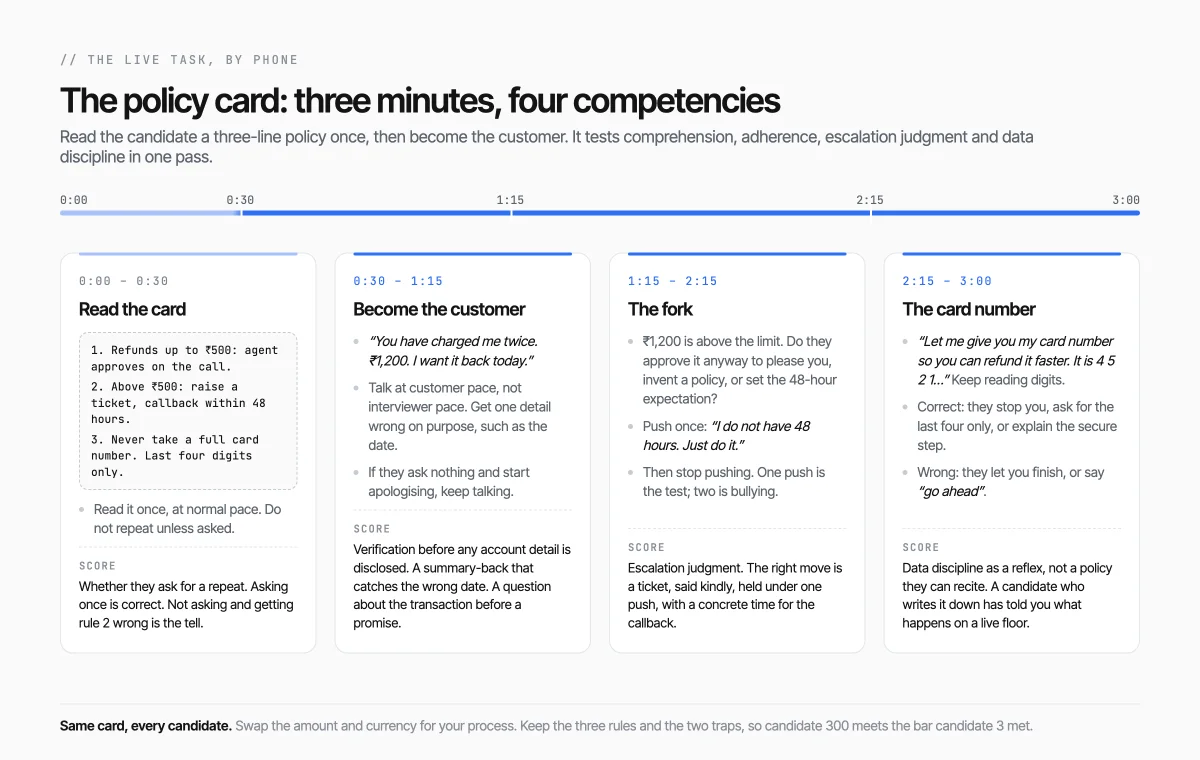
The rules are simple on purpose, so the task measures behaviour rather than memory. Rule one gives the candidate something they can resolve. Rule two forces the fork: the amount is above the limit, and the only correct move is a ticket, said kindly and held under one push. Rule three is the reflex test, and the one candidates fail most, because a customer offering a card number "to make it faster" sounds like help. Score against the rubric as it happens, then ask question 18 and read the case notes. For a domestic process, run it in the process language and make the customer code-switch; for chat, paste the customer's message and score the typed reply.
Adapting the bank: international voice, domestic voice, chat and email
A US, UK or Australian customer at 3 am IST, a client QA audit, and payment data on the line. The default weighting.
- Re-weight
- Comprehension 25, Data security 20, Night shift 20. Take it from Metric literacy and Process adherence, which the training batch will drill anyway.
- Add
- "When a customer says 'y'all', 'reckon' or 'cheers, mate', what do they mean and what do you say back?"
- Also add
- "It is 4 am IST and the client's own supervisor is on the floor listening in. What changes about your call?" The right answer is nothing.
- Decline on
- Letting the card number be read out in the live task, or having no plan for the 3 am commute. Both are cheaper to find now than at the client's first audit.
An Indian customer who switches languages mid-sentence, a day or evening rotation, and a regulator behind the BFSI or telecom complaint.
- Re-weight
- Comprehension stays at 20 but across regional accents and code-switching, not native English. Metric literacy 20, Escalation 20. Night shift drops to 10 unless the process is 24x7, Data security to 10.
- Add
- "A customer says they will complain to the banking ombudsman or TRAI. What do you tell them, word for word?" Strong answers give the customer the correct route, calmly.
- Also add
- Run the policy card in Hindi or the process language, and code-switch into English halfway. Score whether the structure survives the switch.
- Decline on
- Bluffing when they did not understand a regional accent, or treating the customer's language as the customer's problem.
No accent, no voice. Typed comprehension, written tone, and three conversations running at once replace the whole first column.
- Re-weight
- Replace Comprehension under accent with Written communication at 20. Process adherence 20, because macros and templates are the job. Night shift depends on the client's hours; often 10.
- Add
- Live: "I'll paste a customer message with two questions and a typo in the order number. Reply in four lines." Score whether both questions are answered and the typo is caught.
- Also add
- "You are on three chats and one customer has gone silent for two minutes. What do you type, and what do you do with the other two?"
- Decline on
- Pasting a macro that does not answer the question asked. It is the chat equivalent of bluffing at a customer, and the most common failure on a chat floor.
When four hundred candidates have read the same page
At BPO volume the answer-key problem becomes the signal: when the two-hundredth candidate opens with the same paragraph, the sameness tells you where it came from, and the swap questions break the pattern. The habit that matters most is the second follow-up on the same thread; coached answers survive one and run out on the next, which is also the cheapest countermeasure against a proxy on the line.
The harder problem is that you cannot run the policy card four hundred times by hand. The BPO recruitment process article works through what a real ramp demands in screening conversations per day, and why the bottom two-thirds of the pile is usually never spoken to, so it is not repeated here. A question bank only helps the candidates you reach, and at volume the constraint on who you reach is interviewer-minutes, which is why the bulk hiring process breaks at screening rather than sourcing. Getting the night-shift block wrong also has a price the question lists never state: an agent who leaves in month two has consumed a training seat and a client ramp commitment, and the seat goes back into a funnel that has already run once. The bad hire calculator will put a rupee figure on it for your floor.
How EasyInterview runs a BPO voice screen
EasyInterview is built for the first-round call, the one rationed by recruiter hours.
One branded apply link goes out to LinkedIn, Naukri, Indeed, apna, WhatsApp, foundit, Shine, a careers page or a QR poster, and a CSV of applicants you already hold enters the same pipeline. You write the knockout rules, which for a BPO seat are shift availability, location, notice period and salary band, shown politely to the candidate at submit. Every decline is clicked by a human, every rule has an "include anyway" override, and every screened candidate gets an outcome message.
Everyone who clears the rules gets a live AI phone interview in their own language, across eleven: English, Hindi, Bengali, Tamil, Telugu, Kannada, Malayalam, Marathi, Gujarati, Punjabi and Odia. For a BPO floor that is a routing tool as much as a screen: a candidate strong on substance in Telugu and weaker in English is a domestic-process hire, not a reject. The AI is disclosed in every invite, the candidate picks their own slot over WhatsApp with a one-tap reschedule, and a person reads the transcript.
The call does not read questions off a script. It probes a vague answer with follow-ups until the real number comes out, which is the AHT-and-target problem above, and it flags coached or scripted answers rather than scoring them as fluent. Calls run in parallel, so the screening window is set by applicant volume, not recruiter headcount. What comes back is a ranked shortlist on seven dimensions, Communication, Role knowledge, Experience fit, Problem solving, Availability, Integrity and Language fluency, every rating pinned to the moment in the call that earned it, with the recording, the transcript and a percentile rank. Language fluency and Communication are scored separately, which is the split the international-versus-domestic routing decision needs. Consent is collected at apply, and every message carries a STOP opt-out.
The honest caveat: this is a newer product with no public bulk-hiring case study yet. Evaluate it with a pilot on one live process, run alongside your existing screen, comparing the two shortlists and then who is still on the floor at day 90. The sample report shows one scored call, and the comparison page sets out how this differs from a chat-based pre-screen or an outsourced human call centre.
Frequently asked questions
How many rounds should a BPO interview have?
Three, and the first should be the shortest: a ten-to-fifteen-minute structured phone screen that runs the knockouts, the night-shift block and the policy card; a voice or written assessment for the process language if the client requires one; and an operations round where the floor manager or the client tests process fit. Candidates ask "how many rounds are there in a BPO interview" because the answer varies from one walk-in conversation to five rounds, and that variance is the problem. A fixed sequence with written anchors is what lets you compare candidate 300 with candidate 3.
What should I ask a fresher in a BPO interview?
Drop what needs history: 7 to 13, 17, 23, 32 and 36. Most of the bank survives, because the live tasks work at zero experience: the Glasgow passage, the pace test, the husband calling about her account, the policy card, and the whole night-shift block. A fresher's risk is rarely skill; it is discovering in week two what sleeping at 11 am in a shared flat actually means.
Are voice process interview questions different from customer support interview questions?
Mostly in the first column. A voice process adds comprehension under accent, pace control and the hold procedure, none of which exist in chat or email support, where written tone, typing accuracy and concurrency take their place. Metric literacy, escalation judgment and data discipline are the same job in both. For a blended process, run the policy card by voice, then paste one customer message for a typed reply, and score them as two competencies.
Should I test accent in a BPO interview?
Test comprehension and intelligibility, not accent. Whether the customer understood the agent first time, and whether the agent understood the customer, are what move AHT and CSAT. An Indian accent that is clear at a controlled pace is a hire; a neutral accent on a candidate who did not catch the fault in question 1 is not. Asking a candidate to rate their own English or read a passage aloud tests confidence and reading, and neither is the job.
Should I share the questions with candidates in advance?
Share the shape, not the questions. Tell them it is a fifteen-minute call with a short customer role-play and questions about shift and commute, so a nervous but capable candidate is not disadvantaged by surprise. Do not share the policy card or the swap questions; their value is that they cannot be prepared for, and the prep pages will have them within a month if you do.
Score the floor, not the answer key
The candidates have the answers. Your advantage is that the questions that predict a BPO agent's first ninety days, their own AHT with its target, the husband on the line, the card number offered as help, the cab at 3 am, do not have an answer key. Copy the rubric into a sheet, re-weight it for the process you are actually filling, and run the policy card on every candidate in the same order.
Book a demo to see EasyInterview take one BPO req from an apply link to a ranked, evidence-scored shortlist.
Rohit Pandit
Founder, EasyInterview · easyinterview.life
I build EasyInterview, an AI hiring pipeline for high-volume roles in India. These are field notes on screening at volume, hiring signal, and interview integrity, written from the work rather than from a keyword list.
Connect on LinkedIn