Walk-In Interview Alternative: What Replaces the Drive at Volume
A walk-in interview alternative for employers: where drives break at volume, what a virtual walk-in interview is, and how to make the drive a closing event.
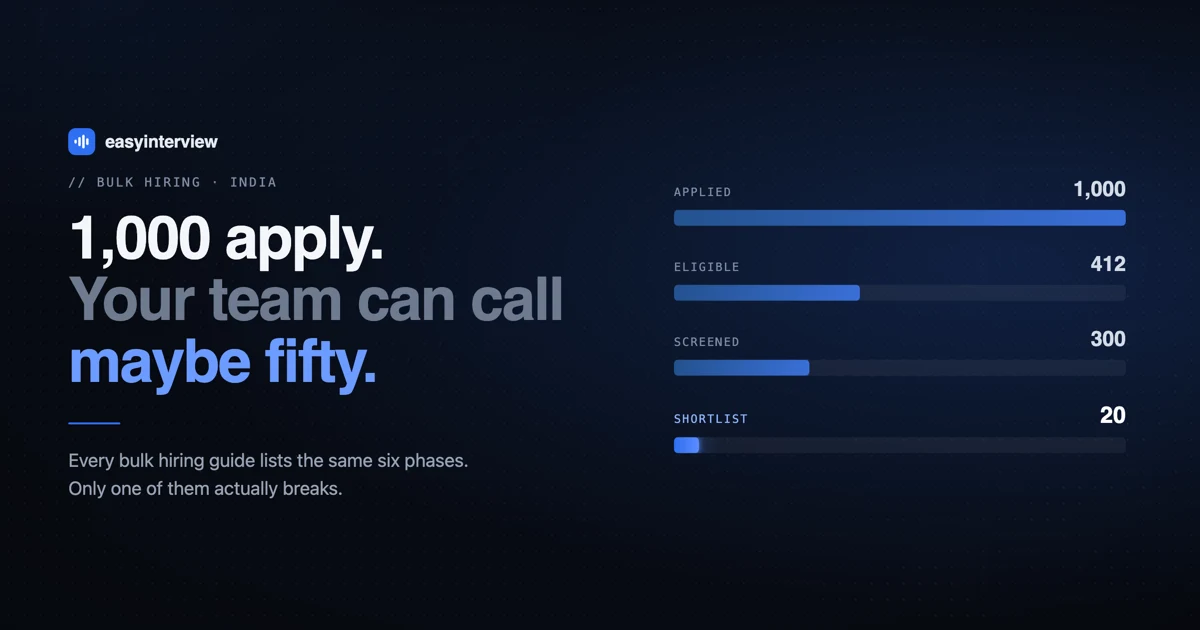
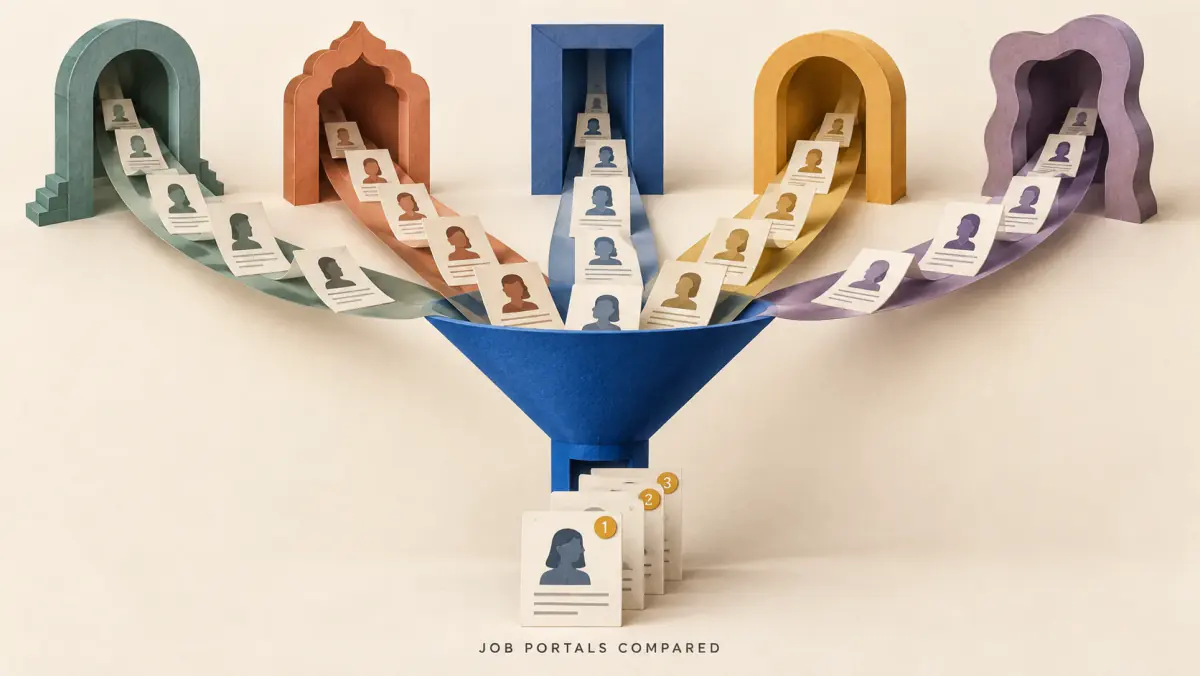
Search for a walk in interview alternative and Google hands you lists of job portals, because it assumes you are a candidate looking for somewhere other than Naukri to find a drive. This page is for the other side of the table: the recruiter who has run walk-in drives for years, has 40 seats to fill by month end, and suspects the hall, the poster and the queue are no longer the fastest way to fill them.
What a walk-in drive still does well
Anyone who calls walk-ins outdated has not hired for a store floor in a tier-2 city. Five things the format gets right:
- Same-day closing. The offer letter is in the candidate's hand before they leave the building.
- Pre-committed turnout. Someone who took a half day and travelled forty minutes is signalling intent no application form captures.
- It works without good internet. Retail, warehouse, security, delivery: many candidates have intermittent data and no email they check. A venue on a poster reaches them.
- Documents and presence are checked in the room. Aadhaar, marksheets, the licence sighted, grooming for a customer-facing role, once, in person.
- Zero technology. A hall, a register and a panel. Anyone can run one tomorrow.
The plan below keeps every item on this list and removes the queue.
Where walk-in drives break at volume
The trouble starts when the drive stops being a way to meet twenty people and becomes the way you filter three hundred. Four things go wrong, and none is fixed by a bigger hall.
A drive selects for who could travel that day. The people who can reach your venue on a Saturday morning live close, are not on a shift, and have nobody to look after at home. That correlates with distance and employment status, not ability. The strongest telecaller in the city may be on another company's floor until 6 pm, and your drive never meets her.
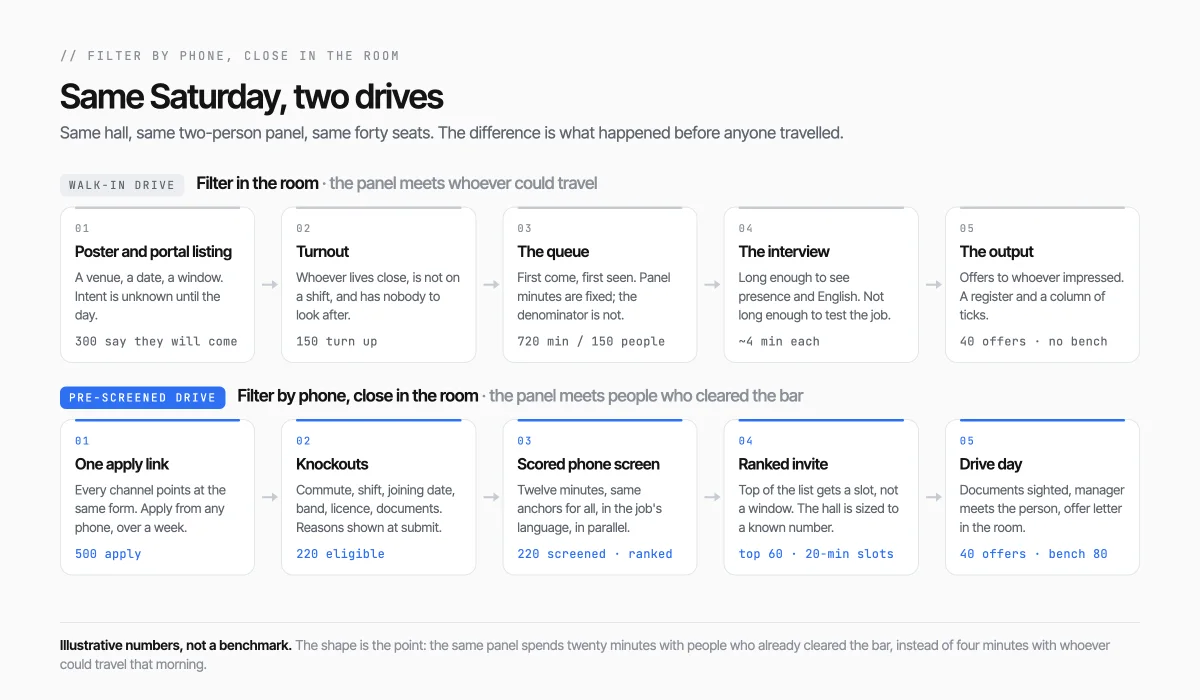
Panel maths. The panel's minutes are fixed before the day starts; turnout is not. Two interviewers for six hours is 720 interviewer-minutes. Divide by whoever walks through the door.
Arithmetic, not a benchmark: 720 interviewer-minutes (two interviewers, six hours, no breaks) divided by turnout. Registration, lunch and the walk to the room all come out of the same 720.
Four minutes is enough to check a document and form an impression, not to find out whether someone can handle an angry customer. So the panel scores what four minutes can see, presence and English, and the drive quietly becomes a grooming check.
The day is unpredictable, and you pay for it twice. You book the hall and roster the panel against a number you cannot forecast. At 60 you paid for empty chairs and a manager's Saturday. At 240 you sent people home at 3 pm who had travelled two hours, and each of them tells ten others.
Nothing is recorded or scored consistently. The output of most drives is a register and a column of ticks. You cannot compare candidate 3 with candidate 30, because the panel at 10 am is not, in any meaningful sense, the panel at 3 pm. There is no evidence for the manager who was not in the room, and no ranked bench when an offer is declined. The pillar on the bulk hiring process in India calls this bar drift: sharp at candidate 10, coasting by candidate 100.
All four come from doing the filtering in the room, where the panel's time is finite and the queue is random. That is the wrong place to filter and the right place to close.
What is a virtual walk-in interview?
A virtual walk-in interview is a walk-in drive with the venue replaced by a video link. The employer opens a Google Meet, Zoom or Teams room for an announced window, often a full working day or a run of days. Candidates join without a fixed slot, wait in the lobby and are admitted one at a time for a short interview when a panel member is free. In Indian job postings the term appears mostly for voice-process BPO, IT-services and work-from-home roles. One August 2026 posting for a work-from-home voice role kept a Meet link open from 10 am to 6 pm for nine days, with one room for Tamil speakers and one for Malayalam, and asked candidates to bring an i5 laptop and a 30 Mbps connection.
What it fixes is real: no hall to rent, and no travel filter, so a candidate across the city can join on a lunch break. For a role done from home on a laptop, the laptop is a legitimate knockout, and the format tests it for free.
What it does not fix is everything else on the list. The queue is still first-come, the panel's minutes are still fixed, nothing is scored against a common bar unless you build one, and nothing is recorded unless you press the button. It also swaps one filter for another: instead of selecting for who could travel, it selects for who has a quiet room, a working laptop and stable data at 11 am on a Tuesday. And a link that does not open at the announced time is a hall with the doors locked; candidates say so on forums.
The honest summary: a virtual walk-in interview is a walk-in with the venue removed, not a redesign of the funnel. Reasonable for a genuinely remote role with genuine hardware requirements; for everything else, the fix is structural.
The alternative: filter by phone, close in the room
A walk-in drive is trying to do two jobs at once, filtering and closing, and it is badly under-resourced for the first. Split them: filter before anyone travels, in a format where panel minutes are not the constraint, and use the room only for people who already cleared the bar.
1. One apply link, not a venue address
Every channel you already use points at the same short form: the Naukri and apna posting, the WorkIndia listing, the WhatsApp groups, the QR poster outside the store. Applications arrive across a week instead of a Saturday morning, you see the count before you book anything, and the candidate on a floor until 6 pm applies at 6:15.
2. Hard knockouts, written before the post goes live
Decide the disqualifiers first and encode them in the form, not in the panel's head. For a frontline role they are usually the same six:
| Knockout | Ask it as | Why a knockout, not a score |
|---|---|---|
| Commute | Area or pin code, and how they would travel | Why joiners stop coming in week three |
| Shift | The exact shift, stated plainly, then yes or no | A yes to an unseen shift is worth nothing |
| Joining date | Notice period, and whether it has been raised | You are hiring for a start date |
| Salary band | Current fixed and expected fixed, separately | Above the band, the interview is wasted |
| Licence or vehicle | Own two-wheeler, valid licence (field and delivery roles) | Cannot be trained or waived on the day |
| Documents | Which documents they hold today | "Come back with your marksheet" is not a close |
Show the reason politely at submit, so nobody travels ninety minutes to hear that the shift is 6 to 3. A person clicks every decline, every rule has an override for the exception you want to see anyway, and everyone who applied gets an outcome. A knockout exists to stop spending interview minutes on questions a form can answer.
3. A structured phone screen for everyone eligible, scored against anchors
This is the step the drive never had. Ten to twelve minutes on the phone, the same questions in the same order for every eligible applicant, scored as the call happens against written anchors, which are what let two interviewers, or one interviewer at 10 am and 4 pm, give the same answer the same number. What that round should test, and the order to run it in, is set out in the AI telephonic interview guide.
| Dimension | 1 | 3 | 5 |
|---|---|---|---|
| Communication | Cannot follow a two-part question; drifts | Answers the question, needs one prompt for detail | Structured, specific, volunteers the example unprompted |
| Role knowledge | Describes the job as they imagine it | Describes a real day in a similar job, one concrete example | Describes the job, its hard part, and how they handled it |
| Availability | Hedges on commute, shift or joining date | Clear on two of the three | Exact travel time, unqualified yes on the shift, joining date fixed |
| Integrity | Hedges on "what did you do when the cash was short" | Says the right thing, without an example | Says the right thing and describes the time it actually happened |
Run the screen in the language the job is done in; a Tamil-market retail seat screened in English tests a skill the job does not need and hides the one it does. Add two or three role-specific knowledge questions; the telecaller question bank and the retail store staff bank are written to drop into this slot.
Two rules of execution. First, the screen must run in parallel, not as a serial queue through one recruiter, or you have rebuilt the drive's queue over the phone. Second, do the arithmetic first: 220 eligible applicants at 12 minutes is 44 recruiter-hours, two working days for three recruiters doing nothing else. This is the bottleneck of the whole plan, the step where automation earns its place, and the sum to rerun in the cost-per-hire calculator.
4. Rank, then invite the top to a drive with slots
Now the drive, as a closing event. Sort by score, invite about one and a half times the seats you need, and give each person a twenty-minute slot rather than a window. Put the score sheet in front of the panel and do the things only a room can do: sight the documents, let the manager meet the person, hand over the offer letter.
Because everyone in the room is expected and pre-screened, the panel spends twenty minutes per candidate instead of four, the hall is sized to a number you actually know, and the manager chooses between people who all clear the bar rather than hunting for the few who do.
5. Close the loop with everyone
Everyone screened gets an outcome, including the people ranked 61 to 120, who are next week's invite list when the first offers meet their drop-off. The old drive had no bench, because nothing was scored. For the compressed two-day version of this plan, how to hire telecallers fast runs the same pipeline against the clock. For the seasonal version — bench math and second-batch dates for a festive peak — see the Diwali hiring checklist.
Walk-in vs pre-screened drive vs fully remote: the decision table
The pre-screened drive is not the answer for every role. The third option is a fully remote screen with no venue at all: phone screen for everyone eligible, a video final for the top, documents verified at joining. Choose per role.
| Walk-in drive | Pre-screened drive | Fully remote screen | |
|---|---|---|---|
| What you pay for | Venue, panel day, lunch, for an unknown turnout | Screening minutes for everyone eligible, then a small venue for a known number | Screening minutes plus video finals; no venue |
| Calendar | One day, but the day is a gamble | About a week: apply window, screen, drive day | Days, set by how fast the screen runs |
| Signal per candidate | Presence, documents, four minutes of talk | A scored screen plus twenty minutes in person | A scored screen plus a video conversation |
| Who it selects for | Whoever can travel that day | Whoever can do the job, then keep a fixed appointment | Whoever can do the job, wherever they are |
| Who it loses | Employed, distant or care-giving candidates | Candidates with no phone at all | Candidates who cannot do a video call; roles needing a physical check |
| Consistency | Panel drift across the day | Anchors on the screen; the room decides between qualified people | Anchors throughout |
| Use it when | Immediate joiners, hyperlocal roles, no connectivity | The manager must meet the person, documents must be sighted, or the role is customer-facing | Remote or phone-based roles, hiring across cities, or the screen is the work sample |
Three worked cases. A telecaller is hired to work a phone, so the phone screen is a work sample and fully remote is usually right. A store or warehouse role needs the manager to meet the person and the documents sighted: pre-screened drive, at the store if you can. A field sales role needs a market visit as its real final round, so the drive shrinks to a document-and-offer session after it. The comparison page covers how the screening step itself differs between a chat pre-screen, an outsourced call centre and a live AI phone interview.
How EasyInterview replaces the filtering half of the drive
EasyInterview is built for steps 1 to 3 of the plan above, the part the drive was never resourced to do. Steps 4 and 5 stay yours.
One branded apply link goes out to LinkedIn, Naukri, Indeed, apna, WhatsApp, foundit, Shine, your careers page or a QR poster at the store, and a CSV of applicants you already hold enters the same pipeline. You write the knockout rules, such as location, notice period, salary band and shift availability, and they are shown politely to the candidate at submit. Every decline is clicked by a human, every rule has an "include anyway" override, and every screened candidate gets an outcome message.
Everyone who clears the knockouts gets a live AI phone interview in their own language, across eleven: English, Hindi, Bengali, Tamil, Telugu, Kannada, Malayalam, Marathi, Gujarati, Punjabi and Odia. Calls run in parallel, so the 44-hour arithmetic above stops being a calendar problem; throughput is set by applicant volume, not recruiter headcount. Candidates pick their own slot over WhatsApp with a one-tap reschedule. The AI is disclosed in every invite, and a person reads the transcript.
The call does not read questions off a script. It probes a vague answer with follow-ups until the real number comes out, and it flags coached or scripted answers rather than scoring them as fluent. What comes back is a ranked shortlist scored on seven dimensions, Communication, Role knowledge, Experience fit, Problem solving, Availability, Integrity and Language fluency, with every rating pinned to the moment in the call that earned it, plus the recording, the transcript and a percentile rank. That list is your drive-day invite list. Consent is collected at apply, and every message carries a STOP opt-out.
The honest caveat: this is a newer product without a public bulk-hiring case study yet. Evaluate it with a pilot on one live req, run alongside your next scheduled drive, comparing the shortlist it produces with the one your panel would have picked in the room. The sample report shows what one scored call looks like.
Frequently asked questions
What is a virtual walk-in interview?
The same format with the venue replaced by a video link. The employer keeps a Google Meet, Zoom or Teams room open for an announced window; candidates join without a slot, wait in the lobby and are interviewed briefly when a panel member is free. It removes the hall and the travel filter and suits work-from-home roles where a laptop and connection are genuine requirements. It keeps the first-come queue, the fixed panel minutes and the lack of scoring, and adds a bandwidth filter of its own.
Is a walk-in interview a good idea for an employer?
For a handful of immediate-joiner seats in a hyperlocal role, where candidates may lack reliable connectivity, yes. As the only filter for a hundred or more applicants, no: minutes per candidate collapse, the day selects for who could travel, and nothing is scored consistently enough to compare candidates or build a bench. Use the drive to close, not to filter.
How many candidates should I invite to a pre-screened drive day?
Work backwards from the panel: two panels running twenty-minute slots for six hours is 36 slots. Invite about one and a half times the seats you need, and never more than your slots; a candidate invited to a slot and then made to queue has been treated worse than a walk-in. If the ranked list is longer, run a second day. The list is already in order.
Can I do this without any software?
Yes. A Google Form with knockout questions, a spreadsheet, a printed anchor sheet and recruiters making calls is the whole plan, and you should understand that version before buying anything. What it cannot escape is step 3's arithmetic: 44 recruiter-hours per role, in parallel or you have rebuilt the queue. That is the one step where an automated phone screen changes the shape of the work, not just the tooling.
Rent the hall to close, not to sort
A walk-in drive fails at volume for a structural reason: it filters in the most expensive room you have, with fixed panel minutes and a random queue. Move the filter to the phone, score it against written anchors so candidate 3 and candidate 30 meet the same bar, and give the room back to the job it does well. The people who travel are the ones you already want to hire.
Book a demo to see EasyInterview take one req from an apply link to a ranked, evidence-scored invite list for your next drive day.
Rohit Pandit
Founder, EasyInterview · easyinterview.life
I build EasyInterview, an AI hiring pipeline for high-volume roles in India. These are field notes on screening at volume, hiring signal, and interview integrity, written from the work rather than from a keyword list.
Connect on LinkedIn