Delivery Boy Interview Questions to Ask, and What to Verify First
Delivery boy interview questions for employers in India: a 90-second document and vehicle knockout, a 1-5 rubric, and 34 questions on cash, routes and safety.
Search for delivery boy interview questions and you get two kinds of page: prep guides written for the rider, and five-question lists written for nobody in particular. Neither says the uncomfortable thing about this role. Most of the signal in a delivery hire is not in the interview. It is a valid licence, a bike that runs, a home inside the zone, a shift the person will actually work, and a phone that runs the app. Those are facts you verify, not qualities you assess.
The interview matters for what a document cannot tell you: what happens to the cash, what happens at the door when the order is late, how they ride when they are behind, and whether they are still logging in during month two. This is a bank of 34 delivery partner interview questions built around that split, with a ninety-second knockout to run first and a 1/3/5 rubric for what is left. It is written for the hub manager, the fleet supervisor and the recruiter filling sixty seats a month, not for the candidate.
"Delivery boy" is what most Indian job posts still say; the rest of this article says delivery partner or rider, which is what the person on the bike is called at work.
What delivery boy interview questions can and cannot tell you
Be honest about the split before you design the screen. It is the screening interview's two halves, can take the job and can do the job, except that for this role the first half is almost entirely documents.
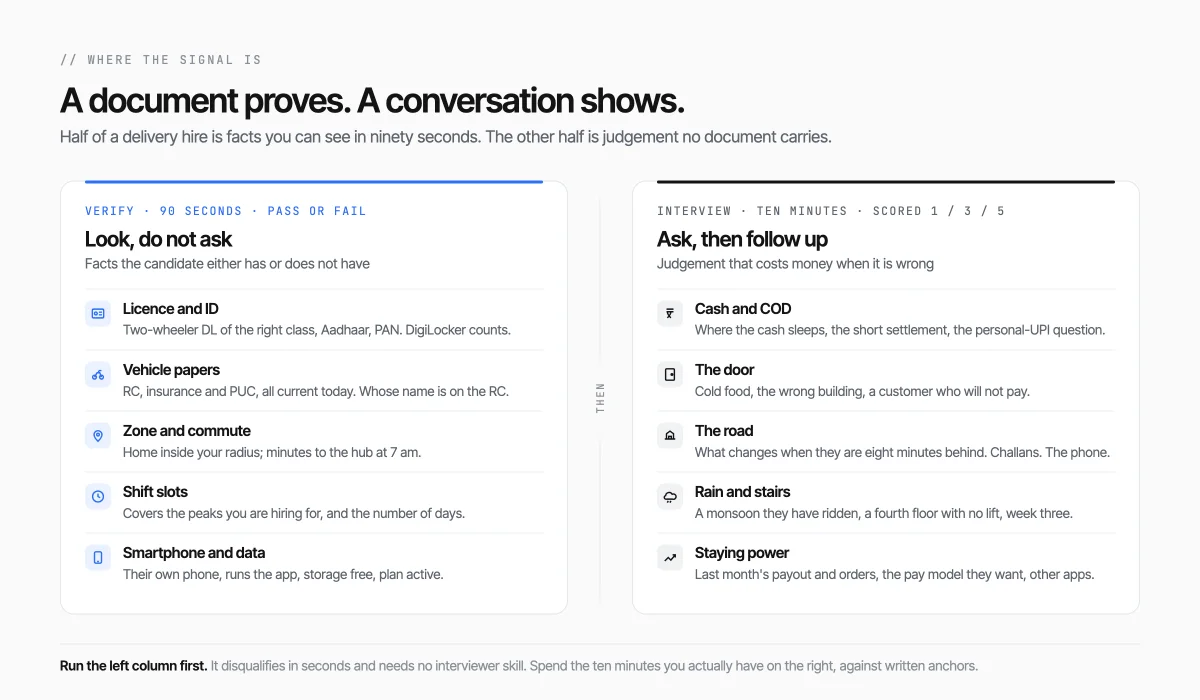
Five things decide whether the person can do the job at all, and all five are facts: a two-wheeler licence and ID, a vehicle with its papers in order, a home inside the zone, the slots you need covered, and a phone that can run the app. No interview question improves on looking at the licence, and fleets that hire on documents alone are right about this half.
Five other things decide whether the hire costs you money, and none of them is on a document: what happens to cash on delivery, what happens at a door when the customer is angry, how they ride when they are eight minutes behind, whether they have thought about a monsoon and a fourth floor, and whether their earnings expectation matches your pay model. A short settlement, a complaint, an accident and an empty slot in week three all come from this half. Verify the first five in ninety seconds; spend the interview on the second five.
The ninety-second knockout: documents, vehicle, zone, shift, smartphone
Run this before any question, at the hub gate, over WhatsApp, or as the first block of a phone screen. Every gate is a fact with a rule attached, which is what belongs on the apply form rather than in the interviewer's minutes. It is pass or fail, not scored, and anyone who fails is told immediately and politely.
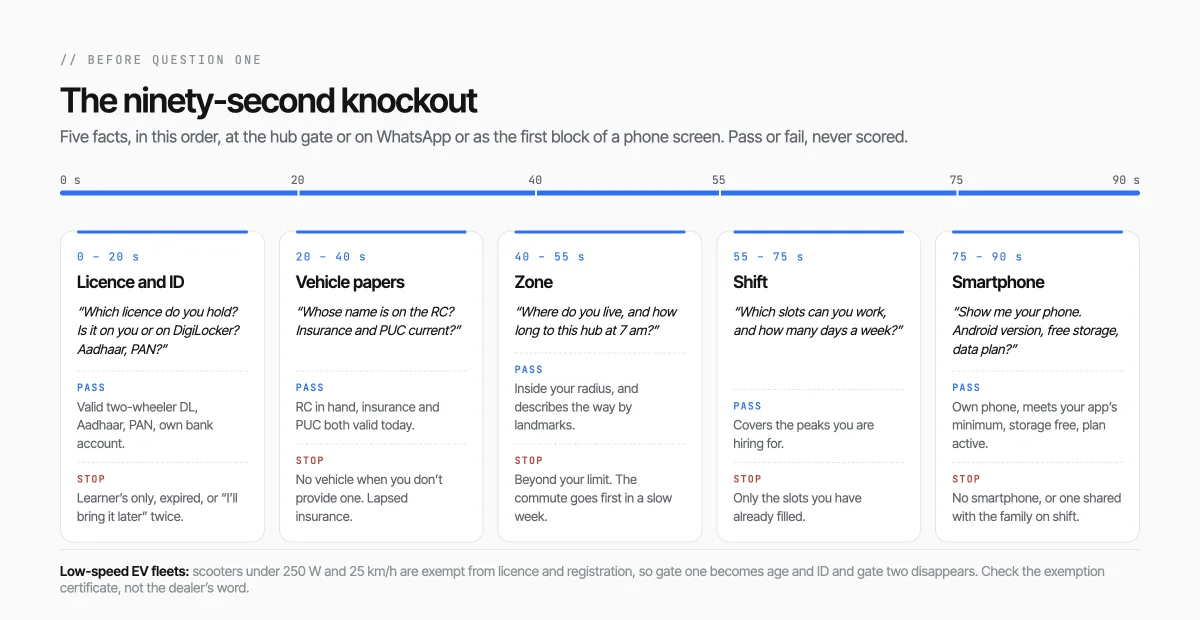
| Gate | Ask | Pass | Stop |
|---|---|---|---|
| Licence and ID | "Which licence do you hold, and is it on you or on DigiLocker? Aadhaar and PAN?" | A valid two-wheeler DL (MCWG for a geared bike, MCWOG for a gearless scooter), Aadhaar, PAN, a bank account in their own name. | A learner's licence only, an expired DL, or "I'll bring it later" twice. |
| Vehicle papers | "Whose name is on the RC? Are the insurance and PUC current?" | Own or family vehicle, RC in hand, insurance and PUC both valid today. | No vehicle when you do not provide one, or lapsed insurance. You cannot put them on the road. |
| Zone | "Where do you live, and how long to this hub at 7 am?" | Inside the radius you set, and they describe the way by landmarks. | Beyond your limit. A long commute is the first thing that goes when a slow week hits earnings. |
| Shift | "Which slots can you work, and how many days a week?" | Covers the peaks you are hiring for. | Only the slots you already have filled. |
| Smartphone | "Show me your phone. Which Android version, how much free storage, which data plan?" | Their own phone, meets your app's minimum version, a gigabyte or two free, an active plan. | No smartphone, or a phone shared with the family during shift hours. |
Three notes. Digital copies on DigiLocker or mParivahan are valid documents in India, so "it is on my phone" is a pass, not a dodge. If your fleet runs low-speed electric scooters (under 250 W and 25 km/h, which are exempt from licence and registration), the first gate becomes age and ID and the second disappears; check the exemption certificate, not the dealer's word. If you provide the vehicle, keep the licence gate and match the licence class to what you hand over.
The scoring rubric: what a 1, a 3 and a 5 sound like
Score each competency out of 5 while the conversation happens, against written anchors. This is the same discipline as the telecaller and field sales banks, with a different set of competencies, because it is a different job.
| Competency | Weight | 1 | 3 | 5 |
|---|---|---|---|---|
| Zone and route knowledge | 15 | Names the city, not the zone. Navigates only by the GPS pin. | Knows the main roads and a few landmarks; can describe a route from the hub to a named locality. | Names societies, one-ways and the buildings that will not let riders up, and says what they do when the pin is wrong. |
| App and smartphone literacy | 10 | Has never used a rider or maps app; cannot say what "picked up" or "delivered" does. | Has used one platform's app and can describe the order flow. | Describes the flow end to end, the OTP or photo step, the masked-call button, and what they do when GPS drifts. |
| Cash handling and COD | 20 | Vague about how much cash they carried or when it was handed in. "We adjust it." | Knows the daily deposit routine. Says they have never been short. | Names the cash limit, the deposit method and cut-off, and describes the evening the amount did not tally and what they did before going home. |
| The customer at the door | 15 | Argues, or promises whatever the customer asks for. | Apologises and calls the support line. | Apologises once, states what they can and cannot do, uses the app's process, and does not take the kitchen's delay personally. |
| Safety and traffic | 15 | Boasts about speed or shortcuts. No helmet in the profile photo. | Says the right things about helmets and signals, with no example. | Describes a specific near-miss and what changed after it. Treats a late order as the platform's problem, not a reason to jump a signal. |
| Physical and weather realism | 10 | Has not thought about rain, heat or stairs. | Has done the job in one season. | Has ridden a monsoon and a May, and describes rain gear, phone protection and how they pace a ten-hour login. |
| Earnings and staying power | 15 | Expects a fixed salary from a per-order role, or the reverse. Cannot name last month's earnings. | Knows the pay model and roughly what they earned. | States last month's payout and orders per day, knows the incentive slabs, explains the last exit in one sentence, and says which other apps they still log into. |
Re-weight before you use it. A cash-on-delivery parcel hub should push Cash to 25. A prepaid quick-commerce dark store should drop Cash to 5 and push Safety and Zone up, because the ten-minute promise is where the risk lives.
34 delivery partner interview questions to ask, by competency
Ask for the licence and the phone before question one; it sets the tone that this is a job with facts in it. There are no model answers here, deliberately. The italic notes are for the interviewer.
Zone and route knowledge
-
"Which localities would you cover from this hub? Name three landmarks in each."
Strong answer: society names, markets and junctions, not the name of the city.
-
"The GPS pin drops you outside the wrong gate. What do you do next?"
Strong answer: reads the flat number on the label, asks the guard, calls the customer with a landmark question. "I follow the map" is a rider who will mark delivered at the wrong building.
-
"Which societies in this area do not let riders come up? How do you hand over there?"
-
"From here to that locality, which way at 7 pm and which way at 11 pm?"
Strong answer: two different routes.
-
"Have you delivered in this zone for another platform? Which one, and roughly how many orders a day?"
-
"Tell me about an address you could not find. How long did you spend, and what ended it?"
App and smartphone literacy
-
Live task: "Open Maps on your phone and search this address."
Strong answer: done in under a minute, on their own phone, with storage and battery to spare. The cheapest test in the bank.
-
"Walk me through one order in the app, from the ping to delivered, in your own words."
Strong answer: accept, reach store, mark picked up, navigate, OTP or photo, delivered, with the cash or OTP step named unprompted.
-
"The app crashes after you have picked up but before you have marked it. What do you do?"
-
"Which language is your phone set to, and can you read order notes written in English?"
Cash handling and COD reconciliation
This is where the integrity exposure sits, so it carries the most weight.
-
"How much cash did you carry on your heaviest COD day, and where was it by 10 pm?"
Strong answer: a number and a deposit method, with the cut-off time. Vagueness about where the cash slept is the answer.
-
"A customer has a ₹2,000 note for a ₹640 order and you have no change. What do you do?"
Strong answer: the company QR or UPI link, then support. Not "I'll come back tomorrow".
-
"If the company QR fails, can the customer pay to your personal UPI?"
The correct answer is a flat no, with the reason. A yes here, however helpful it sounds, is the cleanest integrity signal in the bank.
-
"Your settlement is ₹300 short at the end of the day. Walk me through your next hour."
Strong answer: recounts, checks the app's cash ledger against orders, reports the same evening with the number. Waiting to be asked is the failure.
-
"Have you ever been handed a note you thought was fake? What did you do with it?"
-
"What happens to the cash if you go home with it for the night?"
The customer at the door
-
Role-play: "I'm the customer. 'This is forty minutes late and the food is cold. I'm not paying.' Go."
Strong answer: apologises once, does not argue about the kitchen, points to the refund route in the app, offers nothing from their own pocket.
-
"The label says flat 302 and the customer on the phone says a different building. Whose word do you follow?"
Strong answer: the address in the app, and they report the mismatch. They can say why.
-
"It is 11 pm, the customer is not answering, and the guard says nobody by that name lives here. Your next three steps?"
-
"A customer asks you to fetch cigarettes, or to carry a parcel back for them. What do you say?"
-
"Your best delivery interaction and your worst, one sentence each."
Safety and traffic behaviour
-
"You are eight minutes behind on a stack of three orders. What do you do differently on the road?"
Strong answer: nothing; the app or a call handles the customer. A candidate who says "go faster" or names a signal they skip is a liability, not a hustler.
-
"How many challans in the last two years, and what for?"
Strong answer: an honest count. A pattern of helmet or signal fines is a stop.
-
"Tell me about a fall or a near-miss on the bike. What changed afterwards?"
-
"Where is your phone while you ride?"
Strong answer: on a mount, with voice navigation. In the hand is a no.
-
"It is raining and the road under the flyover is flooded. What do you do with the order?"
Physical and weather realism
-
"Describe a day you rode through heavy rain. What went wrong, and what do you carry now?"
Strong answer: a rain cover for the bag, a pouch for the phone, and a slower pace they can describe.
-
"This is a ten-hour login with two peaks, six days a week. Have you done that for a month straight? What did week three feel like?"
-
"Twelve kilos of groceries, fourth floor, the lift is out. What do you do?"
Earnings, gig versus payroll, and staying power
This is one of the highest-churn roles in India, and most exits are a mismatch between what the rider expected to earn, and how, and what the role pays.
-
"What did you earn last month, and how many orders a day was that?"
Strong answer: both numbers, and the split between base, distance and incentive.
-
"This role is [per-order with a weekly payout, or a fixed salary with a fuel allowance]. Which have you done, and which do you want?"
Strong answer: has done both, or knows the difference. A per-order rider who wants a salary leaves in the first slow week; a salaried rider who wants incentives leaves in the first busy one.
-
"Why did you stop riding for your last platform, and which apps are you still logged into?"
Strong answer: one sentence for the exit, and an honest list. Multi-apping is normal in this market; hiding it is the signal.
-
"How many days did you log in last month?"
-
"The night slot: is that a yes from you, and from whoever you live with?"
Adapting the bank: quick commerce, food delivery, parcel hubs and your own fleet
"Delivery partner" covers four different jobs. The same questions weighted the same way will hand you the wrong rider for three of them.
A dark store, a two to three kilometre radius, a ten-minute promise, and almost no cash.
- Weight up
- Safety to 25, Zone to 20. Cash drops to 5. The risk is on the road, not in the bag.
- Add
- "How many orders an hour at peak, and what happens to the promise time when it rains?"
- Also add
- "Name the five nearest societies and which gate each one uses for riders."
- Watch for
- Speed as a point of pride. Question 22 is the one that decides it.
Two peaks a day, a restaurant that runs late, and a customer at the door with cold food.
- Weight up
- The customer at the door to 20, Physical realism to 15. Cash stays at 15 for COD markets.
- Add
- "The restaurant is fifteen minutes late. What do you tell the customer, and when?"
- Also add
- "How do you carry a curry and a cold drink in the same bag through rain?"
- Watch for
- A rider who blames every late order on the kitchen and never on the route they chose.
E-commerce last mile: a fixed beat, sixty to a hundred packets a day, COD, returns and doorstep OTP.
- Weight up
- Cash to 25, Zone to 20 for route sequencing, App to 15 for the scan and OTP flow.
- Add
- "You have eighty packets. How do you sequence the bag before you leave the hub?"
- Also add
- "A customer refuses a COD parcel at the door. What do you mark, and where does the parcel go?"
- Watch for
- Anyone vague about the return-to-origin process. That is where parcels go missing.
A pharmacy, grocery, restaurant or D2C brand with its own riders: fixed salary, often a company vehicle, and the rider is the only face of the brand the customer meets.
- Weight up
- The customer at the door to 20, Earnings and staying power to 20. Payroll expectations differ from gig expectations.
- Add
- "You are the only person from our store the customer ever meets. What should they remember?"
- Also add
- "A fixed shift means slow afternoons with no incentive. Have you done that, and did you stay?"
- Watch for
- A gig rider used to incentive slabs who will find a salaried afternoon slow by week two.
Screening at fleet volume: where the hours go
The role is large and getting larger. NITI Aayog's 2022 report on India's gig and platform economy estimated 7.7 million gig workers in 2020-21 and projected 23.5 million by 2029-30, with transport and retail among the biggest segments (the report, NITI Aayog, June 2022). Delivery is a large share of that, and it churns, so a hub is never done hiring.
Say a hub needs sixty riders this month and 600 people apply through WhatsApp groups, apna, referrals and the walk-in board. The knockout takes ninety seconds. Suppose 40% pass, and each of those gets a ten-minute structured screen. Eighty are selected, and each spends twenty minutes at the hub having originals checked and the app installed.
Arithmetic from the assumptions stated above, not a benchmark or customer data. Your pass rates and volumes will differ by city, platform and season.
Two things in that chart. The knockout is cheap even at 600 people, so it should run on everyone. The screens are the expensive block, which is why nobody runs them: a hub with a ramp date fills the seats on documents alone, or holds a walk-in where 200 people show up and the same five questions get less attention each hour. Both roads end at a rider who passed every gate and is gone by week three. Skip the knockout and it is worse: ten minutes on all 600, and forty hours becomes a hundred.
The fix is not a longer interview. It is the gate first, on everyone, then the same short screen against the same anchors for everyone who passes, in parallel rather than in a queue. Rerun the arithmetic for your own hub in the time-to-hire calculator. The bottleneck is the one that breaks the bulk hiring process in every frontline role, and the reason a walk-in drive selects for who could travel that morning rather than who can ride the zone.
How EasyInterview runs a delivery partner screen
EasyInterview is built for the forty-hour block, and it is honest about what a phone call can and cannot do for this role.
One branded apply link goes into the WhatsApp groups where riders actually are, onto apna, Naukri, Indeed, foundit, Shine, LinkedIn, a careers page or a QR poster at the hub, and a CSV of applicants you already have enters the same pipeline. You write the knockout rules, for a rider zone, two-wheeler, shift availability and an earnings band, shown politely at submit. Every decline is clicked by a human, every rule has an "include anyway" override, and every screened candidate gets an outcome message.
Everyone who clears them gets a live AI phone interview in their own language, across eleven: English, Hindi, Bengali, Tamil, Telugu, Kannada, Malayalam, Marathi, Gujarati, Punjabi and Odia. The candidate picks the slot over WhatsApp with a one-tap reschedule, which matters for someone riding for another platform while you try to hire them. The AI is disclosed in every invite, and a person reads the transcript.
The call does not read a script. It probes a vague answer with follow-ups until the number comes out, which is the "how much cash, and where was it by 10 pm" problem above, and it flags coached or scripted answers rather than scoring them as fluent. Calls run in parallel, so the window is set by applicant volume rather than by recruiter headcount.
What comes back is a ranked shortlist scored on seven dimensions, Communication, Role knowledge, Experience fit, Problem solving, Availability, Integrity and Language fluency, with every rating pinned to the moment in the call that earned it, plus the recording, the transcript and a percentile rank. Cash sits under Integrity, the wrong-pin and angry-door questions under Problem solving, zone and shift under Availability. Consent is collected at apply, and every message carries a STOP opt-out.
Two caveats, stated plainly. A phone screen cannot verify a licence or an RC; the originals still get checked at the hub, and the screen's job is to make sure the eighty people who come to the hub are the right eighty. And this is a newer product without a public bulk-hiring case study yet, so evaluate it with a pilot on one live hub, run alongside your existing screen, comparing the two shortlists and who is still logging in at thirty days. The sample report shows one scored call, and the comparison page covers how this differs from a chat pre-screen or an outsourced calling team.
Frequently asked questions
Should I interview delivery partners at all, or just verify documents and start them?
Verify first, always, because the documents are half the signal and take ninety seconds. Then run a short interview for the other half, because cash handling, behaviour at the door, riding when late and earnings expectations are not on any document, and they are where the losses come from. Ten minutes against the rubric above is enough; thirty minutes of general questions is only longer.
What documents should a delivery boy have before joining?
A valid two-wheeler driving licence of the right class, Aadhaar, PAN, and a bank account in their own name for payouts. If they ride their own vehicle, the RC, current insurance and a current PUC certificate. Digital copies on DigiLocker or mParivahan are valid. Some fleets add police verification and an address proof; decide that before the drive, not at the gate.
Does a delivery partner need a driving licence for an electric scooter?
Not for a low-speed one. Electric two-wheelers under 250 W and 25 km/h are exempt from licence and registration in India, which is why several fleets run them. Anything faster or more powerful is a motor vehicle and needs a licence and an RC like any other. Check the exemption certificate for the exact model, and keep the ID and age gate.
How do I hire delivery boys in bulk without a walk-in every week?
Put the knockout online. Zone, shift, vehicle and licence are yes-or-no questions a form can ask at apply, declining politely. Then screen everyone who passes with the same short call in the same order, in parallel, and bring only the ranked top to the hub for originals and onboarding. The walk-in becomes a verification appointment, not the screen.
What is the difference between a delivery partner and a delivery executive?
In Indian usage, "delivery partner" usually means a gig rider paid per order through a platform app, with no fixed salary and no notice period, while "delivery executive" or "delivery boy" more often means a payroll role with a fixed salary, a fuel allowance and a shift. The bank above works for both; what changes is the weight on Earnings and staying power, and the wording of question 31.
How do I reduce rider attrition in last mile delivery hiring?
Match the pay model to the person before you hire them, and believe what they tell you about shifts. Ask what they earned last month and how, tell them plainly what this role pays and how, and treat a hesitation about nights or the commute as information rather than something to talk them out of. Most riders who leave in week three were never going to sustain the slot; the interview simply did not ask.
Verify first, then interview for the rest
A delivery partner screen has two halves and they do not need the same tool. The documents, the vehicle, the zone, the shift and the phone are facts: look at them, in ninety seconds, before anything else. The cash, the door, the road, the weather and the earnings expectation are judgements: ask about them, against written anchors, for the ten minutes you have. Copy the knockout and the rubric into a sheet, re-weight them for your fleet, and run them at the next drive.
Book a demo to see EasyInterview take one hub's rider req from an apply link to a ranked, evidence-scored shortlist.
Rohit Pandit
Founder, EasyInterview · easyinterview.life
I build EasyInterview, an AI hiring pipeline for high-volume roles in India. These are field notes on screening at volume, hiring signal, and interview integrity, written from the work rather than from a keyword list.
Connect on LinkedIn