Phone Screening Questions to Ask Candidates: A Five-Check Test
Phone screening questions to ask candidates, as an instrument: a five-check test for any question, a core set for volume roles, and what not to ask in India.
Search for phone screening questions to ask candidates and you get the same twenty questions, on the same career sites, that every candidate read the night before the call. That is the problem with the list, not with the candidate: a question with a published model answer measures preparation. This article is about the questions themselves, as an instrument. It gives you a five-check test to run on any question, including the ones you already ask, a core set that works for any volume role, the four questions to stop asking, and the ones you must not ask in India. The role-specific banks for telecallers and field sales are linked from here, not repeated.
Why the standard phone screen questions stop working
Almost everything that ranks for this query is written for the person waiting for the call. "Tell me about yourself", "why are you leaving", "what are your salary expectations", "when can you start", each with a sample answer underneath. The candidate reads it, and so does the next one. In a volume role, where 400 people apply for 20 seats and half of them prepared from the same three pages, the screen becomes a test of who read the page most recently. By candidate forty the interviewer is hearing the article read back.
Two things follow. The answers converge, so the screen stops discriminating: everyone is target-driven, a quick learner and good with people. And the questions that would discriminate get squeezed out by the ones that do not, so a twelve-minute call spends five minutes on the opener, the weakness and the five-year plan, and two on whether the person can do the job.
The fix is not a longer list. It is a test you can run on any question.
The five-check test for a phone screening question
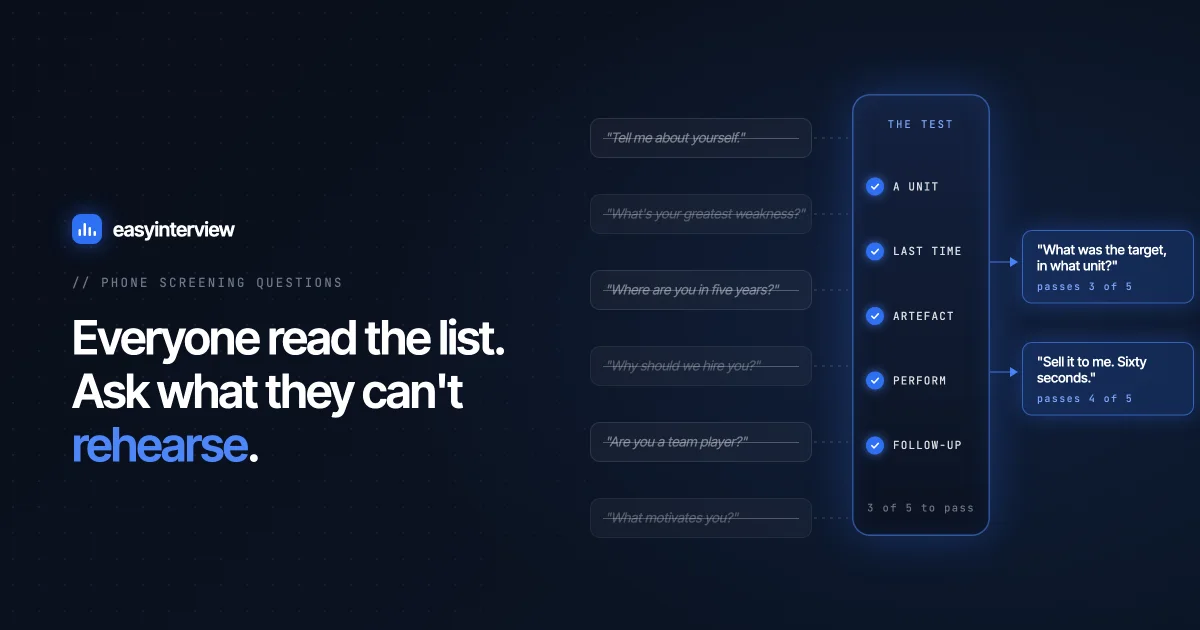
A question earns its minute on the call if it does at least three of these five things. The strongest do all five.
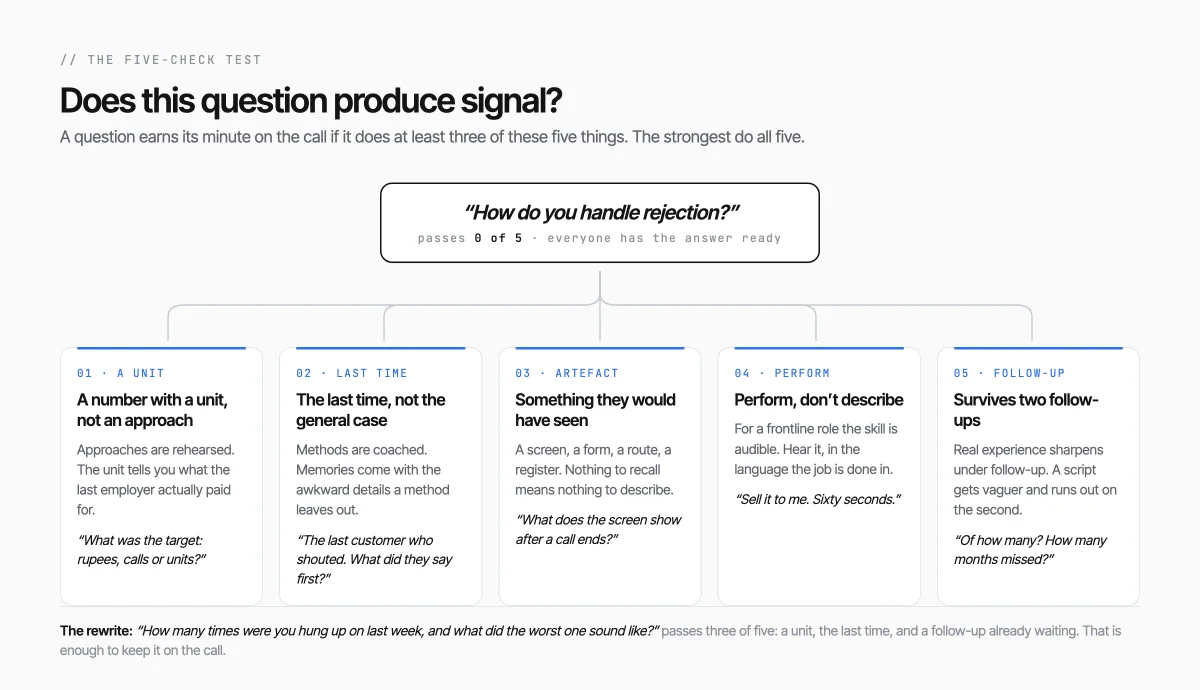
1. It asks for a number with a unit, not an approach. "How do you handle targets?" has an answer everyone gives. "What was your monthly target, and was it in rupees, calls or units?" has one answer per candidate, and the unit tells you what the last employer actually paid for. Approaches are rehearsed. Numbers with units are remembered or invented, and invented ones fall apart on check five.
2. It asks about the last time, not the general case. "How do you deal with an angry customer?" produces a method. "Tell me about the last customer who shouted at you. What did they say first?" produces a memory, with the awkward details a method leaves out. The general case is where coaching lives. The specific instance is where experience lives.
3. It asks for something they would have seen. A screen, a form, a route, a register. "Describe the screen you see after a call ends." "What does the DSR look like at the end of a day?" "What is on the challan you sign at the warehouse gate?" A candidate who has done the job describes the artefact, often with some irritation about it. One who has not stays abstract, because there is nothing to recall.
4. It makes them perform rather than describe. For a frontline role the skill is audible, so hear it. Sixty seconds of pitch. A complaint summarised back in three sentences. A ten-digit number read back correctly. "Describe how you would sell this" is a description of selling. "Sell it to me now" is selling.
5. It survives two follow-ups on the same thread. A good question has the next question built in. "What was the target?" leads to "of how many outlets?" leads to "how many months did you miss?" Real experience gets more specific under follow-up. A rehearsed story gets more abstract and runs out on the second one. If you cannot think of a follow-up, the question is a yes/no fact and belongs on the apply form, not on the call.
Run your current list through the test. Most lists have two or three questions that pass and ten that do not, and the ten are usually at the top.
| What you ask now | Passes | The rewrite | Passes |
|---|---|---|---|
| "How do you handle rejection?" | 0 of 5 | "How many times were you hung up on last week, and what did the worst one sound like?" | Unit, last time, follow-up |
| "Are you comfortable with targets?" | 0 of 5 | "What was your last monthly target, in what unit, and how many of the last six months did you hit it?" | Unit, last time, follow-up |
| "Do you have CRM experience?" | 0 of 5 | "Which dialler did you use, and what does the screen show after a call ends?" | Artefact, follow-up |
| "How are your communication skills?" | 0 of 5 | "I will describe a complaint for thirty seconds. Summarise it back in three sentences." | Perform |
| "Can you work under pressure?" | 0 of 5 | "It is 4 pm, you are at sixty dials and zero conversions. What did you do the last time that happened?" | Unit, last time, follow-up |
The rewrites are longer. The answers are shorter, and different for every candidate, which is the point.
Phone screening questions for recruiters: the core set for any volume role
Four blocks, in the order the call runs them. The timing and the scorecard are covered in the telephonic interview structure, and what the round as a whole can and cannot establish is in the screening interview guide; this is the question set that goes into it. Everything here is role-agnostic. The role-specific questions slot into the verification block and the live task.
The knockout block: facts with a rule attached
These end most calls, so they go first. If the apply form already asked them, confirm rather than re-ask.
| Question | A strong answer sounds like | First follow-up |
|---|---|---|
| "Where do you live, and what is your door-to-door time to the site at shift start?" | Minutes, without hesitation. They have already worked it out. | "And on a day it rains?" |
| "What is your notice period, and have you told your current employer you are looking?" | Days, and a yes or a dated plan for the conversation. | "What will your relieving letter say?" |
| "What is your current fixed salary, and what are you expecting, fixed and variable separately?" | Two numbers each. Hedging on current fixed is the tell. | "What was the last variable you actually received?" |
| "Do you hold a valid [licence / registration / certificate], and what is the number?" | Reads it out. | "When does it expire?" |
The verification block: claims with units
| Question | A strong answer sounds like | First follow-up |
|---|---|---|
| "Walk me through yesterday at work, from the start of the shift." | A sequence with times and place names. Vagueness means a job they watched someone else do. | "What went wrong?" |
| "What number were you measured on, and what was it measured in?" | Volunteers the unit and the months missed, unasked. | "Of how many? How many months did you miss?" |
| "Why did your last two jobs end? Month and reason for each." | Dates and events: a site that closed, a shift that changed, a family move. | "Who did you tell first?" |
| "Describe the screen, form or register you used most." | Names the fields, with an opinion about them. | "What did you write when a call went nowhere?" |
Then spend two follow-ups on whichever answer was vaguest. That is part of the block, not an optional extra.
The one live task
One per role, in the language the job is done in, scored against a written anchor while they are still talking. A sixty-second pitch. A complaint summarised back. A twelve-character SKU read back. One objection handled. What they do when the delivery address is wrong. If they cannot do it, that is the result; do not coach them through it and score the coached version. This is where the telecaller and field sales banks plug in, with their own rubrics.
The availability block: the job as described
| Question | A strong answer sounds like | First follow-up |
|---|---|---|
| "Here is the hardest part of this job: [six days / the 2 pm to 11 pm rotation / monsoon on a two-wheeler]. Is that a yes from you, and for your household?" | Answers both halves. A candid "I need to check at home" beats a fast yes. | "What would make it a no?" |
| "If we make an offer this week, what could stop you joining on the date?" | Something specific: the notice, a relieving letter, a festival. "Nothing" is the weak answer. | "What would make you leave in month three?" |
| "What do you want to ask me?" | A question about the shift, the incentive or the team lead. | Answer it honestly. |
Pre-screening questions to ask candidates before the call
Pre-screening questions and phone screen questions are different instruments, and most lists blur them. A pre-screening question is a fact with a rule attached: the answer is a yes, a no or a number you compare with a threshold, and there is no follow-up worth asking. Those belong on the apply form, where they cost nothing per candidate and apply identically to all of them. A phone screen question is one where you would want to ask "why" afterwards. Those need a voice.
| Belongs on the apply form | Belongs on the call |
|---|---|
| Location and commute radius | Door-to-door time at shift start, and on a rainy day |
| Notice period in days | Whether the employer has been told, and what the relieving letter will say |
| Salary band, fixed and variable | Current fixed, and the last variable actually received |
| Shift availability, yes or no per rotation | Whether the rotation is a yes for the household |
| Own two-wheeler and valid licence | The territory they can cover from home |
| Languages they can work in, self-declared | The live task, in that language |
| Registration or certificate number | Whether it is current, and the story behind any gap |
Two cautions. Nothing about a typed answer proves who typed it, so self-declared language and skill are claims until the call verifies them, and even a live call only raises the bar for a proxy interview; identity is checked at offer. And a form knockout should be shown to the candidate politely at submit, with the reason, and a person should confirm each decline; a rule that silently discards applicants is the fastest way to lose the ones who would have been good.
Phone screen questions to stop asking, and why
None of these is fashionable to criticise. The argument against them is signal, not taste: each has a model answer on the first page of Google in three languages, so the answers converge, and none passes a single one of the five checks.
| Stop asking | What it actually measures | Ask instead |
|---|---|---|
| "Tell me about yourself." | Preparation and English register. The candidate picks the frame, and it costs two of your twelve minutes. | "Walk me through yesterday at work, from the start of the shift." |
| "What is your greatest weakness?" | The quality of an evasion. The only rational answer is a weakness that is secretly a strength. | "Tell me about the last month you missed target. What did your team lead say, and what did you change?" |
| "Where do you see yourself in five years?" | Storytelling. For a volume role the honest answer is "in a job that pays more", which you would penalise, so the question teaches candidates to lie to you in minute three. | "What could stop you joining? What would make you leave in month three?" |
| "Why should we hire you?" | Confidence, which tracks English fluency rather than the job. It also asks the candidate to do the interviewer's work. | The live task. Selling is performed, not argued for. |
| "What are your strengths?" / "What motivates you?" | Vocabulary. Everyone is hardworking and a team player. | "What is the most boring part of this job, honestly?" |
Every replacement is already in the core set. Dropping the legacy questions does not shorten the call; it moves about five minutes onto questions that can tell candidates apart.
What you must not ask in India
This is the section none of the ranking pages covers, and it needs stating carefully. India has no single anti-discrimination statute for private-sector hiring. The constitutional guarantees in Articles 15 and 16 bind the State, and the private member's Anti-Discrimination and Equality Bill of 2016 lapsed with the Lok Sabha in 2019 (L&E Global's India employment law overview, updated 2024, makes the same point). So a good deal of what would be unlawful on a US or UK phone screen is, in India, merely bad practice.
"Merely" is doing a lot of work in that sentence. Several statutes do bind private employers directly, a phone screen is a recorded conversation, and a question with no lawful use has only unlawful ones left.
| Statute | What it says | What it means on the call |
|---|---|---|
| Code on Wages, 2019, s.3(2), in force since 21 November 2025 | No employer shall discriminate on the ground of sex while recruiting for the same or similar work. | Questions about marriage, children or family plans, put to women candidates, are the evidence trail for a complaint. |
| Rights of Persons with Disabilities Act, 2016, s.3(3) and s.21 | No discrimination on the ground of disability unless it is a proportionate means to a legitimate aim; private establishments with twenty or more employees must publish an equal opportunity policy. | Do not ask "do you have any disability or health problem". State the essential function and ask whether they can do it, with or without an arrangement. |
| HIV and AIDS (Prevention and Control) Act, 2017, s.3 | Denial of employment on HIV status, and HIV testing as a pre-requisite for employment, are prohibited, and the Act reaches private actors (Cyril Amarchand Mangaldas, 2018). | No questions about HIV or medical status. A pre-joining medical is the doctor's business, not the recruiter's. |
| Transgender Persons (Protection of Rights) Act, 2019, s.9 | No establishment shall discriminate against a transgender person in any matter relating to employment, including recruitment. | Do not ask about gender identity or whether a name is "real". Ask what name to use. |
| Maternity Benefit Act, 1961, s.12 | Dismissal on account of pregnancy is unlawful. | A pregnancy question has no lawful use in a hiring decision, so its only use is an unlawful one. |
Caste and religion sit outside the table. No statute forbids a private employer from asking, but no hiring purpose is served by the answer, caste-based humiliation is an offence under the SC/ST (Prevention of Atrocities) Act, 1989, and the Digital Personal Data Protection Act, 2023, which lets an employer process personal data for employment purposes, gives you nothing to point to for a caste or religion field. Many Indian application forms still ask for father's or husband's name, religion and community out of habit. Remove the fields.
The practical difficulty is that a legitimate question and an invasive one are often after the same fact. You need to know whether the candidate can work the late rotation. You do not need to know whether they are married. The line is the job requirement: ask about the requirement, plainly, and let the candidate decide what to tell you about their life.
| You need to know | Ask this | Not this |
|---|---|---|
| Whether they can work the shift | "The rotation includes 2 pm to 11 pm, six days a week. Is that a yes?" | "Are you married?" "Will your husband or in-laws allow it?" |
| Whether they will join and stay | "What could stop you joining on the 15th? What would make you leave in month three?" | "Are you planning to have children?" "How old are your kids?" |
| Whether they can reach the site | "What is your door-to-door time to Whitefield at 8 am?" | "Where is your native place?" "Which community are you from?" |
| Festival-season cover | "Which specific dates in October and November do you need off?" | "Which religion do you follow?" |
| Whether they can do the physical work | "The job is eight hours standing and lifting 15 kg cartons. Can you do that, with or without any arrangement from us?" | "Do you have any disability or health problem?" |
| Whether they speak the market's language | "Pitch this to me in Kannada." | "Are you a local?" |
| Household support for the hours | "Is the rotation a yes for your household as well as for you?" | "Who do you live with?" "Does your family let you work late?" |
The last row is the line in one sentence: you may ask whether the household supports the shift; you may not ask who is in the household. Age belongs in the same category. Where a statute sets a floor, ask for the document rather than the number.
One more thing. If an AI runs your phone screen, its question set is your question set. Whoever writes the prompt owns the questions, and this table applies to it word for word; the automated phone screening guide has the twelve questions to put to the vendor before you sign, three of them with a legal floor of their own.
Adapting the core set to a specific role
The four blocks do not change. What changes is the artefact you ask about, the number you ask for, and the live task. For telecallers, field sales and delivery partners, use the published banks rather than rebuilding them. For a role without a bank, write three questions using the five checks and stop there.
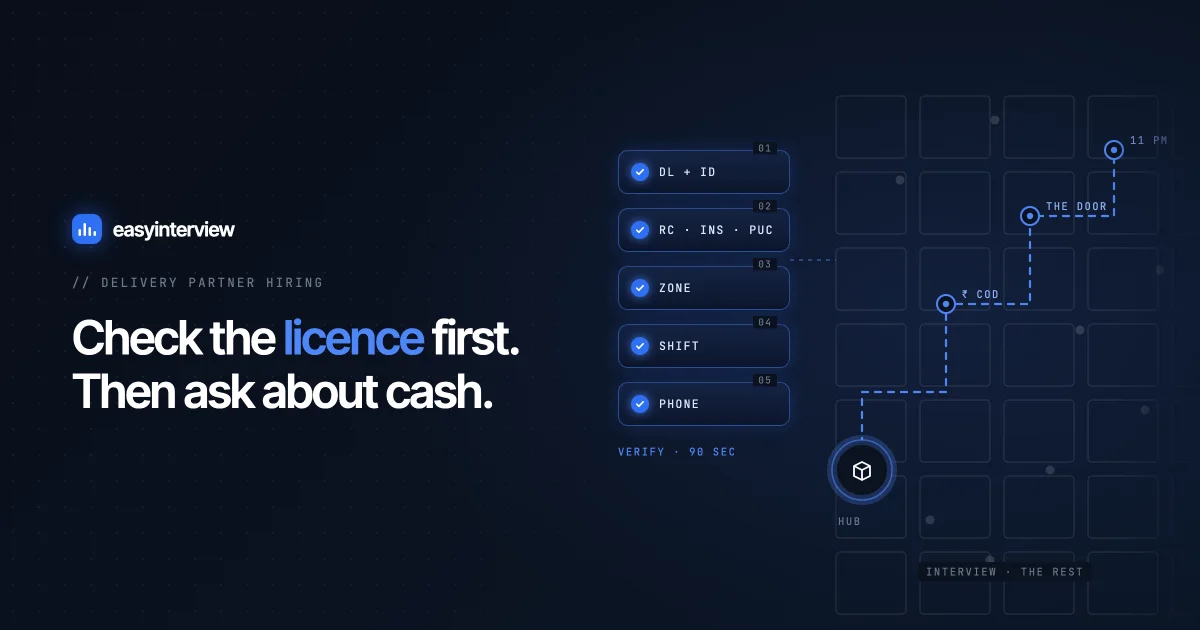
The skill is navigation and the customer at the door; the risk is the vehicle and the zone.
- The number
- "How many orders on a normal day, and how many on a rainy Sunday? What was the furthest drop from the hub?"
- The artefact
- "What does the app show you after you mark an order delivered? What do you do when the OTP fails?"
- The live task
- "The customer's pin is wrong and they are not picking up. It is raining. Talk me through the next five minutes."
- Knockouts
- Own two-wheeler, valid licence, smartphone, and the zone they can cover from home. All on the form.
Accuracy under a rate target, on a shift, at an industrial address most candidates have not commuted to.
- The number
- "What was your pick rate, and was it lines or units per hour? What happened when you missed it?"
- The artefact
- "Describe the scanner screen when the item does not match the pick list. What did you do next?"
- The live task
- Read out a twelve-character SKU with letters and digits and have them repeat it. Then a second one, faster.
- Knockouts
- Door-to-door time to the industrial area at 6 am, the rotation, and the lifting requirement stated plainly.
Judgment at the gate and the discipline of the register, across night shifts.
- The number
- "How many posts did you rotate through, and how long was a shift? How many nights a month?"
- The artefact
- "What columns are in the visitor register you kept? What goes in the occurrence book, and what does not?"
- The live task
- "A man without ID says he is the MD's guest and is late for a meeting. What do you say, exactly?"
- Knockouts
- PSARA training certificate and its date, night-shift availability, and the commute at 10 pm.
Each tab is three questions and a form. That is enough for a first round. If you find yourself writing a fourth, check whether it passes three of the five, and whether the round has a minute left for it.
What a question that measures preparation costs at volume
Take 400 applicants for a twenty-seat floor and a twelve-minute screen each. A typical call spends about five minutes on the opener, the weakness, the five-year plan and "why should we hire you", two on the knockout facts, three on claims and two on anything resembling a live task.
Arithmetic from the assumptions stated above, not a benchmark or customer data. Legacy openers are tell me about yourself, greatest weakness, five years and why should we hire you, at roughly five minutes between them.
Thirty-three recruiter hours, most of a working week, spent hearing the same page read back 400 times. Swapping the legacy questions for the core set does not shorten the round. It moves those hours onto questions that separate candidates, which is the only thing the round is for. Run your own volumes through the time-to-hire calculator; screening is where the bulk hiring process breaks whatever the role, and a question list that cannot discriminate makes it break earlier.
How EasyInterview asks these questions
EasyInterview runs the four blocks as a pipeline rather than a phone list. The knockout block runs at apply: one branded apply link goes out to LinkedIn, Naukri, Indeed, apna, WhatsApp, foundit, Shine, a careers page or a QR poster, a CSV of applicants you already have enters the same pipeline, and you write the knockout rules, which are the pre-screening questions above: location, notice period, salary band, shift availability. They are shown politely to the candidate at submit. Every decline is clicked by a human, every rule has an "include anyway" override, and every screened candidate gets an outcome message.
The verification block and the live task run as a live AI phone interview in the candidate's own language, across eleven: English, Hindi, Bengali, Tamil, Telugu, Kannada, Malayalam, Marathi, Gujarati, Punjabi and Odia. The AI is disclosed in every invite, the candidate picks a slot over WhatsApp with a one-tap reschedule, consent is collected at apply, and every message carries a STOP opt-out. Calls run in parallel, so throughput is set by applicant volume rather than recruiter headcount.
Check five is what the product is built around. The call does not read a script. It probes a vague answer with follow-ups until the real number comes out, and flags coached or scripted answers rather than scoring them as fluent. What comes back is a ranked shortlist scored on seven dimensions, Communication, Role knowledge, Experience fit, Problem solving, Availability, Integrity and Language fluency, with every rating pinned to the moment in the call that earned it, plus the recording, the transcript and a percentile rank. A person reads the transcript and makes the decision.
The honest caveat: EasyInterview is a newer product with no public bulk-hiring case study yet. Evaluate it the way you would any vendor claim, with a pilot on one live req, run alongside your existing screen, comparing the two shortlists. The sample report shows what one scored call looks like, and the comparison page sets it against chat pre-screens and outsourced call centres.
Frequently asked questions
What are good phone screening questions to ask candidates?
Ones that pass at least three of the five checks: a number with a unit, the last time rather than the general case, something the candidate would have seen, a performance rather than a description, and two follow-ups. "Walk me through yesterday at work", "what number were you measured on, and in what unit" and "sell it to me in sixty seconds" all qualify. "Tell me about yourself" passes none.
How many questions should a phone screen have?
Ten to twelve in twelve minutes, in four blocks: knockout facts, claims with units, one live task, the job as described. Fewer questions with follow-ups beat more questions without them.
What questions are asked in a pre-screening interview?
The facts with a rule attached: location, notice period, salary band, shift availability, vehicle and licence, certificate number. Each is compared with a threshold and has no follow-up worth asking, which is why they belong on the apply form. The phone screen starts where the follow-ups start.
Is it legal to ask about marital status in a job interview in India?
No single statute forbids it for private employers, so the honest answer is that it is lawful and a bad idea. The Code on Wages, 2019 prohibits discrimination on the ground of sex while recruiting, and a recorded question about marriage or children put to women candidates is the evidence such a complaint runs on. Ask about the shift, the commute and the joining date, which is what you needed to know.
Can I ask for current and expected salary in India?
Yes. There is no salary-history ban in India, and for a volume role the two numbers, fixed and variable separately, are among the most useful facts on the call. Ask for the last variable actually received, not the one on the offer letter.
How do I stop candidates giving rehearsed answers?
Change the question. Ask for numbers with units and for specific screens and moments, then follow up twice on the same thread; a rehearsed answer runs out on the second follow-up and a real one gets more specific. And drop the questions that have a model answer on the first page of Google, because you will hear it every time.
Test the list before the next call
A phone screening question is an instrument, and most of the ones in circulation were designed for the candidate to answer, not for you to learn from. Run your current list through the five checks, drop what passes none of them, and put the core set in the order above. Candidate 300 should meet the same questions, and the same bar, as candidate 3.
Book a demo to see EasyInterview run the verification block and the live task for every eligible applicant, in their own language, with every follow-up on the transcript.
Rohit Pandit
Founder, EasyInterview · easyinterview.life
I build EasyInterview, an AI hiring pipeline for high-volume roles in India. These are field notes on screening at volume, hiring signal, and interview integrity, written from the work rather than from a keyword list.
Connect on LinkedIn