Staff Nurse Interview Questions for Indian Hospitals, With a Rubric
Staff nurse interview questions for Indian hospitals: a 1-5 rubric, a registration knockout block, and scenario questions with what good reasoning sounds like.
Most staff nurse interview questions published online are written for the nurse, and the nurse has read them. That is why every candidate tells you they are compassionate, work well in a team, and handle stress. This is a bank of 32 questions written for the person hiring, for a hospital in India, with a knockout block for registration and shift, a 1-to-5 rubric, and scenario questions with a note on what good clinical reasoning actually sounds like.
One thing first, because it shapes everything below. A phone screen cannot assess clinical skill, and a screen that pretends to is worse than no screen. Nobody can hear IV cannulation. What a call can do honestly is confirm the registration, place the candidate on the acuity ladder, test whether they can talk to a frightened attendant in the ward's language, and hear how they reason about a deteriorating patient. Clinical competence is assessed in person, by the nursing superintendent, with a drug calculation and a ward round. The screen exists so that her time goes to the right twenty people.
What a nurse screen can check, and what it cannot
Be precise about the boundary, because a hiring mistake here is a patient-safety event, not a missed sales target. It is the screening interview's rule that a screen removes rather than selects, applied to a role where the expensive round is clinical.
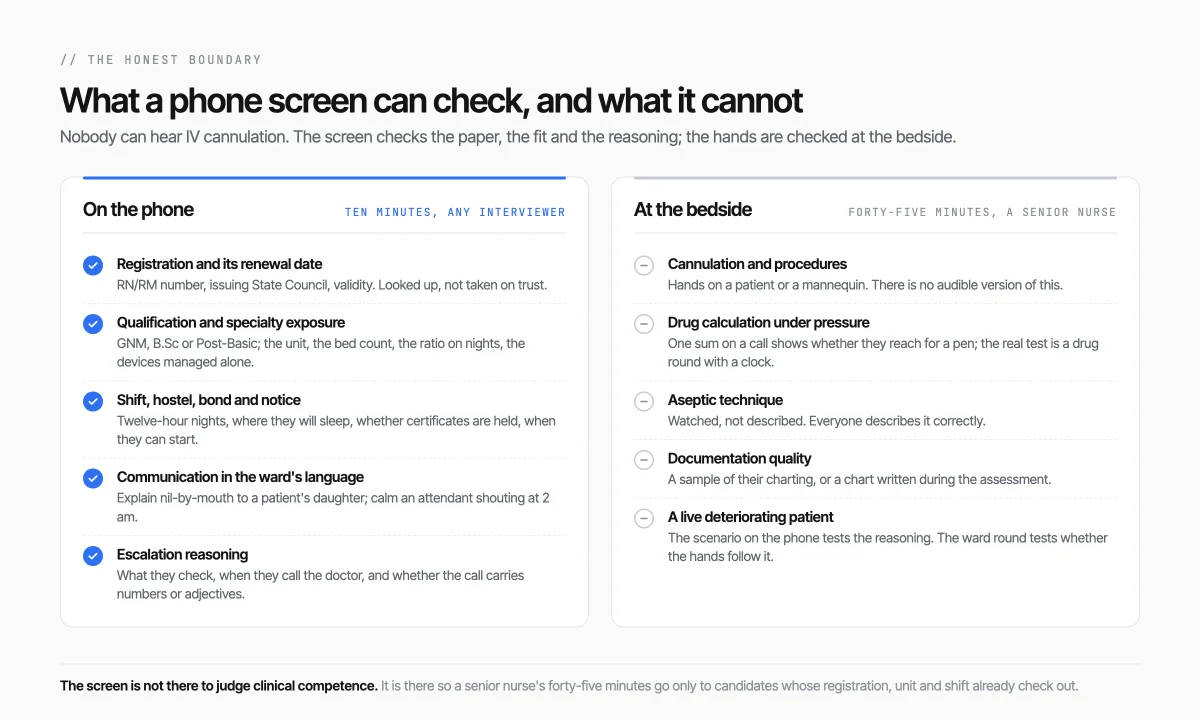
The left column is where a structured screen earns its keep: it is cheap, it is audible, and most of it can be verified against a register. The right column is the nursing superintendent's round. Confusing the two produces the two classic failures: a fluent talker with no ICU hours on a ventilated patient, and a good ward nurse declined because her English was hesitant on a call that never tested her Kannada.
The knockout block: registration, qualification, specialty, shift, bond, notice
Ask these before any competency question. Every one of them can end the call in under two minutes, and none of them can be discovered later without wasting a clinical round.
| Knockout | Ask | Ends the conversation if | Verify by |
|---|---|---|---|
| Registration | "Your State Nursing Council registration number, which council issued it, and when it is due for renewal." | No registration, a lapsed renewal, or a name that does not match the certificate. | Looking the RN/RM number up on the issuing State Council's register, or through the INC's NRTS portal, and keeping the result in the credential file. |
| Qualification | "GNM, B.Sc Nursing or Post-Basic B.Sc? From which institution, and which year did you register?" | ANM only, for a staff nurse post. A course from an institution the council does not recognise. | The registration entry itself: a State Council registers only recognised qualifications, so the register is the check. |
| Specialty and acuity | "Which unit, how many beds, what nurse-to-patient ratio on nights, and which devices did you manage alone?" | An ICU, NICU, OT or dialysis seat with no exposure to that acuity. (A general ward seat does not need it.) | The competency questions below, then the in-person round. |
| Shift | "Twelve-hour rotations, seven nights a month, festival weeks included. Yes or no?" | A no, unless the post is genuinely day-only. | Nothing to verify; believe the hedge. |
| Bond and certificates | "Are you under a bond or service agreement now, and does your current hospital hold any of your original certificates?" | Not a disqualifier by itself. It is a joining-date reality: a held certificate with no release date is a candidate who cannot start. | Ask for the release date and who will give it. |
| Notice and joining | "What is your notice period, has it been given, and what is the earliest date you can be on the floor?" | A joining date past the date the ward opens. | The relieving letter, at offer stage. |
Two notes on the regulatory side, stated carefully because it is easy to get wrong.
The Indian Nursing Council is the national standards body under the Indian Nursing Council Act, 1947. It sets the training standard; it does not license individual nurses. Registration and the licence to practise come from the State Nursing Council, and the RN/RM number that council issues is the legal licence. The INC's Nurses Registration and Tracking System is a national live register that gives each registered nurse a NUID, and the INC's own FAQ is explicit that NRTS enrolment is neither a licence nor a registration and that renewal stays with the State Council. Verify against the issuing council first; treat the NUID as a cross-check. Parliament passed the National Nursing and Midwifery Commission Act in August 2023, which repeals the 1947 Act once brought into force and creates a national register; rules were notified in March 2024 and commencement is phased. At the time of writing, the document to verify is still the State Council registration.
On qualifications: GNM is a three-year diploma, B.Sc Nursing a four-year degree, Post-Basic B.Sc a two-year degree for GNM holders, and the INC lists one-year post-basic diplomas in critical care, operation room, neonatal, emergency and other specialties. ANM is a two-year auxiliary qualification and is not a staff nurse. Whether an ICU seat requires a B.Sc or a post-basic diploma is your policy; the screen's job is to check that the paper matches the unit.
The scoring rubric: what a 1, a 3 and a 5 sound like
Credential verification is a gate, not a score, so it is not in the table. Everything else is scored 1 to 5 during the call against written anchors, so that two interviewers hearing the same answer land on the same number, the same discipline as calibrating an interview rubric for any other loop.
| Competency | Weight | 1 | 3 | 5 |
|---|---|---|---|---|
| Specialty and acuity fit | 20 | "All departments." Cannot give a bed count, a ratio or a device. | Names the unit, the ratio and the common procedures. | Names the unit, ratio and devices, and volunteers what they have not done alone. |
| Clinical judgement and escalation | 25 | Reacts to a single reading, or "I would inform the doctor" with no numbers and no threshold. | Re-checks, escalates with vitals, stays with the patient. | Trends the readings, names a threshold, escalates with a structured handover of numbers, and treats "worried and cannot say why" as a valid trigger. |
| Medication safety | 15 | Cannot name the rights of administration or a high-alert drug. Guesses at the calculation. | Names the rights and the double-check drugs; reaches for a pen on the calculation. | Names them, gives a real story of one stopping a dose, and describes what an independent double-check actually involves. |
| Documentation discipline | 10 | "Patient slept well." Overwrites a wrong entry. | Charts by round; knows the single-line correction. | Charts in real time, knows the correction rule, has filed an incident report and can say what changed after it. |
| Infection control | 10 | Hand hygiene is "before and after". Vague on needle-stick. | Names the five moments; knows to wash and report a needle-stick. | Five moments with today's example, needle-stick protocol with times, and can distinguish contact, droplet and airborne precautions. |
| Patient and attendant communication | 10 | Only functional in English; argues with the aggressive attendant. | Explains a clinical instruction plainly in the ward's language. | Explains and de-escalates in the ward's language, checks understanding, and knows which conversations belong to the doctor. |
| Shift, night-duty and bond realities | 10 | Hedges on nights, hostel, commute or bond. | Clear on two of the four. | Clear on all four, with the family's answer, a release date for any held certificate, and the notice already given. |
Re-weight for the unit. An ICU seat pushes Specialty and Clinical judgement up and Communication down; a general ward pushes Communication and Documentation up; a maternity unit is its own rubric. The weights above are a starting point for a general medical-surgical seat, not a law.
32 staff nurse interview questions to ask, by competency
These are written to be asked, not answered, to the five-check test for a question that produces signal rather than a recital. There are no model answers here, on purpose: publish a model answer for a role with this many applicants and you will hear it read back to you within a month. The italic notes are for the interviewer, and for the scenario questions they describe what good reasoning sounds like, not a protocol. Your hospital's protocol wins.
Specialty and acuity fit
-
"Which unit did you work in last, how many beds, and how many patients were you responsible for on a night shift?"
Strong answer: a real unit and a real ratio. An ICU nurse at one-to-one or one-to-two and a ward nurse at one-to-eight on nights are different hires; a candidate who worked in "all departments" has rotated, not specialised.
-
"Which of these have you done alone, unsupervised, in the last six months?" Read the list for your unit: cannulation, catheterisation, NG tube insertion, setting up a transfusion, suctioning a ventilated patient, arterial line care.
Strong answer: says no to some of them. A candidate who has done everything alone has either worked somewhere with no supervision, or is telling you what you want to hear.
-
"Who was the sickest patient you looked after last month, and what made them the sickest?"
Strong answer: a specific patient, with the parameters that worried them. It tells you what "sick" means on the unit they came from, which calibrates the rest of the call.
-
"When did you last do a BLS or ACLS course, and when did you last actually do chest compressions?"
-
"Have you ever refused a procedure because you were not trained for it? What happened?"
Strong answer: yes, once, with the name of the procedure and who they told. Knowing the edge of your competence is the competence.
Clinical judgement and escalation
-
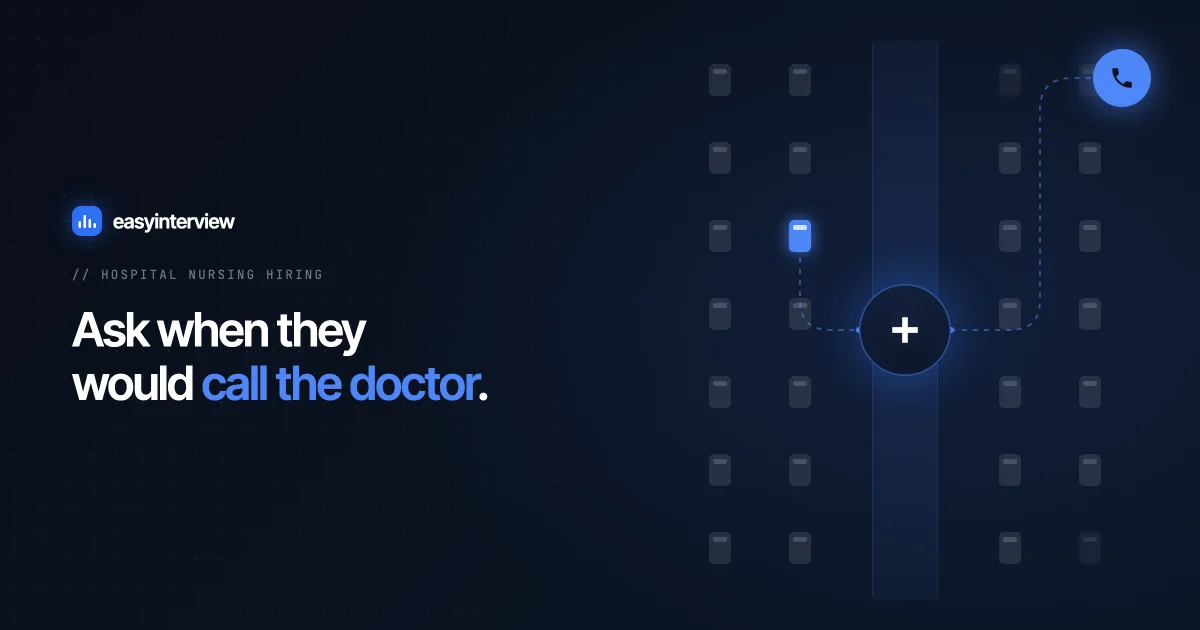
Scenario: "A post-operative patient's BP was 120/80 at 10 pm. At midnight it is 92/58, the pulse is 118, and he is restless. The duty doctor is in another ward. Walk me through your next ten minutes."
Good reasoning sounds like: re-check and trend rather than react to one reading; look at the obvious (the wound, the drain, urine output, pain, saturation); call the doctor now, with numbers rather than adjectives; do not leave the patient; get a colleague; note the times. Weak reasoning is "I would inform the doctor" with nothing attached, or a treatment offered without an order.
-
"When do you call the doctor at 2 am, and when do you wait for the morning round? Give me a real example of each."
Strong answer: a threshold, whether your hospital's early warning score or the parameters written in the chart, plus "when I am worried and cannot say why" as a legitimate reason. Listen for the wrong reason to wait: the doctor gets angry.
-
Scenario: "A patient refuses his evening medication. Talk me through your next ten minutes."
Good reasoning sounds like: find out why (side effects, fear, taste, cost), explain, never hide the drug in food, never force it; inform the doctor if it is a drug that cannot be missed; document the refusal and who was told.
-
"Tell me about a time you were wrong about a patient: you thought he was fine and he was not, or the other way around."
-
Scenario: "The doctor gives you a verbal order over the phone for a dose that seems high to you. What do you do?"
Good reasoning sounds like: repeat it back, say the concern out loud, check the reference, ask for it in writing within whatever window your policy allows, and do not give it until satisfied. A candidate who "would give it because the doctor said so" is the medication error you will read about.
-
"Hand over a patient from last week to me the way you would at the end of a night shift."
Strong answer: a structure, with pending tasks and what to watch for. Handover is where wards leak.
Medication safety
-
"Name the rights of medication administration you check, and tell me about the last time one of them stopped you."
Strong answer: the rights come out fluently, and the story matters more than the list. A candidate who has never been stopped by one has not been checking.
-
"Which drugs on your ward needed a second nurse to check, and what did the check actually involve?"
Strong answer: names the high-alert drugs your unit would expect (insulin, heparin, concentrated potassium, narcotics, chemotherapy) and describes an independent check, not a glance over the shoulder.
-
Calculation: "The order is 350 mg. The vial is 500 mg in 10 ml. How many ml?" Or: "One litre over eight hours on a 20-drops-per-ml set. Drops per minute?"
The answers are 7 ml and about 42 drops a minute. The answer matters less than whether they reach for a pen instead of guessing.
-
"Two patients on your ward have the same surname. How does your ward stop the wrong drug going to the wrong bed?"
Strong answer: two identifiers and the wristband, never the bed number.
-
"Tell me about a medication error you made or saw. What happened afterwards?"
Strong answer: owns it, describes the incident report, and can say what changed. A candidate with three years and no example is not being straight with you.
Documentation discipline
-
"What do you write in the nursing notes for an uneventful night, and when do you write it?"
-
"You realise you have charted a vital sign in the wrong patient's file. Show me the correction."
Strong answer: a single line through the entry, initial, date and time, the correct entry alongside, and informing someone if it could have affected care. Overwriting or whitener is a 1.
-
"What is an incident report for, and what was the last one you filed?"
Infection control
-
"Walk me through the five moments for hand hygiene using a patient you saw today: before what, after what."
-
"You get a needle-stick from a used cannula at 3 am. What are your first fifteen minutes?"
Good reasoning sounds like: wash immediately, report to the supervisor or infection control nurse on the same shift, establish the source patient's status, get assessed for post-exposure prophylaxis within the window your policy sets, and document. "I would be more careful next time" is not an answer.
-
"Which colour bin does a soiled dressing go in, and which does a used needle go in?"
Strong answer: instant, and in line with the Bio-Medical Waste Management Rules. Hesitation means the last hospital did not enforce segregation and yours will have to teach it.
-
"A patient on your ward is isolated for suspected TB. What changes about how you work for the next eight hours?"
Strong answer: the right mask, the door, dedicated equipment, limiting attendants, and a clear distinction between contact, droplet and airborne precautions.
Patient and attendant communication, in the ward's language
Run this block in the language the ward actually speaks, then in English if your documentation and doctor communication need it. They are different bars.
-
"Explain to me in Kannada, as you would to a 65-year-old patient's daughter, what 'nil by mouth from midnight' means and why." Substitute the ward's language.
Strong answer: the same content in plain words, and a check that she understood. Weak candidates translate the phrase and stop.
-
Scenario: "It is 2 am. A patient's attendant is shouting in the corridor that nobody has come for an hour and he will complain to the management. Go, in the language he would be shouting in."
Good reasoning sounds like: lower the voice, acknowledge, check the patient first, give a specific action and a time, involve security only for an actual threat, inform the supervisor, document. Weak reasoning argues about whether it was really an hour.
-
"A family member asks you whether the biopsy result is cancer. You know that it is. What do you say?"
Strong answer: does not disclose the diagnosis, because that conversation belongs to the treating doctor, but does not lie or brush the question off either. Arranges the conversation and stays with the family.
-
"Which languages could you take a history in, and which could you calm a frightened patient in?"
Shift, night duty and bond realities
The section every published list skips, and the one that decides whether the nurse is still on the roster in month four.
-
"Our rotation is twelve-hour shifts, seven nights a month, festival weeks included. Is that a yes from you, and from whoever you live with?"
Strong answer: answers both halves. A candid "I need to ask at home" is a better sign than a fast yes.
-
"Where will you stay: our hostel, family, or a rented room? How will you get home when a night shift ends at 8 am?"
-
"Are you under a bond or service agreement right now, and does your current hospital hold any of your original certificates?"
Strong answer: a straight answer either way, and if certificates are held, a release date and a name. Certificate retention is contested ground (see the FAQ), but whatever your own policy, this question decides the joining date.
-
"Why did you leave your last two hospitals? The real reason, not the one on the resume."
-
"What does a staff nurse actually do between 2 am and 5 am on a quiet night?"
Strong answer: rounds, charting, IV changes, preparing the 6 am medications, the paperwork. "Look after patients" is a candidate who will be surprised by week two.
The ten-minute staff nurse screen: what to ask when
Thirty-two questions is a bank. A first-round call is ten minutes, and the order is the instrument.
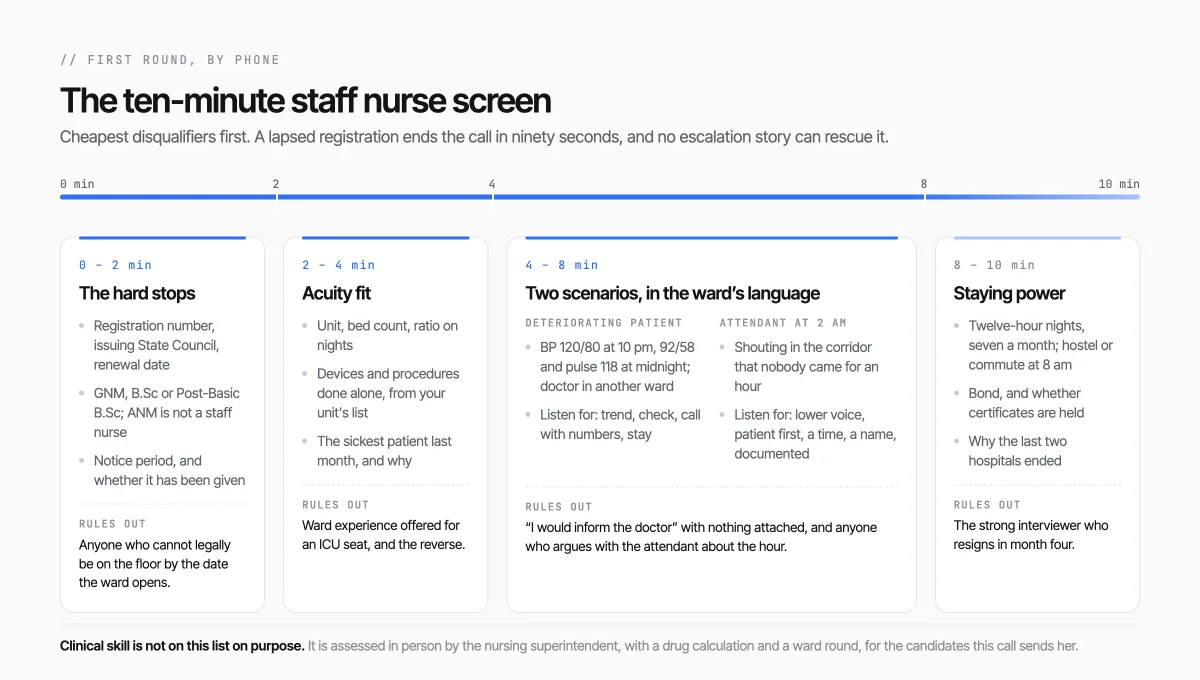
The logic is the same as for any volume role, and the same as the telephonic round's four blocks: disqualifiers are cheap and skills are expensive, so interviewer minutes go in that order. The difference in nursing is that the expensive round is a clinical assessment run by a senior nurse whose time is the scarcest thing in the hospital. The screen is not there to judge clinical competence. It is there to make sure she never spends forty-five minutes on someone whose registration lapsed in March.
Adapting the bank: general ward, ICU, OT, NICU and dialysis
"Staff nurse" covers several jobs. The same questions weighted the same way will hand you the wrong person for most of them.
Higher ratios, more attendants, more documentation, less machinery. The closest fit to the default weighting.
- Weight up
- Patient and attendant communication to 20, Documentation to 15. Take it out of Specialty fit.
- Add
- "You have eight patients and three call bells ring at once. Which one first, and how do you decide?"
- Also add
- "Which patient on a ward is most likely to fall, and what do you do about it at the start of a night?"
- Watch for
- A candidate whose only experience is corporate ICU. The ward's problem is volume and attendants, not ventilators.
Low ratios, high acuity, and a hire that goes wrong quietly at 3 am.
- Weight up
- Specialty and acuity fit to 30, Clinical judgement to 30. Communication drops to 5.
- Add
- "Your ventilated patient's saturation drops from 96 to 88 over two minutes. What do you check, in order?"
- Also add
- "Which infusions have you titrated yourself, and against which parameter?"
- Watch for
- Ward experience presented as ICU experience. Question 2, read with your ICU's list, is the test; a post-basic critical care diploma is a plus, not a substitute.
Scrub, circulate, count. The rubric shifts from patient communication to process discipline.
- Weight up
- Infection control to 20, Documentation to 15. Communication drops to 5.
- Add
- "Walk me through the surgical count. What do you do when it does not tally at closing?"
- Also add
- "Which surgeries have you scrubbed for alone, and which only circulated?"
- Watch for
- The count question has one right shape: stop, recount, tell the surgeon, escalate, document. Anything softer is a decline for an OT seat.
Specialty units where the unit-specific exposure is the whole question.
- Weight up
- Specialty and acuity fit to 35. Ask for the post-basic diploma or documented unit hours before the call.
- Add (NICU)
- "How do you calculate a neonatal dose from weight, and who checks it?"
- Add (dialysis)
- "A patient's BP drops mid-session. What do you do before you call anyone?"
- Watch for
- General paediatric or ward experience offered for a NICU seat. Kind, competent, and not the same job.
How to hire nurses in India at volume: where the hours actually go
A good question bank assumes a nursing superintendent with attention left. When a new wing opens, that is the first thing to go.
Say forty staff nurse openings, around 600 applicants (nursing postings draw large fresher volumes on Naukri, apna and the state job groups), a ten-minute screening call each, then an in-person clinical round for two candidates per seat at forty-five minutes, and a registration check for everyone who reaches that round.
Arithmetic from the assumptions stated above, not a benchmark or customer data. Your numbers will differ by city, unit and channel.
A hundred hours of calls before anyone meets a nurse, on top of the sixty hours of senior clinical time that is the actual bottleneck. In practice nobody spends the hundred. The calls shrink into availability checks, or the pile gets cut on resumes, and a resume tells you almost nothing about how a nurse reasons at 2 am. Both roads end at the same place: a nursing superintendent spending forty-five minutes on someone who could never do nights. Run your own version in the cost-per-hire calculator; it is the same bottleneck that breaks the bulk hiring process in every volume role, and the same shape as the telecaller screen, with the difference that the expensive round here is clinical.
How EasyInterview runs a staff nurse screen
EasyInterview is built for that hundred-hour block, and it is honest about the boundary above: it runs the screen, not the clinical assessment.
One branded apply link goes out to LinkedIn, Naukri, Indeed, apna, WhatsApp, foundit, Shine, your careers page or a QR poster at the nursing college, and a CSV of applicants you already hold enters the same pipeline. You write the knockout rules, which for a nursing post are the ones in the block above: location, notice period, salary band, shift availability. They are shown politely at submit. Every decline is clicked by a human, every rule has an "include anyway" override, and every screened candidate gets an outcome message.
Everyone who clears them gets a live AI phone interview in their own language, across eleven: English, Hindi, Bengali, Tamil, Telugu, Kannada, Malayalam, Marathi, Gujarati, Punjabi and Odia. For a ward that runs in Kannada, that is the difference between testing the skill the job needs and testing English. Licence, shift availability and patient-care judgement are checked in the candidate's language; "a patient refuses their evening medication, talk me through your next ten minutes" is the kind of question it asks. The AI is disclosed in every invite, candidates pick their slot over WhatsApp with a one-tap reschedule, and a person reads the transcript. The call cross-questions rather than reading a script, probing a vague answer until the real unit, ratio and threshold come out, and it flags coached or scripted answers instead of scoring them as fluent. Calls run in parallel, so the window is set by applicant volume, not recruiter headcount.
What comes back is a ranked shortlist scored on seven dimensions (Communication, Role knowledge, Experience fit, Problem solving, Availability, Integrity and Language fluency), every rating pinned to the moment in the call that earned it, with the recording, transcript and percentile rank. Consent is collected at apply and every message carries a STOP opt-out. The clinical round is still yours, and it should be.
The honest caveat: this is a newer product without a public bulk-hiring case study yet, so evaluate it the way you would any vendor claim. Pilot it on one live req, run it alongside your existing screen, and compare the two shortlists after the nursing superintendent has seen both. The sample report shows what one scored call looks like, and the comparison page covers how this differs from a chat pre-screen or an outsourced call centre.
Frequently asked questions
How do I verify a staff nurse's registration in India?
Ask for the registration number and the issuing State Nursing Council, then look it up on that council's register. The INC's NRTS portal lets you search by council and RN/RM number as a cross-check, but the INC's own FAQ says NRTS enrolment is not itself a licence; the State Council registration is. Check the renewal date too, since an expired registration is a nurse who cannot legally practise, and keep the lookup in the credential file.
GNM or B.Sc Nursing: which should a hospital hire?
Both register as staff nurses. GNM is a three-year diploma, B.Sc Nursing a four-year degree with more theory, and Post-Basic B.Sc lets a GNM nurse upgrade in two years. For a general ward, the unit and acuity exposure in question 1 predicts more than the degree does. For ICU, NICU or OT, many hospitals require a B.Sc or an INC post-basic specialty diploma; that is a policy choice, and the screen's job is to enforce whichever you made.
Can a phone interview assess a nurse's clinical skills?
No, and it should not claim to. It can confirm the registration, place the candidate on the acuity ladder, test communication in the ward's language and hear how they reason about escalation, medication safety and infection control. Cannulation, aseptic technique, drug calculation under pressure and documentation quality are assessed in person by a senior nurse. A screen that does the first list well is what makes the second list affordable.
What should I ask a fresher GNM or B.Sc nurse?
Drop everything that needs history (1, 3, 4, 13, 16, 19, 31) and lean on the scenarios and the live tasks, which a fresher can do as well as anyone: the deteriorating patient, the refused medication, the calculation, the five moments, the attendant at 2 am in the ward's language. Then weight question 5 heavily. A fresher's biggest risk is not knowledge; it is not asking for help.
Should I interview nurses in English or the local language?
Both, for different things. Run the attendant and patient scenarios in the language the ward speaks, because that is the skill the job needs and the one an English-only screen hides. Check English separately if your documentation and doctor communication require it. Question 27 makes the candidate draw the line for you.
Can a hospital ask a nurse to sign a bond?
It is contested ground and this is not legal advice. The Indian Nursing Council issued a circular in 2011 warning of penal action against institutions that take service bonds or retain original certificates; the Trained Nurses Association of India took wages and bonds to the Supreme Court, which in 2016 ordered an expert committee on private-hospital nurses; and a WHO India study published in 2022 still found bonds enforced through post-dated cheques in Delhi. Whatever your policy, state it in the screen, never hold certificates, and ask question 30 so the joining date is real.
Verify the register, score the reasoning, keep the bedside for the bedside
A question bank is half an instrument. The other half is the anchored scale that keeps the bar in one place across 600 calls and three interviewers, plus the discipline of ending a call in ninety seconds when the registration does not check out. Copy the knockout block and the rubric into a sheet, re-weight them for the unit you are actually staffing, and give your nursing superintendent's forty-five minutes only to the candidates who earned them.
Book a demo to see EasyInterview take one staff nurse req from an apply link to a ranked, evidence-scored shortlist.
Rohit Pandit
Founder, EasyInterview · easyinterview.life
I build EasyInterview, an AI hiring pipeline for high-volume roles in India. These are field notes on screening at volume, hiring signal, and interview integrity, written from the work rather than from a keyword list.
Connect on LinkedIn