Mass Recruitment Strategy in India: Plan Back From the Joining Date
A mass recruitment strategy for India that starts at the joining date: seats to offers to screens to applicants, over-offering, channel mix and 3 metrics.
A mass recruitment strategy in India is mostly arithmetic done before the job post goes up. The business hands you two numbers, the seats and the date they must be filled by, and the strategy is everything you have to decide to make those two numbers meet: how many offers, how many interviews, how many screening calls, how many applicants, from which channels, in which week. Most guides skip that part and list the phases of the mass hiring process instead. The phases are covered in the bulk hiring process, step by step. This piece is the planning layer above them.
One clarification, because the same words mean different things to different people. This is written for employers running a bulk hiring or mass hiring drive: a BPO ramping a new process, a retailer staffing the festive quarter, a lender opening forty field territories at once. If you are looking for a drive to apply to, this is not that page.
What a mass recruitment strategy in India has to decide first
Five inputs, in this order, because each one sets the next.
- The joining date and the seat count, in writing. Everything below is derived from these two, so a change to either reruns the plan.
- The five ratios. The share of accepted offers that join, of final interviews that end in an offer, of completed screens worth an interview, of booked screens that get completed, and of applicants that pass the knockouts. Take them from your last drive. If you have none, write down guesses and label them guesses; the first drive's real job is to replace them.
- The knockout rules and the scoring rubric, written before the post goes up, because they define "eligible" and "shortlisted", the two ratios most under your control.
- Three channels, not eight, and the opening split of budget between them.
- The over-offer cap, and what happens if more people join than you have seats.
Everything else in a mass recruitment process, posting, screening, interviewing, offering, onboarding, is execution against these five.
Build the mass hiring plan backwards from the joining date
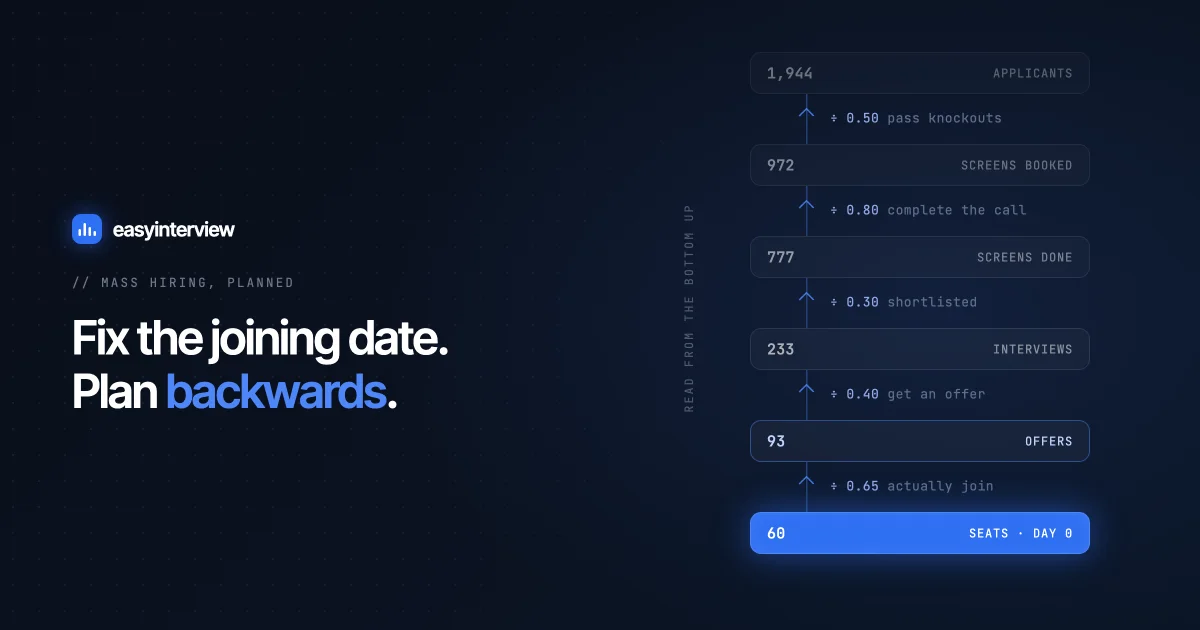
Take 60 inbound support seats that must be on the floor for training on Day 0. Assume, for the worked example only, that 65% of accepted offers join, 40% of final interviews end in an offer, 30% of completed screens earn an interview, 80% of booked screens get completed, and 50% of applicants pass the knockouts. Then work upwards from the seats, dividing by each rate and rounding up, because you cannot issue 92.3 offers.
| Stage | Rate assumed | Arithmetic | Needed |
|---|---|---|---|
| Seats on Day 0 | given | 60 | |
| Offers | 65% of offers join | 60 ÷ 0.65 | 93 |
| Final interviews | 40% of interviews get an offer | 93 ÷ 0.40 | 233 |
| Completed screens | 30% of screens make the shortlist | 233 ÷ 0.30 | 777 |
| Screens booked | 80% of booked screens complete | 777 ÷ 0.80 | 972 |
| Applicants | 50% pass the knockouts | 972 ÷ 0.50 | 1,944 |
Multiply the five rates together and you get 0.0312, the whole plan in one number: about one seat filled per 32 applicants. Change any rate and the applicant count moves with it.
Arithmetic from the assumptions stated above, rounded up at each step. Not a benchmark and not customer data. Replace every rate with your own before you use it.
Two things fall out of the table that a list of phases never shows you.
The first is sensitivity. Every rate carries the same weight in the multiplication, but the join rate is the one you find out about last. Drop it from 65% to 50% and the plan becomes 120 offers, 300 interviews, 1,000 completed screens, 1,250 booked and 2,500 applicants. A miss on the knockout rate shows up in week one, when there is time to fix it. A miss on the join rate shows up on Day 0, when there is not.
The second is capacity. In the calendar below, the 972 screens have a two-week window: ten working days, about 97 calls a day. At fifteen minutes a call including notes, that is roughly 24 recruiter-hours a day, three people doing nothing else, assuming every call connects first time. This is the line that breaks most often, and why screening, not sourcing, is the phase to design around. If the answer is to buy capacity rather than hire it, how to judge an automated phone screening vendor sets out what to ask before you do. The same arithmetic at ten times the scale is in the BPO recruitment process for a 600-seat ramp.
Over-offer deliberately, and set the cap before the first offer goes out
Offer drop-off is not a failure of your process. It is the market: a counter-offer, a notice period that was never going to be served, a better shift ten kilometres closer to home. Plan for it the way you plan for no-shows, with a number.
The number is offers = seats ÷ join rate. At 65%, that is 93 offers for 60 seats. Making 60 offers and hoping is the most common way a drive ends up two weeks late with a floor two-thirds full.
Over-offering has a cost on the other side, and it has to be decided in advance. If 80% of those 93 join instead of 65%, 74 people arrive for 60 seats. There are two honest ways to handle that and one dishonest one.
A second batch date. Issue all 93 offers, tell the last 20 or so candidates plainly that their joining date is the second batch, two or three weeks later, and mean it. A real later date is a fair offer; a vague one is not.
Tranching. Issue about 1.2 times the seats immediately, 72 here, and release the rest as declines and drop-offs come in. It avoids over-joining but costs calendar time, since each wave of drop-offs takes about a week to surface, so it only works when the hold can absorb that week.
Quietly rescinding whichever offers you do not need is the dishonest way. Apart from being unfair, it destroys the referral channel for the next drive, because candidates talk.
Whichever route you take, track one number from the day the first offer goes out: projected joins, meaning accepted offers multiplied by your observed join rate. Recount it every Friday. It is the only early warning the plan has.
The ramp calendar: count back in weeks from Day 0
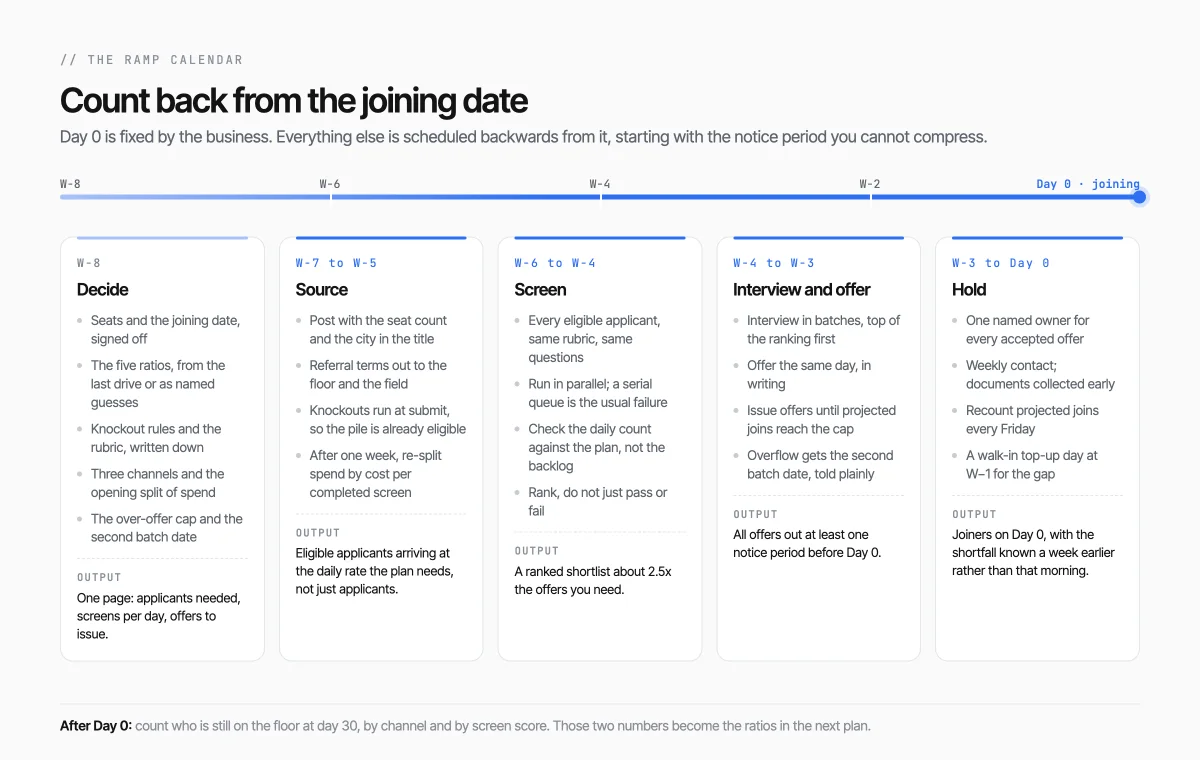
Read it from the right. The hold is set by the notice period your candidates actually carry, and it is the one block you cannot shorten. Three weeks covers the fifteen-to-twenty-one-day notices common in frontline roles; thirty-day notices make it five weeks and start the plan at week minus ten. Freshers often carry no notice at all, so the hold shrinks to a week, but they tend to hold several offers at once, so the join rate becomes the ratio you know least.
Interviews and offers take a week if you interview in batches from the top of the ranking and offer the same day, in writing. Screening takes two weeks, and the daily count is the check: if the plan says 97 completed screens a day and Tuesday shows 40, you know on Tuesday, not at the end of the window. Sourcing overlaps the first week of screening, because applicants arrive over days. Deciding takes a week, and it is the week most teams skip.
Put a walk-in top-up day at week minus one and size it from the projected-joins recount on the Friday before. A walk-in planned to fill a known gap of eight is a good tool; one run because the drive is behind is a sign the plan was never written down. To see where the days go in your own pipeline, the time-to-hire calculator models a hiring funnel one stage at a time and shows which stage is the bottleneck.
Channel mix for volume roles in India
Three channels, not eight. Every extra channel is another place applicants must be pulled from, deduplicated and answered, and at volume that overhead is real. Pick three, measure for a week, move money.
Compare channels on cost per completed screen, not cost per applicant. Applicant counts are inflated by people who fail the knockouts and people who never pick up; a channel that produces 300 applicants and 40 completed screens is worse than one that produces 120 and 70. Which channel wins for your role and city is empirical; the table is where to start looking, not the answer.
| Role family | Where applicants usually come from | The knockout that matters most |
|---|---|---|
| Telecalling, BPO voice | apna, WorkIndia, Naukri, referrals from the current floor, WhatsApp groups | Language and shift; night and weekend rosters remove more people than the salary band |
| Field sales | apna, WorkIndia, referrals through ASMs and distributors, walk-ins, a QR poster at the distributor point | Two-wheeler and the territory they can reach daily |
| Delivery, warehouse | WorkIndia, apna, referrals, walk-in days near the hub | Documents and shift; a lapsed licence is a joiner who never starts. The delivery partner bank has the ninety-second knockout |
| Retail store staff | Walk-ins at the store, a QR poster on the door, apna; foundit or Shine for supervisors | Commute radius and availability across festival weeks; the store staff bank has the store-opening calendar |
| Freshers, any role | Campus placement cells, Internshala, foundit, Shine, Naukri | Joining date certainty; ask which other offers they hold |
A working opening split: half on whichever channel filled the last similar role, a quarter each on two challengers, re-split after a week by cost per completed screen. Pay referral bonuses at day 90, not at joining, so the floor refers people who will stay rather than people who will start.
Two points about the posting itself. Put the seat count and the city in the title, because candidates search for drives by company and city, and a post that reads like a drive gets treated like one. Run the knockouts at submit, not afterwards, so the pile you screen is already eligible. And keep walk-ins as the top-up rather than the main channel: they close fast but skew hard by distance and shift, so a plan that leans on them fills the seats nearest the office first and the night shift last. How to hire telecallers fast walks the posting-to-offer stretch of this calendar for one role.
Three metrics worth tracking, not twenty
A mass hiring dashboard with twenty tiles is a way of not looking at anything. Three numbers run this plan.
- Cost per completed screen, by channel, weekly. The number that moves budget. It already contains the knockout and completion rates, which is why cost per applicant is a worse version of it.
- Projected joins against seats, from the first offer. Accepted offers multiplied by the observed join rate, recounted every Friday against the seat count. This is the over-offer control.
- Day-30 survival, by channel and by screen score, once. Who from each channel is still on the floor a month after Day 0, and how their screen score related to that. It is the only number that says whether the screen and the channel mix were worth what they cost, and it is next quarter's set of ratios.
Time to fill, applicants per day and interview show-up rate are real, but each is a component of one of these three or derived from it. Track them if you like; decide on the three.
How EasyInterview fits a mass hiring plan
The plan above has two weak points: screening capacity, the 97 calls a day, and the fact that the ratios stay guesses until somebody reconciles a spreadsheet in week nine. EasyInterview is built around both.
One branded apply link goes out to LinkedIn, Naukri, Indeed, apna, WhatsApp, foundit, Shine, a careers page or a QR poster, and a CSV of applicants you already have enters the same pipeline. You write the knockout rules, location, notice period, salary band, shift availability, and they are shown politely to the candidate at submit. Every decline is still clicked by a human, every rule has an "include anyway" override, and every screened candidate gets an outcome message. For the plan, that means the knockout pass rate stops being a guess on the first day applicants arrive.
Everyone who clears the knockouts gets a live AI phone interview in their own language, across eleven: English, Hindi, Bengali, Tamil, Telugu, Kannada, Malayalam, Marathi, Gujarati, Punjabi and Odia. The calls run in parallel, so throughput is set by how many people apply, not by how many recruiters you have, and the 97-a-day constraint stops being a constraint. Candidates pick their own slot over WhatsApp with a one-tap reschedule, the AI is disclosed in every invite, and a person reads the transcript.
The call does not read questions off a script. It probes a vague answer with follow-ups until the real number comes out, and flags coached or scripted answers rather than scoring them as fluent. What comes back is a ranked shortlist scored on seven dimensions, Communication, Role knowledge, Experience fit, Problem solving, Availability, Integrity and Language fluency, every rating pinned to the moment in the call that earned it, plus the recording, the transcript and a percentile rank. That is the calendar's "rank, do not pass or fail" step, done for you. Consent is collected at apply, and every message carries a STOP opt-out, which keeps the drive on the right side of TRAI rules.
The honest caveat: this is a newer product without a public bulk-hiring case study yet. Evaluate it the way this article evaluates everything else, with a number: a pilot on one live req alongside your existing screen, comparing the two shortlists and comparing the ratios the pilot produced with the ones you guessed in week minus eight. The comparison page covers how this differs from a chat pre-screen or an outsourced call centre.
Frequently asked questions
What is a mass recruitment strategy?
The set of decisions made before a mass hiring drive starts that determine whether the seats are filled on the date: the joining date and seat count, the five conversion ratios, the knockout rules and rubric, the channel mix and budget split, and the over-offer cap. The mass hiring process is the execution of those decisions; you can run it perfectly and still finish with forty people on a sixty-seat floor if nobody worked out that sixty seats meant ninety-three offers. A strategy that consists of "post on three job boards and run a walk-in" has skipped the arithmetic, and the arithmetic is the strategy.
How many applicants do you need per seat in mass hiring?
Multiply your five ratios together and take the reciprocal. In the worked example, 0.65 × 0.40 × 0.30 × 0.80 × 0.50 = 0.0312, or about 32 applicants per seat. That is an illustration, not a benchmark: a role with a high knockout pass rate and a strong join rate needs far fewer, and a night-shift role in a small city may need more. Compute yours from your own rates rather than borrowing anyone else's.
How far ahead should a mass hiring drive start?
Count backwards from the joining date: the notice period your candidates carry, a week for interviews and offers, two weeks for screening, a week for planning, with sourcing overlapping the start of screening. For frontline roles with two-to-three-week notices that is about eight weeks; for thirty-day notices closer to ten; for freshers with no notice period five or six, with a join rate you know least.
What is the 80/20 rule in recruiting?
The observation that most of a drive's joiners tend to come from a minority of its channels, and most recruiter hours go to a minority of the pipeline. It is a heuristic, not a law, and the split differs by role and city. The useful version for mass hiring is an instruction to measure: track cost per completed screen by channel for a week and move budget to the channels actually producing, rather than spreading it evenly because that feels balanced.
How do you plan mass hiring for freshers?
The same way, with two changes. There is usually no notice period, so the hold shrinks from three weeks to about one and the calendar compresses. But freshers often hold several offers at once, so the join rate is less predictable and the over-offer cap matters more. Ask about other offers directly at the screen, treat a candid answer as a good sign, and prefer a second batch date over tranching, because the compressed calendar leaves no room for waves of drop-offs to surface.
Write the plan before the post
Sixty seats is not sixty offers, and a joining date is not a deadline for posting a job. Take the seats and the date, put your own five ratios under them, run the division, and count the weeks back. The plan fits on one page, and it tells you on a Tuesday in week minus five what most teams find out on the morning of Day 0.
Book a demo to see EasyInterview take one mass hiring req from an apply link to a ranked, evidence-scored shortlist, and put real numbers under the ratios you guessed.
Rohit Pandit
Founder, EasyInterview · easyinterview.life
I build EasyInterview, an AI hiring pipeline for high-volume roles in India. These are field notes on screening at volume, hiring signal, and interview integrity, written from the work rather than from a keyword list.
Connect on LinkedIn