Screening Interview: What It Is and What It Can Actually Establish
What a screening interview is, how long it takes and what comes after, then the employer's half: what the round can establish, formats compared, a checklist.

A screening interview is the short first conversation, or form, that decides who gets a proper interview. For the candidate it is the ten-minute HR call before anything else happens. For the employer it is the round that decides where the managers' hours go. Most pages on the subject are written for the first reader and stop at the definition. This one answers the definitional questions properly, then turns to the half nobody writes: what a screening round can and cannot establish, how the formats compare on signal, cost and drop-off, and how to design one that does its job.
What is a screening interview?
A screening interview is a short, structured first round, held before the main interview, that establishes two things: whether the candidate could do the job, and whether they could take it. It is not meant to choose the best candidate. It removes the people for whom the rest of the process would be a waste, on both sides, so that the expensive rounds are spent on people who might actually be hired.
It goes by many names. In Indian job posts and WhatsApp groups it is the screening round, the HR round, the telephonic round or TI, or just "the HR call". In American usage it is the phone screen. Recruiters say pre-screen or shortlisting call. All of them mean a first filter, run by someone other than the person who makes the final decision.
It is usually run by an HR recruiter or a consultancy, sometimes the hiring manager, and increasingly by software. It lasts ten to thirty minutes: ten to fifteen is common for frontline and volume roles in India, twenty to thirty for corporate roles. A phone call is still the default format, but a video call, a WhatsApp questionnaire, an apply-page form and the first table at a walk-in drive are all screening rounds.
What gets asked is predictable. First the facts that decide whether a hire is possible at all: where you live and the commute at shift start, your notice period, current and expected salary, availability for the shift or the six-day week, and for some roles a two-wheeler, a licence or a registration number. Then a check on the CV: what you actually did, the number you were measured on, why the last two jobs ended. Then two or three questions about the work, sometimes a small live task. Then the job described, ideally honestly, and a chance to ask questions.
What happens after a screening interview
One of three things. You are advanced to the next round: a typing or voice assessment for a BPO seat, a manager interview or market visit for a field role, a technical or panel round for a corporate one. You are held while others are screened. Or you are declined.
A well-run process says which within a stated time, usually two to seven working days, and says so either way. Many do not, and silence after a screening round is the most common complaint about it. If you have heard nothing after a week, follow up once, then assume the answer. From the employer's side the outcome message is not a courtesy: frontline candidates are usually in three processes at once, and the one that answers first is the one they join.
Screening round vs interview: the difference
The difference is not length. It is direction. A screening round removes; an interview selects.
| Screening round | Interview | |
|---|---|---|
| Question it answers | Could this person do the job, and take it? | Is this the person we want, and on what terms? |
| Direction | Removes | Selects |
| Who runs it | HR, a consultancy, a recruiter, or software | The hiring manager or a panel |
| Length | 10 to 30 minutes | 45 minutes to several hours across rounds |
| Questions | The same for everyone, facts first | Deep, role-specific, adaptive |
| Output | Advance, hold or decline, and an order for the next round | An offer, or a no |
| How it fails | Passes people who could never take the job, so the interview is wasted | Picks the wrong person among people who could all have done it |
The failure modes differ too, and teams confuse them. A manager spending an hour to discover that the candidate lives two hours from the site is a screening failure. A good interviewee turning out to be the wrong hire is an interview failure, and the usual response is to load the screen with interview questions it cannot answer. The screen gets longer, the bar gets vaguer, and the unscreened pile grows.
What is a phone screen interview?
A phone screen is a screening interview held by telephone, and in most of the world it is the default form of the round. The phrase is American; the Indian equivalent is the telephonic interview or telephonic round, and they are the same thing: a ten-to-twenty-minute call covering the facts, the CV and a couple of role questions.
The phone wins because it is cheap, needs no travel or camera, and for any job done by talking to people it tests the actual skill. A telecaller, a field seller or a nurse giving a handover is audible, and the phone hears them in the language the work is done in.
If you are running the telephonic round rather than sitting one, the AI telephonic interview guide covers its twelve-minute structure, a scorecard, and what changes when software makes the calls. This article stays on the general question: what any screening round, in any format, can and cannot do.
For the employer: what a screening round can and cannot establish
From here on, this is written for the person running the round.
A screening round exists to remove people who cannot do the job or cannot take the job. It does not exist to find the winner. The design rule that follows is short: if a question's answer would not remove anyone, the question does not belong in the screen.

Cannot take the job is a list of facts, and facts should be asked as rules with a pass or a fail. Door-to-door commute at shift start, not the city. Notice period, and whether it has been raised. Current fixed and expected pay, as two numbers. The shift, the six-day week, the festival season. A two-wheeler and licence for a beat role; a registration number for a nurse. Nothing here needs judgment, so it should never take up judgment's time.
Cannot do the job is a shorter list, and it needs a person or a good rubric. Can a customer understand them in the language the job is done in? Does a CV claim survive two follow-ups on the same thread, with a unit and a month? Can they do one small piece of the work live: a sixty-second pitch, a complaint summarised back, a scenario with a wrong answer available? Each of these can remove someone, and each can be scored against written anchors.
Not the screen's job is everything else, and it is where screens bloat. Who is best among those who could do it. Team fit. Hands-on skill with a POS, a vehicle in traffic or a patient. The salary negotiation. Whether the person on the line is the person who applied: a live voice answering unscripted follow-ups is a higher bar than a typed form, but it is not identity verification, and no screen should claim to be; proxy interview calls are caught by documents and people at offer and joining. Push all of it to the round that can test it.
The screen's output is therefore not a hire. It is a smaller pile and an order to work through it: who gets the expensive round first. A ranking helps with the order. It does not make the decision.
The five screening formats compared
Every guide lists the formats. None scores them on the things that decide which one to use: the signal each produces, recruiter minutes per candidate actually screened, where candidates drop out, and whether it works for a candidate whose best language is not English, which in most Indian frontline pools is most of them.
The minutes column is arithmetic from stated assumptions, not a benchmark. A recruiter call: twelve minutes of talking, two extra dial attempts of three minutes each, three minutes of notes. A one-way video: one minute of admin, five to watch and score. A form: two minutes to read. A walk-in drive: three panel members for eight hours, seeing sixty attendees. Substitute your own.
| Format | Signal it produces | Recruiter minutes per completed screen | Where candidates drop | Non-English speakers | Best used for |
|---|---|---|---|---|---|
| Recruiter phone call (telephonic round) | Strong: speech in the job's language, claims under follow-up, reaction to the job described honestly | About 21 | Unanswered calls and phone-tag, and the fraction of the pile the team never reaches | Only as good as the recruiter's languages | Any audible frontline role, when the eligible pile fits the team's hours |
| One-way recorded video | Medium: presentation and fluency. No follow-up, so a coached answer looks like a real one | About 6 | Candidates without a quiet room, data or comfort on camera, which skews against the frontline pool | Prompts are usually in English; the reviewer must speak the answer's language | Roles where being on camera is the job |
| Chat or form pre-screen (WhatsApp, apply page) | Narrow but exact: the knockouts. Nothing conversational, and nothing proves who typed | About 2 | Long forms, and anyone uncomfortable typing in the form's language | Text literacy in the form's language; typing Hindi on a phone is a real barrier | The gate before any conversation, at any volume |
| Walk-in or in-person drive | Strong on presence, documents and identity; weak on consistency, because the panel drifts by candidate forty | About 24, plus the candidate's day | Everyone who could not travel that day, skewed by distance and shift rather than ability | The panel's languages | Documents, identity and the offer, for people a screen has already picked |
| Live AI phone screen | Phone-call signal with follow-ups, plus a recording and transcript. Not identity proof, and only as good as the rubric you wrote first | Under 1, spent reviewing the ranked top | Candidates who distrust an undisclosed AI call; unanswered scheduled calls | Set by the tool's language list, not the recruiter's | Volume roles where the eligible pile exceeds the team's hours |
Arithmetic from the assumptions stated above, not a benchmark or customer data. The walk-in figure excludes the hall and the candidate's travel; the phone figure assumes two unanswered attempts per connected call.
Read the table by row and the pattern is uncomfortable. The formats with the most signal cost the most recruiter minutes or the most candidate effort; the formats that scale answer a narrower question. That is why the screen degrades at volume: the pile gets cut on CVs, the calls shrink into two-minute availability checks, or a drive is held and the shortlist becomes whoever could travel that Saturday. It is the phase where the bulk hiring process reliably breaks, and the time-to-hire calculator shows how many weeks a serial screen adds at your applicant volume.
The useful way to read it is to combine rows. A form does the cannot take the job half for everyone, at any volume. A conversation does the cannot do the job half for everyone left. The in-person round does documents, identity and the offer for the ranked top only, which is what a walk-in drive is actually good at. What no combination of human-run rows fixes is the conversation itself, because it is rationed by the team's hours. That is the row where a live AI phone screen changes the arithmetic, with the caveats in the last row of the table. The candidate screening software comparison applies the same columns to twelve named tools.
How to design your screening round: a checklist
Ten decisions, in the order to make them.
- Write the knockouts as rules before anyone is called. Commute limit, notice ceiling, pay band, shift, vehicle or registration. If it cannot be written as a rule, it is a judgment and belongs in the conversation.
- Write down what "cannot do the job" sounds like. One live task, two follow-ups, anchors for a 1, a 3 and a 5. Two interviewers hearing the same answer should give the same number. The five-check test is how to tell which questions earn their minute.
- Pick the format by the row, not by habit. Form for facts, conversation for the audible skill, in-person for documents and the offer. Never a one-way video for a job nobody does on camera.
- Cheapest disqualifiers first. Facts in the first three minutes, claims next, the live task only for people who could take the job, the honest job description last.
- Run it in the language the work is done in. A Hindi-selling telecaller screened in English is tested on a skill the job does not use. If the team cannot run it in the market's language, fix that first, with people or with software.
- Keep it to ten to fifteen minutes. Past twenty you are running the interview without the manager and calling it a screen.
- Same questions, same order, scored during the call. Write the moment that earned the score, not an adjective. "Good communication" cannot be compared across three recruiters or audited when the hire fails.
- Screen the whole eligible pile. A serial queue through one recruiter filters on who was at the top of the list on Monday. Run it in parallel, or accept that you are screening a sample.
- Tell every candidate the outcome, with a date. Advance, hold or decline, inside a week. Silence loses exactly the candidates you wanted.
- Measure the screen by the round after it. Of those who reached the expensive round, how many were declined for something the screen should have caught? That is its miss rate. Then at ninety days, who is still on the floor.
How EasyInterview runs the screening round
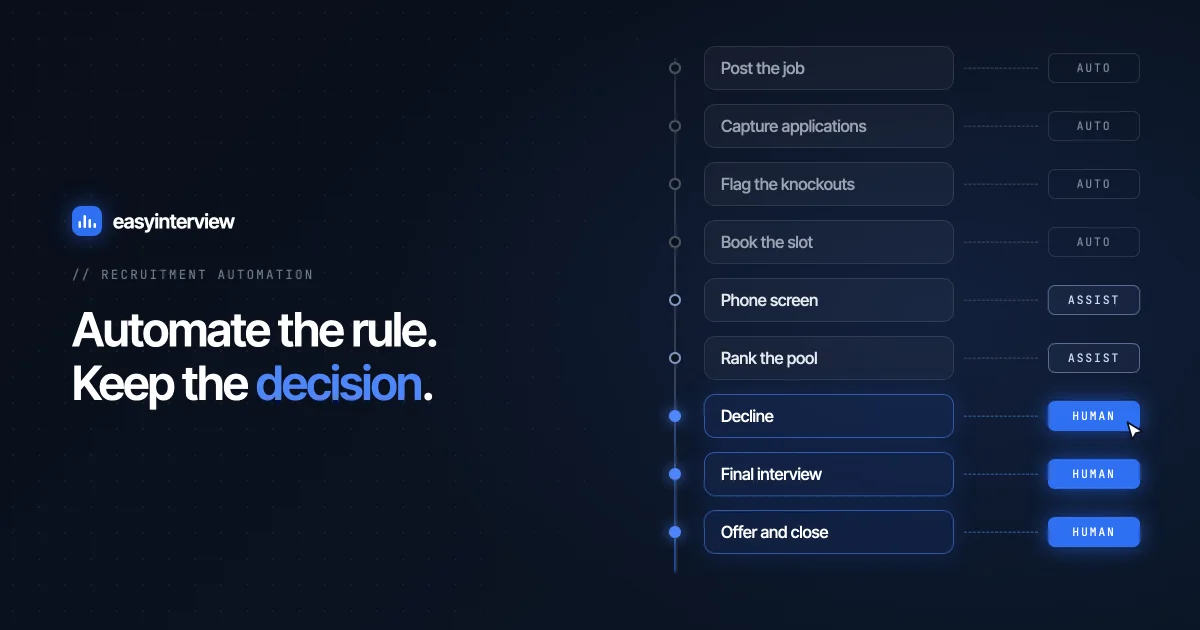
EasyInterview runs the two halves of the screen as two steps, for every applicant rather than the fraction a team can reach.
The cannot take the job half is knockout rules you write: location, notice period, salary band, shift availability, shown politely to the candidate at submit. One branded apply link carries them to LinkedIn, Naukri, Indeed, apna, WhatsApp, foundit, Shine, a careers page or a QR poster, and a CSV of applicants you already hold enters the same pipeline. Every decline is clicked by a human, every rule has an "include anyway" override, and every screened candidate gets an outcome message.
The cannot do the job half is a live AI phone interview for everyone who clears the rules, in the candidate's own language across eleven: English, Hindi, Bengali, Tamil, Telugu, Kannada, Malayalam, Marathi, Gujarati, Punjabi and Odia. The AI is disclosed in every invite, the candidate picks a slot over WhatsApp with a one-tap reschedule, and a person reads the transcript. The call does not read a script; it probes vague answers with follow-ups and flags coached or scripted answers rather than scoring them as fluent. Calls run in parallel, so throughput is set by applicant volume, not recruiter headcount.
What comes back is a ranked shortlist scored on seven dimensions, Communication, Role knowledge, Experience fit, Problem solving, Availability, Integrity and Language fluency, with every rating pinned to a moment in the call, plus the recording, the transcript and a percentile rank. That is the screen's output as this article describes it: a smaller pile and an order to work through it, with the decision left to a person. Consent is collected at apply and every message carries a STOP opt-out.
The honest caveat: this is a newer product with no public bulk-hiring case study yet. Evaluate it with a pilot on one live req, run alongside your existing screen, comparing the two shortlists and then who is still there at ninety days. The sample report shows one scored call end to end, the comparison page sets it against chat pre-screens and outsourced call centres, and the automated phone screening guide has twelve questions to put to any vendor in this category, including this one.
Frequently asked questions
How long does a screening interview last?
Ten to thirty minutes. For frontline and volume roles in India, ten to fifteen is typical and is enough to verify the facts, probe two claims and hear one live task. Corporate screens run twenty to thirty. If a screen regularly runs past twenty minutes, it has become an interview without the person who should be conducting it.
What happens after a screening interview?
You are advanced, held or declined. A good process says which within two to seven working days and tells you either way, along with what the next round is: an assessment, a manager interview, a market visit, or a walk-in for documents and the offer. If you have heard nothing after a week, follow up once, then assume the answer.
What is a phone screen interview?
A screening interview held over the phone. It is the American term for what Indian job posts call a telephonic interview or telephonic round; the round is the same. It typically runs ten to twenty minutes and is the default format because it is cheap, needs no travel, and hears the candidate in the language the work is done in.
What does "screening round" mean in an Indian job posting?
The first filter before any technical, manager or HR-salary round. In practice it is a telephonic call or a WhatsApp form, sometimes the first table at a walk-in drive, checking location, notice period, expected CTC, shift availability and basic communication. Clearing it means you are invited to the next round; it does not mean you have been shortlisted for the job.
Can a screening interview be done on WhatsApp or through a form?
Half of it can. A form is the right tool for the facts: location, notice, pay band, shift, vehicle. It works at any volume and in the candidate's own script. It cannot do the other half, because nothing typed can be followed up on, and nothing in a typed answer proves who typed it. Use the form as the gate, then a conversation for everyone who clears it.
Should candidates be told when a screening call is run by AI?
Yes, in the invite, along with the fact that a person reads the transcript. Collect consent when they apply and give every message a way to opt out. A candidate who discovers mid-call that they were talking to software will tell everyone they know, and in India commercial calls and messages sit under TRAI's consent and opt-out rules in any case.
Remove first, then choose
A screening interview is the cheapest round you run and the one that decides where every expensive hour after it goes. Ask it only the questions whose answers can remove someone, pick the format by what it can actually establish, run it for the whole eligible pile in the language the work is done in, and measure it by the round that follows. Then let the interview do the choosing.
Book a demo to see EasyInterview take one req from an apply link to a ranked, evidence-scored shortlist, with every screening call in the candidate's own language.
Rohit Pandit
Founder, EasyInterview · easyinterview.life
I build EasyInterview, an AI hiring pipeline for high-volume roles in India. These are field notes on screening at volume, hiring signal, and interview integrity, written from the work rather than from a keyword list.
Connect on LinkedIn