Candidate Screening Software in India: 12 Tools, Compared by Signal
Candidate screening software in India, compared by the signal each tool gives you: 12 tools across resume filters, tests, video, chat and AI phone screens.
"Candidate screening software in India" is a shelf label, not a product category. Search it and the results mix Zoho Recruit with Mercer | Mettl, a resume parser with a proctored aptitude test, a one-way video tool with an AI that phones candidates in Hindi. These products do not compete with each other. They answer different questions about a candidate, ask the candidate to do different things, and fail differently at the volume an Indian frontline posting draws. This is a comparison of twelve tools an Indian hiring team would realistically shortlist, organised by the signal each one produces, with a selection table built on the five things vendor pages tend not to state.
Two scope notes. Bulk hiring tools, by funnel stage covers the whole pipeline from job boards to onboarding; this page is the screening stage only, vendor by vendor. And EasyInterview is ours. It appears below, labelled, and is judged on the same columns as everyone else.
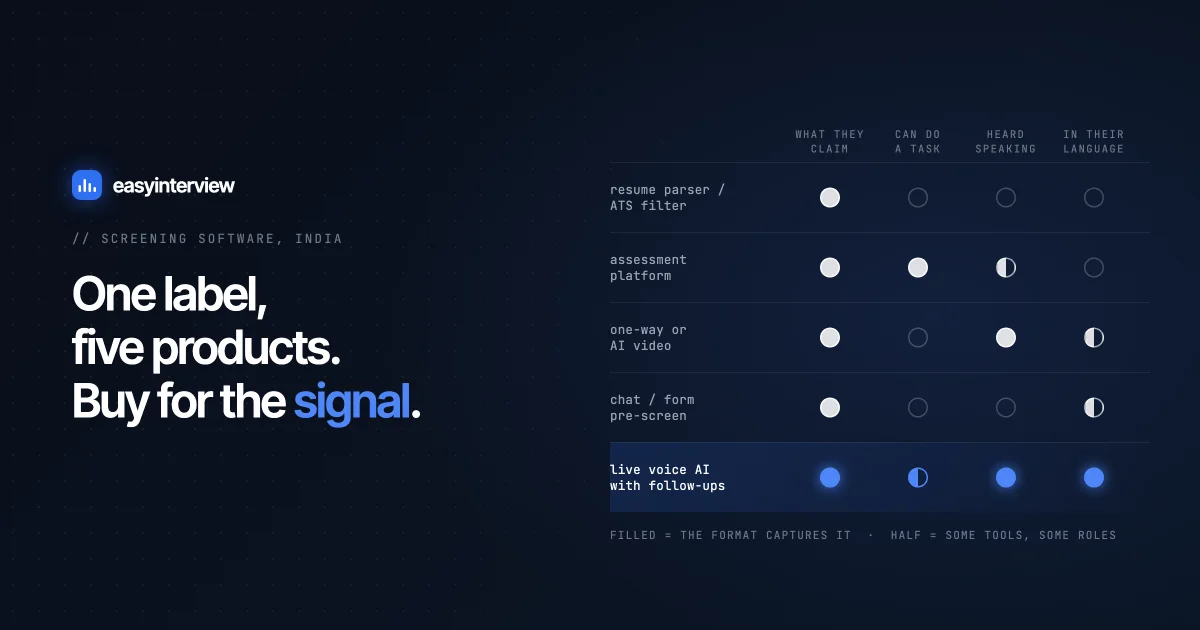
The five kinds of candidate screening software
Every tool on this list belongs to one of five categories, and the category decides more than the brand does.
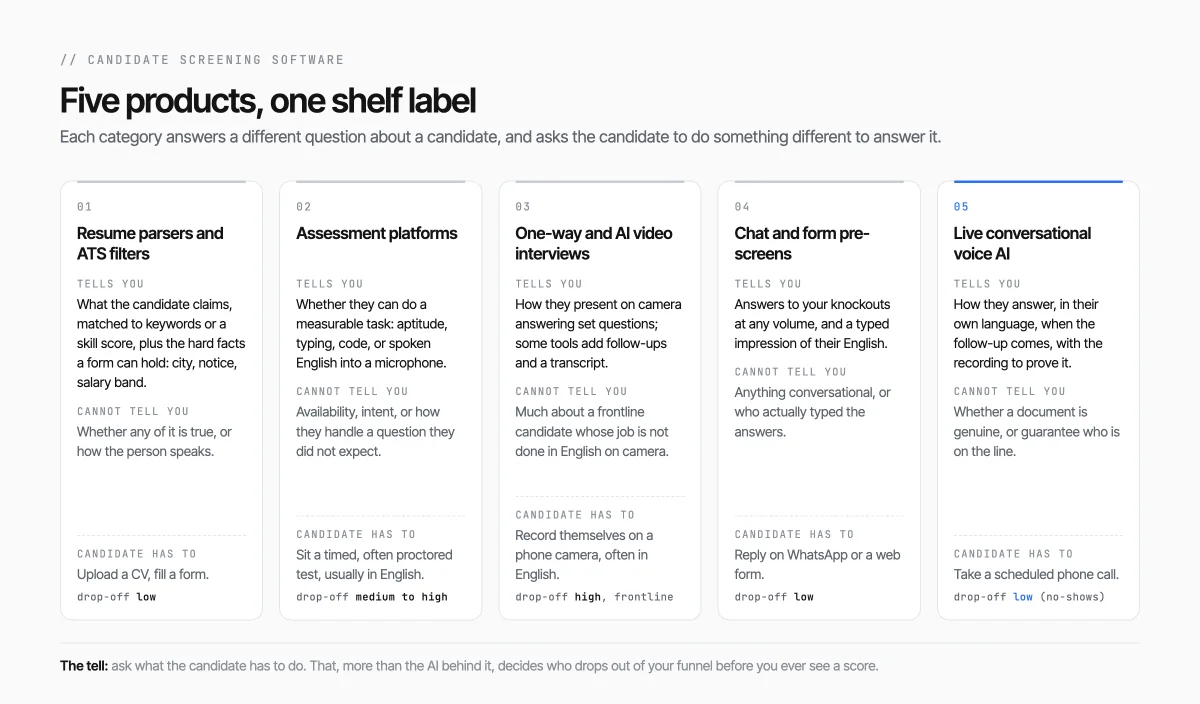
Resume parsers and ATS filters read what the candidate submitted and rank it against the job: a keyword match, a skill score, or the hard facts a form can hold, such as city, notice period and salary band. Nearly every ATS sold in India includes one. It tells you what is claimed, which for a frontline role is the least predictive thing about a person, and nothing about how they speak.
Assessment platforms test whether the candidate can do a measurable task: aptitude, typing, code, and increasingly spoken English into a microphone. The signal is real. The format is unforgiving: a timed, usually proctored, usually English test that a telecaller applicant on a shared phone may not finish.
One-way and AI video interviews put the candidate on camera answering set questions; the AI versions add follow-ups and a transcript. For campus and white-collar hiring the trade is reasonable. For a delivery or field-sales pool, recording yourself in English on a phone camera is a bar many capable candidates will not attempt.
Chat and form pre-screens, usually on WhatsApp, run your knockouts at any volume. Cheap and fast, and nothing about a typed answer proves who typed it or how they would hold a conversation.
Live conversational voice AI phones the candidate, asks the screening questions in their language, follows up on thin answers, and returns a recording and a score. It is the only one of the five that stands in for a recruiter's first call, and the only one that cannot check a document. Automated phone screening covers that category in depth, including a twelve-question vendor checklist, so this page does not repeat it.
Most vendors are honest about their category. Most buyers are not. A team that buys an assessment platform to solve a "we cannot call 400 people" problem has bought a good tool for the wrong stage of the bulk hiring process.
The selection table: 12 candidate screening tools compared
Vendor pages compare features. A buyer needs five other things: what signal the tool produces, whether it works for a candidate who does not operate in English, who actually declines a candidate, what evidence you hold when a manager disagrees, and what the format costs in candidates who never finish. Every cell below comes from the vendor's own pages as read in September 2026. "Not stated" means the page does not say, so do not assume.
| Tool | Category | Signal it produces | Non-English candidates | Who declines | Evidence per candidate | Drop-off |
|---|---|---|---|---|---|---|
| Zoho Recruit | ATS with resume filter, form pre-screen, one-way video | Zia match grade and skill score against the job; pre-screening answers with point values | Not stated | Recruiter, from a grade; assessments "automatically rate applicants" | Match grade, skill score, saved questionnaire responses, one-way video | Low; the video step raises it |
| Keka Hire | ATS with resume filter and tests | Parsed profile ranked on skills, experience and education; pre-employment tests | Not stated | Recruiter, via structured scorecards | Parsed profile, test results, scorecard with feedback and notes | Low |
| HROne | HRMS recruitment module with knockouts | Knockout questions that "filter unqualified applicants automatically"; skill matching with scoring | Not stated | Automatic at the knockout; "human intervention happens only when judgment calls are needed" | Ratings, source and category per candidate; consolidated interviewer feedback | Low |
| Mercer Mettl | Assessment platform | Aptitude, psychometric, coding and communication scores; a spoken-English speech test; blue-collar test packs | Speech tool assesses English; other languages not stated | Cut-off you set; reviewer not stated | Test scores; report contents not stated | Medium to high: timed, proctored |
| iMocha | Assessment platform | Proficiency across coding, cognitive, domain and English communication; automated video and AI-assisted interviews | English communication test; other languages not stated | Cut-off you set; reviewer not stated | Skill profile with proficiency percentages | Medium to high |
| HackerEarth | Technical assessment | Code that runs, plus FaceCode live coding; proctoring including a locked browser | Not stated; developer roles | Cut-off you set; an engineer reviews | Code submissions and analytics | Medium; developers expect it |
| Talview | AI video interview plus proctoring | Ivy AI interviewer with "real-time listening, follow up questions"; scoring metrics | "Supports multiple languages"; none named | "Accountable human review" is stated | Transcript and scoring metrics; live rooms add face and voice authentication | High for frontline: camera |
| Zappyhire | ATS with AI video interview | Recorded answers with pre-set follow-ups, scored; personality and work-style inferences | Not stated on the product page | Automated scoring "narrows down your applicant pool"; human review not stated | Transcript, custom scorecard | High for frontline: camera |
| InCruiter | Live voice AI, plus human interview-as-a-service | AI phone screen: role-specific questions, follow-ups, real-time scoring; or a human expert interview | "Speaks Spanish, Mandarin, Arabic, or Hindi" | Recruiter "review[s] this report to decide the next step" | Call transcript, recording, structured report, scores, AI recommendation | Low: phone |
| apna AI Calling Agent | Live voice AI, tied to apna job posts | Voice interview of apna applicants: eligibility, experience, communication; follows up 4 to 5 times | "Fluent in English and Hindi" | "Shortlists only the best candidates"; human review not stated | Full transcript, audio responses, skill words, live score | Low: phone |
| HeyMilo | Live voice or video AI, US-based | Two-way adaptive interview, per-question scores with reasoning; SMS and form screens | Multilingual; 20+ per third-party reports, list not published | Recruiter, from scored results written back to the ATS; auto-decline not stated | Per-question scores with reasoning, transcript, recording | Low on phone; video raises it |
| EasyInterview (ours) | Live voice AI pipeline: apply link, knockouts, phone screen | Seven scored dimensions from a cross-questioning call; percentile rank | 11 Indian languages, named | A human clicks every decline; every rule has an override | Recording, transcript, every rating pinned to a moment in the call, percentile rank | Low: phone in own language, slot picked on WhatsApp |
Three notes on reading it. The drop-off column is a judgement about the format, not a vendor measurement: nobody on this list publishes completion rates by role, so it reflects what the candidate has to do. "Who declines" is the column most vendor pages skip, and the one that decides whether your team stays accountable for its own funnel. Pricing is absent on purpose: most of these vendors are quote-led, and the figures circulating in other listicles are not on the vendors' own pages.
Resume parsers and ATS filters
The system-of-record category. These are the right first purchase for a team whose problem is six inboxes and no count, and the wrong purchase for a team whose problem is 400 eligible people nobody can call.
Zoho Recruit
Zoho's ATS, headquartered in Chennai and the usual pick for a small or mid-size Indian team. Its feature page describes resume parsing, Zia grading and ranking candidates against the job, a skill score on must-have and nice-to-have skills, pre-screening assessments where "you can assign point values to each answer choice and automatically rate applicants", and one-way video interviews. Not stated: the languages any of this works in, and whether anyone is declined without a recruiter clicking. Buy it as a pipeline and a first filter, not as a judgement about a candidate.
Keka Hire
The recruitment module of Keka's Hyderabad HRMS. Its pages describe AI resume parsing into structured profiles you can search, filter and rank, built-in pre-employment tests, and scorecards that consolidate test results, feedback and notes for a decision. The case for it is continuity: the hire flows from application into onboarding and payroll on one record. Language handling and automatic rejection are not stated.
HROne
Noida-based HRMS with a recruitment module and, unusually for this category, a specific high-volume claim. Its January 2026 article on high-volume recruitment lists "knockout questions that filter unqualified applicants automatically", skill matching with scoring, and says its "bulk hiring module ... can screen 5,000 applications against predefined criteria within 15 minutes". That is HROne's claim, not a measurement we have seen. The same article says "human intervention happens only when judgment calls are needed", so the knockout is automatic; ask in the demo what a knocked-out candidate receives. A "language proficiency assessment" is listed; the languages are not named.
Assessment platforms
Buy one when the job has a testable component and the screen is really a test. Put it after the phone screen and before the panel, so the expensive round goes only to people who can do the measurable part of the job.
Mercer | Mettl
Gurugram-based and the broadest library on this list: aptitude, psychometric, coding, behavioural, sales and communication assessments, a speech assessment tool for spoken English, and an AI proctoring suite with a secure browser. "Blue Collared Hiring" is a listed solution category, which matters for retail and warehouse ramps. Which Indian languages the tests are delivered in, and what the per-candidate report contains, are not stated on the pages we read. The strongest choice when you need a defensible test score, and the wrong one when you need to hear someone talk.
iMocha
Pune-founded, with a library it puts at "10,000+" evaluations across coding, cognitive ability, domain knowledge and English communication, plus proctoring, automated video interviews, live coding and AI-assisted interviews. The employer-side artefact is a skill profile with proficiency percentages. Languages beyond the English communication test are not stated.
HackerEarth
For engineers only. Coding assessments, FaceCode for live coding interviews, and proctoring including a locked-down browser, with a large developer community feeding the top of the funnel. There is nothing here for a telecaller or a field-sales seat, and it does not pretend otherwise.
One-way and AI video interviews
The category that works for campus and white-collar volume and struggles below it. Before you buy, look at your applicant pool and ask honestly how many of them will record themselves on camera, in English, on a phone.
Talview
Began at IIT Bombay and now enterprise, demo-led, with a Bengaluru office. Ivy, its AI interviewer, is described with "real-time listening, follow up questions and observation capabilities", and its reports include transcripts and scoring metrics. It "supports multiple languages", none named. Two things stand out on the buyer's columns: live interview rooms with "face and voice authentication to identify proxy candidates", and a trust architecture that states "accountable human review" outright. Strongest where proctoring and campus scale matter.
Zappyhire
Headquartered in Ernakulam with a Mumbai office, and India-focused: Federal Bank and Maruti Suzuki are on its logo wall. Its Robotic Video Interview lets recruiters pre-set questions "with tailored follow-up questions based on the interviewee's response", produces a transcript and a custom scorecard, and uses machine learning to infer "personality and work styles". "Automated Interview Scoring helps you efficiently narrow down your applicant pool"; human review of that narrowing is not stated. Its blog claims 50+ languages; the product page does not list them. If you pilot it, put the personality inferences next to the recordings and check them yourself.
Live conversational voice AI
The category built for the stage that breaks. A call in the candidate's language, with follow-ups, run in parallel across the whole eligible pool. The vendor checklist for it is in the automated phone screening guide; what follows is only what each vendor's page states.
InCruiter
Bengaluru, with two lines for different budgets. Interview-as-a-service puts one of its "4500+" human expert interviewers on the call. The AI phone screen "automatically reaches out to candidates, asks generic and role-specific screening questions, evaluates responses in real time", asks follow-ups, and returns "detailed call transcripts", a structured report, scores and an AI recommendation; "recruiters can ... review this report to decide the next step", which is the right answer to the who-declines question. On languages it "speaks Spanish, Mandarin, Arabic, or Hindi". Hindi is the only Indian language named.
apna's AI Calling Agent
apna sells this alongside its job posts, so the pool it screens is apna's applicants for your apna posting. Its September 2025 announcement describes a voice agent "fluent in English and Hindi" that follows up "4–5 times via phone, WhatsApp & email", confirms eligibility, asks about experience, and gauges "selling and communication skills". The employer receives full transcripts, audio responses, skill words and live scoring. The employer page says the AI "interviews all job applicants 24/7 & shortlists only the best candidates" and quotes an "80% response rate with AI" against 30% for manual calls; both are apna's figures. Whether a human reviews the shortlist boundary is not stated, nor are languages beyond Hindi. If apna is already your main frontline channel, this is the lowest-friction way into the category. For its employer-side costs and walled-garden limits, see the Apna alternative guide.
HeyMilo
New York-based, and the most mature conversational AI recruiter on the list: two-way adaptive voice or video interviews, per-question scores with written reasoning, transcript and recording, native write-back into staffing ATSs, and a trust score against impersonation. Third parties report 20+ languages; the list is not published, so check it against yours. Pricing is not published either. Our head-to-head is at HeyMilo alternatives. Also in this category: SkillBrew.AI in Jaipur, whose site says its voice agent Rhea calls candidates in "10+ languages", unnamed.
EasyInterview is the twelfth tool and it is ours. It gets its own section below so every claim can be checked against one source.
Best candidate screening software in India, by the problem you have
The table is the instrument. These are the four shortlists it usually produces.
A system of record and a first filter; a recruiter can still make every call.
- Buy
- An ATS with a resume filter and form pre-screen: Zoho Recruit or Keka Hire. Write the knockouts as facts about the role.
- Screen
- Recruiter calls against a written rubric. The queue is small enough for headcount to clear it.
- Skip
- Assessments and video at this volume; both cost completion without buying much signal.
Telecallers, field sales, delivery, retail: hundreds of eligible applicants, most of them not working in English.
- Buy
- Knockouts first, then live voice AI in the market's language: InCruiter, apna's agent if apna is your channel, or EasyInterview. Check the named languages against your pool.
- Insist on
- A recording behind every score, and a person clicking every decline.
- Skip
- Camera video and English-only tests as the first filter. They remove the people the job actually needs.
Typing, code, spoken English for an international process: the screen is really a test.
- Buy
- Mercer Mettl or iMocha for aptitude, communication and blue-collar packs; HackerEarth for engineers.
- Place it
- After the phone screen and before the panel, so only people who cleared the conversation sit the test.
- Ask
- Which languages the test is delivered in, and what the proctoring flags mean before you act on one.
Graduates and office roles, where a camera is not a barrier and proctoring matters.
- Buy
- An AI video platform with proctoring: Talview or Zappyhire, or HeyMilo if the ATS write-back is the priority.
- Check
- Completion by college tier and the human-review statement, which Talview makes explicitly and others do not.
- Skip
- Personality inferences as a decision input until you have compared them with the recordings yourself.
Whichever row you are in, the arithmetic is the same. A pool of 400 eligible applicants at twelve minutes each is 80 recruiter-hours before dialling and notes; the other half of the cost is the candidates a format loses before they finish. Put your own volumes into the cost-per-hire calculator and compare the salaried hours against the tool.
How EasyInterview approaches AI candidate screening
EasyInterview sits in the fifth category, and it runs the stages around it too: one branded apply link goes out to LinkedIn, Naukri, Indeed, apna, WhatsApp, foundit, Shine, a careers page or a QR poster, and a CSV of applicants you already hold enters the same pipeline. You write the knockout rules, on location, notice period, salary band and shift availability, and they are shown politely to the candidate at submit. Every decline is clicked by a human, every rule has an "include anyway" override, and every screened candidate gets an outcome message. That is the who-declines column, answered.
Everyone who clears the rules gets a live AI phone interview in their own language, across eleven: English, Hindi, Bengali, Tamil, Telugu, Kannada, Malayalam, Marathi, Gujarati, Punjabi and Odia. The candidate picks their own slot over WhatsApp with a one-tap reschedule, the AI is disclosed in every invite, and a person reads the transcript. Calls run in parallel, so throughput is set by applicant volume rather than recruiter headcount. The call cross-questions: it probes vague answers with follow-ups until the real number comes out, and it flags coached or scripted answers rather than scoring them as fluent.
What comes back is a ranked shortlist scored on seven dimensions, Communication, Role knowledge, Experience fit, Problem solving, Availability, Integrity and Language fluency, with every rating pinned to the moment in the call that earned it, plus the recording, the transcript and a percentile rank. That is the evidence column. Consent is collected at apply and every message carries a STOP opt-out, in line with TRAI rules. The scorecard exports today; named ATS integrations are on the roadmap, not live.
The honest caveat: this is a newer product with no public bulk-hiring case study yet, so evaluate it the way you would evaluate any row in the table, with a pilot on one live requisition, run alongside your existing screen, comparing the two shortlists. The sample report shows one scored call; pricing is a prepaid wallet billed per connected minute with the scored report included, with current rates on the pricing page; and the comparison page sets out how the live screen differs from assessment platforms and outsourced interview services.
Frequently asked questions
What is AI candidate screening software?
Software that uses a model rather than a recruiter to make the first cut. The label covers three different products: a resume ranker that scores what candidates wrote, a video tool that scores how they answered on camera, and a conversational voice agent that phones them and scores a live exchange. They produce different evidence and lose different candidates, so the first question for any vendor is which of the three you are looking at.
Which ATS is used in India?
Among mid-size teams, Zoho Recruit and Keka Hire are the common answers; HROne, Darwinbox and PeopleStrong appear as the company grows, and Naukri RMS where Naukri is the dominant channel. An ATS is a system of record. The screening layer, whether a form, a test, a video or a phone screen, is a separate decision and can sit in the ATS or beside it.
Is there free candidate screening software in India?
Free tiers and trials exist for some ATS products, and they cover the system-of-record part: capturing applications and running a keyword filter. No free tier gives you the screening conversation, because someone still has to have it. The real cost of screening is recruiter hours or billed call minutes, and the free-tier question is smaller than it looks.
What is the best candidate screening software in India for bulk hiring?
For frontline bulk hiring, the combination that survives a 400-applicant week is hard knockouts on a form, a live screen in the candidate's language run in parallel, a test only if the job has a testable component, and a panel only for the ranked top. No single product covers all of that well; the table tells you which category each one is, and the tabs above tell you which combination fits your funnel.
Does AI candidate screening software reject candidates automatically?
Some of it does, and the vendors usually say so in passing: HROne describes knockouts that filter automatically, and apna's agent "shortlists only the best candidates". Automation at the knockout is defensible when the rule is a fact about the role and the candidate sees the reason. Automation at the judgement step, where a score decides who is never heard, is where good candidates disappear. Ask every vendor who clicks the decline, and what the declined candidate receives.
Buy the signal, not the label
Twelve tools, five categories, one question underneath them all: what does this software tell me about a candidate that the resume did not, and what does it cost me in candidates who never finish? Answer that for your own funnel, shortlist two vendors from the right category, and pilot both on one live requisition before you sign anything.
Book a demo to see EasyInterview take one requisition from an apply link to a ranked shortlist with a recording behind every score.
Rohit Pandit
Founder, EasyInterview · easyinterview.life
I build EasyInterview, an AI hiring pipeline for high-volume roles in India. These are field notes on screening at volume, hiring signal, and interview integrity, written from the work rather than from a keyword list.
Connect on LinkedIn