Recruitment Automation: What to Automate, Assist, and Leave Alone
Recruitment automation explained for Indian hiring teams: which hiring steps automate well, which need a person, and an automate / assist / leave-alone table.
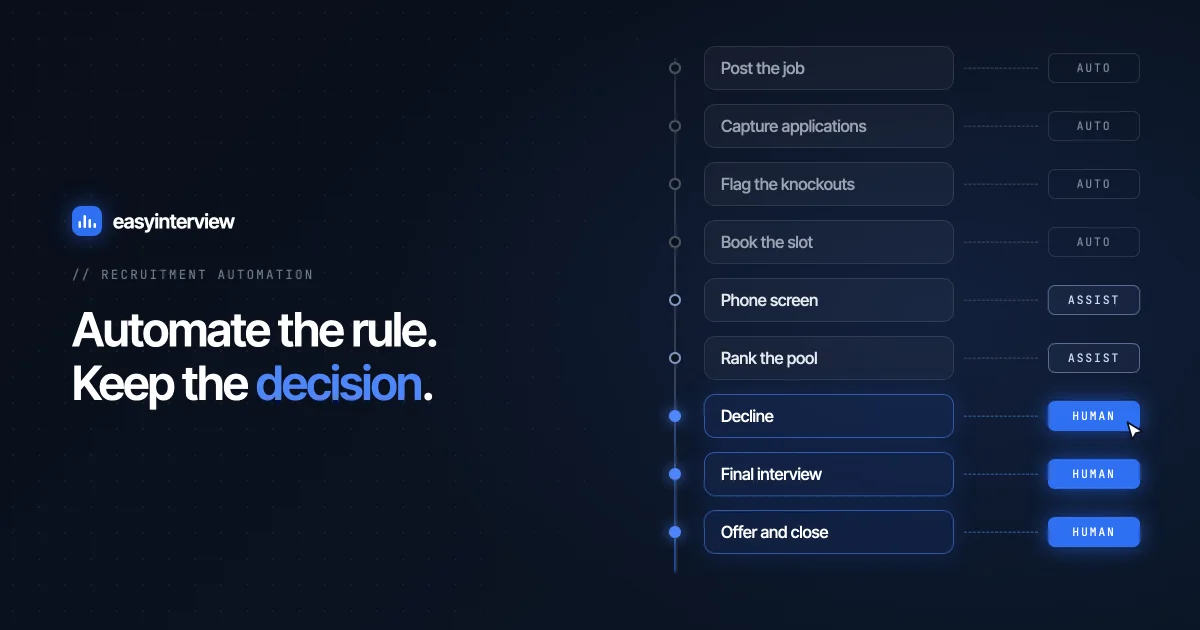
Recruitment automation is the most oversold phrase in HR software, for a structural reason: nearly every page that ranks for it is written by a company that sells it. So the pages agree. Automate posting, screening, scheduling and onboarding, and a chart shows recruiter hours falling. None of them say which steps of a hiring process genuinely run well without a person, which only look like they do, and what breaks when you automate the wrong one. This page does, for Indian teams hiring at applicant volume: a usable definition, a three-question test for any step, an automate / assist / leave-alone table across the stages, and an honest account of the failures.
One note on the word. In India, "recruitment" on its own means IOCL and AAI notifications, and Google knows it. Everything here is about an employer's hiring process and the recruitment automation software that runs parts of it, not a vacancy list.
What recruitment automation actually is
Strip the marketing and recruitment automation is software executing a rule you wrote, on every applicant, without a person touching each instance. If the notice period entered is more than 45 days, tag the application. When a candidate completes the screen, send the next message. Two hours before a slot, send a reminder. The rule is the product; the software is the loop that applies it a thousand times without getting bored.
That separates automation from two things it is sold alongside. An ATS is the record: who applied, where they are, what was said. Automation is the loop that moves the records and messages the people in them; most Indian teams have the record, in Zoho Recruit, Keka Hire, Naukri RMS or a spreadsheet, and very little of the loop. And an AI phone screen that scores an answer is not applying a rule you wrote; it is making a judgment you asked for, which is a different category with different obligations.
So three things trade under one name: rule execution, workflow, and judgment-assist. The first two automate. The third assists. Nothing in a hiring process should be fully delegated to software if its output is a judgment about a person and its errors cannot be taken back.
The three-question test for any step in the hiring process
Take any step your recruiters do today and ask three questions.
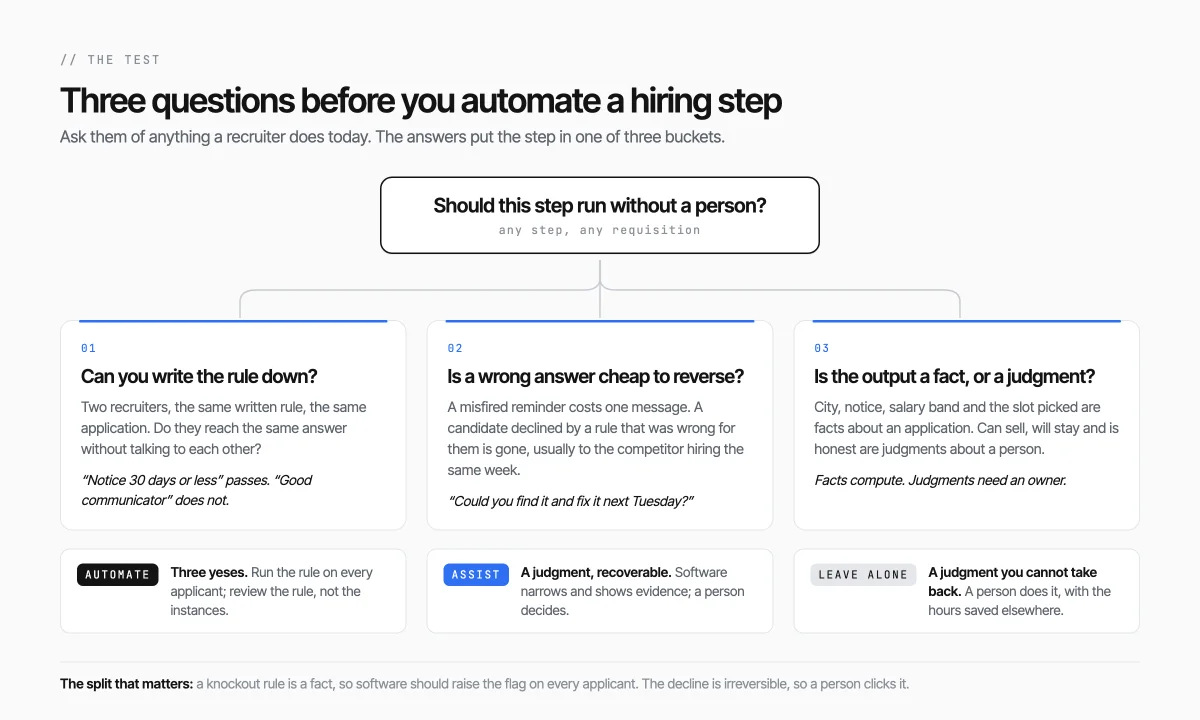
Can you write the rule down? Not whether you can describe the step, but whether two recruiters, handed the written rule and the same application, reach the same answer without talking. "Within 25 km of the Thane branch", "notice 30 days or less", "own two-wheeler and a valid licence": yes. "Good communicator", "will stay": no. If the rule cannot be written there is nothing to automate, only a judgment to make.
Is a wrong answer cheap to reverse? A reminder sent for the wrong slot costs one correcting message. A candidate declined by a rule that was wrong for them is gone, usually to the competitor hiring the same week. Cheap errors can run unattended; expensive ones need a person at the point of no return.
Is the output a fact about the application or a judgment about the person? City, notice, salary expectation, the slot picked: facts. Can sell, will show up, is telling the truth: judgments. Facts compute. Judgments can be informed by software, which is the whole of what AI in hiring honestly offers, but they stay with the person whose name goes on them.
Three yeses: automate, and review the rule rather than the instances. A judgment whose errors are recoverable because a person reviews the output: assist, meaning software narrows and produces evidence, a person decides. A judgment that cannot be taken back, or that carries fairness or legal exposure: leave alone, and give it the hours saved elsewhere.
The automate / assist / leave-alone table
Run a typical Indian volume hiring process through the test and this is what comes out. Copy it into a sheet and re-mark it for your own steps; the buckets rarely move, but the order you attack them in should.
| Hiring step | Bucket | Why it lands there | What the person still does |
|---|---|---|---|
| Distributing the post to Naukri, apna, WorkIndia, foundit, WhatsApp groups, careers page | Automate | Same post, many channels; an error is a re-post | Writes it once, picks the channels |
| Capturing applications into one pipeline, de-duplicating | Automate | A record is a fact; a duplicate is a phone-number match | Nothing per applicant |
| Acknowledgement and status messages | Automate | Same message to everyone at a stage; a wrong one is a correction | Writes the templates, keeps STOP honoured |
| Knockout filtering (city, notice, band, shift, licence) | Automate the flag, not the decline | The rule is a fact; the decline is irreversible | Reviews the flagged list, overrides, clicks the decline |
| Slot booking and reminders | Automate | The candidate picks; the reminder is a rule | Sets the availability windows |
| First-round screening conversation at volume | Assist | A judgment about a person; software can run the call in parallel and return evidence, but the bar is yours | Sets the rubric, reads transcripts at the margin, decides the cut |
| Ranking the screened pool | Assist | Usable only if every rating is pinned to evidence a person can check | Reviews the top and a sample of the rest |
| Skills tests (typing, spoken language, aptitude, code) | Automate the score, assist the cut | Scoring is arithmetic; the pass mark is a decision | Sets and revisits the pass mark |
| Final interview and selection | Leave alone | Judgment is the product; software holds the calendar and the scorecard, not the choice | Interviews and decides |
| Declining a candidate | Leave alone (the click) | Irreversible, fairness exposure, needs an owner; the message can be a template | Clicks; the system sends the outcome message |
| Offer, negotiation, closing to joining | Leave alone | Every candidate's situation differs; a templated offer loses joiners | Calls, negotiates, follows up until Day 0 |
| Documents, onboarding paperwork, background checks | Automate the chase, assist the judgment | Collecting is a rule; deciding what a discrepancy means is not | Reads the discrepancy |
Two rows carry the article. The knockout row is split on purpose: the flag is a fact, so software should raise it on every applicant, but the decline is the one action the candidate cannot undo, so a person performs it. And the screening row is where every vendor page, including ours, would like you to read "automate". Read "assist".
The three leave-alone rows share one reason: judgment is the product, and the cost of a wrong answer is a person. The final interview is a manager's choice, with software holding the calendar and the scorecard. The decline message can be a template so everyone hears back, but the act belongs to a named person with the option to include anyway. And in Indian volume hiring the gap between "offer accepted" and "joined" is where cohorts are lost; it is closed by a person calling a candidate who has two other offers and a family with opinions, and a templated offer sequence is faster and loses joiners. Give those rows the hours the automate bucket frees.
Which parts of hiring genuinely automate well
The honest case for recruitment automation is strong exactly where the work is high-volume, rule-based and repetitive, and Indian volume hiring has a great deal of that. Take a field sales or telecalling req that draws 1,000 applicants and count where the hours go before an offer is made.
Arithmetic from the assumptions stated in the labels, not a benchmark or customer data. Your minutes per step will differ; the shape rarely does.
Three of those bars, about 106 hours, sit in the automate bucket. Phone tag disappears when the candidate picks a slot on WhatsApp and the reminder sends itself. Status messages disappear when every stage change fires a template, and more of them actually get sent, since a recruiter with 1,000 applicants sends the good news and skips the rest. Knockout checks disappear when the four facts are asked at apply instead of read off a CV, with the decline still clicked by a person from a pre-flagged list. Distribution is not on the chart because it is already cheap: one link to the right two or three boards, as the bulk hiring process pillar sets out, is an afternoon.
That is a real saving, and where a team should start. It is also where recruitment automation software earns its keep, because an ATS or a WhatsApp pipeline delivers these reliably today, and the messaging half needs nothing more exotic than a template set, a consent record at apply and an opt-out on every message.
The largest bar is not in that bucket.
Where software assists and a person decides
The first-round conversation is the biggest block on the chart and the step with no traditional tool: a recruiter completes a bounded number of calls a day, so the queue clears at the speed of headcount. It is also where the word "automation" does the most damage, because what is being produced is a judgment about a person.
Software helps here in a specific way. It can run the conversation in parallel across the whole eligible pool, in the candidate's own language, against the same rubric every time, and hand back evidence per candidate. That removes the headcount term from the arithmetic. What it must not do is decide, for three reasons.
The bar is yours. Whether a 3 out of 5 on role knowledge is a pass depends on how many seats you have, how many offers you will extend for each, and what the last cohort taught you. A tool can rank against the rubric; where the line falls changes by req.
A score is only as auditable as the evidence under it. "Communication: 4" with nothing else is a rule you cannot read. When a hiring manager asks why a candidate they liked was ranked 80th, the answer has to be a quoted moment in a transcript, not "the model". Buy assist tools on that test alone; the twelve vendor questions in automated phone screening are mostly variations on it.
Errors are not cheap to reverse. A candidate ranked out of the top 40 on a call that misheard a Bengali number is, in practice, gone. A person reading at the margin, places 35 to 50 rather than the top five, is the recovery mechanism. Budget for it. The same logic covers the pass mark on a skills test: software computes, a person owns the cut.
What breaks when you automate the wrong step
Every failure of recruitment automation that reaches a hiring team's inbox is one of three, and all three come from moving a judgment-shaped step into the automate bucket.
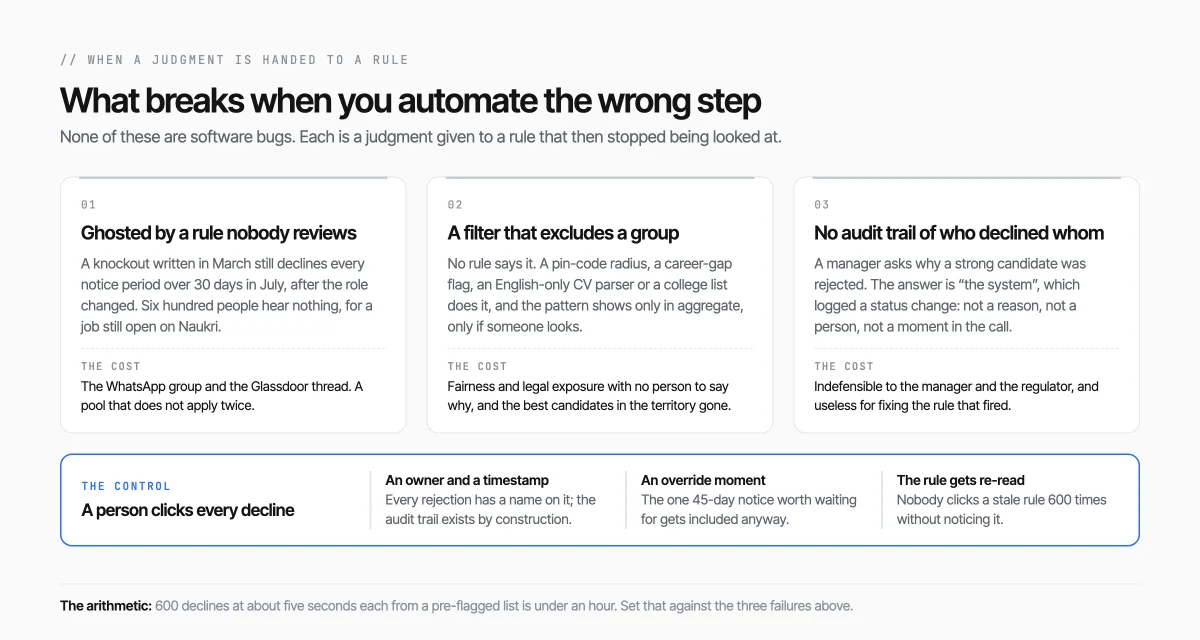
Candidates ghosted by a rule nobody reviews. A knockout set up in March quietly declines every notice period over 30 days. In July the role changes and 45 days is fine, but nobody re-reads the rule, because rules that run themselves do not ask to be read. Six hundred people receive nothing, or a "we have moved forward" template for a role still open on Naukri. The damage lands in the WhatsApp group and the Glassdoor thread, and that pool does not apply twice.
A filter that silently excludes a group. No one writes "decline women" or "decline anyone over forty". The exclusion arrives through a proxy: a pin-code radius that cuts off one community's neighbourhoods, a career-gap flag that lands on mothers, an English-only CV parser that drops everyone who applied in Marathi, a college list that is really a caste list. Because the rule reads as neutral, the pattern shows only in aggregate, and only if someone looks. The legal exposure is no longer hypothetical. In May 2025 a US federal court allowed Mobley v. Workday to proceed as a nationwide collective action on the allegation that an AI screening tool systematically disadvantaged applicants over 40, per Holland & Knight's summary of the ruling; the allegations are unproven and the case is ongoing at the time of writing, but the court's willingness to hear it is the point. India has no AI-in-hiring statute yet. What applies is the DPDP Act 2023, whose Rules were notified in November 2025 with the main duties phasing in through 2027 on the reading of the law firms that have summarised them, TRAI's rules on calls and SMS, and the reputational cost of being the employer whose filter did that. None of this is legal advice; it is the reason the decline needs an owner.
No audit trail of who declined whom. A manager asks why a strong-looking candidate was rejected. The honest answer is "the system", and the system logged a status change: not a reason, not a person, not a moment. That is unacceptable to the manager, indefensible to a regulator, and useless for improving the rule, because you cannot tell which rule fired.
Why a human clicks every decline
The argument on the merits, not as a feature. A human click on each decline does three things a rule cannot. It creates an owner and a timestamp, so every rejection has a name on it and an audit trail exists by construction. It creates an override moment: the recruiter looking at a flagged list sees the one 45-day notice worth waiting for and includes them anyway, the only place a policy failure can become visible before it becomes a pattern. And it forces the rule to be re-read, because a person who clicks decline 600 times on a rule that no longer makes sense will notice, where a scheduler never will.
The cost is small. Six hundred declines at five seconds each, from a pre-flagged list where the reason is already shown, is about fifty minutes. Set that against the ghosted pool, the proxy filter nobody caught, and the manager's question you cannot answer, and the click is the cheapest control in the pipeline. Automate the flag. Keep the click.
How to decide what to automate first
The table gives the buckets. This is the order.
- Count the hours on one live req. For one week, have each recruiter log minutes per step: messages, knockout reads, scheduling, calls, interviews, offers. Estimates are off by a factor of two in both directions; a week of logging is not.
- Run every step through the three questions and write the bucket next to it. Argue about the borderline ones; the argument is where the process gets understood.
- Sort the automate rows by hours and start with the top two. For most Indian volume teams that is scheduling and status messages, then knockouts. These pay back inside the first req and carry almost no fairness exposure.
- Before automating knockouts, write each rule as a fact you would show the candidate, then show it at apply. Keep the decline click from day one.
- Only then look at the assist bucket, and buy on evidence per candidate: transcript, quoted answer, rating pinned to a moment. A score with nothing under it fails the audit-trail test before any other.
- Measure five numbers before and after: captured, eligible after knockouts, screens completed, shortlisted, still employed at day 30. Run the time side through the time-to-hire calculator with your own minutes, not ours.
- Never automate a leave-alone row to save time. Spend the saved time there. The offer call that closes a joiner is worth more than the hours the reminders saved.
Recruitment automation software in India: what to check before buying
This is deliberately not a tools list; the category-by-funnel-stage guide, with the products an Indian team would actually consider, is in bulk hiring tools. What belongs here is the short set of checks that decide whether recruitment automation software holds up in Indian conditions, whichever name is on it.
- Languages. If the screen, the form or the messages run only in English, that is a knockout rule you did not write, and it declines the people who would have performed best in the territory.
- WhatsApp-native scheduling. Frontline candidates do not read email. Slot-picking and reminders belong in the thread, with a one-tap reschedule.
- Consent at apply and STOP on every message. Anyone contacting candidates on your behalf needs consent collected at apply, scheduled rather than cold calls, and an opt-out on every message, so the phone leg stays inside TRAI's framework.
- Candidate data handling. A CV, a number and a recording are personal data under the DPDP Act. Ask what is kept, for how long, and how a candidate withdraws.
- An override and an outcome message on every rule. If the tool can decline a candidate with no person in the loop and no message out, it fails the audit-trail test before you have bought it.
- Export. The result has to land in your ATS or HRMS without retyping, or the saving upstream is lost downstream.
The comparison page sets out how a live phone screen differs from assessment platforms and outsourced interview services on these axes.
How EasyInterview draws the line
EasyInterview is a hiring pipeline for volume roles, built on the split this article argues for: automate the facts, assist the judgment, leave the decision to a person.
The automate bucket is the front of the pipeline. One branded apply link goes out to LinkedIn, Naukri, Indeed, apna, WhatsApp, foundit, Shine, a careers page or a QR poster, and a CSV of applicants you already hold enters the same pipeline. You write the knockout rules, on location, notice period, salary band and shift, and candidates see them politely at submit. Every rule has an "include anyway" override, every decline is clicked by a human, and every screened candidate gets an outcome message. Candidates pick their own slot over WhatsApp with a one-tap reschedule. Consent is collected at apply and every message carries a STOP opt-out, in line with TRAI rules.
The assist bucket is the screen. Everyone who clears the rules gets a live AI phone interview in their own language, across eleven: English, Hindi, Bengali, Tamil, Telugu, Kannada, Malayalam, Marathi, Gujarati, Punjabi and Odia. Calls run in parallel, so throughput is set by applicant volume rather than recruiter headcount. The call cross-questions rather than reading a script: it probes vague answers with follow-ups and flags coached or scripted ones. The AI is disclosed in every invite, and a person reads the transcript. What comes back is a ranked shortlist scored on seven dimensions, Communication, Role knowledge, Experience fit, Problem solving, Availability, Integrity and Language fluency, with every rating pinned to a moment in the call, plus the recording, the transcript and a percentile rank. That is the evidence-per-candidate test from the assist section, built in; the sample report shows one scored call.
The leave-alone bucket stays yours. The product does not reject anyone; it ranks, and your team decides where the line sits, runs the final interviews and makes the offers. The scorecard exports today; native ATS integrations are on the roadmap, so check the export step against your own system.
The honest caveat: this is a newer product with no public bulk-hiring case study yet. Evaluate it like any recruitment automation software: a pilot on one live req, run alongside your existing screen, comparing the two shortlists and then who was still there at day 30.
Frequently asked questions
What is recruitment automation, in one sentence?
Software that executes a rule you wrote on every applicant without a person touching each instance: posting to channels, capturing and de-duplicating applications, flagging knockouts, booking slots, sending reminders and status messages. AI tools that score or rank candidates assist a judgment rather than automate it, and should be bought and run on that basis.
Can recruitment automation reject candidates automatically?
Technically yes, and it is the one thing to refuse. A knockout rule should flag, show the candidate the reason at submit, and put them on a list a person reviews and declines with an override available. Automating the flag saves the hours; automating the decline removes the owner, the override and the audit trail, and is how a stale rule ghosts a pool for months.
Is automated screening legal in India?
There is no AI-specific hiring law in India at the time of writing. What applies is the DPDP Act 2023 and its 2025 Rules for candidate data, TRAI's rules for calls and SMS, and general employment law. In the US, courts have begun to hear discrimination claims against AI screening tools, Mobley v. Workday being the prominent 2025 example, and that direction of travel is worth assuming. Keep consent at apply, disclose the AI, keep a person on every decline and keep evidence behind every score. None of this is legal advice.
Does recruitment automation remove bias?
It removes one kind, where two recruiters treat the same answer differently at 10 am and 4 pm. It can introduce another, where a neutral-looking field acts as a proxy for a group and the pattern only shows in aggregate. Automation makes hiring consistent; whether it makes hiring fair depends on who is reading the rules and the outcomes, which is why both need an owner.
Automate the rule. Keep the decision.
Recruitment automation is worth having where it is honest: the facts, the messages, the calendar, the flag. It is worth resisting where it is sold hardest: the decision, the decline, the close. Copy the table, log a week of hours on one req, and start with the two automate rows that cost you most. Then give the time you win to the rows that were never going to be software.
Book a demo to see EasyInterview take one volume req from an apply link to a ranked, evidence-scored shortlist, with a person clicking every decline.
Rohit Pandit
Founder, EasyInterview · easyinterview.life
I build EasyInterview, an AI hiring pipeline for high-volume roles in India. These are field notes on screening at volume, hiring signal, and interview integrity, written from the work rather than from a keyword list.
Connect on LinkedIn