The Evidence-Based Engineering Hiring Scorecard
How to build an engineering hiring scorecard where every rating links to a quote, a timestamp, and a defined bar instead of a gut feeling.

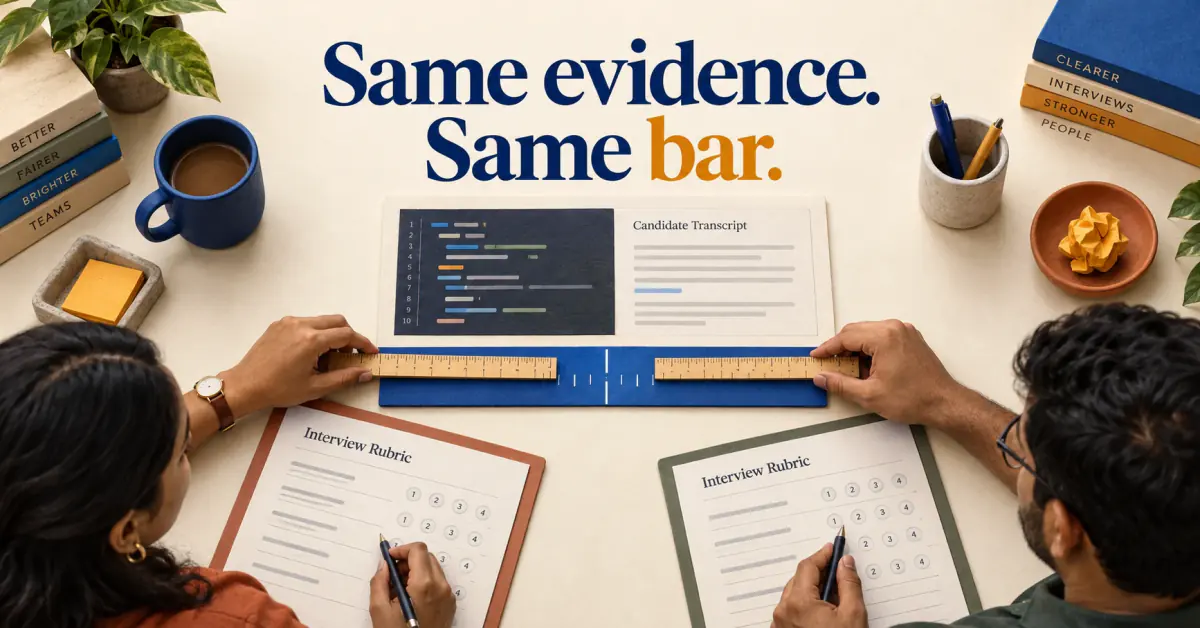
An engineering hiring scorecard is the record of what an interview actually produced: one row per competency, a rating against a defined bar, and the specific evidence behind that rating — a quote, a timestamp, an artifact. When those three parts are present, a debrief becomes an argument about evidence. When they are missing, it becomes an argument about who sounds more certain.
Most hiring teams already run structured interviews. Far fewer capture structured evidence. The scorecard gets filled in after the call, from memory, in a text box, and the result reads like this: “Strong communicator, 4/5. Good problem solver, 4/5. Slight concern on depth.” Three sentences, no way to check any of them.
This article covers what an evidence-linked row looks like, why vague ratings collapse under pressure in a hire/no-hire meeting, and the three failure modes that quietly ruin otherwise well-run loops.
Why “strong communicator, 4/5” is useless in a debrief
Consider what a reviewer can do with that rating. They cannot tell what the candidate said. They cannot tell what question prompted it. They cannot tell whether the interviewer’s 4 means the same thing as their own 4. They cannot tell whether the rating covers the whole interview or one memorable moment in minute eight.
So the reviewer does the only thing available: they weigh the interviewer, not the evidence. The senior engineer’s 3 outranks the junior engineer’s 4. The person who talks first anchors the room. A hiring manager who liked the candidate’s résumé reads the same 4 as confirmation, and a skeptic reads it as faint praise.
That is not a debrief. It is a negotiation between impressions, and it produces two expensive outcomes. First, decisions become unreproducible — run the same loop twice and you get different answers. Second, they become indefensible. When a rejected candidate asks why, or a manager asks six months later how a bad hire cleared the bar, “4/5, strong communicator” explains nothing.
A rating is a conclusion. A scorecard that stores only conclusions has thrown away the reasoning.
What one scorecard row should contain
A useful row carries four fields, and each does distinct work.
Competency. A named, pre-agreed signal — “decomposes an ambiguous problem,” not “technical ability.” If the competency is broad enough that two interviewers would score different things under it, it is not a competency yet.
Rating against a defined bar. The number matters less than the anchor behind it. “3 = meets the senior bar” is usable; “3 = pretty good” is not. Anchors should be written before the loop starts and describe observable behavior at each level.
Evidence quote. The candidate’s own words, verbatim, not the interviewer’s paraphrase. Paraphrase is where interpretation leaks in — “he seemed unsure about indexing” is already a judgment, while “I’d add an index on user_id, but I’m not sure it helps here because the query filters on created_at first” is a fact anyone can re-read.
Timestamp or artifact link. The pointer that lets a reviewer verify in ten seconds instead of replaying forty-five minutes. Without it, evidence is technically present and practically unused.
The discipline this enforces is subtle but important: an interviewer who has to attach a quote to a rating discovers, at the moment of writing, whether they actually observed the thing they are about to score. Quite often they did not, and the rating quietly changes.
A worked example engineering hiring scorecard
Here is a completed engineering hiring scorecard for a senior backend screen. The candidate is the same person in every row; the point is what a reviewer can do with it.
| Competency | Rating (1–4 vs. senior bar) | Evidence quote | Where | Reviewer note |
|---|---|---|---|---|
| Problem decomposition | 4 — exceeds | “Before I write anything, the write path and the read path have different constraints here, so I’ll design them separately.” | 04:12 | Unprompted; set structure for the rest of the round |
| Correctness under edge cases | 2 — below | “Yeah, that would break if the list is empty. I didn’t handle that.” | 21:40 | Found only after the interviewer supplied the case |
| Complexity reasoning | 3 — meets | “It’s O(n log n) because of the sort; the scan after it is linear, so the sort dominates.” | 26:05 | Correct and volunteered |
| Data modeling trade-offs | 3 — meets | “I’d denormalize the counter. It’s a consistency risk, but the read volume is 100x the writes.” | 33:18 | Named the cost of the choice, not just the benefit |
| Response to challenge | 2 — below | “I guess you could do it that way too.” | 38:02 | Conceded a correct design without defending it, twice |
| Communication | 3 — meets | “Let me restate the requirement so I know we agree: writes are idempotent by request ID.” | 02:55 | Clear, but the 38:02 exchange shows it thins under pressure |
Now compare that with “Strong communicator, 4/5. Good problem solver, 4/5. Slight concern on depth.” The table supports a real conversation: the candidate structures problems well and reasons about cost honestly, but does not hold a position when challenged and needed help finding an edge case. Whether that clears your senior bar is a judgment call — but it is a judgment call about specific, checkable behavior, and two reviewers who disagree can point at the row they disagree on.
Notice also that the communication row is a 3, not a 4, and that the note explains why. Evidence makes ratings less flattering. That is the feature.
How evidence changes the hire/no-hire meeting
Three things change once every rating carries a pointer.
The meeting gets shorter. Most debrief time goes to reconstructing what happened. When the record already says what happened, the discussion starts at interpretation. Disagreements narrow to one or two rows instead of the whole candidate.
Disagreement becomes productive. “I read 38:02 as deference to a senior engineer, not weak conviction” is a claim someone can check and respond to. “I just got a stronger feeling from him” is not. Panels that argue about evidence converge; panels that argue about impressions escalate.
Calibration becomes possible. Once quotes are attached to ratings, you can look across many scorecards and see that one interviewer’s 4 sits where everyone else’s 3 sits. You cannot fix rating drift you cannot see, and you cannot see it from numbers alone.
There is a fourth effect that matters more over time. Evidence-linked scorecards are the only version of a hiring record you can review after the outcome is known. When a hire works out or does not, you can go back and ask which signals predicted it. That feedback loop is how a rubric improves. Loops that store only conclusions never get better; they just accumulate opinions.
Common failure modes evidence corrects
Halo effect. One impressive answer colors every subsequent rating. The candidate name-drops a system you respect at minute five, and communication, judgment, and depth all drift upward. Per-competency evidence breaks this because each row needs its own quote. If you cannot find a quote for the judgment row, the judgment rating was borrowed from a different moment.
Recency bias. The last ten minutes dominate the write-up, especially when the scorecard is filled in afterward. Timestamps expose this immediately: a scorecard where every quote sits after minute 35 is not a record of the interview, it is a record of what the interviewer still remembered.
Uncalibrated scales. “4/5” means nothing until someone writes down what a 4 looks like. Without behavioral anchors, a scale measures interviewer optimism. The fix is cheap and unglamorous — write one observable sentence per level per competency, before the loop opens, and make interviewers score against that sentence rather than against their sense of the candidate pool.
Note debt. Interviewers who are running the interview cannot also transcribe it. Asking for verbatim quotes without giving people a way to capture them produces either thin scorecards or interviewers who type instead of listening. This is the failure mode most teams hit when they try to adopt evidence-based scorecards by policy alone — the standard is right, the capture mechanism is missing.
Making evidence capture the default, not extra work
The practical obstacle is not agreement. Nobody argues that quotes are worse than impressions. The obstacle is that producing an evidence-linked scorecard by hand costs the interviewer time they do not have, and the discipline decays after a few busy weeks.
That is why the capture belongs to the tooling. If the interview produces a transcript and a recording chaptered by question, the quote and the timestamp are already there — the interviewer’s job shrinks to judgment, which is the part only a person should be doing.
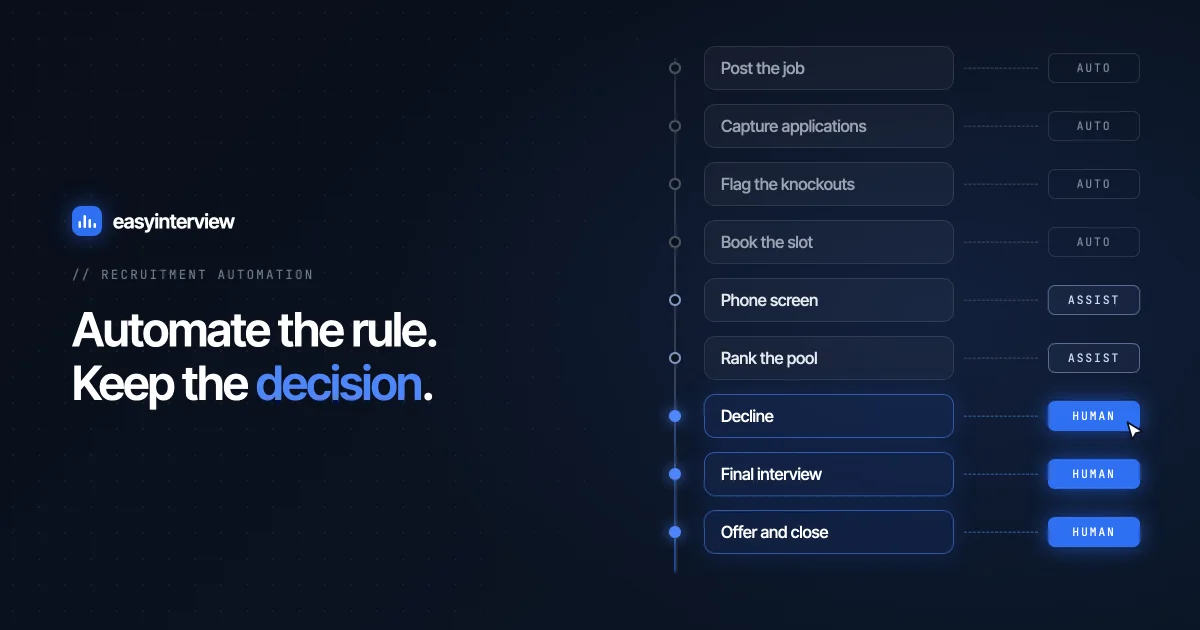
This is how EasyInterview, an AI hiring pipeline for high-volume hiring, structures every round. The AI phone interview that screens applicants pins each dimension score to a quoted moment in the call, with the recording and transcript attached, so the ranked shortlist a reviewer opens is already evidence-linked. For engineering roles, the live technical round goes further. It runs your rubric in a real code editor or on a shared system-design whiteboard, then returns an evidence-scored report where each score links to the exact transcript quote and the specific deduction behind it, alongside the optimal answer, a confidence score, and a recording chaptered by question. Reviewers jump to the exchange that supports a score instead of replaying the session. Integrity flags for paste, lookup, and tool-assisted patterns arrive attached to the same record, so a flag is something a human can inspect rather than an unexplained rejection. The scorecard exports in an ATS-ready format today; named Greenhouse, Lever, and Ashby integrations are on the roadmap.
You can review a sample scorecard to judge whether that evidence meets your committee’s standard, or read how the live technical round produces it for the mechanics of the round itself.
Frequently asked questions
What should an engineering hiring scorecard include?
One row per competency, each with a rating against a written behavioral anchor, a verbatim quote from the candidate, and a timestamp or artifact link that lets a reviewer verify the quote in context. A rating without evidence is a conclusion with its reasoning deleted.
How many competencies should a scorecard have?
Enough to cover the signals the role actually needs, usually five to eight for a technical screen. Each one must be specific enough that two interviewers would score the same behavior under it. Broad labels like “technical ability” collapse several independent signals into one number.
Does an evidence-based scorecard slow interviewers down?
Filling one in manually does. That is why the quote and timestamp should come from the interview record rather than the interviewer’s memory — when the transcript and recording are already chaptered by question, attaching evidence costs nothing and the interviewer spends their attention on judgment.
Can this help with hiring audits or bias reviews?
An auditable trail of what was asked, what the candidate said, and why a rating was given is far more defensible than a set of numbers with no supporting record. It supports that kind of review, though no scorecard format should be treated as a guarantee of legal compliance.
Start from evidence, not impressions
The gap between a good hiring loop and an unreliable one is rarely the questions. It is whether anyone can reconstruct, a week later, why a candidate got the rating they got. Structured questions without structured evidence still leave the decision resting on whoever remembers the interview most confidently.
Fix the record and the rest follows: shorter debriefs, disagreements that resolve, rubrics that improve because you can check them against outcomes.
Book a demo to see the evidence-linked scorecards EasyInterview returns from its AI phone interviews and live technical rounds.
Rohit Pandit
Founder, EasyInterview · easyinterview.life
I build EasyInterview, an AI hiring pipeline for high-volume roles in India. These are field notes on screening at volume, hiring signal, and interview integrity, written from the work rather than from a keyword list.
Connect on LinkedIn