Bulk Hiring Tools: Pick by the Funnel Stage That Is Breaking
Bulk hiring tools by funnel stage: job boards, ATS, knockout filters, AI phone screens, assessments and scheduling. A symptom-to-tool table for Indian teams.
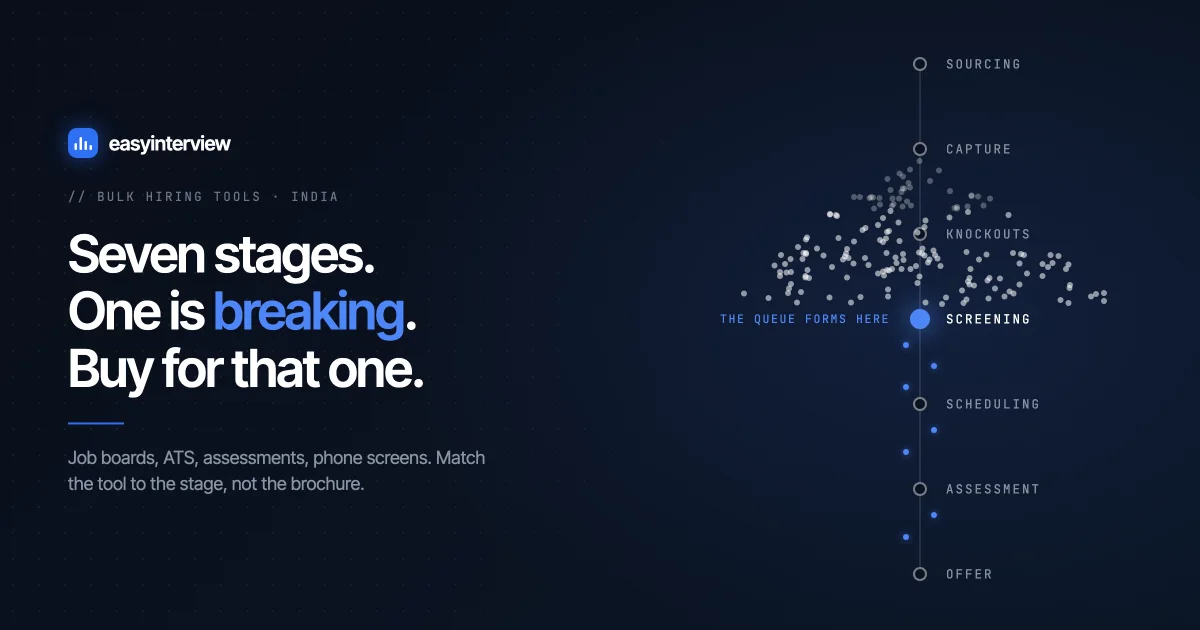
Most lists of bulk hiring tools fail the same way: ten products, each described in the same flattering paragraph, and you close the tab knowing what exists but not what to buy. A hiring team's real question is narrower. Something in the funnel is breaking, too few applicants or too many nobody can call or interviews people do not turn up to, and they want the category of tool that fixes that stage. This page is organised that way: seven stages of a bulk hiring funnel, the symptom each produces when it fails, and the bulk hiring software an Indian team would realistically consider for each. The process itself, phase by phase, is in the bulk hiring process in India. This is the tools spoke that hangs off it.
Start with the symptom, not the software
Two rules first. No single product covers all seven stages well; anything sold as end-to-end bulk hiring software is strong at two or three and adequate at the rest. And the stage that is breaking is rarely the one the budget goes to: sourcing gets the money because it is visible, screening gets the pain because it is invisible until offers go out three weeks late.
| Symptom you can see | Stage that is breaking | Tool category | Options an Indian team would consider | What it will not fix |
|---|---|---|---|---|
| Under twenty applicants a day; the same profiles on every board | Sourcing and distribution | Job boards and sourcing platforms | Naukri, apna, WorkIndia, foundit, Indeed, LinkedIn; referral and WhatsApp-group drives | The quality of the pile |
| Applications in six inboxes, a WhatsApp number and an Excel sheet; nobody trusts the count | Application capture | An ATS, or one apply link into one pipeline | Zoho Recruit, Keka Hire, Darwinbox, Naukri RMS | Any judgment about a candidate |
| Half of every call ends at "wrong city", "sixty-day notice" or "wants ₹5,000 more" | Knockout filtering | Structured pre-screen questions with rules | Questionnaires in the ATS or on the job post; a pipeline tool with knockout rules | Anything conversational |
| 400 eligible, the team calls 50, the rest hear nothing | Screening throughput | Phone screening at volume | More recruiters, an outsourced call team, one-way video, or an AI phone screen (EasyInterview is one; apna lists an AI calling agent) | The final interview |
| Four in ten scheduled interviews no-show; a walk-in day draws a third of the invites | Scheduling and show-up | WhatsApp-native scheduling and reminders | WhatsApp Business tools; slot-picking built into the ATS or the phone-screen tool | People who were never interested |
| Shortlisted candidates fail on the floor: typing, English, aptitude, code | Assessment | Skills and aptitude assessment platforms | HackerEarth, iMocha, Mercer Mettl | Availability, attrition, or a bad brief |
| Offers accepted, joiners do not arrive; documents chased for weeks | Offer and joining | HRMS onboarding and background verification | Keka, Darwinbox; a BGV vendor | A weak offer, or a slow one |
Find your funnel in the first column and shop in that row only. The rest of this article walks the rows.
Stage 1: Sourcing and distribution
The symptom is a thin or repetitive pile. The tools are the job boards, and they are not interchangeable.
Naukri is the default for white-collar and experienced roles, and sells two things: job postings, and Resdex, its resume database for recruiters who would rather search than wait. apna is built for grey-collar and frontline hiring in Indian cities: posting, a candidate database with area filters, WhatsApp invites and walk-in drive features. WorkIndia is built around the phone call for telecalling, delivery and field roles: candidates call the employer from the listing, and employers call from its database. foundit, formerly Monster India, sells posting, a Talent Search database and social job ads. Indeed and LinkedIn round out the list for volume and for professional roles respectively. The head-to-head on reach, speed, cost and applicant quality is at best job portal for bulk hiring.
Two or three of these, chosen for the role, beat posting everywhere; the channel plan in how to hire telecallers fast shows what that looks like. What a board will not fix is the quality of what arrives. Every board optimises for applications, and the more you pay for reach, the bigger the pile the next stage has to absorb.
Stage 2: Application capture
The symptom is that nobody can say how many people applied. Applications arrive on Naukri, in an inbox, on a WhatsApp number a recruiter gave out at a walk-in, and in a consultant's spreadsheet. Duplicates and drop-off are both invisible.
The fix is an applicant tracking system, or at minimum one apply link every channel points to, so every applicant lands in one pipeline with one count.
- Zoho Recruit publishes to boards including Naukri and Indeed, hosts a careers page, parses resumes, supports pre-screening assessments and one-way video, and sends SMS and email at volume. The usual pick for a small or mid-size team.
- Keka Hire is the recruitment module of Keka's HRMS: board posting, a careers page, scheduling with scorecards, and a hand-off straight into onboarding and payroll. Its case is continuity from application to first salary.
- Darwinbox is enterprise HCM: configurable requisitions with approval flows, sourcing from Naukri's database and LinkedIn into one place, and a flow into onboarding. For a company hiring across many cities that needs budget control on every requisition.
- Naukri RMS is Naukri's own ATS, worth a look if Naukri is already the dominant channel.
What an ATS will not fix: judgment. It is a system of record. It tells you who applied and where they are, not who is good.
Stage 3: Knockout filtering
The symptom is recruiter time spent discovering on the call what a form could have asked: the candidate is in Pune and the job is in Thane, the notice is sixty days, the expectation is a band above budget, the shift is a no.
The category is structured pre-screen questions with rules attached, living in questionnaires on the job post, screening questions in the ATS, or knockout rules in a pipeline tool. Write the rules as facts about the role: location, notice period, salary band, shift, two-wheeler and licence for a field role. Show the candidate the reason at submit, keep a human clicking every decline with an override for the rule that is wrong for one person, and send everyone an outcome message.
What a knockout will not fix: anything conversational. A form cannot hear whether someone can hold a sales conversation, and nothing about a typed answer proves who typed it.
Stage 4: Screening throughput, the stage with no traditional tool
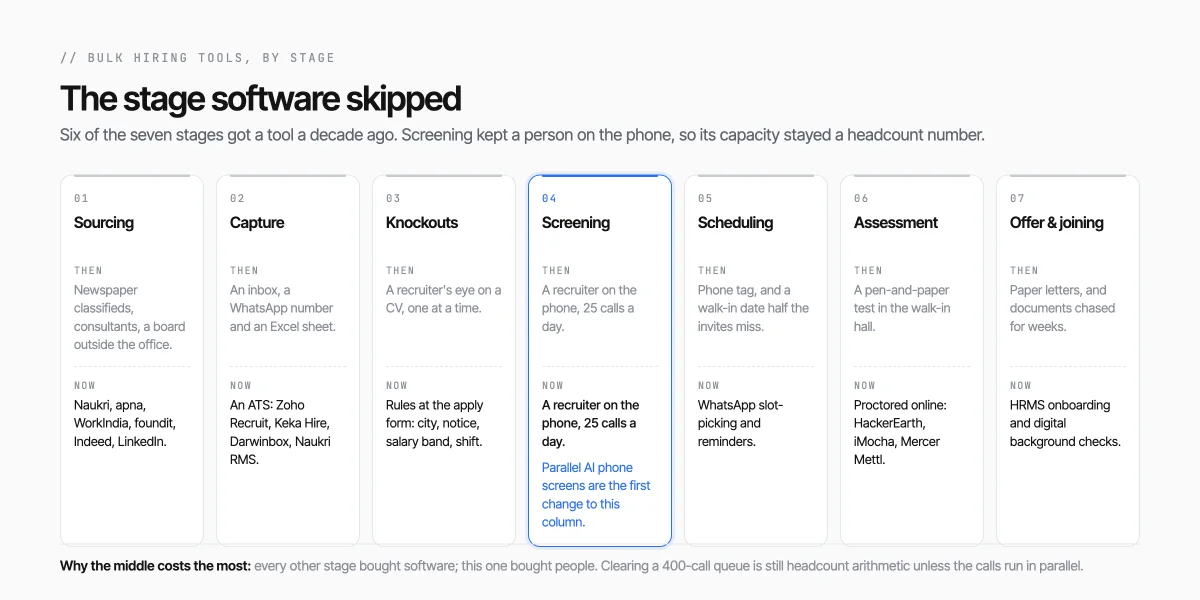
This row is different in kind. Every other stage was given software a decade ago. Screening kept the tool it always had, a recruiter on the phone, and a recruiter completes a bounded number of calls a day. The queue is headcount arithmetic.
Arithmetic from one assumption: 25 completed ten-minute calls per person per day, including notes and phone-tag. Not a benchmark. The point is the shape: the queue clears at the speed of the headcount you throw at it.
The options an Indian team actually weighs:
- More recruiters, or a temporary call team. What most BPOs do for a ramp. The cost is salaried hours, and the bar drifts by the afternoon. The BPO recruitment process shows how many calls a day a 600-seat ramp really implies.
- An outsourced RPO or call centre. Buys the headcount without hiring it. You inherit their script and their judgment, and rarely get evidence back beyond a yes or no.
- One-way video interviews. Built into Zoho Recruit and sold standalone. Faster to review than a live call, but for frontline roles the trade is completion: recording yourself on camera in English is a bar many good telecallers will not clear.
- AI phone screens. A live call in the candidate's language, run in parallel across the whole eligible pool, with a scored transcript per candidate. This is the category EasyInterview is in, and it is not alone: apna lists an AI calling agent on its employer platform (evaluated from the employer side in the Apna alternative guide). Three quite different products get sold under the name, and how to judge an automated phone screening vendor sets out the twelve questions that separate them.
The parallel option removes the headcount term from the arithmetic: the window becomes a function of how quickly candidates pick a slot, not of how many people you have. Run your own req through the time-to-hire calculator.
What no screening tool will fix: the final interview. A screen exists to make sure the twenty people who get a manager's hour are the right twenty.
Stage 5: Scheduling and show-up
The symptom is empty slots: interviews booked over phone tag, confirmed by an email a frontline candidate does not read, and walk-in days that draw a fraction of the invites because attendance skews by distance and shift, not ability.
The category is WhatsApp-native scheduling: the candidate picks a slot in a message, gets the reminder in the same thread, and reschedules with a tap. It is sold as WhatsApp Business tooling, built into some boards' employer products (apna's WhatsApp invites, for one), and built into the phone-screen category.
What it will not fix: people who were never interested. If the salary band was wrong at apply, a well-timed reminder gets you a well-timed no-show.
Stage 6: Assessment
The symptom is a shortlist that passed the interview and failed the floor: typing speed, spoken English, aptitude, code that does not run. The fix is a proctored assessment placed after the screen and before the panel, so the expensive round goes only to people who can do the measurable part of the job.
- HackerEarth is for technical hiring: coding assessments, FaceCode for live coding interviews, proctoring including a locked-down browser, and hackathons for developer sourcing.
- iMocha sells a large library across coding, cognitive ability, domain knowledge and communication, including a business English assessment.
- Mercer Mettl covers psychometric and aptitude tests, coding, communication including a speech assessment, and remote proctoring, with packaged use cases for campus, sales and blue-collar hiring.
What an assessment will not fix: availability, attrition or a bad brief. It also adds a step, and every step in a frontline funnel costs completion; for a telecalling seat, a spoken-language check on the screening call often replaces the typed English test.
Stage 7: Offer and joining
The symptom is offers accepted and joiners who do not arrive, plus a document chase that runs for weeks. The tools are the HRMS onboarding modules above, Keka and Darwinbox both carry the hire from offer into documents and payroll, and a background-verification vendor for roles that need one.
What they will not fix: a weak offer, or a slow one. Offer-to-joining loss in volume roles is mostly the days between interview and letter, and a second employer moving faster. Software shortens the paperwork; only the process shortens the gap.
Three stacks that actually get bought
The table is the instrument. These are the three combinations it usually produces.
A small team that needs one pipeline and one count more than it needs any AI.
- Sourcing
- Two boards chosen for the role, plus a referral drive on WhatsApp.
- Capture and knockouts
- Zoho Recruit or Keka Hire, with screening questions on every post.
- Screening
- Recruiter calls against a written rubric. The queue is small enough for headcount to clear it.
- Skip
- Assessments and a separate scheduling tool. Both cost completion at this volume without buying much.
A BPO, retail or field-sales ramp where the middle of the funnel is the whole problem.
- Sourcing
- apna, WorkIndia and Naukri for frontline seats; walk-ins as a supplement, not the spine.
- Capture and knockouts
- One apply link into one pipeline, with hard rules on city, notice, band and shift.
- Screening
- Parallel: an AI phone screen or a dedicated call team. Serial recruiter calls are what makes a ramp late.
- Then
- WhatsApp scheduling for the panel round, a typing or language assessment where the job needs it, and HRMS onboarding in batches.
Continuous hiring across business units, where requisition control and audit matter as much as speed.
- Capture
- Darwinbox or a comparable enterprise ATS with approval flows on every requisition.
- Sourcing
- Naukri Resdex and LinkedIn pulled into the ATS, plus the frontline boards per city.
- Screening and assessment
- Parallel screening with evidence per candidate, and Mettl or iMocha where a role has a testable skill.
- Joining
- Background verification and onboarding inside the HRMS, with export from every upstream tool.
How to evaluate any bulk hiring tool in a two-week pilot
Vendor pages, ours included, are written by the vendor. Evaluate any tool with a two-week pilot on one live requisition, run alongside whatever you do today.
- Pick one req with real volume. A tool that handles 40 applicants tells you nothing about 400.
- Measure the same five numbers on both tracks: captured, eligible after knockouts, screens completed, shortlisted, still employed at day 30.
- Compare shortlists, not dashboards. Put the tool's top twenty next to your team's and have the hiring manager interview from both blind.
- Ask for evidence per candidate. A score with no transcript or quoted answer behind it cannot be audited when a manager disagrees.
- Check the languages your applicants speak. A screen that runs only in English is a knockout rule you did not write.
- Check consent and opt-out. Anyone calling or messaging candidates on your behalf needs consent collected at apply and a STOP path in every message.
- Check the export. The output has to land in your ATS or HRMS without retyping, or the saving upstream is lost downstream.
If a tool cannot show a better shortlist on one req, more reqs will not help.
How EasyInterview fits the stack
EasyInterview is ours, and it sits in stages one to five of the table: circulation, capture, knockouts, the phone screen and scheduling. It does not do assessments or onboarding; for a frontline ramp you still want an HRMS at the end.
One branded apply link goes out to LinkedIn, Naukri, Indeed, apna, WhatsApp, foundit, Shine, a careers page or a QR poster, and a CSV of applicants you already hold enters the same pipeline. You write the knockout rules, on location, notice period, salary band and shift, and candidates see them politely at submit. Every decline is clicked by a human, every rule has an "include anyway" override, and every screened candidate gets an outcome message.
Everyone who clears the rules gets a live AI phone interview in their own language, across eleven: English, Hindi, Bengali, Tamil, Telugu, Kannada, Malayalam, Marathi, Gujarati, Punjabi and Odia. Calls run in parallel, so throughput is set by applicant volume rather than recruiter headcount. The candidate picks their own slot over WhatsApp with a one-tap reschedule, the AI is disclosed in every invite, and a person reads the transcript. The call cross-questions: it probes vague answers with follow-ups and flags coached or scripted ones.
What comes back is a ranked shortlist scored on seven dimensions, Communication, Role knowledge, Experience fit, Problem solving, Availability, Integrity and Language fluency, with every rating pinned to a moment in the call, plus the recording, the transcript and a percentile rank. Consent is collected at apply and every message carries a STOP opt-out, in line with TRAI rules. The scorecard exports today; native ATS integrations are on the roadmap, so check the export step of the pilot list against your own system.
The honest caveat: this is a newer product with no public bulk-hiring case study yet, so evaluate it exactly as the pilot section says: one live req, alongside your existing screen, comparing the two shortlists. The sample report shows one scored call; pricing is a prepaid wallet billed per connected minute with the scored report included, with current rates on the pricing page; and the comparison page covers how the live screen differs from assessment platforms and outsourced interview services such as HackerRank and Karat.
Frequently asked questions
What is the best bulk hiring software in India?
There is no single best one, because no product covers all seven stages well. The right stack for a 300-seat telecalling ramp (apna and WorkIndia, one pipeline with knockout rules, a parallel phone screen, WhatsApp scheduling, HRMS onboarding) is the wrong stack for an enterprise hiring 40 roles a month across business units, where requisition control matters most. Find the stage that is breaking in the table and buy for that row.
Do I need an ATS for bulk hiring?
You need one pipeline with one count. For most teams that is an ATS such as Zoho Recruit, Keka Hire or Darwinbox. A team hiring a few frontline roles at a time can get by with a single apply link into a pipeline tool that also runs the knockouts and the screen, as long as the result exports into whatever runs onboarding and payroll.
Can WhatsApp be used as a bulk hiring tool?
Yes, at two stages. As a sourcing channel, group and referral drives reach frontline candidates who do not check email. As the scheduling layer, slot-picking and reminders in a thread cut no-shows compared with phone tag. It is a poor system of record on its own; applications that arrive on a recruiter's WhatsApp number need to land in the same pipeline as everything else.
How much do bulk hiring tools cost in India?
Each category prices differently, and most vendor pages we checked do not publish figures. Job boards sell posting plans and database access; ATS products price per recruiter seat or, bundled with an HRMS, per employee; assessment platforms price per test or candidate; AI phone screens bill per call or connected minute. Ask every vendor for the price at your applicant volume, not the headline plan, and compare it with the salaried hours the tool replaces.
Buy for the stage that is breaking
Six stages of a bulk hiring funnel have had software for years. One kept a person on the phone, and that is the one that sets your time to hire. Find your symptom in the first column of the table, shop in that row, and pilot the tool on one live requisition before you sign anything.
Book a demo to see EasyInterview take one bulk-hiring req from an apply link to a ranked, evidence-scored shortlist.
Rohit Pandit
Founder, EasyInterview · easyinterview.life
I build EasyInterview, an AI hiring pipeline for high-volume roles in India. These are field notes on screening at volume, hiring signal, and interview integrity, written from the work rather than from a keyword list.
Connect on LinkedIn