WhatsApp Recruitment in India: Templates, Consent and the Pipeline
WhatsApp recruitment for Indian employers: a five-stage pipeline, copyable message templates for each stage, and a compliance checklist for Meta, TRAI and DPDP.

WhatsApp recruitment in India is not a channel strategy. It is the default. A retail chain opening forty stores, a BPO adding a floor of voice seats, a distributor hiring field sales across three districts: the opening reaches candidates as a forwarded message in a job group before it reaches them on a job board, and the first question comes back on the same app. Almost every guide that ranks for the term is written for a European recruiter and spends its compliance section on GDPR. This one is for the Indian employer: the shape of the pipeline, a copyable message template for each stage, and the rules that actually apply here, which are Meta's, TRAI's and the DPDP Act's.
Quick answer: run one apply link with five templated messages around it (acknowledge, knockout, slot offer, reminder, outcome), each an approved Meta template with a STOP line; the WhatsApp message answers to Meta's policy and the DPDP Act while the phone call it schedules answers to TRAI. Templates live in your business-messaging tool or ATS — this guide covers the pipeline and wording, not any single vendor's buttons.
Why WhatsApp recruitment works in India, and where it stops
The candidate for a frontline role has one device, one data plan and one app they open a hundred times a day. TechCrunch put WhatsApp's India user base at more than 500 million in December 2024, making India the app's largest market by a distance. For a telecaller, a delivery partner or a store associate, email is something they created to fill in a form once; WhatsApp is where their family, their current employer and the local job groups already are. A message about an interview lands in the same list as a message from their mother, and a candidate who sees three openings in a morning applies to the one whose next step is a tap rather than a portal registration.
You will see open rates of 95 to 98 percent on every vendor page. Treat them as vendor numbers on vendor traffic. WhatsApp gets read and email to frontline candidates mostly does not; measure your own reply and completion rates rather than borrow someone's.
Two things WhatsApp is bad at, which is why this is an article about a pipeline rather than a chat. It is a poor screen: a typed answer to "tell me about your last target" is shallow, and nothing about typed text proves who typed it. And it is a poor database: eleven recruiters' phones full of chats is not a record of who applied, who consented, who was declined and why. Use it to reach people and move them to the next step, and keep the record somewhere else.
The WhatsApp recruitment process: one apply link, five stages
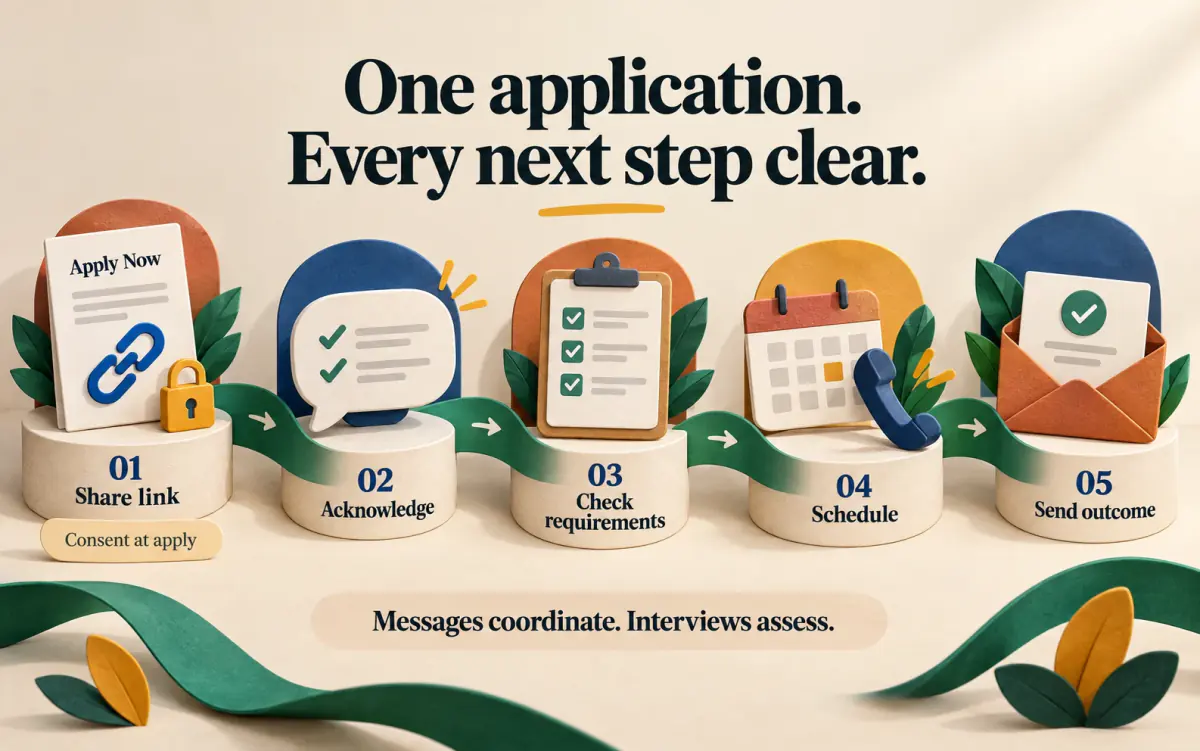
The shape that works is one apply link and five messages around it.
Circulate. One branded apply link goes everywhere the role is advertised: the WhatsApp job groups, Naukri, apna, WorkIndia, foundit, and a QR code on the poster at the store or the distributor point. One link means one form, one set of questions, and one place where the number and the consent are collected. Nobody collects a number anywhere else.
Acknowledge. Within minutes of submitting, the candidate gets a message that names your company, the role and a job ID, says what happens next and by when, and carries an opt-out. The candidate was just told to expect it, so it does not get reported.
Knockout. Location, notice period, salary band and shift are asked on the form, not in chat, so the same rule applies to applicant 3 and applicant 300. A person, not the rule, clicks the decline, and every rule needs an "include anyway" override for the candidate who is fifteen kilometres out but has done the exact job.
Schedule and remind. Everyone who clears the knockouts is offered numbered slots and replies with a digit. The invite says how long the call is and in which language, and if an AI conducts it, says so, says it is recorded, and says a person reviews it. A reminder goes out 24 hours before with a one-word reschedule path.
Outcome. Everyone who applied hears back by the promised date: shortlisted, declined, or not reached, with one reason in one clause. This is the stage most WhatsApp recruiting quietly skips, and the one candidates remember.
It is the same pipeline as the bulk hiring process generally; WhatsApp makes the candidate's side of it fast. The screen in the middle is still where the hours go.
Message templates for every stage
Send these in the candidate's language, which for most frontline roles is not English, and keep numbers, dates, times and the STOP keyword in numerals and Latin script so they survive translation. Placeholders are in braces. Each is a business-initiated message under Meta's rules, so each needs to be an approved template on the WhatsApp Business Platform; the category under each is our reading of Meta's guidelines, and Meta decides at approval.
1. Acknowledgement, sent on submit.
Hi {Name}, this is the {Company} hiring team. We have received your application for {Role} in {City} (job {ID}). Next step: a short phone interview, in {Language}, at a time you choose. You will hear from this number within {N} days. Reply STOP to stop messages about this role.
Company, role and job ID in the first line so it cannot be mistaken for a scam; a deadline you will meet; the opt-out on the first message, not buried later. Likely category: utility.
2. Knockout questions, only if the form could not collect them.
Three quick questions before we schedule, {Name}. 1) Which area of {City} do you live in? 2) How soon can you join? 3) Are you available for {shift}? Reply with all three in one message, like this: Andheri, 15 days, yes.
Three questions, an example reply, asked once. If you send this often, move the questions onto the form, where a rule applies them and nobody reads 400 chats.
3. Slot offer, once the candidate clears the knockouts.
{Name}, you are through to the phone interview for {Role} at {Company}. Pick a time: 1) Tue 10 Sep, 11:00 am 2) Tue 10 Sep, 4:00 pm 3) Wed 11 Sep, 11:00 am. Reply 1, 2 or 3. The call takes about {N} minutes, in {Language}. It is conducted by an AI interviewer and recorded; a person at {Company} reviews every interview. Reply STOP to opt out.
A digit is the lowest-effort reply there is. The AI and the recording are disclosed before the candidate commits, not discovered on the call. Likely category: utility.
4. Reminder, 24 hours before and again one hour before.
Reminder: your phone interview for {Role} at {Company} is tomorrow, {Day} at {Time}. We will call {Number}. Please be somewhere quiet with good signal, and have your notice period and expected salary ready. Need another time? Reply CHANGE.
Which number will ring and what to have ready is most of what separates a completed interview from a missed one. Likely category: utility.
5. Holding message, after the interview and before the decision.
{Name}, your interview for {Role} is complete. Thank you. {Company} is reviewing all candidates and will message you with a decision by {Date}. You do not need to call; you will hear from us either way.
It kills the "any update?" calls and commits you to a date. Hit the date. Likely category: utility.
6. Decline, after a human has clicked it.
{Name}, thank you for applying for {Role} at {Company}. We are not moving ahead this time: the role needs {one reason, e.g. someone who can join within 15 days}. We will delete your details from this hiring drive in {N} days unless you reply KEEP and would like to be considered for future roles. We wish you well. Reply STOP to stop messages from us.
One reason, no adjectives; a retention statement, which is the habit the DPDP Rules are about to make mandatory; a closed loop instead of silence. Declined candidates talk in the same job groups your next opening will be forwarded in.
On STOP. STOP means stop, for that number, across every recruiter and role, from that moment. Send one confirmation and nothing else. Meta's policy requires you to honour "all requests (either on or off WhatsApp) by a person to block, discontinue, or otherwise opt out", and a candidate who has to say it twice reports you instead.
WhatsApp compliance for Indian employers: three rulebooks, not one
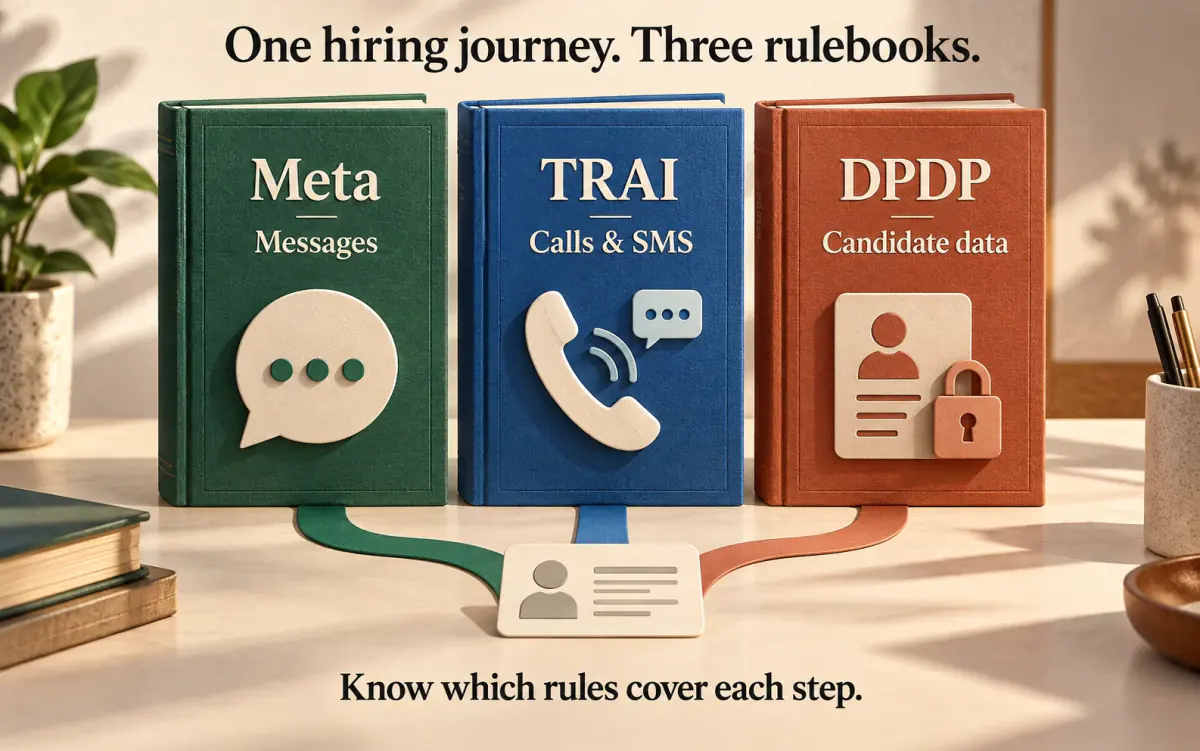
The European guides collapse compliance into GDPR. India has no single equivalent; three sets of rules govern three different things.
| Rulebook | What it governs | What it asks of you | What ignoring it costs |
|---|---|---|---|
| Meta's WhatsApp Business Messaging Policy | The message: who you may message, how, with what | Opt-in before the first business-initiated message; approved templates outside a 24-hour reply window; every opt-out honoured; your business identified | Reports and blocks lower the number's quality rating; Meta rate-limits, then disables it |
| TRAI's TCCCPR 2018 (the DND framework) | The phone call and SMS legs, on the telecom network | Commercial calls and SMS respect the DND registry, with consent on record; a scheduled call the candidate asked for is not an unsolicited one | Complaints against the calling number, which the operator acts on |
| The DPDP Act 2023 and DPDP Rules 2025 | The candidate's data: number, CV, answers, recording | Notice of what you collect and why, a way to withdraw, retention only as long as needed; main duties phase in through May 2027 | Penalties under the Act run to hundreds of crores at the top of the schedule |
Meta's rules bite first, because Meta enforces them automatically. The Business Messaging Policy allows you to contact people only if "they have given you their mobile phone number" and "you have received opt-in permission from the recipient confirming that they wish to receive subsequent messages or calls from you". The opt-in must name the business and what is being agreed to; a web form is an acceptable method. Business-initiated messages need an approved template, and free-form replies are allowed only within 24 hours of the candidate's last message. Since July 2025 the platform charges per delivered template, by category, with replies inside the 24-hour window free; rates vary by country and change, so read Meta's pricing page, not an article.
The TRAI point is the one every guide gets backwards. TRAI's Telecom Commercial Communications Customer Preference Regulations govern commercial calls and SMS on the telecom network; when they were amended in February 2025, the telecom operators' own association objected publicly that OTT apps such as WhatsApp remained outside their scope. So, at the time of writing, the WhatsApp message answers to Meta and the DPDP Act, and the phone call your pipeline schedules answers to TRAI. That is why the call should always be one the candidate consented to at apply and picked a time for, never a cold call to a list. Regulators have consulted on OTT for years; treat the current position as current, not permanent.
The DPDP Act was passed in 2023 and its Rules were notified in November 2025 on a phased timeline, with the main duties on notice, security, breach reporting and data principal rights taking effect from 13 May 2027, on the reading of the law firms that have summarised it. A candidate's number, CV and recording are personal data. Build the habits now: a plain-language notice at the form of what you collect and why, an easy way to withdraw, and a retention period you enforce. None of this is legal advice; your obligations depend on your entity and your counsel.
Business API or a personal number
| A recruiter's personal number | WhatsApp Business Platform (API) via a solutions provider | |
|---|---|---|
| Who owns the history | The recruiter. It leaves when they do. | The company. Every thread in one system. |
| Opt-in and STOP | Whatever each recruiter remembers | Captured, timestamped, enforced across the team |
| Templates | None; tone and content drift by person | Approved once, sent identically at any volume |
| Volume | One thread at a time | Set by applicant count, not thumbs |
The free WhatsApp Business app sits between the two: one company number, small broadcast lists, a history on one phone. Fine for a single store hiring two people. Not a hiring system.
The compliance checklist
- A company-owned number on the Business Platform, not a recruiter's SIM.
- Opt-in captured at apply, naming the company and what will be sent, with the timestamp and exact wording stored against the candidate.
- Every business-initiated message is an approved template; free-form only inside the 24-hour reply window.
- A STOP line on every template; STOP honoured immediately, for that number, across every recruiter and role, and logged.
- No messages to numbers you did not collect yourself: no scraped groups, no bought lists, no forwarded CVs.
- Company, role and job ID in the first line of every message.
- AI and recording disclosed in the invite, before the candidate picks a slot.
- A notice at the form of what you keep and for how long, and deletion when the drive closes.
- Never ask for Aadhaar, PAN, bank details or payment over WhatsApp before an offer. That is the job-scam pattern, and candidates are right to block it.
- Calls only at the candidate's chosen time, with the consent record attached, so the phone leg stays inside TRAI's DND framework.
- One audit trail: consent, chats, decline reason and who clicked it, in one system rather than on eleven phones.
Do these templates work with my ATS or hiring tool?
The wording does; the buttons depend on the tool. The templates above are written to the Meta policy level — approved template, named business, STOP line — so they can be pasted into any WhatsApp Business Platform tool, whether that is a dedicated BSP, an ATS with a WhatsApp module (Zoho Recruit, Recruitee and Oracle all document their own template flows), or your team's manual sends. What the tool cannot supply is the record: opt-in wording and timestamp, STOP log, consent source per candidate. Keep that in your hiring system against the candidate row, not inside the messaging tool, so a number change or vendor switch does not erase your proof.
What not to do
Blast a scraped list. Numbers lifted from a job group have not opted in. Each report lowers the number's quality rating, and a drive that gets the company number rate-limited in week two has cost more than it saved.
Let recruiters use their own numbers. Fast on day one, a liability by month three: no shared history, no way to enforce STOP across the team, and every candidate relationship leaves with the recruiter.
Screen in chat. Typed answers tell you little and prove nothing about who typed them. Run knockouts on the form and move the assessment to a live conversation, the argument the 48-hour telecaller hiring plan makes for the phone screen.
Promise and ghost. The acknowledgement says "within 3 days", nothing arrives, and 400 people conclude the company is fake or careless. Whatever date is in the message goes in the calendar too.
Collect documents over chat. Aadhaar photos in a recruiter's gallery are a breach waiting for a lost handset, and asking before an offer is indistinguishable from a scam. Collect documents after the offer, through a system.
Where the recruiter hours actually go
Templates fix the candidate side. The recruiter side is arithmetic. Say one role draws 1,000 applicants, about 412 clear the knockouts, and a team runs WhatsApp by hand: four minutes to type knockout questions and read the reply, five minutes to offer slots and close the back-and-forth, a minute and a half for each reminder, holding message and outcome.
Arithmetic from the assumptions stated above, not a benchmark or customer data. The last bar assumes knockouts on the form and templated scheduling, so a human handles only the one in ten threads that needs a person.
About 111 recruiter hours, nearly three working weeks, before anyone has heard a candidate speak. Move the knockouts onto the form, template the scheduling and reminders, and a human touches only the exceptions: the paragraph instead of a digit, the commute question, the candidate who wants Sunday. Call that one in ten and the WhatsApp layer costs an afternoon. Run your own numbers in the time-to-hire calculator; the messaging layer should never be the bottleneck. The screen is, whether you are hiring telecallers or field sales.
How EasyInterview fits a WhatsApp-led pipeline
EasyInterview does not send WhatsApp messages today. Run the templates above on the WhatsApp Business Platform for the messaging side, and use EasyInterview for the apply, screen and evidence side.
You share the job's apply link through your sourcing channels, including WhatsApp groups, Naukri, apna, WorkIndia, foundit, a careers page or a QR poster. The apply form records consent and runs the configured knockout rules; a recruiter can review an exclusion and use "Include anyway". Existing applicants can also enter through CSV import, which records existing consent rather than collecting it and does not run the apply form's knockout checks. The Naukri applicant screening workflow covers that distinction.
The recruiter schedules eligible applicants with consent on file. Calls run within the workspace's calling window, using the applicant's selected call language, across eleven: English, Hindi, Bengali, Tamil, Telugu, Kannada, Malayalam, Marathi, Gujarati, Punjabi and Odia. Set the allowed call languages for the job and check that the candidate's selection matches the task you need to assess. For spoken-language tasks, pilot the translated questions with a fluent reviewer before using the results to make hiring decisions, as the multilingual screening guide sets out. Reading and writing checks still need a separate exercise.
The interview is the part WhatsApp cannot do. It cross-questions, probing a vague answer until the real number comes out, and flags coached or scripted answers instead of scoring them as fluent. Reports link scored answers to transcript evidence, alongside the transcript and recording. The scoring dimensions depend on the interview preset: the communication rubric includes clarity, listening relevance, answer structure, concision, thought process and adaptability. These are transcript-based scores, not a certified spoken-fluency assessment. A fluent person needs to listen to the recording for pace, tone and spoken-language quality.
The hiring team reviews the evidence and decides whom to advance. Outcome emails are optional at handoff and require an email address. WhatsApp slot-picking, automated consent messages and one-tap messaging reschedules are not part of this version; your team handles any additional candidate communication with the templates above.
The honest caveat: EasyInterview is a newer product without a public bulk-hiring case study yet. Evaluate it with a pilot on one live req, run alongside your existing screen, and compare the two shortlists. The sample report shows one scored call, and the comparison page covers how this differs from a chat pre-screen or an outsourced call centre.
Frequently asked questions
Is WhatsApp recruitment legal in India?
Yes, with conditions. Meta's policy requires that the candidate gave you their number and opted in to messages from your named business, that business-initiated messages use approved templates, and that you honour every opt-out. The DPDP Act treats the candidate's number, CV and recording as personal data, so you need a notice, a purpose and a way to withdraw. Phone calls your pipeline places sit under TRAI's DND framework and should be scheduled with consent on record. Take the specifics to counsel; the checklist above is practice, not legal advice.
Do TRAI DND rules apply to WhatsApp messages?
At the time of writing, not directly. TRAI's regulations cover commercial calls and SMS on the telecom network, and the February 2025 amendment left OTT apps such as WhatsApp outside their scope, which the operators' association objected to publicly. The message answers to Meta's policy and the DPDP Act; the phone call it schedules answers to TRAI, which is why it should be a consented, scheduled call rather than a cold one.
Can I run the whole screen on WhatsApp?
Run the knockouts, the scheduling and the outcomes there. The assessment is a poor fit: typed answers are shallow, nothing proves who typed them, and reading 400 chats is slower than 400 calls in parallel. Use WhatsApp to move candidates to a live conversation, then use the conversation to judge them.
How should candidates apply for a job via WhatsApp?
From the employer's side, they should not have to. Circulate an apply link, not a "send your CV to this number" line. The link means one form, one consent capture and one record; a CV sent to a number means a gallery full of PDFs, no consent on file and no way to tell the candidate what happens next. If a candidate messages first anyway, reply with the link and the acknowledgement template.
Make the channel do the moving, not the judging
WhatsApp is where Indian frontline candidates already are; that is the whole case for using it. Give it the job it is good at, reaching people and moving them on with a consented, templated, auditable message, and keep the judgment in a live conversation and the record in one system. Copy the six templates, run the checklist, and fix the personal-number problem first.
Book a demo to see EasyInterview take one role from an apply link you circulate on WhatsApp to a ranked, evidence-scored shortlist.
Rohit Pandit
Founder, EasyInterview · easyinterview.life
I build EasyInterview, an AI hiring pipeline for high-volume roles in India. These are field notes on screening at volume, hiring signal, and interview integrity, written from the work rather than from a keyword list.
Connect on LinkedIn