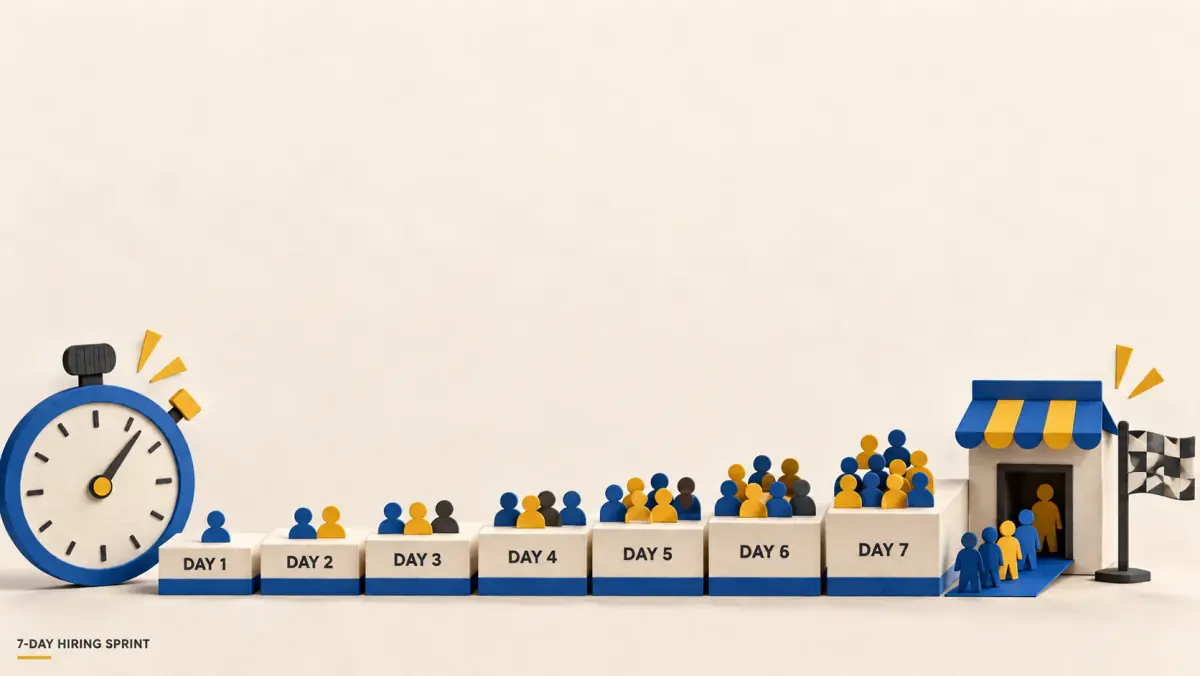
Diwali Hiring Checklist: Staffing the Festive Rush
Diwali bulk hiring checklist for India: 90-day countdown, role-wise screening plan, and buffer math for the 2026 festive rush.

Diwali bulk hiring does not fail in Diwali week. It fails in August, quietly, when the forecast was a guess, the sourcing started late, and the screening queue was still serial.
In 2026 Diwali falls on Sunday, 8 November. That puts the operational peak in late October through mid-November, with Navratri, Dussehra, Dhanteras to Bhai Dooj, and then Christmas, New Year and the winter wedding season extending the tail. If you are hiring pickers, packers, dark-store crew, delivery riders, retail associates or BPO seats for that peak, this is the checklist to work from.
It is written for the employer side of the table: the recruiter, HR manager or operations head who has to have trained people on the floor before the first sale banner goes up. If you want the planning arithmetic in its general form, start with the mass recruitment strategy. This piece applies that logic to the festive quarter.
Quick answer: start 12 weeks out (early August for an 8 November Diwali), build a pre-assessed pool at 2x need by September, screen everyone eligible in parallel in early October, and over-offer against a written cap — about two offers per productive Diwali-week head at typical join and survival rates. The plan fails most often at screening throughput and week-one attendance, not sourcing.
Why festive bulk hiring breaks every year
Three forces hit at once. That is why the festive quarter behaves differently from a normal bulk hiring drive.
1. The demand spike is longer and steeper than a normal peak.
TeamLease Services' Festive Season Workforce Report 2026, published 12 August 2026 and based on anonymised records of about 60,000 frontline associates, expects temporary hiring across organised retail, e-commerce, quick commerce, logistics, FMCG and consumer durables to grow 15-20% this festive season. Adecco India's festive outlook, released 17 August 2026 and based on inputs from over 100 clients, expects the same 15-20% growth band, or 2.5 to 2.7 lakh temporary and gig jobs, as reported by Business Standard and ETHRWorld.
The categories driving it are operational, not corporate. TeamLease identifies warehouse pickers, packers and dark-store personnel as the largest hiring categories, followed by in-store promoters and specialists, retail associates, cashiers and store operations executives. Adecco's split is similarly operational: logistics and last-mile delivery, BFSI, organised retail and e-commerce, hospitality, manufacturing.
Two structural facts make 2026 harder than 2025. Festive e-commerce GMV crossed Rs 1.2 lakh crore last season, while quick commerce increased its share of festive spending to 12% from 8% a year earlier, according to TeamLease coverage in The Economic Times. Quick-commerce hiring demand itself is expected to rise 35-40% year-on-year this festive season, according to staffing firms quoted by Moneycontrol on 19 August 2026. And the sale window no longer starts at Diwali. TeamLease describes it as extending from Independence Day through Diwali into the year-end holiday season, which means employers are staffing for sustained execution over 10-12 weeks, not a two-week burst.
Geography concentrates the pain. TeamLease expects Tier-1 metros to account for 40.5% of the frontline festive workforce in 2026, up from 38.2% in 2025 and 33.1% in 2024, with Tier-2 at 26.5% and Tier-3 at 33%, driven by dark-store and hyperlocal fulfilment scale-up in Bengaluru, Hyderabad, Chennai, Mumbai, Pune and Ahmedabad. Adecco, meanwhile, expects about 45% of workforce demand to come from Tier-2 and Tier-3 cities such as Lucknow, Bhubaneswar, Jaipur and Coimbatore. Both can be true: absolute hiring grows everywhere, but the sharpest crunch sits in the metros.
2. Attrition and no-shows compound the spike.
This is the part most festive plans under-budget. Adecco reports around 80% of employers facing shortages in frontline and operational roles this season. Moneycontrol, quoting TeamLease, notes attrition among quick-commerce frontline workers can reach as high as 50% a month in some cases. Workers move between quick commerce, food delivery, e-commerce and logistics platforms on earnings, incentives, flexibility and availability of work.
Wages follow. TeamLease estimates frontline salaries could rise 8-10% in H2 2026, with median monthly CTC for festive frontline workers at Rs 20,525 in H2 2025 against Rs 20,282 a year earlier. Adecco expects temporary wages up 10-15% year-on-year overall, driven partly by statutory wage revisions in states including Haryana, Uttar Pradesh, Telangana and Karnataka. Employers are responding with attendance bonuses, sale-event surge pay, referral incentives, and productivity-linked rewards, per TeamLease.
Translation for your plan: assume churn, assume counter-offers, assume a candidate holding three offers. The buffer math below is not pessimism. It is the market.
3. The wedding-season overlap extends the tail.
The festive hiring cycle does not end at Bhai Dooj. TeamLease and Adecco both describe demand running through Christmas, New Year and into the winter wedding season, across retail, hospitality, logistics and BFSI-linked field roles. About 25% of seasonal associates are expected to transition into longer-term assignments after the season, per Adecco. That is good for pipelines and bad for November rosters if you assumed everyone hired for Diwali stays for December.
Practically, this means three separate staffing problems, not one: the Diwali peak crew who must be trained and productive by mid-October, the go-live week cover for Dhanteras to Bhai Dooj when leave requests spike, and the December bench for returns, exchanges, wedding-season retail and collections. A plan that hires exactly for Diwali week headcount, with no bench and no second-batch date, runs short twice.
The common thread across all three: TeamLease says there is no major quantitative shortage of talent for customer-facing, retail or warehouse roles this season. The bottleneck is deployment readiness — digital literacy and the ability to be productive quickly during short, high-intensity surges. That is why their report highlights paperless onboarding, pre-assessed talent pools built months in advance, and cross-functional training. Start 12 weeks out, not 6.
The 90-day countdown checklist
Adecco notes employers are now mapping festive requirements around 12 weeks before the peak, against 8-10 weeks last year. For Diwali on 8 November 2026, 90 days back is early August. If you are reading this in late September, compress, do not skip — run the same steps in order, with smaller numbers.
| Window | Focus | What ships | Done means |
|---|---|---|---|
| T-90: forecast (early Aug) | Seats, dates, ratios, budget | Seat count by site and role, go-live date, knockout rules, over-offer cap, channel split | One-page plan signed: seats, offers needed, applicants needed, weekly targets |
| T-60: sourcing + pre-assessed pool (early Sep) | Build the pile before you need it | Apply link live on 2-3 channels, rehire pool contacted, referrals open, pre-assessed bench started | Eligible applicant count at 2x the illustrative need, not 1x, with knockouts already applied |
| T-30: screening at volume (early Oct) | Rank everyone eligible, in parallel | Scored phone screens for every eligible applicant, ranked shortlist, interview slots for the top | Ranked list of 1.5x seats ready, panel time reserved only for the top |
| T-7: onboarding + bench (early Nov) | Convert offers to joiners who stay | Offers out with second-batch date, documents sighted, training started, warm backups kept | Projected joins recounted weekly against seats; bench of next-20 named |
| Go-live week (Dhanteras to Bhai Dooj) | Protect the floor | Daily attendance tracking, surge incentives paid fast, returns lane staffed, redistribution of hours | No untrained person on a customer or packing line; every no-show has a named backup |
T-90: forecast from the joining date
Write the joining date and seat count first. Everything else divides from there. Pull last year's numbers for your site: applicants to eligible, eligible to screened, screened to interviewed, interviewed to offered, offered to joined, joined to still-there-at-Diwali. If you have none, write down explicit guesses and label them as illustrative guesses — the first season's real job is to replace them.
Decide the knockout rules now, before the post goes up: commute radius, shift and festival-week availability, joining date and notice status, salary band with fixed-variable split, documents, and for field and delivery roles, two-wheeler and valid licence. Decide the over-offer cap and what happens if more people join than seats — a real second-batch date two to three weeks later, or tranching in waves. Quietly rescinding offers destroys the referral channel for the next season.
Split budget across three channels, not eight, and agree the weekly re-split rule: cost per completed screen by channel, not cost per applicant. For the full method, use the mass recruitment strategy backwards-planning table.
T-60: source and build the pre-assessed pool
Post to two or three channels per role family with one apply link so the pile lands in one place deduplicated. For entry-level volume, Apna and WorkIndia plus Naukri as third; for Tier-2/3 regional-language floors, WorkIndia plus local groups and a QR poster at the site; for experienced roles, Naukri plus referrals. Run knockouts at submit so the pile you screen is already eligible.
This is also the rehire window. Both TeamLease and Adecco flag pre-assessed pools and prior-season re-engagement as the highest-leverage festive tactic. Contact last season's completers now with a fast-track path, pay referral bonuses at day 30 or 90 rather than at joining so the floor refers stayers not starters, and tag every applicant by skill, language and availability so the October scramble pulls from a list, not from scratch.
Target an eligible pile at roughly twice your illustrative need by end of this window. That sounds excessive until the first week of October attrition hits another employer's floor and your applicants get three counter-offers.
T-30: screen at volume, in parallel
This is where festive plans die. A pile of 800 eligible applicants at 10-12 minutes per screen is 130-160 recruiter-hours. Through one recruiter that is a month. Through three recruiters doing nothing else it is still two weeks, assuming every call connects first time, which it never does.
Two rules: screen everyone who clears the knockouts against the same written anchors, and run the calls in parallel. Do not ration calls to the top of the pile by timestamp. Do not re-screen at interview — interview only the ranked top for the things a short call cannot test: a longer role-play under product pressure and the manager's read. For the two-day compressed version of this pipeline, see how to hire telecallers fast.
Screen in the language the job is done in. Adecco notes employers increasingly seeking multilingual candidates across Hindi, English, Tamil, Telugu, Kannada and Marathi. A Tamil-market retail seat screened in English tests a skill the job does not need and hides the one it does.
T-7: onboard, document, and name the bench
Digitise onboarding now: letter, wage terms, shift and overtime rules, photo for attendance, documents sighted once. A spreadsheet maintained by a shift supervisor is not an audit trail when overtime disputes arrive in December.
Train for 5-7 days minimum by role (illustrative duration — set your own): app and handheld flow, scheme or SKU basics, returns and exchange handling, safety, and the exact Diwali-week roster including the late week nobody wants. Cross-train across picker-packer-loader and cashier-promoter pairs so a no-show moves hours, not targets. Name the next 20 backups from the ranked list and keep them warm with a date, not a vague promise.
Recount projected joins every Friday: accepted offers multiplied by your observed join rate, against seats. Size the top-up from that recount.
Go-live week: protect the productive hours
Freeze new screening. The week's job is attendance, reallocation and fast payouts: daily roster-versus-reality check, exception alerts for late check-ins and no-shows routed to the supervisor in real time, surge and attendance incentives settled fast, and a dedicated returns and exchange lane from day one. If you run biometric or app-based attendance, reconcile it against the roster daily — projected joins mean nothing if week-one shows are not counted. Review yesterday's output every morning by site — orders picked, outlets covered, deliveries completed, tickets closed — not just hours attended.
Do not put an untrained person on a customer-facing or packing line in go-live week to cover a gap. A wrong pick, a rude refusal or an unverified return costs more than an empty slot covered by overtime. Pull from the warm bench.
Role-by-role notes: what to knock out and what to screen
Bulk hiring is not one funnel. Five role families dominate festive demand, and each breaks on a different filter. Adjust knockouts and screen tasks per family; do not run one common interview.
Pickers and packers
Largest festive category per TeamLease, and the most training-sensitive. Knock out hardest on shift and festival-week availability, commute to the specific warehouse (not the city), and documents. Screen for sustained physical routine tolerance: WMS or handheld comfort, SKU-counting accuracy under time pressure, safety basics, and willingness for overtime weeks. The failure mode is week-three dropout when overtime bites — ask for the exact overtime roster as a yes-or-no, not a vibe. Cross-train picker-packer-loader triples from day one.
Dark-store crew
The quick-commerce engine: small box, high velocity, instant fulfilment. The talent pool overlaps food delivery, e-commerce and logistics. Knock out on hyperlocal commute (a 45-minute commute kills a 6 am slot), slot flexibility including weekends, and smartphone plus app fluency. Screen live on the handheld flow: pick-pack-dispatch sequence, substitution logic, and a 60-second angry-customer handover. Attrition is the highest here; assume the illustrative buffer below, not last year's permanent-floor join rate.
Delivery riders
Last-mile and sortation scale with the same curve as the warehouse. Knock out on valid two-wheeler licence sighted, vehicle ownership or rental terms stated plainly, and territory they can actually reach daily. Do not waive documents to hit a number — a lapsed licence is a joiner who never starts. Screen for route familiarity, delivery-app comfort, cash-handling integrity with a concrete past example, and festival-week availability including the Dhanteras-to-Bhai Dooj stretch. Verify address-proof and licence before training, not after. Plan shift-wise benches by hub, because one hub's no-show rate does not predict another's.
Retail associates, cashiers, promoters
In-store promoters and specialists plus retail associates and cashiers are the second demand block per TeamLease. Knock out on commute to the specific store, availability across all festival weeks (not just Diwali day — the 10 days before Diwali carry the buying), and grooming and standing-hour willingness stated honestly. Screen in the selling language with a 60-second pitch plus a complaint de-escalation, a POS or billing walkthrough, and one returns-exchange scenario. The classic mistake is overstaffing Diwali day when many customers stay home and understaffing the pre-Diwali rush. Staff the curve, not the festival date. For closing in person after phone screening, the pre-screened drive model in the walk-in interview alternative fits retail better than an open hall.
BPO and customer support seats
Festive BPO demand rides returns, refunds, EMI and dispatch queries across retail, e-commerce and BFSI. Knock out on language pair (sell in versus de-escalate in — different bars), night and weekend roster acceptance, and notice-period reality. Screen by voice only: 60 seconds of pitch in the selling language plus the same in English, a 30-second complaint summarised back, one "I am busy" deflection role-play, then the availability block early. Resumes do not predict this job; hearing does. The full 48-hour pipeline for this family is worked out in how to hire telecallers fast.
Across all five, add two to three role-specific knowledge questions and score them on written 1-3-5 anchors so candidate 3 and candidate 300 meet the same bar. Record the screen or keep the transcript. Memory is where bar drift lives.
The no-show and attrition buffer math
Festive arithmetic has one more divisor than a normal drive: survival to the peak week. Offers must cover joins, joins must cover week-one shows, and shows must cover who is still productive in Diwali week.
Worked illustration only — every number below is illustrative, not a benchmark. Replace each rate with your own site's last-season rate before using it:
| Stage | Illustrative rate assumed | Arithmetic (illustrative) | Needed (illustrative) |
|---|---|---|---|
| Productive in Diwali week | target | 100 | |
| Shows surviving to peak week | 80% survive (illustrative) | 100 ÷ 0.80 | 125 |
| Joiners showing week one | 85% show (illustrative) | 125 ÷ 0.85 | 148 |
| Accepted offers joining | 70% join (illustrative) | 148 ÷ 0.70 | 212 |
| Offers to issue | 212 |
Multiply the three illustrative rates: 0.70 × 0.85 × 0.80 = 0.476. About 48 joiners-and-stayers per 100 offers in this illustration — roughly two offers per productive Diwali-week head. Change any rate and the offer count moves multiplicatively. A site with high quick-commerce churn needs a larger bench than a store floor with fortnightly payouts and a second-batch date.
Illustrative arithmetic for a 100-seat festive target with assumed screen-to-join leakage, not a benchmark or customer data. Front-load screens; the last week is top-up, not first contact.
Three decisions fall out of the table:
Over-offer against the cap, in writing. Offers equal seats divided by the join rate divided by the survival rates. Making exactly 100 offers for 100 Diwali-week heads in the illustration above leaves roughly half the floor empty. Set the cap before the first offer, and handle the upside with a real second-batch date or tranching — never quiet rescinds.
Track projected joins from the first offer. Accepted offers multiplied by your observed join rate, recounted every Friday against seats. That single number is the early warning. If Tuesday of screening week shows 40 completed screens against a 90-a-day plan, you know on Tuesday.
Keep the ranked bench, not a register of ticks. Everyone screened gets a score and an outcome. Ranks 101-150 for a 100-seat plan are next week's invites when offers meet drop-offs. An unscored walk-in register cannot do this, which is why open drives without pre-screening misfire at festive volume.
Cost follows the same logic. Compare channels on cost per completed screen and cost per Diwali-week survivor, not cost per applicant. Applicant counts are inflated by knockout failures and no-picks; a channel delivering 300 applicants and 40 survivors loses to one delivering 120 and 70.
Where EasyInterview fits (and where it does not)
This section is deliberately narrow, because festive advice full of vendor magic is how October scrambles happen.
EasyInterview is a phone-screening pipeline for high-volume hiring. What it does in a festive plan is the T-30 bottleneck: hearing every eligible applicant and returning a ranked shortlist with evidence, so the panel interviews only the top and the drive day becomes a closing event.
Concretely: one branded apply link goes out to your channels and a QR poster, and applicants you already hold can enter by CSV. The apply form records consent and applies the knockout rules you wrote — location, notice period, salary band, shift availability — with an "Include anyway" override on every rule that a human clicks. Every decline path is human-confirmed. CSV import records existing consent you already hold; it does not collect fresh consent and it does not run the form knockouts — that distinction matters for your compliance file, so keep the source of consent tagged per applicant.
Everyone who clears the knockouts can be phone-screened in the applicant's selected language, inside the workspace calling window, across eleven languages: English, Hindi, Bengali, Tamil, Telugu, Kannada, Malayalam, Marathi, Gujarati, Punjabi and Odia. The call probes vague answers with follow-ups and flags coached or scripted answers rather than scoring them as fluent. What comes back is a ranked shortlist with transcript-linked evidence: reports link scored answers to transcript evidence, alongside the transcript and recording. The scoring dimensions depend on the interview preset: the communication rubric includes clarity, listening relevance, answer structure, concision, thought process and adaptability. These are transcript-based scores, not a certified spoken-fluency assessment; a fluent person on your side should still listen to the recording for pace and tone before confirming a voice-process shortlist. Outcome emails to candidates at handoff are optional and require an email address on file.
What it does not do, explicitly: it does not send WhatsApp, SMS or any candidate messages on your behalf. Your team handles all candidate communication outside the workspace. It does not replace document verification, the manager meeting, or the offer close — steps 4 and 5 stay yours, in the room or at the hub.
The honest caveat: there is no public bulk-hiring case study for EasyInterview yet. Do not buy it on the arithmetic in this article. Run a pilot on one live festive req — one warehouse, one store cluster, one BPO batch — alongside your existing screen, compare the two shortlists and the ratios the pilot produced against the illustrative guesses in your T-90 plan, and then decide. That pilot is the cheapest way to replace guesses with your own rates before go-live week.
Frequently asked questions
When should Diwali bulk hiring start?
Count back from the go-live date, not forward from today. For Diwali on 8 November 2026, T-90 forecasting lands in early August, sourcing and the pre-assessed pool in early September, volume screening in early October, onboarding and bench in early November. Employers now map requirements around 12 weeks before the peak this year against 8-10 weeks last year. Starting in October means training during the busiest days — the team is learning while customers are buying.
How many extra offers should we make for festive no-shows?
Divide, do not guess. Offers equal seats divided by the join rate divided by the week-one show rate divided by the survive-to-peak rate, using your own site's last-season rates. The worked illustration above uses 70%, 85% and 80% purely as illustrative placeholders to show the method — about two offers per productive Diwali-week head in that illustration. Your rates will differ by role, city and shift. The only number that controls the plan during execution is projected joins: accepted offers times observed join rate, recounted every Friday.
Can walk-in drives cover festive volume?
As a closing event for pre-screened candidates, yes. As the only filter for hundreds of applicants, no. An open hall selects for who could travel that day, panel minutes per candidate collapse with turnout, and nothing is scored consistently enough to build a bench. The model that works at festive volume is filter by phone, close in the room: one apply link, knockouts at submit, a scored screen for everyone eligible, then a slotted drive day for about 1.5x seats with scores in front of the panel. The trade-offs are set out in the walk-in interview alternative.
How does screening differ for pickers, dark-store crew, riders, retail and BPO?
The knockout and the work sample change per family. Pickers and packers: shift plus commute plus overtime-week yes-or-no, screened on handheld accuracy and safety. Dark-store: hyperlocal commute plus slot flexibility plus app fluency, screened on the pick-pack-dispatch sequence. Riders: licence and vehicle sighted plus daily territory, screened on route familiarity and cash-handling integrity. Retail: store-specific commute plus full festival-week availability plus selling language, screened with a live pitch and a returns scenario. BPO: language pair plus night-weekend roster plus raised notice status, screened entirely by voice tasks. One common interview misranks all five.
What should we track weekly during the festive run?
Three numbers: cost per completed screen by channel (moves budget), projected joins against seats from the first offer (controls over-offering), and Diwali-week survivors by channel and screen score (grades the screen and the mix for next season). Roster-versus-reality and task output — picks, covers, deliveries, tickets — sit underneath as the daily operations check.
Festive bulk hiring rewards the team that did the arithmetic in August. Write the seat count and the go-live date, divide by your own rates, build the pre-assessed pool before you need it, screen in parallel in the selling language, and keep a named bench. The rush is predictable. The scramble is optional.
Book a demo to pilot EasyInterview on one live festive req — one site, one role — and replace the illustrative rates in your plan with a ranked, transcript-evidenced shortlist.
Rohit Pandit
Founder, EasyInterview · easyinterview.life
I build EasyInterview, an AI hiring pipeline for high-volume roles in India. These are field notes on screening at volume, hiring signal, and interview integrity, written from the work rather than from a keyword list.
Connect on LinkedIn